Best Robot Vacuum for Dark Floors: No Cliff Detection False Alarms
Many robot vacuums get confused by dark floors and refuse to move. Here are the best robot vacuums that work reliably on dark hardwood, tile, and carpet in 2025.

Table of Contents
Best Robot Vacuum for Dark Floors: No Cliff Detection False Alarms
You bought a robot vacuum to handle floors automatically. But now it sits at the edge of your dark hardwood or dark tile, refuses to move, or spends most of its time reversing away from perfectly flat surfaces. This is not a malfunction — it is a fundamental design limitation with how most robot vacuums detect edges and drop-offs. The good news is that certain models handle dark floors reliably, and this guide will show you exactly which ones to buy and why.
Why Dark Floors Confuse Robot Vacuums
Every robot vacuum that is designed to avoid falling down stairs uses infrared (IR) cliff sensors. These sensors work by emitting an invisible infrared beam downward and measuring how much of that beam bounces back to a receiver on the underside of the robot. On a light-colored surface, IR light reflects readily. On a dark surface — espresso hardwood, charcoal tile, dark slate, or even dark carpet — that same IR beam is absorbed by the surface instead of reflected back.
When little or no IR signal returns, the robot’s software interprets this as an absence of floor — essentially a cliff or staircase. The robot treats your perfectly flat dark floor the same way it would treat the top step of a staircase. The result: it stops, reverses, and refuses to clean.
The physics are straightforward. Dark colors absorb more light across the visible and near-infrared spectrum. Most robot vacuum IR sensors operate in the 850–940nm wavelength range, where dark pigments, especially those in wood stains and ceramic glazes, are highly absorptive. A single-sensor robot has no secondary input to override this false reading.
This problem disproportionately affects:
- Dark hardwood floors (espresso, ebony, walnut, dark mahogany stains)
- Dark tile (charcoal, slate, dark porcelain)
- Black or very dark area rugs (the robot may refuse to cross them entirely)
- Highly polished dark surfaces (glare can scatter the IR signal erratically)
What to Look For in a Robot Vacuum for Dark Floors
Not all robot vacuums handle this equally. Here is what separates the models that work from the ones that do not.
LiDAR Navigation
LiDAR (Light Detection and Ranging) uses a rotating laser at the top of the robot to build a precise map of the room. Because LiDAR operates at a different wavelength and from the top of the unit rather than the bottom, it is not affected by floor color at all. Robots with LiDAR navigation move confidently through rooms, plan efficient cleaning routes, and do not rely solely on the IR cliff sensors to understand where they are in space.
LiDAR-equipped robots still carry downward-facing cliff sensors for actual drop-off protection, but the floor color issue becomes far less severe because the robot’s primary navigation does not depend on IR floor reflection.
Camera-Based and Optical Navigation
Some robots use an upward or downward-facing camera array for navigation. Like LiDAR, optical navigation gives the robot a second independent source of spatial information. This means even if a cliff sensor fires a false positive, the navigation system can contextualize whether an actual drop-off is present.
Adjustable Cliff Sensor Sensitivity
A small number of robot vacuums allow you to lower the sensitivity of cliff sensors through the companion app. This is a practical solution: by reducing how aggressively the sensors fire, the robot becomes less likely to mistake a dark floor for a cliff. Check whether a model supports this before buying if dark floors are your primary concern.
Multiple Cliff Sensors
Budget robots often carry only two or three cliff sensors. Premium models use four or more, distributed around the underside perimeter. More sensors improve accuracy and reduce false positives because the robot can compare readings across multiple points rather than reacting to a single anomalous value.
Best Robot Vacuums for Dark Floors in 2025
The following picks were selected specifically for their ability to handle dark floors reliably, based on navigation technology, user reports, and sensor design.
1. Roborock Saros Z70 — Best Overall
Rating: 4.4 stars
The Roborock Saros Z70 is the strongest pick for dark floors due to its full LiDAR navigation system, which means the robot builds a complete room map using laser ranging rather than floor reflection. It does not care what color your floors are — it already knows where the walls, furniture, and room boundaries are before it starts cleaning.
Beyond the navigation, the Saros Z70 brings 22,000Pa of suction and Roborock’s OmniGrip arm, which can pick up small objects like socks and cables before vacuuming over them. For dark hardwood floors specifically, the combination of LiDAR confidence and aggressive suction means thorough coverage without the hesitation or backing-away behavior that plagues lower-end models.
Why it works on dark floors: LiDAR primary navigation eliminates dependence on downward IR for positional awareness. Cliff sensors are present for stair protection but do not drive navigation decisions.
Best for: Dark hardwood, dark tile, multi-surface homes, users who want the most capable robot available.
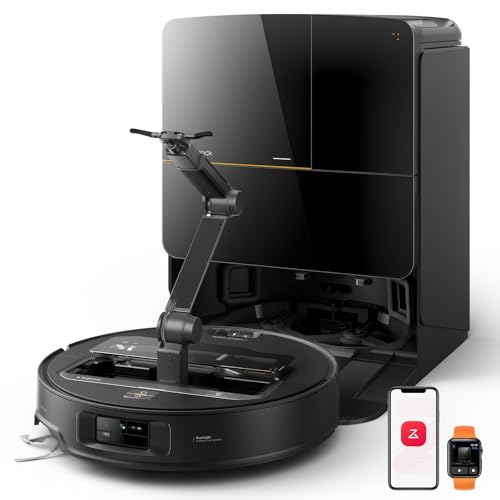
Roborock Saros Z70 features a robotic OmniGrip arm, 22,000Pa suction, hot water mopping & 10-in-1 dock. The most advanced robot vacuum available.
2. Dreame C20 Plus Robot — Best Value LiDAR Pick
Rating: 4.2 stars | 5,000+ reviews
The Dreame C20 Plus is a strong mid-range option that brings LiDAR navigation at a lower price point than the Saros Z70. With over 5,000 user reviews and a 4.2-star average, it has earned widespread confidence from real buyers — including those with dark floors who specifically note that it moves across them without hesitation.
The C20 Plus includes a self-emptying base station, which is a meaningful convenience addition: you will not need to manually empty the dustbin after every run. Dreame’s app provides no-go zone controls and room-level scheduling, giving you precise control over where and when the robot cleans.
Why it works on dark floors: LiDAR mapping handles room navigation independently of floor reflectivity. The robot reads the room before it moves, not while it moves.
Best for: Value-focused buyers who want LiDAR performance and self-emptying without paying flagship prices.
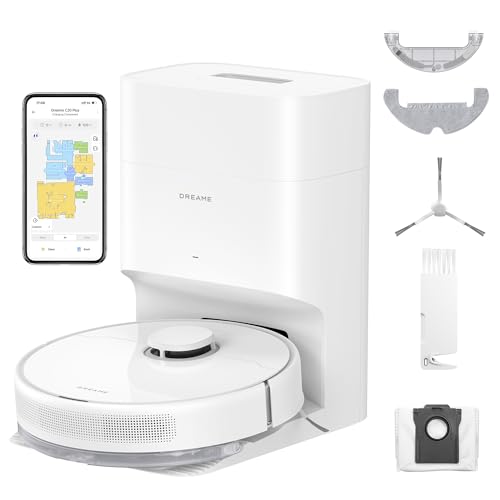
The Dreame C20 Plus offers 6000Pa suction, 90-day self-emptying base, LiDAR navigation, and 180-min battery. Shop now for effortless whole-home cleaning.
3. eufy Omni C20 Robot — Best for High-Traffic Homes
Rating: 4.2 stars | 80,000+ reviews
With over 80,000 user reviews, the eufy Omni C20 is one of the most-reviewed robot vacuums in this guide and a strong signal of real-world reliability. The Omni C20 is a vacuum-and-mop combo with an all-in-one station that handles dust emptying, water refilling, and mop pad cleaning automatically.
eufy has worked to improve cliff sensor calibration across its Omni lineup, and user reports from buyers with dark floors are largely positive. The robot’s iPath laser navigation maps rooms efficiently and avoids the random-bounce behavior that tends to exaggerate false-positive cliff detection.
Why it works on dark floors: iPath laser navigation provides room-level spatial awareness independent of floor color. Large user base means known dark-floor performance is well-documented.
Best for: High-traffic homes with dark hardwood that also need mopping capability, buyers who want the reassurance of a massive review base.

eufy Omni C20 robot vacuum and mop combo with auto emptying, washing, and drying station. 7000Pa suction and 3.35-inch low profile. See the full review!
4. iRobot Roomba 694 — Best Entry-Level Option
Rating: 4.2 stars | 25,000+ reviews
The Roomba 694 is the entry-level pick here, and it comes with an important caveat: iRobot has specifically acknowledged dark floor issues in older Roomba lines and has iterated on sensor calibration to improve dark-surface performance. The 694 uses iRobot’s dirt detect technology and a three-stage cleaning system that works well on both hardwood and low-pile carpet.
This is not a LiDAR robot — it uses a combination of IR cliff sensors, optical encoders, and bump detection to navigate. However, iRobot’s long history of cliff sensor refinement means the 694 tends to perform better on dark floors than generic budget competitors at a similar price. At a strong discount off premium Roomba models, the 694 is the right choice when budget is the primary constraint.
Why it works on dark floors: iRobot’s multi-generation cliff sensor calibration reduces false positives on dark surfaces compared to generic IR-only designs.
Best for: Budget-conscious buyers, apartments, smaller homes with dark floors who want the reliability of a recognized brand.
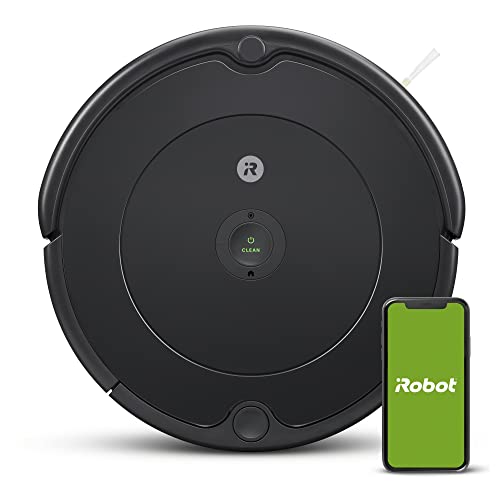
The iRobot Roomba 694 self-charges, navigates around furniture, and tackles pet hair on carpets and hard floors. Shop now for smarter daily cleaning.
5. Shark IQ RV1001AE — Best Self-Emptying Mid-Range Pick
Rating: 4.2 stars | 27,000+ reviews
The Shark IQ RV1001AE combines home mapping, self-emptying capability, and Wi-Fi control at a mid-range price. Shark’s IQ navigation uses a combination of structured light and optical sensors for room mapping, which gives it better spatial awareness than pure-IR-navigation robots, translating into improved behavior on dark floors.
The self-emptying base is a genuine convenience feature: the robot returns to its dock after each run and automatically evacuates its dustbin. For households that run the robot daily — which is the ideal schedule for dark hardwood that shows dust readily — this means you can go weeks without manually touching the dustbin.
Why it works on dark floors: Shark’s IQ navigation system uses visual and structured data for mapping, reducing reliance on downward IR for positional decisions.
Best for: Mid-range buyers who want self-emptying capability and improved dark-floor performance without paying for a top-tier LiDAR robot.

Shark IQ robot vacuum empties itself for 45 days, maps your home, and features a self-cleaning brushroll. Perfect for pet hair. Works with Alexa. Shop now!
Practical Tips for Running a Robot Vacuum on Dark Floors
Even with the right robot, there are steps you can take to further improve performance.
Use the White Tape Workaround (for persistent cases)
This is a well-known community fix. If your robot consistently refuses to cross a particular dark area — say, a transition strip, a section of very dark tile, or a dark rug border — place a small strip of white or light-colored masking tape across the problem area. The tape provides enough IR reflectivity for the cliff sensor to read a solid floor signal and cross over. It is not elegant, but it works reliably and costs nothing.
Adjust Cliff Sensor Sensitivity in the App
If your robot’s companion app offers a cliff sensor sensitivity slider or setting (Roborock and Dreame models increasingly include this), reduce the sensitivity one step at a time until the robot moves freely on dark surfaces. You are balancing false-positive prevention against actual stair-detection safety. Do not disable cliff sensors entirely if your home has stairs.
Keep Floors Clean and Matte
Highly polished dark floors can create specular reflection that confuses IR sensors in a different way — a sharp glare point can scatter the signal erratically. If your dark floors have a high-gloss finish, a lightly matte cleaning product can reduce glare and improve sensor stability.
Schedule Daily Short Runs
Dark hardwood and dark tile show debris and dust very visibly. Rather than running a full deep-clean cycle weekly, schedule shorter daily runs. This keeps floors consistently clean, reduces run time per session, and puts less strain on the robot’s ability to navigate complex paths through cluttered rooms.
Clear Low Obstacles Before Runs
Dark-colored cables, dark rugs with fringe, and dark thresholds can all register as obstacles or edges to a struggling IR sensor. Before each run, do a quick pass to remove dark items that sit close to the floor in open areas.
Frequently Asked Questions
Why does my robot vacuum stop on dark floors and beep?
Your robot’s cliff sensors use infrared light to detect drop-offs. Dark floor surfaces absorb infrared light rather than reflecting it, so the sensor receives little or no return signal and interprets this as a cliff or staircase edge. The robot stops or reverses as a safety response.
Will a LiDAR robot vacuum work on black floors?
Yes. LiDAR navigation uses a laser mounted on top of the robot to map walls and room boundaries. This system operates completely independently from the downward-facing IR cliff sensors that cause the dark-floor problem. LiDAR robots navigate confidently on any floor color, though their cliff sensors are still present for actual drop-off detection.
Can I disable the cliff sensors on my robot vacuum?
Most manufacturers do not allow full disabling of cliff sensors because they are a primary stair-fall safety feature. Some robots (Roborock, Dreame) allow you to lower sensor sensitivity through the app. Only reduce sensitivity enough to resolve false positives — do not disable entirely if stairs are present in your home.
Do all Roombas have problems with dark floors?
Earlier Roomba generations had well-documented dark-floor issues. iRobot has improved sensor calibration across newer models. The Roomba 694 performs reasonably well on dark floors for an entry-level robot. If dark floors are a top priority and budget allows, a LiDAR robot like the Roborock Saros Z70 is a more reliable solution.
My dark area rug is causing my robot to stop. What can I do?
Area rugs with very dark pile can trigger the same false-cliff response as dark hard floors. Try the white tape workaround along the rug edges, reduce cliff sensor sensitivity in the app if available, or block the rug from the cleaning zone and clean it manually. Alternatively, switch to a LiDAR-based robot that is less reliant on downward IR for navigation.
Will a robot vacuum scratch dark hardwood floors?
Robot vacuums generally do not scratch hardwood, but the risk is higher with dark finishes because scratches are more visible. Look for models with soft rubber wheels and avoid robots with aggressive side brush designs that fling debris against baseboards. Regular emptying of the dustbin prevents the robot from dragging grit across the floor.
Bottom Line
Dark floors and standard infrared cliff sensors are a poor match by design. The clearest path to a robot vacuum that works reliably on dark hardwood, tile, or carpet is to choose a model with LiDAR navigation, which removes floor-color sensitivity from the primary navigation system. The Roborock Saros Z70 is the strongest pick for users who want the most reliable and capable option. The Dreame C20 Plus delivers LiDAR performance at a lower price point. For those with tighter budgets, the iRobot Roomba 694 and Shark IQ RV1001AE both offer improved dark-floor behavior compared to generic alternatives, with the practical addition of the white-tape workaround available in stubborn cases.
Choose based on your floor layout, budget, and whether you need mopping capability — then run it on a daily schedule and enjoy consistently clean dark floors without the constant stopping and reversing.
Ready to Find Your Perfect Vacuum?
Browse our expertly reviewed vacuum cleaners and make an informed decision
Browse All Vacuums