Best Robot Vacuum Under $300 in 2026: Smart Navigation on a Budget
Best robot vacuums under $300 in 2026 — get basic LiDAR mapping and smart navigation features without spending $500 or more.
Table of Contents
Best Robot Vacuum Under $300 in 2026: Smart Navigation on a Budget
The $200 to $300 price range is where robot vacuums stop being novelties and start becoming serious household tools. This is the tier where intelligent navigation begins. Below $200, you are largely stuck with random bounce-pattern robots that cover your floors eventually but inefficiently. Cross into the $200 to $300 bracket and something changes fundamentally: real LiDAR laser navigation becomes accessible, and with it comes systematic row-by-row cleaning, accurate floor mapping, virtual no-go zones, and room-specific scheduling.
That shift matters more than almost any other specification on the sheet. A robot vacuum with LiDAR does not wander randomly until the battery runs out — it builds a precise map of your home on the first run and then follows optimized cleaning routes that cover every accessible square foot in the least possible time. The difference in day-to-day performance between a $150 random-navigation robot and a $250 LiDAR-equipped robot is significant, and it is often the reason that robot vacuum converts become long-term enthusiasts.
At this price tier you also start to find self-emptying base stations bundled with some models — a feature that was firmly in premium-only territory as recently as 2023. Combined with LiDAR navigation, this puts genuinely hands-free automated floor cleaning within reach of mainstream budgets for the first time.
This guide identifies the best robot vacuums under $300 available in 2026, explains exactly what this price range delivers, and helps you decide whether to spend at the lower or upper end of the bracket.
What You Get in the $200 to $300 Range
Real Navigation Technology
This is the defining upgrade at this price point. You will find two types of navigation in the $200 to $300 range:
Basic LiDAR navigation is available in several models at or just below $300. LiDAR — Light Detection and Ranging — uses a spinning laser to measure distances to walls and obstacles 360 degrees around the robot, creating a precise digital floor map in real time. The result is systematic, efficient cleaning that covers your home in parallel rows rather than random patterns. LiDAR works equally well in darkness, making it ideal for scheduled overnight cleaning sessions.
Gyroscope plus camera mapping is the other common option at this price. These systems combine an inertial gyroscope for orientation tracking with upward-facing cameras for visual landmark recognition. Performance is generally good in well-lit conditions, though camera-based systems can struggle in very dark rooms or on featureless white ceilings.
For most buyers in this price range, LiDAR is the preferred option where available. It is more reliable, more accurate, and works in all lighting conditions.
Suction Power
Budget LiDAR robots in the $200 to $300 range typically deliver 2,000Pa to 6,000Pa of suction. For context:
- 2,000 to 3,000Pa: Adequate for hard floors and light pet hair maintenance. Handles daily dust, crumbs, and fine debris reliably.
- 3,000 to 5,000Pa: Handles low-pile carpet and moderate pet hair with ease. A practical all-rounder for mixed-flooring homes.
- 5,000 to 6,000Pa: Competitive with mid-range models at $400 to $500. Handles medium-pile carpet and heavier pet shedding effectively.
Wi-Fi, App Control, and Scheduling
Every robot vacuum in this guide includes 2.4GHz Wi-Fi, a companion smartphone app, and support for Alexa and Google Assistant voice commands. Scheduled cleaning — where the robot runs automatically at set times without any manual trigger — is standard. You can also set specific rooms to clean on specific days, adjust suction levels remotely, and receive cleaning completion notifications.
Virtual Walls and No-Go Zones
Unlike sub-$200 robots that require physical barrier strips to block off areas, LiDAR-equipped robots let you draw virtual no-go zones directly on the digital map in the app. No physical hardware required. You can block off a pet feeding station, protect a delicate rug, or prevent the robot from entering a cluttered room — all from your phone.
Mopping Capability
Most models in this range include a basic mopping module — a water reservoir attached to a drag mop pad. This is a wet maintenance mop, not a scrubber. It lays a controlled amount of water on hard floors as the robot vacuums, picking up the fine dust layer that dry suction alone leaves behind. It is genuinely useful for hard floor maintenance between weekly manual mops, but it will not remove stuck grime or dried spills.
The 6 Best Robot Vacuums Under $300 in 2026
1. Dreame C20 Plus — Best Overall Under $300
Rating: 4.2/5 | 5,021 reviews
The Dreame C20 Plus is the standout recommendation in this price range, combining LiDAR navigation, a self-emptying base station, a genuine 90-day dustbin interval, and a self-cleaning mop system in a package that typically lands under $280. The number of verified reviews — over 5,000 — gives the rating real statistical weight.
The headline specification is the 90-day self-emptying station, which automatically transfers collected debris from the robot’s dustbin into a sealed 4-liter dustbag after every cleaning session. Most competitors at this price either lack self-emptying entirely or offer far smaller bag capacities. The sealed bag design prevents allergens from re-entering the air during disposal, which matters for allergy-sensitive households.
Suction reaches 6,000Pa through Dreame’s Vormax motor — a number that competes credibly with robots selling at $100 to $150 more. LDS (Laser Distance Sensor) LiDAR navigation creates precise floor maps that are viewable and editable in the Dreame app, with full support for no-go zones, zone cleaning, and custom scheduling. The robot also features a self-cleaning mop system with a 1.5-liter water tank, which sets it apart from models that simply drag a wet pad around — the mop rinses itself during the cleaning cycle, keeping the mopping surface fresh.
Battery capacity is particularly strong: the 5200mAh cell delivers up to 180 minutes of continuous runtime, enough to cover homes exceeding 1,600 square feet on a single charge. For medium to large apartments, this means consistent whole-home coverage without mid-cycle recharging.
The main trade-off is that initial home mapping takes a few cleaning cycles to fully optimize, and the self-emptying base station has a larger physical footprint than a standard charging dock. These are minor practical inconveniences rather than fundamental performance issues.
Best for: Apartment and medium-home owners who want maximum hands-free convenience with reliable LiDAR navigation and a self-cleaning mop at a sub-$300 price.
Read our full Dreame C20 Plus review
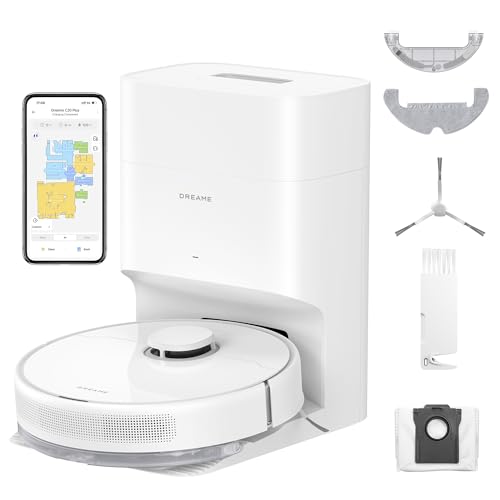
The Dreame C20 Plus offers 6000Pa suction, 90-day self-emptying base, LiDAR navigation, and 180-min battery. Shop now for effortless whole-home cleaning.
2. Roborock Q8 Max — Best for Hard Floors and Pet Hair
Rating: 4.2/5 | 659 reviews
The Roborock Q8 Max is the premium option in this bracket — it may push the top of the $300 ceiling depending on sales timing, but its combination of brand reputation, navigation precision, and DuoRoller brush engineering makes it worth stretching for. Roborock’s PreciSense LiDAR is widely regarded as one of the most accurate navigation systems in the robot vacuum market, full stop, regardless of price tier.
The defining innovation of the Q8 Max is the DuoRoller brush system: two interlocking rubber rollers that work together to pick up debris while actively preventing hair tangles. Roborock’s data shows a 20% improvement in hair pickup efficiency over single-brush designs, and the anti-tangle benefit is real — in pet-heavy households, the Q8 Max requires significantly less brush maintenance than competitors. This directly reduces the most frustrating aspect of robot vacuum ownership: pulling hair off the brush roll.
Navigation quality is class-leading. PreciSense LiDAR combined with Quick Mapping (up to 6x faster initial mapping than standard systems) means your home is accurately mapped and ready for scheduled cleaning much sooner after unboxing. 3D mapping in the Roborock app allows room labeling, virtual furniture placement, and floor-type designation for customized cleaning behavior per zone. Multi-floor mapping supports up to four levels.
Suction reaches 5,500Pa HyperForce — strong for the price, though slightly below the Dreame C20 Plus. The mopping module offers 30 adjustable water flow levels (substantially more granular than the 3-level systems on most competitors), which is meaningful if you have both sealed hardwood and tile that benefit from different moisture applications.
The important trade-off: the Q8 Max does not include a self-emptying base. You will need to manually empty the dustbin after each cleaning session. For users who prioritize navigation precision and cleaning performance over hands-free dust disposal, this is an acceptable compromise. For users who want true set-and-forget operation, the Dreame C20 Plus is the better fit.
Best for: Pet owners and mixed-flooring homes who want Roborock’s premium LiDAR accuracy and DuoRoller anti-tangle technology at the lowest available Roborock price point.
Read our full Roborock Q8 Max review
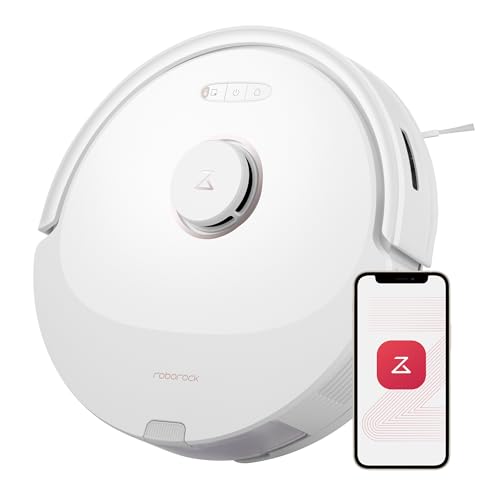
Roborock Q8 Max: 5500Pa suction, DuoRoller brush, LiDAR navigation, vacuum & mop combo. Perfect for pet hair & multi-level homes. Shop now.
3. Dreame D10 Plus Gen 2 — Best Value Self-Emptying Robot Vacuum
Rating: 4.2/5 | 531 reviews
The Dreame D10 Plus Gen 2 is the entry point for buyers who want a self-emptying robot vacuum with LiDAR navigation at the most accessible price possible. It typically sits at the lower end of the $200 to $300 bracket, making it one of the most affordable routes to genuinely hands-free automated floor cleaning.
The self-emptying base station’s 4-liter dust bag provides up to 90 days of hands-free operation — identical to the Dreame C20 Plus — at a meaningfully lower price. LiDAR navigation with multi-floor mapping handles precise room planning, and the Smart Pathfinder technology optimizes cleaning routes across complex floor plans. Virtual boundaries and no-mop zones are configurable through the Dreamehome app on a 2.4GHz Wi-Fi connection.
The floating rubber main brush is a practical engineering choice that pays consistent dividends for pet owners. Unlike traditional bristle brushes that accumulate wrapped hair over time, the rubber design conforms to uneven floor surfaces while actively resisting hair tangling. The 2-in-1 vacuum and mop system uses a 150ml water tank with three adjustable flow settings for light moisture control on hard floors.
The limitations at this price point are real but manageable. Suction tops out at 6,000Pa, which is adequate for hard floors and low-pile carpet but noticeably less aggressive on medium-pile carpet than the higher-priced Roborock options. The mopping is genuinely basic — a drip-fed pad rather than a self-cleaning or actively scrubbing system. And like most models at this price, 5GHz Wi-Fi is not supported.
For buyers whose primary goal is acquiring a self-emptying LiDAR robot at the lowest feasible price, the D10 Plus Gen 2 delivers without meaningful compromise on the core functionality.
Best for: Budget-conscious buyers who want the self-emptying convenience and LiDAR navigation combination at entry-level pricing within the $200 to $300 range.
Read our full Dreame D10 Plus Gen 2 review

Dreame D10 Plus Gen 2 robot vacuum and mop with self-emptying base, 6000Pa suction, LiDAR navigation, and 90 days of hands-free cleaning convenience.
4. Tapo RV30 Max Plus — Best Smart Home Integration Under $300
Rating: 4.2/5 | 873 reviews
The Tapo RV30 Max Plus is the strongest option in this price range for smart home enthusiasts, and it carries one of the better-documented user review bases of any robot vacuum in the sub-$300 bracket. Tapo is TP-Link’s smart home brand, which means the RV30 Max Plus integrates seamlessly into existing Tapo and Kasa ecosystems — a significant convenience advantage for anyone already using TP-Link networking equipment or smart home devices.
LiDAR navigation is present, and the DeepVac technology — Tapo’s proprietary system optimizing the air inlet, cleaning brush geometry, and air duct routing — achieves a verified dust pickup rate exceeding 97%. Mesh Grid cleaning patterns ensure systematic row-by-row coverage rather than random paths. The self-emptying dock with a 3-liter sealed dust bag handles up to 60 days of hands-free operation before the bag needs changing.
Suction reaches 5,300Pa across five adjustable levels — more granular control than the three-level systems common on competing models. The 2,600mAh battery covers up to 180 square meters of vacuuming area per charge, with smart recharge-and-resume that ensures complete coverage even if the battery depletes mid-session. Carpet detection automatically boosts suction when the robot transitions from hard floor to carpet.
The mopping module with three water flow settings handles light maintenance mopping on hard floors, and intelligent carpet avoidance prevents the mop pad from dragging moisture onto rugs when mopping mode is active. This is a thoughtful feature that many sub-$300 robots omit.
Limitations include 2.4GHz-only Wi-Fi (no 5GHz support) and mopping performance limited to maintenance rather than deep cleaning. The ongoing cost of replacement dust bags is a factor to budget for, though at 60-day intervals this is a modest expense.
Best for: Smart home users in the TP-Link ecosystem, households with mixed flooring who want carpet-aware mopping, and buyers who want the most granular suction control at this price.
Read our full Tapo RV30 Max Plus review

Tapo RV30 Max Plus robot vacuum and mop with self-emptying dock, LiDAR navigation, and 5300Pa suction. 97% dust pickup rate. Read our expert review!
5. ILIFE A30 Pro — Best for Dust Bag Value and Runtime
Rating: 4.2/5 | 579 reviews
The ILIFE A30 Pro takes an unusual approach to self-emptying value: rather than competing purely on technology specifications, it ships with five 2.5-liter dust bags in the box — providing up to 280 days of hands-free operation out of the package. If eliminating consumable costs for the first year of ownership is a priority, no other robot vacuum at this price comes close to that level of included supply.
LDS (Laser Distance Sensor) LiDAR with SLAM algorithm navigation builds accurate home maps, and the ILIFEClean app provides no-go zones, virtual walls, room-specific cleaning, and schedule configuration. Four adjustable suction levels range from 500Pa Quiet mode (for nighttime cleaning) up to 5,000Pa Max for deeper carpet work. The breadth of suction levels — from genuinely quiet operation to full-power deep cleaning — is broader than most competitors, making the A30 Pro adaptable to households with diverse cleaning needs and schedules.
The 3-in-1 sweep, vacuum, and mop combination uses an integrated 200ml dustbin and 200ml water tank that operate simultaneously without module swapping. Runtime extends to a usable length for medium-sized homes, and smart recharge-and-resume handles sessions that outlast the battery.
The A30 Pro is notable for multiple control options: app, Alexa voice commands, and a physical remote control. For users who prefer not to use a smartphone app for routine robot management, the included remote is a practical alternative that most competitors have abandoned.
Trade-offs include a smaller 200ml water tank that requires more frequent refilling in large homes, and 5,000Pa max suction that is lower than the Dreame and Roborock alternatives. The ILIFE brand is less recognized globally than Dreame or Roborock, though its regional market presence is well established.
Best for: Value-focused buyers who want minimal consumable costs in the first year, multi-control households who prefer remote operation, and light to medium cleaning needs across hard floors and low-pile carpet.
Read our full ILIFE A30 Pro review

ILIFE A30 Pro robot vacuum and mop with self-emptying station, 5000Pa suction, LiDAR navigation, and 280-day bag supply. Full expert review inside!
6. eufy C10 — Best Slim Profile LiDAR Robot Under $300
Rating: 3.8/5 | 1,310 reviews
The eufy C10 occupies a specific niche in this price range: it is the thinnest LiDAR-equipped robot vacuum you can buy at under $300, with a 2.85-inch profile that reaches under furniture that taller robots simply cannot access. In homes with low-clearance beds, sofas close to the ground, or entertainment centers with limited clearance, the C10’s slim design addresses a persistent robot vacuum blind spot.
eufy is the robot vacuum brand under Anker, a technology company with a strong track record in consumer electronics. The C10 pairs LiDAR navigation with an automatic self-emptying station that holds up to eight weeks of debris. An edge expansion brush extends outward when the robot detects walls, actively improving corner and baseboard coverage — a feature absent from several more expensive competitors. Automatic carpet detection boosts suction when the robot transitions from hard flooring to carpet.
The lower average rating (3.8 stars versus the 4.2 stars of the other models in this guide) deserves honest discussion. The primary feedback driving the lower score involves connectivity setup issues and occasional mapping inconsistencies that some users encounter during initial configuration. These are software-solvable problems that do not reflect on the robot’s core cleaning performance, but they do indicate a less smooth out-of-box experience compared to Dreame and Tapo alternatives. Once set up and running, users broadly report reliable performance.
For buyers in homes dominated by hard floors and low-pile carpet — where the slim profile is actively advantageous — the C10 is a legitimate option. For buyers with medium-pile carpet or who place high value on setup simplicity, the Dreame C20 Plus or Tapo RV30 Max Plus will serve better.
Best for: Homes with low-clearance furniture where no other robot can reach, eufy/Anker ecosystem users, and buyers who prioritize cleaning profile over navigation setup simplicity.

eufy C10 robot vacuum with self-emptying station, LiDAR navigation, 2.85-inch slim design, and 8-week hands-free cleaning. Great for pet hair and carpets.
Is It Worth Stretching to $300 vs. Buying at $200?
This is the most practical question anyone shopping in this category faces, and the honest answer is: it depends on which specific features matter to your household.
The Case for Spending at $200
If your home is a small to medium apartment with primarily hard floors, limited furniture complexity, and light-to-moderate debris (no heavy pet shedding, no carpets), a well-chosen sub-$200 robot vacuum delivers excellent daily maintenance performance. The eufy RoboVac 11S Max and similar models handle hard-floor cleaning reliably. The gap in cleaning quality on smooth surfaces between a $160 random-navigation robot and a $250 LiDAR robot is smaller than the marketing suggests — both will keep your hard floors clean with daily scheduled runs.
The sub-$200 case weakens significantly for larger homes, homes with multiple rooms and furniture obstacles, homes with any carpet, and homes with pets.
The Case for Spending at $250 to $300
The upgrade from random navigation to LiDAR at $250 to $300 is among the most cost-effective technology jumps in the robot vacuum market. Specific scenarios where the higher price is clearly justified:
Multiple rooms and furniture obstacles: LiDAR navigation knows where it has cleaned, can be directed to specific rooms, and does not get lost or spend 40% of its battery re-cleaning areas it already covered. In a home with a hallway, kitchen, living room, and bedroom, a random-navigation robot is genuinely inefficient.
Pet hair households: 5,000 to 6,000Pa suction combined with LiDAR-optimized cleaning routes picks up significantly more pet hair per run than lower-powered random-navigation robots. The difference in daily maintenance is noticeable.
Carpet in the home: Automatic carpet detection with suction boost requires the robot to know it has transitioned to carpet — a function that benefits from precise mapping and navigation.
Self-emptying base value: Self-emptying stations appear at the $250 to $300 price with Dreame models. At $200, self-emptying stations are extremely rare. If not manually emptying a dustbin every day or two is important to you, this price tier is where that feature becomes accessible.
The verdict: For apartments and small homes with primarily hard floors and no pets, $200 is reasonable. For medium homes with mixed flooring, pets, or multiple rooms, the $250 to $300 investment in LiDAR navigation pays back in cleaning efficiency within the first month.
Who Should Buy a Robot Vacuum in This Range
The $200 to $300 robot vacuum tier is the ideal starting point for a specific type of household profile. You will get the most value from a robot in this range if:
You have a medium apartment or small house (600 to 1,500 sq ft): Large enough that a robot vacuum saves meaningful time per week, small enough that the self-emptying stations and navigation systems in this tier handle the whole home comfortably.
Your floors are primarily hard surfaces: Hardwood, tile, laminate, and vinyl plank flooring are where LiDAR robot vacuums in this price range genuinely excel. The suction levels available here (5,000 to 6,000Pa) are more than sufficient for daily dust, debris, and light pet hair removal on hard floors.
You have light to moderate pet hair: A single cat or short-haired dog shedding at normal levels is well within what models like the Dreame C20 Plus and Roborock Q8 Max handle effectively on a daily schedule. Multi-pet households with heavy shedders will benefit from moving up to the $400+ tier.
You want a maintenance vacuum, not a replacement for deep cleaning: Robot vacuums at any price are daily maintenance tools. They keep floors consistently clean between quarterly or monthly manual deep cleaning sessions. If you are expecting to eliminate manual vacuuming entirely, you will be disappointed regardless of price. If you are expecting to do manual vacuuming once a month instead of twice a week, you will be very satisfied.
You live alone or with a partner, not a large household with children: Higher debris loads from larger households or active children’s play areas begin to push beyond what mid-range daily maintenance cleaning can keep up with.
Quick Comparison
| Model | Suction | Navigation | Self-Empty | Mop | Rating |
|---|---|---|---|---|---|
| Dreame C20 Plus | 6,000Pa | LiDAR | Yes (90 days) | Self-cleaning | 4.2/5 |
| Roborock Q8 Max | 5,500Pa | PreciSense LiDAR | No | 30-level | 4.2/5 |
| Dreame D10 Plus Gen 2 | 6,000Pa | LiDAR | Yes (90 days) | Basic | 4.2/5 |
| Tapo RV30 Max Plus | 5,300Pa | LiDAR | Yes (60 days) | 3-level | 4.2/5 |
| ILIFE A30 Pro | 5,000Pa | LDS LiDAR | Yes (280 days supply) | 3-in-1 | 4.2/5 |
| eufy C10 | N/A | LiDAR | Yes (8 weeks) | No | 3.8/5 |
Frequently Asked Questions
Do robot vacuums under $300 have real LiDAR navigation?
Yes — several models in this guide use genuine LiDAR laser distance sensors for floor mapping. The Dreame C20 Plus, Dreame D10 Plus Gen 2, Roborock Q8 Max, Tapo RV30 Max Plus, and eufy C10 all use LiDAR-based navigation. This is a significant recent development: as recently as 2022, LiDAR navigation was predominantly found in $400 to $600+ robots. Increased manufacturing efficiency and competition between Chinese robot vacuum brands have pushed this technology into the $200 to $300 tier.
Can a robot vacuum under $300 really replace manual vacuuming?
It depends on your definition of “replace.” A LiDAR robot running on a daily schedule will keep hard floors consistently free of dust, debris, and light pet hair — you will rarely feel the need to pull out a manual vacuum for those surfaces. However, for deep carpet cleaning, for reaching inside closets, under appliances, or up onto upholstered surfaces, a manual vacuum is still necessary periodically. Think of a robot vacuum as a daily maintenance appliance that dramatically reduces how often you need to do manual vacuuming, not one that eliminates it entirely.
How often do I need to empty the dustbin on a self-emptying model?
With the self-emptying models in this guide, the base station handles this automatically after every cleaning session. The dustbag itself typically lasts 60 to 90 days (or 280 days with the ILIFE A30 Pro’s included five-bag supply) before you need to replace it. Manual interaction is reduced to quarterly dustbag swaps rather than daily emptying — which is the primary practical value of the self-emptying feature.
Are robot vacuums under $300 good for pet hair?
For households with one or two pets shedding at normal rates, yes — particularly on hard floors and low-pile carpet. The Roborock Q8 Max’s DuoRoller brush system and the Dreame models’ rubber brush designs both handle pet hair effectively while minimizing the tangle buildup that requires manual maintenance. On medium and thick carpet with heavy shedding, the suction levels in this price range (5,000 to 6,000Pa) may not extract as deeply as models in the $400+ tier. Daily scheduling is important: running the robot every day in a pet-heavy home prevents hair accumulation from reaching levels that strain the motor.
What is the difference between LiDAR and gyroscope navigation?
LiDAR uses a spinning laser to measure distances to walls and obstacles 360 degrees around the robot, building a precise geometric map. It works in darkness and does not degrade with lighting changes. Gyroscope-plus-camera navigation uses an internal rotation sensor for orientation combined with a camera to recognize ceiling patterns and visual landmarks for position tracking. Camera systems are generally accurate in well-lit, visually distinctive rooms but can struggle in the dark or in visually uniform spaces (like rooms with plain white ceilings or very low light). In the $200 to $300 range, LiDAR is the more reliable and consistent technology when available.
Do robot vacuums in this range work on both carpet and hard floors?
Yes, all recommended models in this guide are designed for multi-surface cleaning. Performance on hard floors is excellent across all models. On low-pile carpet (under 10mm pile height), all models in this guide handle daily maintenance adequately. On medium-pile carpet (10 to 15mm), the higher-suction models (Dreame C20 Plus at 6,000Pa, Roborock Q8 Max at 5,500Pa) perform noticeably better than the lower-suction options. On high-pile or plush carpet (over 15mm), robot vacuums at any price under $300 are maintenance-level tools rather than deep cleaners.
Is the Roborock Q8 Max worth it without a self-emptying base?
This depends on your priorities. The Q8 Max offers the best navigation system and most sophisticated mapping in this price range, with PreciSense LiDAR that outperforms most competitors at twice the price. The DuoRoller brush system is a genuine engineering improvement for pet hair households. If precision navigation, brand reliability, and cleaning performance are your top criteria, the Q8 Max is worth the trade-off of manual bin emptying. If automated, hands-free operation is your primary goal and you are willing to accept slightly less navigation sophistication, the Dreame C20 Plus is the better choice.
Can these robots handle multi-floor homes?
All LiDAR-equipped models in this guide support multi-floor mapping. You manually carry the robot to each floor, allow it to map that level, and the robot stores a separate floor plan per level. Switching between floor maps happens automatically based on LiDAR recognition of the environment on subsequent visits to that floor. This is a practical solution for two or three-story homes, though it requires some initial setup per floor.
Ready to Find Your Perfect Vacuum?
Browse our expertly reviewed vacuum cleaners and make an informed decision
Browse All Vacuums