Best Self-Emptying Robot Vacuum 2026: Truly Hands-Off Cleaning
Best self-emptying robot vacuums of 2026 — auto-empty docks that hold 30-60 days of debris for truly hands-free floor cleaning.
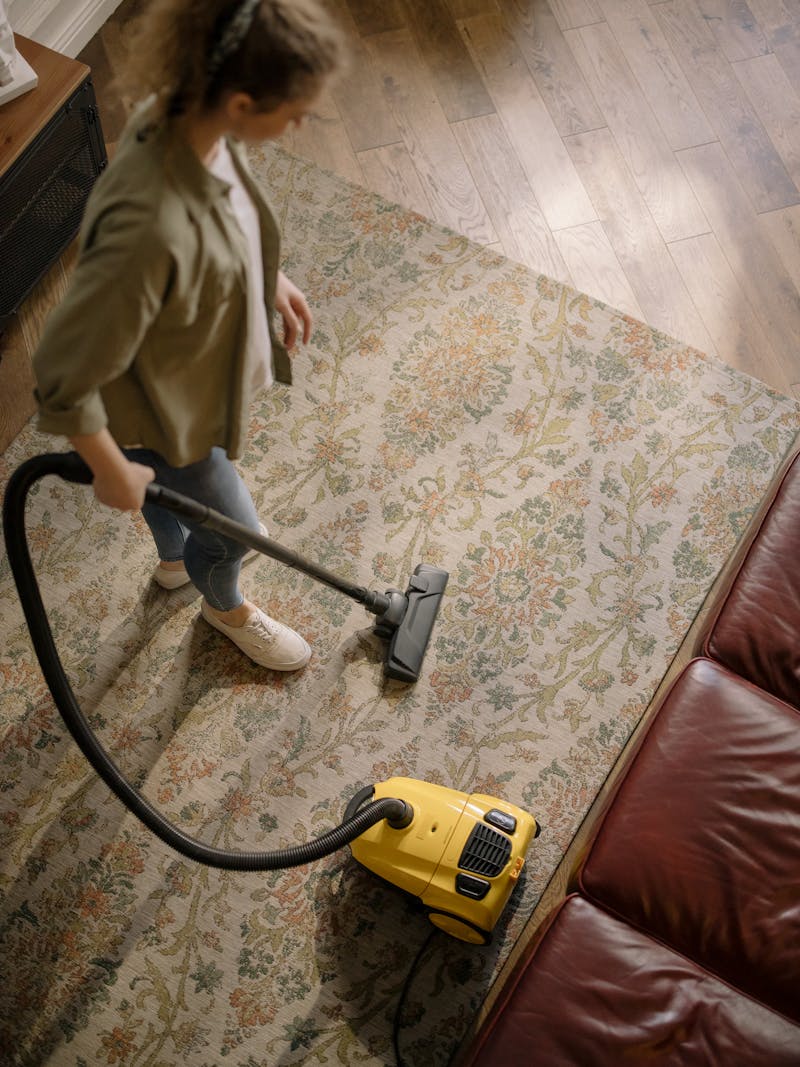
Table of Contents
Best Self-Emptying Robot Vacuum 2026: Truly Hands-Off Cleaning
Robot vacuums already handle the chore of pushing a machine around your floors. But there has always been one catch: you still have to crouch down every few days, pop open the dustbin, and empty it into the trash. For pet owners or anyone living in a dusty home, that can mean emptying the bin after every single run. Self-emptying robot vacuums eliminate that step entirely. They roll back to their dock after a cleaning session and a powerful suction system inside the base station automatically transfers all the collected debris into a large collection bag or bin — one that typically holds 30 to 60 days of dirt before you ever need to touch it.
The result is a cleaning setup that genuinely runs itself for weeks at a time. You schedule a clean, it runs, it empties, and it charges — all without your involvement. In 2026, self-emptying technology has matured significantly, and the options span from budget-friendly all-in-one units to flagship docks that also wash, dry, and refill the mop pad on hybrid robot vacuums. This guide covers everything you need to know, plus six specific models worth buying right now.
How Self-Emptying Docks Actually Work
The mechanics behind auto-empty docks are straightforward but clever. When the robot returns to its base station — either because the cleaning session is done, the battery is low, or the onboard dustbin is full — a high-powered motor inside the dock activates and creates a strong airflow channel that pulls debris from the robot’s small internal dustbin up through a tube and into the large collection reservoir at the top of the station.
The process typically takes 10 to 20 seconds and sounds noticeably loud — more on that below. After the transfer completes, the robot’s internal bin is effectively empty, the robot recharges, and it is ready for its next session.
The large collection reservoir comes in two main forms:
Bagged docks use sealed disposable bags, usually between 2.5 and 4 liters in capacity. These bags trap allergens and fine dust particles inside, so when you do eventually pull the bag out, there is very little chance of dust escaping back into your air. Most manufacturers design the bags so that removal is clean and contact-free. Bags typically need replacing every 30 to 90 days depending on your home’s dirt load.
Bagless docks use a reusable dust container that you periodically empty over a trash can. The Shark AI Ultra is a well-known example. Bagless systems save you the ongoing cost of replacement bags but require you to manually empty and rinse the container — though far less frequently than the robot’s own tiny bin.
Key Features to Look For
Dock Collection Capacity
The capacity rating you see advertised — 30 days, 60 days, 90 days — is based on average household conditions. In homes with heavy shedding pets or high foot traffic, the actual number of days between manual interventions will be lower. A 3-liter bagged dock in a single-person apartment might genuinely last two months. The same dock in a home with two golden retrievers might fill in three weeks. Look for docks with at least a 2.5-liter capacity if you have pets, and consider 3.5- to 4-liter options if you run the robot daily.
Noise During Emptying
The auto-empty process is the loudest part of owning one of these robots. The dock’s internal motor produces a vacuum-cleaner-level burst of noise — typically around 70 to 75 dB — that lasts 15 to 20 seconds. This is roughly comparable to a normal conversation but more startling because it happens suddenly. Most users find it easy to adapt to since the emptying cycle is brief. However, if you run your robot during sleeping hours or have young children napping, you may want to schedule cleaning sessions for times when a short noise burst is not a problem. Some apps allow you to disable auto-emptying at certain hours.
Bag vs. Bagless Dock Systems
Bagged systems are better for allergy sufferers and anyone sensitive to dust. The sealed bag design means allergens, fine particulate, and pet dander stay locked inside the bag through removal and disposal. The ongoing cost of replacement bags is roughly $10 to $20 per 3-pack depending on the brand.
Bagless systems eliminate the recurring cost and reduce plastic waste. They are a solid choice for households without allergy concerns who prefer a one-time purchase approach. The trade-off is that emptying the container exposes you to the accumulated debris, so doing it over a trash can outdoors or with a mask on is advisable if you are dust-sensitive.
Combined Vacuum and Mop with Self-Emptying
Several of the best self-emptying robots in 2026 are also full hybrid vacuum-and-mop units, and the premium dock stations go further still — they also wash the mop pads with clean water, dry them with warm air to prevent mildew, and refill the robot’s onboard water tank before the next session. These all-in-one docks represent the current pinnacle of hands-free floor care. Models like the Roborock Qrevo QV 35A and Dreame X60 Max Ultra offer this level of dock automation.
The 6 Best Self-Emptying Robot Vacuums of 2026
1. Dreame X60 Max Ultra — Best Overall
The Dreame X60 Max Ultra sits at the top of the 2026 self-emptying market for good reason. Its 35,000Pa suction — delivered through a DuoBrush dual main brush system — is among the highest available on any consumer robot vacuum, providing roughly three times the cleaning efficiency of single-brush designs. The ultra-thin 3.13-inch profile allows it to slide under furniture that other robots simply cannot reach.
The dock is a genuine 10-in-1 station that handles auto-emptying, water refilling for the mop tank, hot-water mop pad washing (using water heated to 212°F / 100°C), and warm-air drying of the pads to prevent mildew. The auto-empty dust bag holds up to 100 days of debris before replacement. AI dual cameras with a library of 280+ recognized obstacle types mean the robot intelligently navigates around cables, shoes, socks, and pet toys rather than getting stuck.
- Suction: 35,000 Pa
- Dock capacity: 100 days (bagged)
- Dock functions: 10-in-1 (self-empty, water refill, mop wash, hot-air dry)
- Navigation: Dual AI cameras with proactive illumination
- Rating: 4.6/5
Best for: Tech-forward households that want the most capable all-in-one cleaning station available.
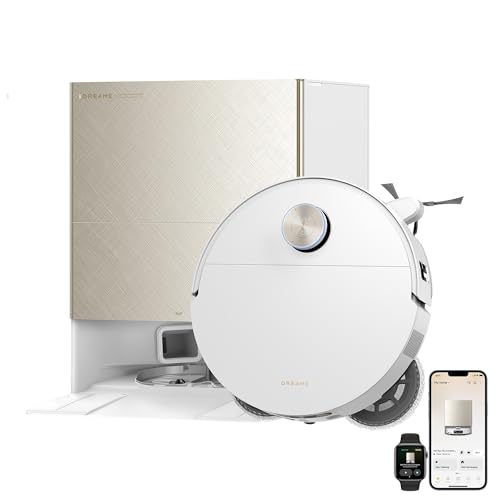
Dreame X60 Max Ultra robot vacuum & mop with 35,000Pa suction, ultra-thin 3.13in body, 280+ obstacle avoidance, 10-in-1 dock & hot-water mop self-cleaning.
2. Roborock Qrevo QV 35A — Best Vacuum + Mop Combo
View the Roborock Qrevo QV 35A
Roborock’s Qrevo QV 35A hits an excellent balance between performance and practicality. The 8,000Pa PreciSense LiDAR-guided robot delivers systematic, row-by-row cleaning across up to 3,552 square feet in a single session, with dual spinning mops running at 200 RPM for a genuine scrubbing action on hard floors. The all-in-one dock automatically empties the 2.7-liter dust bag, refills the 4-liter clean water tank, washes the mop pads, and dries them — so every session starts fresh without any manual preparation.
SGS-certified zero-tangle performance on the side brush is a meaningful benefit for homes with long human hair or pet fur. The robot lifts its mop module 10mm when it detects carpet, preventing wet tracks across rugs. Thirty adjustable water flow levels give precise control over how much moisture reaches the floor.
- Suction: 8,000 Pa
- Dock capacity: 2.7L dust bag
- Dock functions: Auto-empty, water refill, mop wash, warm-air dry
- Navigation: PreciSense LiDAR 360°
- Rating: 4.3/5
Best for: Anyone who wants thorough vacuum-and-mop automation with a fully managed dock.

Roborock Qrevo QV 35A robot vacuum and mop delivers 8000Pa suction, anti-tangle brush, auto mop washing, and all-in-one dock. Full expert review inside.
3. Roborock Q7 Max+ — Best Value Self-Emptying Robot
The Q7 Max+ pairs Roborock’s reliable 4,200Pa PreciSense LiDAR platform with an Auto-Empty Dock Pure that holds up to seven weeks of debris in its 2.5-liter bag. It is a streamlined package — the dock handles auto-emptying only, without the mop washing and drying functions of the more expensive Qrevo line, which keeps the price considerably lower while retaining the core hands-free value proposition.
Simultaneous vacuuming and mopping with 30 electronic water flow levels handles everyday hard floor maintenance effectively. Multi-floor mapping and smart home integration with Alexa and Google Assistant round out a feature set that delivers strong practical value. The included washable filter is a recurring-cost saver.
- Suction: 4,200 Pa
- Dock capacity: 2.5L bag (up to 7 weeks)
- Dock functions: Auto-empty
- Navigation: PreciSense LiDAR
- Rating: 5/5
Best for: Budget-conscious buyers who want proven self-emptying technology without paying for premium dock features they may not need.
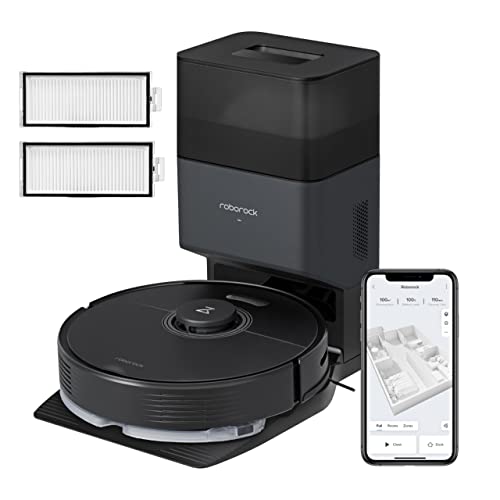
Roborock Q7 Max+ delivers 4200 Pa suction, LiDAR 3D mapping, simultaneous vacuum and mop, and 7-week auto-empty dock. Includes washable filter. Shop today.
4. Shark AI Ultra (AV2511AE) — Best Bagless Self-Empty Base
The Shark AI Ultra is the strongest argument for bagless self-emptying in the current market. Its XL bagless base station holds 60 days of debris without a replacement bag ever required — you simply empty the container when full and rinse it. The 360-degree LiDAR navigation paired with Shark’s Matrix Clean multi-pass pattern ensures highly thorough floor coverage, including edge-to-edge cleaning along walls. The robot’s self-cleaning brushroll handles pet hair without tangling.
The AI Ultra is a vacuum-only robot — it does not mop — which makes it a clean, maintenance-simple option for homes that mop separately or prioritize dry debris pickup above all else.
- Suction: Shark IQ class (high power)
- Dock capacity: 60 days (bagless XL base)
- Dock functions: Auto-empty (bagless)
- Navigation: 360° LiDAR with Matrix Clean
- Rating: 4.0/5
Best for: Pet owners and anyone who prefers bagless operation to avoid recurring bag costs.

Shark AI Ultra robot vacuum with Matrix Clean navigation, 60-day self-empty base, LiDAR mapping, and voice control. Expert review for pet owners.
5. Tikom L8000 Plus — Best Mid-Range Self-Emptying
The Tikom L8000 Plus earns its place as the standout mid-range self-emptying pick for 2026. The 6,000Pa motor with automatic carpet boost handles everyday messes on both hard floors and low-to-medium pile carpets effectively. The self-emptying base uses a 3-liter dustbag rated for up to 90 days — one of the longest intervals in its price class — and supports both 2.4GHz and 5GHz Wi-Fi, a practical advantage for households with newer dual-band routers.
The vacuum-and-mop combination works well on hard floors, with three selectable water flow levels. Five-floor map storage is generous for a mid-range unit, and 150-minute runtime means most homes can be covered in a single pass. One honest note from the product data: the self-emptying process is on the louder side, so mid-night scheduling is worth considering.
- Suction: 6,000 Pa
- Dock capacity: 3L dustbag (90 days)
- Dock functions: Auto-empty (bagged)
- Navigation: 360° LiDAR
- Rating: 4.6/5
Best for: Mid-range shoppers who want long dock intervals, solid LiDAR navigation, and dual-band Wi-Fi support.
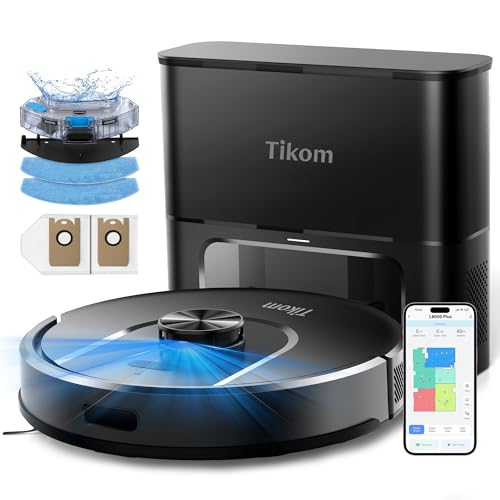
Tikom L8000 Plus robot vacuum and mop with self-emptying base, 6000Pa suction, and LiDAR navigation. 90-day hands-free cleaning for pet hair and all floors.
6. iRobot Roomba 104 Combo — Best for iRobot Ecosystem Users
View the iRobot Roomba 104 Combo
The Roomba 104 Combo brings iRobot’s ClearView LiDAR platform and 70X power-lifting suction into a 2-in-1 vacuum-and-mop package, bundled with iRobot’s AutoEmpty Dock that holds up to 75 days of debris in allergen-trapping sealed bags. The dock’s bags filter 99% of particles as small as 0.7 microns, making this the strongest pick for allergy sufferers in the group.
Smart features include SmartScrub mode for targeted wet scrubbing, automatic floor detection that adjusts cleaning behavior between carpet and hard floor, and keep-out zone management via the iRobot app. Alexa, Siri, and Google Assistant are all supported. The main consideration is that the Roomba 104 Combo ships with a 2.4GHz-only Wi-Fi requirement, which can require router configuration on some modern networks.
- Suction: 70X vs. Roomba 600 series
- Dock capacity: 75 days (allergen-trapping bags, 99% particle filtration)
- Dock functions: Auto-empty (sealed allergen bags)
- Navigation: ClearView LiDAR
- Rating: 3.7/5
Best for: iRobot brand loyalists and allergy sufferers who prioritize sealed-bag dust containment.

iRobot Roomba 104 Combo robot vacuum and mop with 70X suction, LiDAR navigation, and self-emptying dock. Ideal for pet hair on all floor types.
Is the Extra Cost Worth It?
A standard robot vacuum with no dock starts around $150 to $300. A self-emptying robot typically starts around $350 to $500 for entry-level models and climbs to $800 or beyond for premium all-in-one dock systems like the Dreame X60 Max Ultra. The question of whether the premium is worth it depends heavily on your lifestyle.
Strong arguments for paying the premium:
- Pet owners who currently empty the robot bin after every session will see an immediate quality-of-life improvement. Self-emptying shifts that task from daily to monthly.
- Busy households benefit from a setup that truly runs without supervision. Scheduling a clean before work and returning to a clean floor — with zero bin-emptying tasks pending — is a genuinely different experience than standard robot ownership.
- Allergy sufferers benefit from the sealed-bag containment systems that prevent disturbing collected allergens and fine particulates during disposal.
- Large homes benefit from models that can empty mid-session if the onboard bin fills up, allowing the robot to continue cleaning rather than stopping and waiting for manual intervention.
When the standard robot may be sufficient:
- Small apartments where the robot runs once every few days and bin capacity is rarely an issue.
- Homes with minimal foot traffic, no pets, and modest debris loads.
- Anyone on a strict budget who would rather invest the cost difference in a higher-suction non-self-emptying model.
The running cost of replacement bags — typically $10 to $20 per bag — should be factored in. Over two years, a household replacing bags every 60 days spends roughly $120 to $240 on consumables. Bagless dock systems like the Shark AI Ultra eliminate this cost entirely.
FAQ: Self-Emptying Robot Vacuums
How loud is the self-emptying process?
The auto-empty cycle is noticeably loud — similar to a brief burst from a standard vacuum cleaner, roughly 70 to 75 dB and lasting 10 to 20 seconds. It is startling if unexpected but very brief. The robot itself cleans at a much quieter level (typically 55 to 65 dB). Most apps allow you to schedule cleaning sessions and adjust emptying behavior so the loud burst does not occur late at night or early in the morning.
How often do I need to replace dock bags?
With typical household use, most bags last 30 to 90 days. The exact interval depends on your home size, debris load, and how frequently you run the robot. Homes with shedding pets or high-traffic areas should expect to replace bags every 4 to 6 weeks. The manufacturer-rated intervals — often 60 or 90 days — are based on average conditions. Replacement bags are available directly from manufacturers or on Amazon, and most three-packs cost between $10 and $20.
Can I use the robot without the self-emptying dock?
Yes. If the dock is full or you prefer to skip auto-emptying on a particular run, you can still run the robot and manually empty its onboard bin just as you would with a standard robot vacuum. The dock is an add-on system that complements the robot rather than replacing its own dustbin.
Do self-emptying docks also clean the mop pads?
On entry-level models, the dock only handles auto-emptying. On mid-range and premium models — such as the Roborock Qrevo QV 35A and Dreame X60 Max Ultra — the dock also washes the mop pads, dries them with warm air, and refills the robot’s water tank automatically. These all-in-one dock functions are the key differentiator between the $400 to $500 tier and the $700 to $1,000+ tier.
Is a bagless or bagged dock better for allergies?
Bagged docks are significantly better for allergy sufferers. The sealed bag design keeps collected dust, allergens, and fine particulates contained throughout the disposal process. Bagless systems expose you to the collected debris when emptying the container. If you or anyone in your household has dust, pollen, or pet dander sensitivities, choose a robot with a bagged dock system.
Do self-emptying robots work on thick carpets?
Yes, but effectiveness varies by model and suction power. Robots with 6,000Pa and above generally handle medium-pile carpet well. Very high-pile or shag carpets can challenge any robot vacuum, self-emptying or not. If carpet is your primary floor type, prioritize suction power (look for 6,000Pa minimum) and confirm that the robot’s brush roller is designed for carpet engagement. The Dreame X60 Max Ultra and Tikom L8000 Plus are particularly well-suited for households with mixed hard floor and carpet environments.
Conclusion
Self-emptying robot vacuums represent the most meaningful upgrade in robot vacuum convenience since LiDAR navigation maps replaced random-bounce patterns. For households with pets, allergies, or simply a preference for genuine automation, the additional cost delivers a clear and immediate return in reduced maintenance time and effort.
The Dreame X60 Max Ultra leads the field for buyers who want the most capable dock available in 2026. The Roborock Qrevo QV 35A hits the best balance between all-in-one dock functionality and reliable everyday performance. For those focused on value, the Roborock Q7 Max+ and Tikom L8000 Plus both deliver genuine long-interval hands-free cleaning without flagship pricing. Allergy sufferers should look closely at the iRobot Roomba 104 Combo for its 99% allergen filtration bags, and anyone who wants to skip bag purchases entirely will find the Shark AI Ultra’s bagless XL base a compelling long-term cost proposition.
Whichever model fits your home and budget, the principle is the same: a self-emptying robot vacuum is a robot vacuum that actually lives up to the “set it and forget it” promise.
Ready to Find Your Perfect Vacuum?
Browse our expertly reviewed vacuum cleaners and make an informed decision
Browse All Vacuums