Best Vacuum for Asthma: Sealed HEPA Systems That Won't Trigger Attacks
Vacuuming without a sealed HEPA system can trigger asthma attacks by releasing fine particles. Find the best vacuum for asthma that captures allergens instead of releasing them.
Table of Contents
Most people vacuum to clean their homes. For the roughly 25 million Americans living with asthma, vacuuming without the right machine can make their air measurably worse within minutes. The particles that trigger asthma attacks — dust mite feces, pet dander, mold spores, cockroach allergens, and pollen — are microscopic. Standard vacuums without sealed filtration systems pick them up from the floor and blast them directly into breathing air through leaky housings, inadequate filters, and poorly designed exhaust systems.
This is not a minor inconvenience. It is a documented medical hazard. Studies published in peer-reviewed journals including the Journal of Allergy and Clinical Immunology have confirmed that vacuuming with standard or low-filtration machines significantly increases airborne allergen concentrations — sometimes for hours after cleaning ends. The solution is a vacuum engineered around the specific needs of asthma sufferers: a fully sealed HEPA filtration system that captures allergens and keeps them captured from intake to disposal.
This guide covers what actually matters when selecting a vacuum for asthma management, the cleaning habits that reduce exposure, and our top five recommended machines based on real filtration specifications, customer ratings, and suitability for allergy-affected households.
Asthma Triggers Hidden in Your Home Environment
Before selecting the right vacuum, it is worth understanding precisely what you are trying to capture. The common household asthma triggers are not visible to the naked eye, which is part of what makes them so difficult to manage without deliberate equipment choices.
Dust mites are among the most potent asthma triggers. These microscopic arachnids live in mattresses, upholstered furniture, carpets, and bedding. They do not bite or sting — but their fecal particles and body fragments, which range from 1 to 20 microns in size, are among the most common causes of chronic asthma symptoms. A typical mattress can harbor millions of them.
Pet dander is not pet hair — it is the shed skin cells from cats, dogs, birds, and other animals. These particles are jagged in shape at the microscopic level, which causes them to bind to airborne particles and float for extended periods. A room with a cat may have elevated dander levels for hours after the animal leaves it.
Mold spores are reproductive particles released by mold colonies that form wherever moisture accumulates: under sinks, in bathroom tile grout, around window frames, in HVAC systems. Spores range from 2 to 100 microns in diameter and can survive in dried form in dust for months.
Cockroach allergens are among the least discussed but most clinically significant triggers, particularly in urban apartments and older housing. The proteins in cockroach saliva, feces, and shed body parts are potent asthma sensitizers. These proteins bond to household dust particles and persist in flooring and furniture indefinitely.
Pollen is seasonal for outdoor exposure but perennial indoors. Pollen carried in on clothing, shoes, and pets accumulates in carpets and on upholstered surfaces, and standard vacuuming can become the mechanism by which it is re-aerosolized.
All of these triggers share a critical property: they are small enough to pass through inadequate vacuum filters and escape through housing gaps back into the breathing zone.
How the Wrong Vacuum Triggers Asthma Attacks
Choosing a vacuum without understanding its filtration architecture is genuinely dangerous for people with asthma. There are three primary mechanisms by which an inadequate vacuum makes indoor air worse.
Filtration bypass occurs when a vacuum’s filter media does not capture particles at the relevant size range. Filters rated at HEPA standard capture 99.97% of particles at 0.3 microns — the most penetrating particle size — and higher percentages at both larger and smaller sizes. Filters marketed with vague language like “HEPA-style,” “HEPA-like,” or “HEPA-type” are not HEPA filters. They typically capture 85–90% of particles at best, which means 10–15% of allergens pass through the filter and exit through the exhaust.
Leaky housing is the problem that sealing addresses. Even if a vacuum contains a genuine HEPA filter, an unsealed housing allows air to bypass the filter entirely through gaps in the casing, attachment joints, or dust cup connections. This is why “sealed HEPA” or “closed-loop filtration” matters as much as the filter rating itself. A HEPA filter in an unsealed machine is meaningfully less effective than the same filter in a fully sealed system.
Exhaust recirculation is the third mechanism. In poorly designed vacuums, the exhaust air exits in a direction that throws particles into low-level breathing zones or redistributes settled dust from nearby surfaces. High exhaust velocity amplifies this problem. Quality asthma-appropriate vacuums are designed with diffuse, low-velocity exhaust that minimizes turbulence at floor level.
The combination of these three factors means that budget vacuums, “HEPA-type” machines, and older vacuums with worn seals can actively degrade air quality during use for asthma sufferers.
What to Look For: Medical-Grade Guidance for Asthma-Safe Vacuums
When evaluating vacuums specifically for asthma management, filter grade is the starting point — but it is not the complete picture.
Sealed HEPA system, H13 grade or better. H13 is a European EN1822 standard that captures 99.95% of particles at 0.3 microns. True sealed HEPA systems direct 100% of intake air through the filtration media before exhaust. Look for explicit language: “sealed system,” “anti-allergen complete seal,” or “closed-loop HEPA filtration.” Do not accept “HEPA-style” as a substitute.
Bagged design, where possible. Bagged vacuums are clinically preferred for asthma management because disposal is fully enclosed. Self-sealing bags — which pinch closed when removed — prevent the puff of dust that typically occurs when emptying a bagless dust cup. Bagless vacuums are usable if they have sealed disposal mechanisms, but they require more careful handling at emptying time.
High-efficiency motor with low exhaust velocity. A strong motor matters not just for suction but for filtration efficiency: the higher the airflow through a properly sealed filtration system, the more complete the allergen capture. Low exhaust velocity matters because high-velocity exhaust jets disturb settled dust and raise airborne particle counts.
Upholstery and crevice tools. The majority of dust mite habitat in a typical home is upholstered: sofas, armchairs, mattresses, and cushions. A vacuum without a dedicated upholstery tool addresses only a fraction of the total allergen reservoir. Motorized upholstery tools with their own beater bars are significantly more effective than passive suction-only attachments.
Weight and maneuverability. Asthma management requires frequent, thorough vacuuming. A machine that is exhausting to use will be used less often. Canister vacuums are generally lower effort for above-floor cleaning; uprights with swivel steering reduce fatigue on large open floor plans.
HEPA-rated dust bags specifically. If you choose a bagged vacuum, ensure replacement bags are themselves HEPA-rated. Standard paper bags allow fine particles to pass through. HEPA filter bags retain allergens even as the bag fills, maintaining system efficiency throughout the bag’s life.
Vacuuming Habits That Reduce Asthma Risk
Even the best vacuum for asthma should be used with specific behavioral protocols to minimize exposure during and after cleaning.
Wear an N95 or KN95 mask during vacuuming. Even a sealed HEPA vacuum raises some particles through agitation of surfaces. Respiratory protection for the person doing the vacuuming is clinically recommended for those with moderate-to-severe asthma.
Ventilate the space after vacuuming. Open windows or run a standalone HEPA air purifier for 30–60 minutes after vacuuming to capture residual airborne particles. Avoid returning to the room immediately after finishing.
Leave the room, if possible. The highest risk period for the asthma sufferer is during active vacuuming. If another household member can do the vacuuming while the asthma sufferer leaves the home or stays in a different area, this is the most effective single risk reduction strategy.
Consider a robot vacuum for daily maintenance. Robot vacuums with sealed HEPA filtration can perform daily low-intensity passes across floors, reducing the total allergen burden and decreasing the frequency and intensity of manual vacuuming sessions. This is particularly useful for households with pets or high-traffic areas that accumulate allergens quickly.
Vacuum at the right frequency. For asthma-affected households with pets, twice-weekly vacuuming of all carpeted areas and weekly vacuuming of upholstered furniture is the evidence-based minimum. Hard floors benefit from daily maintenance, which robot vacuums handle well.
Replace filters on schedule. HEPA filters that exceed their service life become less effective and can become a source of biological growth if moisture accumulates. Follow manufacturer guidelines and err on the side of more frequent replacement if you have pets or heavy dust loads.
Top 5 Vacuums for Asthma in 2026
The following five machines were selected from our full product database based on confirmed HEPA filtration with sealed system architecture, customer ratings of 4.0 or above, suitability for asthma management, and coverage of different household needs and budget levels.
1. Aircliff VC-1201 Canister Vacuum — Best Overall for Sealed Allergen Capture
Rating: 4.5/5
The Aircliff VC-1201 is the strongest overall recommendation for asthma-affected households because its core engineering decisions align precisely with medical guidance. The machine runs a 1,200W motor generating 17 kPa of sustained suction, with a fully sealed dual HEPA filtration system rated to capture 99.97% of particles at 0.3 microns. Both HEPA filters are washable and reusable — an important practical detail, since filter replacement costs discourage timely maintenance.
The multi-layer cyclonic technology prevents the suction degradation that occurs in many vacuums as the dust cup fills. This matters for allergen management because a vacuum that loses suction mid-session begins leaving particles on the floor that it would have captured at full power. The 5-meter power cord and 3-meter hose give sufficient range for most rooms without outlet switching. Five included attachments — including a turbo brush and hard floor brush — cover the primary asthma allergen reservoirs: carpet, hard floors, and upholstered surfaces.
The primary limitation is the relatively short track record as a newer brand. Prospective buyers who prioritize long-term reliability data may prefer an established name; those who prioritize specifications per dollar will find this hard to beat.
Medical suitability: Fully sealed dual HEPA, 99.97% particle capture, canister design for reduced exhaust turbulence, washable filters for consistent maintenance compliance.
View the Aircliff VC-1201 on VacuumExperts
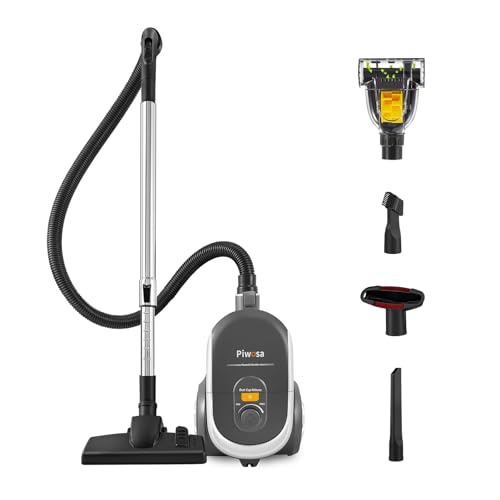
Aircliff canister vacuum delivers 17Kpa suction, dual HEPA filters & 5 attachments for pet hair, carpet & hard floors. Lightweight at 4.5kg. Shop now.
2. Shark Navigator NV352 Lift-Away — Best Mainstream Upright for Asthma
Rating: 4.4/5 | 30,114 customer ratings
The Shark Navigator NV352 is one of the best-reviewed vacuums on the market at any price point, and its Anti-Allergen Complete Seal Technology combined with a genuine HEPA filter makes it a genuinely appropriate choice for asthma management. The anti-allergen seal is the critical differentiator here: it means the filtration system is a closed loop, preventing bypass even through housing gaps. The filter itself captures 99.9% of dust and allergens, including pet dander and pollen.
The Lift-Away detachable pod is particularly valuable for comprehensive asthma allergen management because it gives you reach to stairs, upholstered furniture, and elevated surfaces without purchasing a separate handheld vacuum. The brushroll shutoff is important for bare floor cleaning — on smooth surfaces, a spinning brushroll without shutoff creates a rooster tail of debris behind the vacuum; shutoff eliminates this. Swivel steering reduces the physical effort of whole-home cleaning.
At 12.5 lbs and with a 5-year limited warranty, the NV352 is a practical, durable choice. Its main limitations are the modest accessory kit (upholstery tool and crevice tool only) and the bagless design, which requires careful cup emptying.
Medical suitability: Anti-Allergen Complete Seal, true HEPA filtration, brushroll shutoff eliminates debris scatter on hard floors, Lift-Away enables thorough furniture and stair cleaning.
View the Shark Navigator NV352 on VacuumExperts

Shark Navigator NV352 Lift-Away upright vacuum with HEPA filter, swivel steering, and anti-allergen technology. Ideal for carpet, stairs, and bare floors.
3. Kenmore Intuition BU4022 — Best Bagged Upright for Hygienic Disposal
Rating: 4.3/5 | 6,594 customer ratings
For asthma sufferers who want the clinically preferred bagged disposal mechanism with a sealed HEPA system, the Kenmore Intuition BU4022 is the strongest recommendation at its price point. The no-touch self-sealing bag technology is the feature that sets this machine apart for asthma management: when you remove the bag, it pinches shut before it leaves the vacuum, eliminating the puff of allergen-laden dust that occurs during traditional bag or cup removal. Six HEPA-rated bags are included.
The dual-motor system — with separate motors for suction and brush roll — means brush agitation speed does not degrade as the bag fills, which is a common problem in single-motor uprights. The PowerFlow bag chamber actively maintains suction even with a partially filled bag. Lift-Up portability gives the same above-floor cleaning flexibility as the Shark NV352, and the included Pet HandiMate attachment is well-suited for upholstery allergen removal.
At 14 lbs it is manageable, though the ongoing cost of replacement bags is a real consideration. For the asthma sufferer who prioritizes clean, enclosed disposal above all other factors, this trade-off is justified.
Medical suitability: Self-sealing no-touch bag disposal eliminates dust exposure during emptying, sealed HEPA filtration, dual-motor brush roll maintains agitation efficiency throughout bag life.
View the Kenmore Intuition BU4022 on VacuumExperts
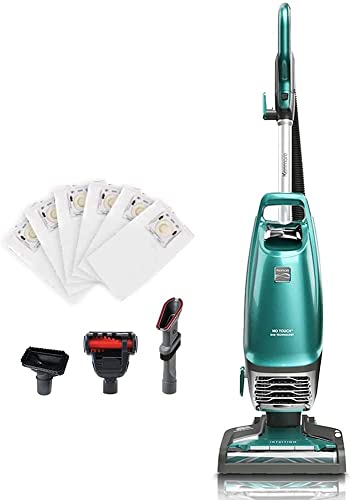
Kenmore Intuition BU4022 bagged upright vacuum with lift-up design, HEPA filtration, and 2-motor suction. No-touch bag system. Ideal for carpet and pet hair.
4. Kenmore Elite 31150 Pet Friendly — Best for Pet-Owner Asthma Sufferers
Rating: 4.2/5 | 2,480 customer ratings
For households that combine pet ownership with asthma — one of the most challenging allergen management scenarios — the Kenmore Elite 31150 is purpose-built for the task. The 3D Inducer Motor with Power Flow Technology delivers 20% more air power than conventional single-motor uprights, which matters when you are pulling deeply embedded pet dander out of carpet fibers. The triple HEPA filtration system captures 99.97% of particles, and the bagged design keeps allergens fully enclosed until disposal.
The beltless agitator is a significant advantage over belt-driven brush rolls: it maintains full RPM regardless of carpet resistance or bag fullness, meaning the last room in a cleaning session gets the same agitation and allergen extraction as the first. The Pet Handi-Mate attachment is specifically designed for upholstery pet hair, and the telescoping wand extends reach to 10 feet for cleaning drapes, high shelves, and ceiling corners — areas where allergen deposits accumulate and rarely get addressed.
The weight of approximately 20 lbs is the primary practical drawback. Multi-floor homes may find it tiring to carry between levels.
Medical suitability: Triple HEPA filtration at 99.97%, bagged with self-sealing disposal, beltless agitator for consistent allergen extraction, dedicated upholstery attachment for dander removal.
View the Kenmore Elite 31150 on VacuumExperts

Kenmore Elite 31150 bagged upright vacuum with Pet Handi-Mate, triple HEPA filtration, 3D Inducer Motor, and 5-position height adjustment for all floors.
5. Shark PowerDetect AV2820S — Best Robot Vacuum for Daily Allergen Management
Rating: 4.1/5 | 688 customer ratings
Robot vacuums occupy a unique position in asthma management: they make daily floor maintenance possible without requiring the asthma sufferer to be present during cleaning. The Shark PowerDetect AV2820S is the most capable robot vacuum with confirmed true HEPA filtration and Anti-Allergen Seal in its class, and it represents a meaningful step forward over standard robot vacuums for allergen-sensitive households.
The three-technology cleaning system — DirtDetect, FloorDetect, and EdgeDetect — gives it adaptive intelligence that standard robot vacuums lack. DirtDetect identifies heavily soiled zones and increases suction and passes automatically. FloorDetect adjusts brush engagement between hard floors and carpet. EdgeDetect uses a controlled air burst to dislodge debris from wall edges and then vacuums it immediately. The 30-day self-empty base with true HEPA filtration means that allergens are contained not just inside the robot but in the base unit as well.
NeverStuck technology prevents the robot from becoming stranded on threshold transitions or thick area rugs — a common failure mode that leaves robot vacuums stuck in one room while the rest of the home goes uncleaned. The Wi-Fi connectivity and app control allow scheduling cleaning while household members are absent, which is the ideal deployment pattern for asthma management.
Medical suitability: True HEPA with Anti-Allergen Seal, adaptive floor-type detection, self-empty base maintains enclosed allergen containment, daily-use capability reduces total manual vacuuming exposure.
View the Shark PowerDetect AV2820S on VacuumExperts

Shark PowerDetect AV2820S self-empty robot vacuum features NeverStuck technology, DirtDetect, EdgeDetect, HEPA filtration, and 30-day bagless base capacity.
Frequently Asked Questions
Does HEPA filter type matter, or is any HEPA vacuum safe for asthma?
The filter grade and the system seal both matter. “HEPA-type” or “HEPA-style” filters are not true HEPA filters and do not meet the 99.97% capture standard. Even a genuine HEPA filter in an unsealed housing allows air to bypass the filter through housing gaps. Only a sealed HEPA system — where all intake air is forced through the filter media before exhaust — provides reliable allergen containment. Look for explicit “sealed system” or “anti-allergen complete seal” language, not just “HEPA filter.”
Are bagless vacuums safe to use with asthma?
Bagless vacuums can be used by asthma sufferers, but they require careful management at the emptying step. Emptying a bagless dust cup releases a concentrated cloud of allergens. Mitigation strategies include emptying outdoors, wearing a mask during emptying, and using a model with a sealed or enclosed emptying mechanism. Bagged vacuums with self-sealing disposal bags remain the medically preferred option for the most sensitive individuals.
How often should an asthma sufferer vacuum?
Clinical guidance for allergen-sensitive households recommends vacuuming carpeted areas at least twice per week and upholstered furniture at least weekly. Hard floors benefit from daily maintenance, which a robot vacuum handles efficiently. Mattresses should be vacuumed monthly with a dedicated upholstery attachment.
Can a vacuum with a washable HEPA filter work for asthma?
Yes, if the filter is maintained correctly. Washable HEPA filters must be completely dry before reinstallation — a damp filter develops mold colonies and degrades filtration efficiency. Allow 24–48 hours of air drying. Replace washable HEPA filters annually or according to manufacturer recommendations even if they are regularly washed, as filter media degrades with repeated washing over time.
Is a robot vacuum enough on its own for asthma management?
A robot vacuum with sealed HEPA filtration is a valuable daily maintenance tool but is not a complete substitute for a full-size vacuum. Robot vacuums cannot currently clean upholstered furniture, mattresses, stairs, or above-floor surfaces, which are the primary dust mite and dander habitats. The most effective protocol for asthma-affected households uses a daily robot vacuum pass on floors plus weekly manual vacuuming of furniture, stairs, and carpeted areas with a sealed HEPA upright or canister.
Should I use a vacuum or a steam cleaner for asthma management?
These are complementary tools. Steam cleaners kill dust mites on contact through heat, but they do not remove the allergenic mite particles — dead mites and their fecal debris remain and continue triggering reactions. Vacuuming after steam treatment removes these particles. For carpet, steam cleaning followed by vacuuming once the surface is fully dry is the most effective combined protocol.
What is the difference between H11, H13, and H14 HEPA filters?
These are European EN1822 efficiency classes. H11 captures 95% of particles at the most penetrating size; H13 captures 99.95%; H14 captures 99.995%. For asthma management, H13 is the practical minimum. Most vacuums marketed in North America as “true HEPA” or “HEPA” are roughly equivalent to H13. H14 is common in medical and cleanroom applications. When in doubt, look for explicit particle capture percentages (99.97% at 0.3 microns is the North American HEPA standard) rather than relying on H-class labeling, which is more common in European product specifications.
Conclusion
The connection between vacuuming and asthma symptoms is well-established and frequently underestimated. Choosing a vacuum is, for asthma sufferers, a medical equipment decision. The minimum acceptable specification is a fully sealed HEPA filtration system — not HEPA-style, not HEPA-type, but sealed true HEPA — combined with thoughtful habits around the timing and execution of cleaning sessions.
For most households, the Shark Navigator NV352 offers the best combination of proven filtration, mainstream availability, and practical versatility. Households that prioritize the most hygienic dust disposal will find the Kenmore BU4022’s self-sealing bag system worth the ongoing bag cost. Pet owners dealing with heavy dander loads should consider the Kenmore Elite 31150’s triple-HEPA bagged system. Those who want to minimize direct vacuuming exposure should add the Shark PowerDetect AV2820S to a daily maintenance routine. And for households that want confirmed sealed dual HEPA performance in a canister form factor, the Aircliff VC-1201 delivers strong specifications at a competitive price.
Any of these five machines represents a meaningful upgrade over a standard or HEPA-type vacuum for allergen management. Pair your choice with consistent vacuuming frequency, mask use during cleaning, and post-vacuuming ventilation, and you will have addressed the primary controllable factor in indoor allergen levels.
Medical Disclaimer: This article is written for informational and educational purposes. It is not intended as medical advice and should not be used as a substitute for consultation with a licensed physician or allergist. Asthma is a serious medical condition with individualized triggers and treatment requirements. If you or a household member has asthma, consult your healthcare provider about allergen reduction strategies appropriate for your specific clinical situation. VacuumExperts does not make any medical claims about the health benefits of specific vacuum cleaners.
Ready to Find Your Perfect Vacuum?
Browse our expertly reviewed vacuum cleaners and make an informed decision
Browse All Vacuums