Best Vacuum for Bad Back 2026: Ergonomic Picks for Back Pain Relief
Best vacuums for bad back sufferers — lightweight, ergonomic picks that minimize strain. Robot vacuums and stick vacuums under 5 lbs reviewed.
Table of Contents
Anyone who has lived with chronic back pain — whether from a herniated disc, lumbar stenosis, muscle strain, sciatica, or the slow accumulation of years of physical wear — knows that vacuuming sits near the top of the list of household chores that punish a bad back. It looks effortless when someone else is doing it. When you are the one doing it, every push and pull transmits force through the lumbar spine, every lean forward to reach under a sofa loads the discs asymmetrically, and the whole process of carrying, maneuvering, and emptying a conventional vacuum can leave you sidelined for days afterward.
The problem is not simply one of willpower or technique. Conventional vacuum design was not built with spinal health in mind. The handle heights, the weight distribution, the cord management requirements, and the need to bend to floor level to empty the dustbin all create compressive and shear forces on the lower back that physical therapists and orthopedic specialists spend entire appointments teaching patients to avoid. For a healthy person, those forces are manageable. For someone with a compromised lumbar spine, they are the difference between a functional afternoon and an afternoon spent flat on the floor with an ice pack.
The good news is that vacuum technology in 2026 has genuinely solved most of these problems — not with design gimmicks, but with real engineering changes that remove the need for bending, reduce weight to under four pounds in some cases, and in the case of robot vacuums, eliminate the need to physically operate the machine at all. This guide covers exactly what to look for, which products deliver on their promises, and how to use any vacuum you choose in a way that protects your back.
Why Conventional Vacuums Are Hard on the Back
Understanding the specific mechanics of why vacuuming hurts helps you identify which features actually solve the problem versus which are marketing language.
Weight and forward-loaded resistance. A full-size corded upright vacuum weighs between 14 and 20 pounds. When you push it forward across carpet, you are not just moving that weight — you are pushing against the friction of the brushroll engaging the carpet pile. The force you generate comes from your core, transmitted through a slightly hunched spine into your arms. On high-pile carpet, this resistance is substantial. The muscle groups recruited are the same ones that rehabilitative medicine spends enormous effort protecting in back-pain patients: the erector spinae, the quadratus lumborum, and the deep stabilizers of the lumbar region. Repeated loading of these muscles across a 30-minute cleaning session, in a slightly flexed forward posture, is a reliable recipe for a flare-up.
Awkward angles and asymmetric loading. Getting a vacuum under a bed, into the gap between a sofa and a wall, or along a baseboard requires you to tilt your torso, twist through the lumbar spine, or hold the machine in an extended position away from your center of gravity. These asymmetric postures are exactly the movements that neurosurgeons and physiotherapists identify as highest-risk for disc injury and muscle strain. Even a relatively short vacuum session might involve dozens of these movements in quick succession.
Bending to floor level. Emptying a dustbin on a standard upright or canister vacuum requires leaning down to floor level. Plugging and unplugging cords at wall outlets requires bending. Clearing tangled hair from a brushroll means crouching on the floor. For someone with lumbar disc disease, each of these seemingly minor tasks places compressive load on already-compromised structures at the exact point in the range of motion where injury risk is highest — the last few degrees of full lumbar flexion.
Carrying heavy equipment. Moving a full-size vacuum from room to room, up a flight of stairs, or into a storage closet requires lifting and carrying a machine that weighs as much as a medium-sized bag of pet food. This is not a minor biomechanical challenge for someone in back pain. The combination of grip, lift, carry, and set-down creates a loading pattern that can trigger or worsen lumbar injury.
Cord management and abrupt movements. Managing a power cord adds an additional layer of physical complexity that forces sudden body rotations, reaching movements, and awkward pauses that break proper vacuuming posture. Every time the cord catches on a piece of furniture or needs to be repositioned, you introduce an uncontrolled movement into what should be a rhythmic, controlled activity.
Key Features to Look for When You Have a Bad Back
Robot Vacuums: Maximum Hands-Off Cleaning
For anyone with significant back pain, a robot vacuum is the single most impactful product category available. A robot vacuum requires zero bending, zero pushing, and zero carrying. You schedule it through a smartphone app or set it to run automatically, and it handles floor cleaning entirely on its own. The only physical interaction required is emptying the dustbin — and with self-emptying models, even that step is eliminated for four to nine weeks at a time.
Modern robot vacuums are not the random-pattern bumping machines of a decade ago. Premium models equipped with LiDAR navigation map your home with precision, clean in systematic rows that cover every square foot, detect and respond to obstacles, and can be directed to specific rooms via app or voice command. They handle hard floors and carpet, and the best models simultaneously mop. For anyone whose back pain makes standing and walking for extended periods difficult, a robot vacuum that runs while you sit, work, or rest is not a luxury — it is a genuine accessibility tool.
Lightweight Design Under 5 Pounds
For quick spot cleanups, stairs, upholstery, and areas robots cannot easily reach, a lightweight cordless stick vacuum is the right tool. The difference between a 3-pound stick vacuum and a 16-pound corded upright is not just convenience — it is the difference between a tool you can guide from an upright posture with minimal muscle effort and equipment that requires continuous physical engagement to control.
At 3 to 5 pounds, a cordless stick vacuum allows you to hold the machine without engaging the deep stabilizers of the lumbar spine. You can vacuum in a fully upright posture rather than hunching forward. You can stop and change direction without the machine pulling on your body. And because there is no cord to manage, the entire session can be completed without a single bending, plugging, or cord-clearing movement.
Ergonomic Upright Handle and Telescopic Wand
Handle ergonomics matter more than most buyers realize. A handle that positions your wrist in a neutral position — not flexed up or down — reduces the muscular effort required to maintain control, which in turn reduces the subtle bracing tension that travels down through the core into the lumbar region. Telescopic wands that adjust to your exact height are similarly important. A wand set even two inches too short forces a forward lean that changes spinal loading in a meaningful way for someone with lumbar sensitivity.
Some cordless stick vacuums also offer a pistol-grip style trigger, which allows you to hold the machine at your side with a natural arm position rather than reaching forward or up. This style of grip works particularly well for people who find any sustained forward reach uncomfortable.
Self-Emptying Bins and Elevated Docks
The dustbin emptying process is one of the highest-risk moments in conventional vacuuming for back-pain sufferers. It requires either bending to floor level (for most uprights and canisters) or reaching overhead (for some stick vacuums that collect debris in the handle). Self-emptying robot vacuum bases eliminate this step by automatically transferring debris from the robot into a larger sealed container in the base station after each cleaning run. Premium all-in-one stations hold 30 to 75 days of debris, meaning you might empty the station only once a month — and because the station sits at counter height, the action requires no bending at all.
Flexible Hose and Extended Reach Attachments
For above-floor cleaning — curtains, upholstery, ceiling edges, car interiors — flexible hoses and extended reach wands allow you to direct suction precisely without having to lift the main vacuum body overhead or contort into positions that load the lumbar spine. Canister vacuums traditionally excelled at this due to their flexible hose designs, and many modern cordless stick vacuums now include flexible crevice tools and extension wands that serve the same purpose.
Swivel Head and Effortless Steering
A vacuum head that swivels through a wide arc lets you change direction with a light wrist movement rather than requiring you to shift your whole body or push against resistance. This matters for back health because the back muscles engaged in direction changes during vacuuming are the same rotational muscles most commonly implicated in lumbar strain. Swivel steering lets you guide the vacuum around furniture legs and into corners with the kind of relaxed, flowing motion that keeps the spine in a neutral, safe alignment throughout.
The 6 Best Vacuums for Bad Backs in 2026
1. eufy Omni C20 Robot Vacuum and Mop — Best Overall for Back Pain
The eufy Omni C20 represents the most complete hands-off cleaning solution available in 2026, and for someone with a bad back, that complete automation is precisely the point. This machine handles the entire floor cleaning cycle — vacuuming, mopping, dustbin emptying, mop washing, and mop drying — without requiring you to touch a floor, carry a machine, bend at the waist, or interact with the vacuum in any way during or after a cleaning session.
The core of the system is the all-in-one docking station that sits in a fixed location in your home. The robot returns to this station after each cleaning run and automatically empties its onboard dustbin into the sealed collection bag in the base. The station also washes the mop pads under clean water and then hot-air dries them, preventing mildew and odor. Transparent water tanks on the station let you monitor fill levels at a glance without needing to open or disassemble anything.
For back pain sufferers, the practical implications are significant. You interact with this system approximately once every 30 to 45 days when the collection bag is full. The bag lifts straight out of the station and drops into a trash can — no bending, no shaking debris into a bin, no filter tapping. Between those infrequent interactions, the robot handles daily floor maintenance entirely independently.
The 7,000Pa suction handles both hard floors and low-to-medium pile carpet effectively. The Mop Master spinning mop pads rotate at 180 RPM with 6N of downward pressure, providing genuine floor scrubbing rather than just light mopping. The ultra-slim 3.35-inch robot profile clears under beds, sofas, and other low-clearance furniture where dust and allergens accumulate — exactly the spaces that would require the most uncomfortable bending to vacuum manually. Obstacle avoidance, smart mapping via the eufy app, room-specific scheduling, and Alexa and Google Assistant compatibility round out a package that earns its premium positioning.
Rating: 4.2/5 | 80,185 reviews
Best for: People with chronic back pain who want to minimize floor cleaning to near zero physical effort. The combination of daily autonomous cleaning and weeks-long hands-free operation makes this the most back-protective option in this guide.

eufy Omni C20 robot vacuum and mop combo with auto emptying, washing, and drying station. 7000Pa suction and 3.35-inch low profile. See the full review!
2. Shark IQ RV1001AE Self-Empty Robot Vacuum — Best Self-Emptying Robot for Larger Homes
The Shark IQ RV1001AE is built around the same core principle as the eufy Omni C20 — put the robot to work so you do not have to — but it approaches self-emptying with a bagless base that many users find more economical to maintain. The self-empty base holds up to 45 days of debris without requiring disposal bag replacement, and emptying it involves tipping collected dust into a trash can rather than ordering replacement bags.
IQ Navigation with Total Home Mapping creates an intelligent floor map of your home that the SharkClean app displays on your phone. You can direct the robot to specific rooms, set no-go zones, and schedule targeted cleanings — a bedroom on weekdays, the kitchen after meals, the whole house on weekends — all from the couch without getting up. Recharge and Resume means the robot returns to its dock when the battery runs low, recharges, and then picks up exactly where it left off until the full clean is complete.
The self-cleaning anti-hair-wrap brushroll is particularly relevant for multi-person households and pet owners. Hair tangling on a conventional brushroll requires you to flip the vacuum over, crouch on the floor, and manually clear the tangle with scissors or a seam ripper — a position that is genuinely hazardous for someone with a lumbar condition. The self-cleaning brushroll virtually eliminates this maintenance step.
Row-by-row systematic cleaning ensures methodical coverage without random wandering, and voice control through Alexa or Google Assistant lets you start, pause, and direct cleaning entirely by voice when even picking up a phone feels like too much effort on a painful day.
Rating: 4.2/5 | 27,200 reviews
Best for: Larger homes where whole-house autonomous cleaning is the priority, and for users who prefer a bagless self-emptying system to avoid recurring bag costs.

Shark IQ robot vacuum empties itself for 45 days, maps your home, and features a self-cleaning brushroll. Perfect for pet hair. Works with Alexa. Shop now!
3. Roborock Q7 M5+ Robot Vacuum and Mop — Best for Comprehensive Floor Care
The Roborock Q7 M5+ brings together the two capabilities that matter most for back-pain users — powerful self-emptying robot cleaning and simultaneous mopping — in a package with one of the most capable navigation systems in its class. PreciSense LiDAR navigation builds a precise, reliable map of your home and uses that map to plan efficient, systematic cleaning routes that cover every area without redundant passes. The difference between LiDAR-guided navigation and cheaper camera or sensor-based systems is the difference between a robot that knows exactly where it is and one that guesses.
The self-emptying dock holds up to 2.7 liters in a sealed dust bag, providing seven to nine weeks of hands-free operation before you need to interact with the system. At that frequency, emptying the dock is a monthly errand rather than a regular chore. For someone managing daily back pain, removing a task entirely from the weekly cleaning rotation has outsized quality-of-life benefits.
The 10,000Pa HyperForce suction delivers genuine performance on carpet, pulling embedded pet hair and fine debris from pile depths that cheaper robot vacuums leave behind. The mopping function uses three adjustable water flow settings to match mopping intensity to floor type, and it captures the fine dust and dried residue that vacuuming alone leaves on hard floors — the kind of microscopic debris that builds up under furniture and along walls.
The dual anti-tangle brush system — JawScrapers on the main brush and a 0% tangle rate on the side brush — means this robot continues operating effectively for weeks without the crouching floor-level maintenance that conventional brushrolls demand. The Roborock app offers some of the most detailed room-partitioning and scheduling controls in the category, letting you build a fully automated cleaning schedule that runs independently.
Rating: 4.1/5 | 14,927 reviews
Best for: Anyone who wants a single robot to handle both vacuuming and mopping autonomously, with premium navigation and extended self-emptying intervals.

Roborock Q7 M5+ robot vacuum and mop with 10000Pa suction, self-emptying dock, LiDAR navigation, and dual anti-tangle system. Up to 7-9 weeks hands-free.
4. Dyson V11 Animal Cordless Vacuum — Best Cordless Stick Vacuum for Back Pain
When you need a vacuum you can physically guide — for stairs, upholstery, car interiors, and areas a robot cannot reach — the Dyson V11 Animal sets the standard for cordless stick vacuum performance. At approximately 3,030 grams (6.7 pounds), it is heavier than a budget stick vacuum, but the center-of-balance engineering and the in-line design of the wand place that weight directly over the cleaning head rather than distributed outward, which translates to significantly less effort to control than the number suggests.
The defining feature for back-pain management is the completely cord-free operation. There is no cord to manage, no outlet to find, no pulling on your body as the cord catches on furniture. You pick the machine up, vacuum, and set it down. The absence of cord management removes an entire category of sudden, uncontrolled movements from the vacuuming process — the cable-catching, the pivot-and-reach, the occasional jerk when the cord runs out of slack — all of which are precisely the unpredictable movements that trigger back spasms in susceptible individuals.
The Dyson Hyperdymium motor delivers up to 60 minutes of runtime on standard suction mode — enough to complete a full multi-room cleaning session without recharging. Intelligent floor-type detection automatically adjusts suction power when moving between carpet and hard floors, which maintains optimal performance without requiring any manual adjustment. The machine converts from a stick vacuum to a handheld in seconds, letting you clean upholstery, car seats, and stairs from a standing or seated position without carrying a heavy machine overhead.
Whole-machine HEPA filtration captures 99.99% of particles at 0.3 microns — a meaningful feature for back-pain sufferers who often find that inflammation is worsened by allergen exposure. The mini-motorized tool removes embedded pet hair from upholstery and stairs with power that rivals a full-size vacuum’s floor head.
Rating: 4.4/5 | 12,321 reviews
Best for: Pet owners and anyone who needs a high-performance cordless stick vacuum for targeted cleaning that robots cannot cover, where cord management creates back-strain risk.
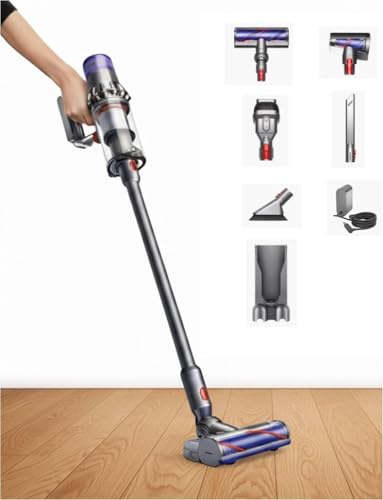
The Dyson V11 Animal offers up to 60 min runtime, auto-adapting suction, and 99.99% filtration. Built for homes with pets. See why it leads the pack!
5. Bissell Featherweight Stick Vacuum 2033 — Best Ultra-Lightweight Option Under 5 lbs
View the Bissell Featherweight 2033
At exactly 3 pounds, the Bissell Featherweight Stick Vacuum 2033 is the lightest full-size floor vacuum in this guide, and for back-pain sufferers whose primary concern is the physical effort of guiding a machine across the floor, that weight is the entire story. Three pounds is approximately the weight of a standard laptop. It is light enough that you can hold it with one hand, change direction with your wrist alone, and complete a full room cleaning without your arm or shoulder muscles fatiguing — which in turn means no compensatory posture changes that would load the lumbar spine.
The 3-in-1 versatility — stick vacuum, handheld vacuum, and stair tool all in one — means you can convert the machine to the configuration needed without swapping between separate pieces of equipment. For stairs specifically, the ability to use the handheld configuration means you can clean treads and risers from a standing position on the step above, rather than crouching at floor level or carrying a full-size machine up and down.
The corded power source means consistent, continuous suction without the battery anxiety of cordless models. On hard floors and low-pile carpet, the suction performance is effective for everyday debris, dust, and pet hair — the regular maintenance cleaning that makes up the majority of most households’ vacuuming needs. The bagless 0.67-liter dust tank empties with a one-touch release that requires no bending; you hold the tank over a trash can and press the button.
For households that already have a robot vacuum handling primary floor maintenance, the Featherweight is the ideal complement: ultralight, quick to grab and put away, and capable of the spot-cleaning tasks — a tracked-in pile of dirt, a visible spill, the edge of a rug the robot missed — that do not justify waiting for a scheduled robot run.
Rating: 4.2/5 | 116,086 reviews
Best for: Anyone who wants the absolute lightest possible manual vacuum for quick cleanups and targeted tasks, particularly useful as a complement to a robot vacuum.

Bissell Featherweight stick vacuum weighs only 3 lbs and converts into 3 machines. Bagless design with crevice tool for carpet, hard floors, and furniture.
6. Eureka Blaze 3-in-1 Swivel Stick Vacuum NES215A — Best Budget Ergonomic Stick Vacuum
The Eureka Blaze NES215A delivers three features that matter specifically for back health — a lightweight 4-pound frame, swivel steering, and a 3-in-1 convertible design — at a price point that makes it accessible without compromise. At 4 pounds with an 18-foot power cord, it occupies the budget end of the lightweight stick vacuum spectrum without sacrificing the ergonomic characteristics that protect the lumbar spine during regular use.
The swivel steering head is the standout feature from a back-health perspective. Unlike rigid-head stick vacuums that require you to reposition your whole body when changing direction, a swivel head responds to a gentle wrist pivot, keeping the spine in a stable, neutral position throughout the cleaning stroke. Navigating around a dining table or between closely spaced furniture pieces — tasks that normally involve a series of small rotational movements through the lumbar region — becomes a fluid, low-effort motion.
At 240 watts and 2 amps, the Blaze provides adequate suction for hard floors and low-pile carpet in the kinds of medium-traffic residential spaces where most daily cleaning takes place. The washable filter eliminates the ongoing cost and replacement chore of disposable filters. The 18-foot cord provides reasonable range across most rooms without constant outlet changes, and the capture nozzle design picks up larger debris on hard floors without scattering it — preventing the frustrating additional pass-overs that add time and physical effort to a cleaning session.
The 3-in-1 capability — detachable handheld mode for upholstery, curtains, and above-floor surfaces — extends the machine’s utility beyond floor cleaning without adding weight or complexity.
Rating: 4.2/5 | 40,555 reviews
Best for: Budget-conscious buyers who want a lightweight, ergonomically sound stick vacuum with swivel steering for daily floor maintenance without breaking the bank.

Eureka Blaze 3-in-1 lightweight stick and handheld vacuum with swivel steering. Just 4 lbs for hard floors and carpet. Read the expert review today!
Proper Vacuuming Technique to Protect Your Back
Even the best vacuum for back pain can contribute to injury if used with poor posture or technique. Physical therapists who work with patients in lumbar rehabilitation consistently identify the same set of technique errors that turn a manageable task into a pain trigger. The following guidelines apply regardless of which vacuum you choose.
Maintain a neutral lumbar curve. The most important single principle in back-safe vacuuming is preserving the natural inward curve of the lower back — what physical therapists call “neutral spine.” The moment you allow your lower back to round forward into flexion — which happens when you lean out over the vacuum to reach further, or when you hunch your shoulders to push through thick carpet — you increase compressive load on the lumbar discs by a factor of two to three compared to an upright position. Hold your core muscles gently engaged throughout cleaning to support this neutral alignment.
Adjust the wand to your height. Before starting, set the telescopic wand of a stick vacuum so that the handle sits comfortably at hip height when the vacuum head is flat on the floor. You should be able to hold the vacuum with a slightly bent elbow and a straight, upright spine. If you are reaching upward for the handle or bending forward to reach down to it, the wand needs adjustment.
Use your legs, not your back, for direction changes. When you need to change direction, pivot by taking a small step with your feet rather than twisting through your torso. The same principle applies to moving the vacuum into a new section of a room — step to reposition your body first, then continue pushing the vacuum forward, rather than reaching and twisting to extend your range.
Move the vacuum with short, controlled strokes. Long, reaching strokes that extend the vacuum far in front of you increase the leverage arm from the vacuum to your spine and require compensatory core effort to prevent forward lean. Short, rhythmic strokes of 18 to 24 inches allow you to stay upright and let the swivel head or robot handle the directional variation.
Avoid sustained static postures. Standing in one position for more than a few minutes while vacuuming, particularly on one leg while reaching to an adjacent area, creates fatigue in the lumbar stabilizers that leads to progressive posture breakdown. Move your feet frequently to redistribute load, and if you feel your posture deteriorating, stop, stand fully upright, do a gentle backward bend to restore the lumbar curve, and then resume.
Take breaks before you feel pain. For people with established back pain, the instinct to push through a cleaning session until the whole house is done often leads to multi-day flare-ups. Plan shorter sessions with seated rest breaks in between. With a robot vacuum handling primary floor maintenance, you may find that the only manual vacuuming needed is a brief spot-cleaning session rather than a whole-house effort — and at 5 to 10 minutes rather than 30 to 45, the risk of a pain flare drops dramatically.
Empty the dustbin before it is completely full. A full dustbin is heavier than a half-full one and requires a more forceful emptying motion. Emptying more frequently keeps the weight of the task lower and reduces the risk that a fumbled or heavy bin creates an awkward carrying movement.
Comparison Table: Best Vacuums for Bad Back 2026
| Vacuum | Type | Weight | Self-Empty | Best For |
|---|---|---|---|---|
| eufy Omni C20 | Robot + Mop | Hands-free | Yes (auto wash + dry) | Full hands-off automation |
| Shark IQ RV1001AE | Robot | Hands-free | Yes (45 days, bagless) | Large homes, bagless preference |
| Roborock Q7 M5+ | Robot + Mop | Hands-free | Yes (7–9 weeks) | Vacuum + mop combo, LiDAR navigation |
| Dyson V11 Animal | Cordless Stick | 6.7 lbs | No | High-performance cordless cleaning |
| Bissell Featherweight 2033 | Corded Stick | 3 lbs | No | Ultra-light quick cleanups |
| Eureka Blaze NES215A | Corded Stick | 4 lbs | No | Budget ergonomic stick with swivel |
Frequently Asked Questions
What type of vacuum is best for someone with a bad back?
For most people with significant back pain, a self-emptying robot vacuum is the single best choice because it eliminates the need to push, carry, bend, or interact with the machine at all during regular cleaning. For spot cleaning and areas robots cannot reach — stairs, upholstery, car interiors — a lightweight cordless stick vacuum under 6 pounds is the next best option. The combination of a robot vacuum for primary floor maintenance and a lightweight stick vacuum for targeted tasks covers essentially all household cleaning needs with minimal physical effort.
Can I use a regular upright vacuum if I have back pain?
You can, but conventional upright vacuums — which typically weigh between 14 and 20 pounds and require sustained pushing and pulling — are among the highest-risk household tools for people with lumbar conditions. If an upright vacuum is your only option, look for models with swivel steering, a zero-gravity or self-propelled mechanism, an ergonomic handle at the correct height, and a dust cup that empties at waist level rather than floor level. Even with these features, an upright vacuum will ask significantly more of your lumbar spine than a robot or lightweight stick vacuum.
What weight vacuum is safe for back problems?
Physical therapists generally recommend cordless stick vacuums under 6 pounds for people with lumbar conditions who need to manually operate their vacuum. At this weight, the machine can be guided from a fully upright posture with minimal muscular effort. The best options in the 3 to 5 pound range include the Bissell Featherweight at 3 pounds and the Eureka Blaze at 4 pounds. The Dyson V11 Animal at 6.7 pounds is at the upper edge of this range but its center-of-balance design makes it feel lighter than the raw weight number suggests.
Are robot vacuums actually effective enough for daily use?
Yes, in 2026 premium robot vacuums are genuinely effective for daily floor maintenance on both hard floors and low-to-medium pile carpet. Models with LiDAR navigation like the Roborock Q7 M5+ map your home precisely and clean in systematic rows rather than random patterns, providing coverage equivalent to a manually operated vacuum for regular maintenance cleaning. Where robot vacuums fall short is in edge and corner precision, deep-pile carpet, and above-floor surfaces — which is why the combination of a daily-run robot and an occasional stick vacuum session covers the full cleaning picture.
Is a canister vacuum better than an upright for a bad back?
Canister vacuums are sometimes recommended for back pain because the motor and dustbin sit on a separate rolling unit rather than being pushed by the user, and the flexible hose allows more natural body positioning during cleaning. However, canister vacuums are not necessarily light — the rolling unit still needs to be moved around, and the frequent cord and hose management can introduce awkward movements. For most back-pain sufferers, a lightweight cordless stick vacuum is more practical than a canister because it eliminates cord and hose management entirely.
How often should I vacuum if I have a bad back?
Rather than thinking about frequency, think about minimizing the total physical load per week. A robot vacuum running daily on a schedule means your floors stay clean continuously without any physical effort from you. When you add a quick stick vacuum session for spot cleaning or above-floor tasks, keep it to under 10 to 15 minutes to stay within a physical work window that does not trigger a pain response. The goal is to replace one long, high-effort cleaning session per week with daily automated maintenance plus very brief targeted touchups.
What features make a vacuum ergonomic for the back?
The most important ergonomic features for back-pain users, in order of impact, are: full automation (robot vacuums), lightweight design (under 6 pounds for stick vacuums), swivel steering (reduces rotational lumbar movements), cordless operation (eliminates cord management movements), self-emptying bins (eliminates bending to empty), telescopic wand with height adjustment (maintains neutral spine posture), and above-floor attachment tools (allows reaching without twisting or overhead lifting).
The Bottom Line
Vacuuming does not have to be a source of back pain. The equipment available in 2026 has moved far enough beyond the heavy, awkward uprights of previous generations that genuinely back-safe cleaning is possible for almost any home and any budget.
If back pain is severe or chronic, start with a self-emptying robot vacuum — the eufy Omni C20, the Shark IQ RV1001AE, or the Roborock Q7 M5+ — and let it handle daily floor maintenance on a schedule you set once and then forget. Add a 3-to-4-pound stick vacuum like the Bissell Featherweight or the Eureka Blaze NES215A for the quick cleanups and targeted tasks that fall outside the robot’s reach. Between these two tools and the technique adjustments outlined above, most back-pain sufferers can maintain genuinely clean floors without the weekly flare-up that conventional vacuuming so reliably produces.
The best vacuum for a bad back is ultimately the one you interact with as little as possible — because the less physical effort your cleaning routine demands, the more your spine can focus on healing rather than compensating.
Ready to Find Your Perfect Vacuum?
Browse our expertly reviewed vacuum cleaners and make an informed decision
Browse All Vacuums