Best Vacuum for Cat Litter: Stop Tracking It Through Your Entire House
Cat litter scatter is a daily battle for cat owners. Here are the best vacuums for picking up cat litter from all floor types without clogging in 2025.
Table of Contents
- Best Vacuum for Cat Litter: Stop Tracking It Through Your Entire House
- Why Cat Litter Is Harder to Vacuum Than It Looks
- What to Look For in a Cat Litter Vacuum
- Top Picks: Best Vacuums for Cat Litter
- Matching Litter Type to Vacuum
- Practical Tips for Managing Litter Scatter
- Frequently Asked Questions
- Final Verdict
Best Vacuum for Cat Litter: Stop Tracking It Through Your Entire House
You filled the litter box. Your cat did what cats do. And now there is a trail of litter granules leading from the box, across the bathroom floor, down the hallway, and onto the living room rug. You did not track it there. Your cat did — one paw at a time.
Cat litter scatter is one of the most persistent cleaning problems in cat-owning households, and a regular household vacuum often makes it worse. The wrong machine can fling granules across the room, clog on clay dust, or leave crystal litter pieces rattling around inside the intake. This guide explains what makes cat litter uniquely difficult to vacuum, what features actually solve the problem, and which specific vacuums do the job without making a mess of their own.
Why Cat Litter Is Harder to Vacuum Than It Looks
Cat litter is not just dirt. It is an engineered product that comes in several very different physical forms, and each one presents its own vacuuming challenge.
Clumping clay litter is the most common type. It is made from sodium bentonite clay, a fine-particle material that absorbs moisture and binds together on contact. Dry clay litter that has been kicked out of the box is extremely fine — effectively a fine dust when broken up underfoot. This dust infiltrates carpet fibers, settles into hardwood floor gaps, and coats the inside of vacuum filters quickly. Vacuums with poor filtration recirculate it back into the room.
Crystal litter (silica gel) is the opposite end of the spectrum. These are large, hard, translucent beads — think tiny pebbles. They are lightweight enough for cats to scatter widely, but heavy enough to make noise and cause real clogging problems in narrow vacuum intakes and hose bends. Crystal litter is the type most likely to rattle through a handheld vac and get stuck.
Pine pellet litter is pressed sawdust formed into dense pellets. When dry, the pellets are large and easy to pick up. When used, they break down into soft sawdust. You end up with a mix of intact pellets and fine sawdust at the same time, which requires a vacuum that handles both extremes.
Beyond litter type, scatter radius is a real phenomenon. Studies and cat owner surveys consistently find litter tracks appearing six to ten feet from the box, with individual pieces traveling as far as fifteen feet on smooth floors. Cats track it with their paws, and the lightweight nature of most litter — especially crystal and clay — means it also scatters when the cat exits the box at speed.
Hardwood floors make this worse. Litter pieces settle into the gaps between planks and are not always reachable with a standard vacuum head. They also get ground into the wood grain if walked over repeatedly, leaving dusty streaks that are hard to clean without direct suction contact.
What to Look For in a Cat Litter Vacuum
Not every vacuum is suited for this specific job. Here are the features that actually matter.
Strong, Sealed Suction
Litter pieces — especially crystal beads and intact pine pellets — need real airflow to be lifted from the floor. A vacuum with adequate suction on paper but poor seal quality loses performance to air leaks. Look for machines described as having sealed systems, and prioritize suction performance over motor wattage alone.
Wide Intake That Will Not Clog
Narrow hose bends and small intake openings are the enemy of crystal litter. A vacuum with a wide, direct pathway from the floor to the dustbin handles large granules without jamming. Canisters and uprights with large floor heads generally outperform handheld vacs on this metric. For quick spot cleaning with a handheld, look for models with a wide nozzle opening.
HEPA Filtration
Clumping clay litter produces fine particulate matter that stays airborne for minutes after vacuuming. Cat dander, litter dust, and silica particles from crystal litter are all potential irritants — especially for anyone with asthma or allergies. A true HEPA filter captures particles down to 0.3 microns, preventing the vacuum from exhausting litter dust back into the room.
Large, Easy-Empty Dustbin
A litter patrol is a daily or near-daily task. A small dustbin fills up fast, and a complicated emptying mechanism makes the chore more annoying than it needs to be. Look for large-capacity dustbins with a one-press, no-touch empty design so you are not reaching into litter dust with your hand.
Multi-Surface Capability
Cat litter ends up on every surface type: tile in the bathroom, hardwood in the hallway, rugs in the bedroom, upholstered stairs. The best vacuum for cat litter is one that transitions between surfaces without you having to stop and switch attachments every few feet.
Top Picks: Best Vacuums for Cat Litter
Best Overall: Bissell CleanView Swivel Pet 2252
View the Bissell CleanView Swivel Pet 2252
Rating: 4.4 stars | 105,000+ reviews
The most-reviewed vacuum on this list, and the one that earns the top spot specifically because of how it handles the litter scatter problem end-to-end. The CleanView Swivel Pet includes Bissell’s scatter-free technology — a design that prevents the intake from blowing debris forward as you approach it, which is exactly the failure mode that makes vacuuming cat litter frustrating with lesser machines.
Key features:
- Scatter-free intake design prevents granules from being pushed away
- Swivel steering for maneuvering around litter box areas and furniture
- Large, easy-empty dirt tank with one-press release
- Multi-surface capability across hardwood, tile, and carpet
- Pet hair specialization with tangle-reducing brush roll
The swivel steering is worth highlighting specifically for litter patrol. Litter boxes are often in bathrooms or laundry rooms with tight clearances, and a vacuum that requires a wide turning radius makes the job harder. The CleanView Swivel navigates tight corners with one hand while you hold back the cabinet with the other. At its price point — consistently one of the most affordable full-size uprights — it is the easiest recommendation for most cat households.
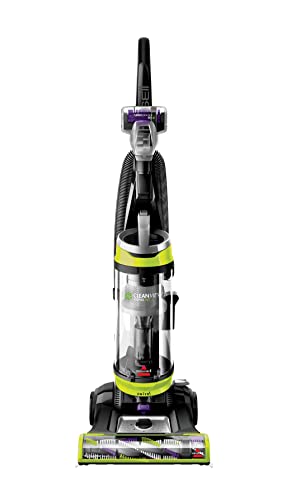
Bissell CleanView Swivel Pet 2252 upright vacuum with triple action brush roll and scatter-free technology. Designed for pet homes. Buy now!
Best HEPA Pick: Shark Navigator Lift-Away Deluxe NV360
View the Shark Navigator NV360
Rating: 4.4 stars | 52,000+ reviews
If litter dust and cat dander are a health concern in your household — allergies, asthma, or a family member with respiratory sensitivity — the NV360 is the vacuum to prioritize. It features Shark’s Anti-Allergen Complete Seal Technology with a genuine HEPA filter, which means the entire airflow path is sealed to prevent dust from escaping around the filter rather than through it. The distinction matters: a HEPA filter in a non-sealed machine still allows litter dust to bypass the filter through gaps in the housing.
Key features:
- Anti-Allergen Complete Seal with true HEPA filtration
- Brush roll on/off switch for transitioning between carpet and hard floors
- Lift-Away design — detach the canister pod to clean stairs and tight spaces
- Large dust cup with no-touch emptying
- Lightweight at under 14 pounds despite full-size performance
The Lift-Away feature is genuinely useful for litter cleanup. Scatter reaches upholstered chairs, the sides of the litter box itself, and sometimes even countertops if your cat is athletic. With the canister detached and the hose extended, you can direct suction exactly where the litter went rather than dragging a full upright across small spaces. The brush roll shutoff lets you use hard floor mode on tile and wood without spreading litter granules with the spinning brush.
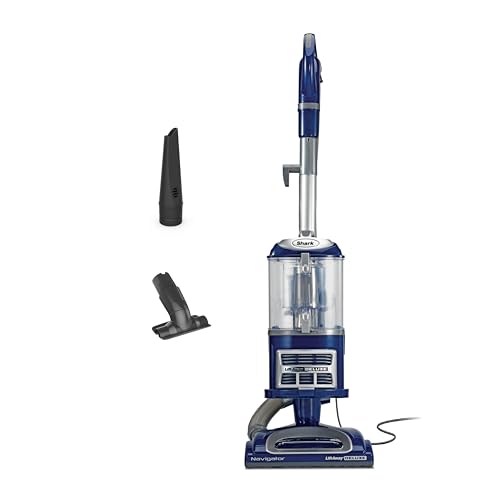
Shark Navigator Lift-Away NV360 delivers powerful suction with HEPA filtration and swivel steering. Perfect for pet hair and allergens. See full expert review.
Best for Hard Floors: Eureka WhirlWind Bagless Canister NEN110A
View the Eureka WhirlWind Canister NEN110A
Rating: 4.2 stars | 43,000+ reviews
Canister vacuums have a structural advantage on hard floors — the cleaning head is light, low-profile, and makes smooth contact with the surface without the weight of the motor pressing down. For cat litter on hardwood or tile, this translates to better granule pickup along baseboards and into floor gaps. The NEN110A is a compact, affordable canister that excels in exactly this scenario.
Key features:
- Canister design with lightweight floor head for precise litter pickup
- Powerful cyclonic suction maintained without bag replacement
- Blower port for cleaning hard-to-reach spaces
- Multi-surface floor head transitions between tile, hardwood, and area rugs
- Easy-empty bagless design
If most of your litter scatter happens on hard floors — a bathroom, kitchen, or tiled laundry room — the WhirlWind’s canister design gives you more control than an upright. The low-profile head slides under cabinet gaps where litter hides, and the long hose gives you reach without moving the body of the vacuum. The blower port is an underrated feature for pushing litter out of corners before vacuuming it up.

Eureka WhirlWind NEN110A bagless canister vacuum with 2.5L dust cup, swivel steering, and multi-surface cleaning. Lightweight and easy to use.
Best for Daily Spot Cleaning: BLACK+DECKER Dustbuster CHV1410L
View the BLACK+DECKER Dustbuster CHV1410L
Rating: 4.3 stars
Not every litter patrol requires pulling out a full-size vacuum. For the daily quick pass around the litter box — a handful of granules that the cat kicked out during the morning visit — a cordless handheld is faster, easier, and less disruptive than getting out the upright. The Dustbuster CHV1410L is the standard recommendation for this role: reliable, widely available, and effective on the small-scale daily cleanup that keeps litter from spreading further into the house.
Key features:
- Cordless — no plug-in required for quick access
- Wide intake opening handles crystal litter and pellets without clogging
- Rotating slim nozzle for targeting corners and edges
- Washable filter for long-term maintenance
- Translucent dustbin so you know when to empty
Keep this stored in or near the room with the litter box. After every litter box cleaning session, a thirty-second pass with the Dustbuster prevents that day’s scatter from becoming tomorrow’s embedded floor dust. It is not a replacement for a full vacuum, but as part of a two-tool system — daily handheld plus weekly full vacuum — it dramatically reduces how much litter accumulates between deep cleans.
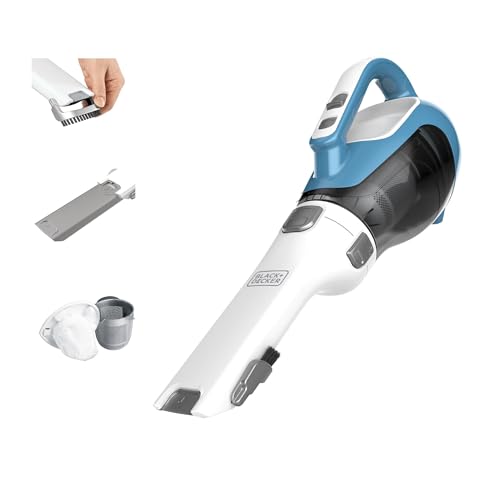
BLACK+DECKER Dustbuster AdvancedClean cordless handheld vacuum with cyclonic suction and 16V battery. Great for home and car. Read our expert review now.
Best for Automated Daily Patrol: eufy Omni C20 Robot Vacuum
View the eufy Omni C20 Robot Vacuum
Rating: 4.2 stars | 80,000+ reviews
Cat litter scatter is a daily problem. A robot vacuum converts that daily problem into something that handles itself. The eufy Omni C20 runs on a schedule, picks up fresh litter scatter before it gets ground into the floor, and self-empties at the base station so you are not manually emptying it after every session. For multi-cat households or larger homes where litter tracking covers significant floor area, automating the daily patrol changes the maintenance equation entirely.
Key features:
- All-in-one self-empty base station — empties dustbin automatically after each run
- Strong suction for picking up litter granules across hard floors and rugs
- Smart navigation maps your home and covers the full floor area systematically
- Mop combo handles the fine litter dust residue that remains after vacuuming
- Compatible with app scheduling and room-specific cleaning zones
A note on robot vacuums and cat litter: program the robot to run at a specific time after peak litter-box activity (typically morning and evening). Running it immediately while the cat is actively using the box can startle the cat and create a negative association with the box — a behavioral issue you want to avoid. A scheduled run two hours after morning feeding covers the peak scatter window automatically.

eufy Omni C20 robot vacuum and mop combo with auto emptying, washing, and drying station. 7000Pa suction and 3.35-inch low profile. See the full review!
Matching Litter Type to Vacuum
Crystal litter (silica gel beads): Prioritize a wide intake opening and direct airflow path. The NEN110A canister and the Bissell CleanView Swivel both handle large granules well. Avoid narrow-nozzle handhelds as a primary tool — they clog on crystal beads.
Clumping clay litter (the dusty kind): Prioritize HEPA filtration above everything else. The Shark NV360’s sealed HEPA system is the right match here. The Dustbuster is adequate for surface granules but will not handle clay dust as effectively as a sealed upright.
Pine pellets: The size range from intact pellets to fine sawdust means you need both good suction for the heavy pieces and filtration for the fine dust. The Bissell CleanView Swivel handles this range well. The robot vacuum can manage the daily sawdust accumulation if programmed to run frequently.
Practical Tips for Managing Litter Scatter
Use a litter-trapping mat. A textured mat placed directly in front of the litter box intercepts granules from the cat’s paws before they reach the open floor. The best mats have a grid or honeycomb surface that lets litter fall through to a lower tray, keeping it contained. Empty the mat into the trash every day or two — do not vacuum the mat itself, as most mats are designed to be shaken out.
Position the litter box strategically. A box placed in a corner, inside a cabinet, or inside a dedicated litter box enclosure reduces the scatter radius significantly. The cat exits in one direction and the litter trail is shorter. Enclosures with a top-entry design are particularly effective — the cat jumps in and out from above, leaving most scatter inside the enclosure.
Vacuum before mopping. Fine litter dust settles on hard floors as a thin, gritty residue. If you mop first, you spread the dust into a paste that sticks to the floor. Always vacuum or dry-sweep first, then follow with a wet mop for tile and sealed hardwood.
Clean filters regularly. Clay litter dust is particularly aggressive at clogging vacuum filters. If you vacuum litter daily, check and clean or replace filters more frequently than the manufacturer’s standard recommendation. A clogged filter reduces suction, which means you need more passes to pick up the same amount of litter — and more passes means more scatter.
Empty the dustbin outside or into a sealed bag. If you are dumping litter dust back into a bathroom trash can with no liner, you are putting the dust back into the air. Empty into a lined trash bin or directly into an outdoor bin to keep litter dust from settling back onto your floors.
Frequently Asked Questions
Can any vacuum handle cat litter without clogging?
Not all vacuums are equally suited. Crystal litter is the most likely to cause clogs — it is heavy enough to jam narrow hose bends and small intake openings. Vacuums with wide, straight intake paths (most full-size uprights and canisters) handle it without problems. Cheap cordless stick vacuums with narrow necks are the most prone to clogging on large litter granules.
Is it safe to vacuum silica crystal litter?
Yes, with proper filtration. Silica particles from broken crystal litter can become airborne fine dust. A HEPA-filtered vacuum captures these particles rather than exhausting them back into the room. The Shark NV360’s sealed HEPA system is the best choice if crystal litter is your primary type.
How often should I vacuum around the litter box?
Daily, ideally. A quick pass with a handheld after peak litter-box activity prevents scatter from traveling further into the house. A full vacuum of the surrounding area two to three times per week handles the accumulation the handheld misses. A robot vacuum on a daily schedule automates this entirely.
Will vacuuming cat litter ruin my vacuum?
It can, if you use the wrong vacuum. Fine clay litter dust clogs poorly-sealed filters quickly. Crystal litter can jam narrow intakes. Using a HEPA-sealed machine, emptying the bin frequently, and cleaning the filter regularly protects the vacuum. The models recommended in this guide are chosen specifically because they handle litter without accelerated wear.
Should I get a separate vacuum just for litter?
Not necessarily. The vacuums in this guide are capable whole-home machines that also handle cat litter well. The exception is the Dustbuster, which is a dedicated spot-cleaning tool intended to complement a full-size vacuum, not replace it. If you want a dedicated litter station vacuum, the Dustbuster stored near the box is the practical answer.
My cat tracks litter into carpet — does a vacuum actually get it out?
Yes, but technique matters. For litter embedded in carpet pile, use multiple slow passes with a brush roll engaged rather than one fast pass. The brush agitates the fibers and brings litter granules up to where suction can capture them. The Bissell CleanView Swivel’s scatter-free intake is particularly useful here — standard vacuums can blow litter forward and deeper into the carpet as the vacuum head approaches.
Final Verdict
The cat litter problem is not going away, but the right vacuum makes it manageable. For most cat households, the Bissell CleanView Swivel Pet 2252 is the answer — it is purpose-built to handle scatter, handles all floor types, and has proven itself with more than 105,000 verified buyers. If clay dust and dander are a health concern, upgrade to the Shark Navigator NV360 for its sealed HEPA system. If most of your litter scatter is on hard floors, the Eureka WhirlWind canister gives you the most precise pickup control.
Add a BLACK+DECKER Dustbuster near the litter box for daily spot cleaning, and if daily litter patrol feels like a second job, a eufy Omni C20 running on a schedule handles it automatically so you do not have to think about it.
Pick the combination that fits your floor types, your litter type, and how much you want to automate. The litter is still going to scatter — but now you will have the right tools to deal with it.
Ready to Find Your Perfect Vacuum?
Browse our expertly reviewed vacuum cleaners and make an informed decision
Browse All Vacuums