Best Vacuum for Dust Allergies: Stop Recirculating Dust With a Sealed HEPA System
Dust allergies are triggered by dust mite feces, not dust itself. Find the best vacuum for dust allergies that captures allergens at the sub-micron level without releasing them.
Table of Contents
- Best Vacuum for Dust Allergies: Stop Recirculating Dust With a Sealed HEPA System
- The Science: What You Are Actually Allergic To
- Dust Allergy vs. Dust Mite Allergy: Clearing Up the Confusion
- Why Standard Vacuums Fail Dust Allergy Sufferers
- HEPA Filter vs. Sealed System: The Distinction That Matters
- What to Look For: The Dust Allergy Vacuum Checklist
- Top Vacuums for Dust Allergies
- Home Environment Strategy: Vacuum Selection Is Only Part of the Solution
- Frequently Asked Questions
- Conclusion
Best Vacuum for Dust Allergies: Stop Recirculating Dust With a Sealed HEPA System
You vacuum your floors and your nose starts running ten minutes later. You spend an hour cleaning the bedroom and wake up the next morning more congested than when you went to bed. If this sounds familiar, the vacuum is not solving your allergy problem — it may be making it worse.
The reason is straightforward, and understanding it changes how you shop for a vacuum entirely. Most vacuums collect allergens in a dust cup or bag, then expel a portion of those captured particles right back into the air through gaps in the housing, leaky seals, or inadequate filtration. You move the allergens from the floor to the air column you breathe. For dust allergy sufferers, that is not cleaning — it is rearranging the problem.
This guide covers the science behind why dust makes you react, why most vacuums fail allergy sufferers, what to actually look for, and which specific models with sealed HEPA systems will let you vacuum without the aftermath.
The Science: What You Are Actually Allergic To
Most people call it a “dust allergy,” but that label is slightly misleading. You are almost certainly not allergic to dust particles themselves. You are allergic to Der p 1, a protein found in the fecal pellets of the house dust mite (Dermatophagoides pteronyssinus and D. farinae).
House dust mites are microscopic arachnids, roughly 0.2 to 0.3 millimeters long, invisible to the naked eye. They feed on shed human skin cells and thrive in warm, humid environments: mattresses, pillows, upholstered furniture, carpets, and stuffed animals. A single mattress can harbor anywhere from 100,000 to 10 million mites. Each mite produces approximately 20 fecal pellets per day. Those pellets are coated with digestive enzymes — Der p 1 and Der p 2 are the primary culprits — that trigger an IgE-mediated immune response in sensitized individuals.
When disturbed by vacuuming, walking, or bed-making, these pellets become briefly airborne. Because they are so small (typically 10 to 40 micrometers), they can remain suspended in air for extended periods and penetrate deep into the respiratory tract. The result is the classic dust allergy symptom cluster: sneezing, rhinorrhea, nasal congestion, watery eyes, and in asthmatic individuals, bronchospasm.
The practical implication: a vacuum that captures visible debris but allows microscopic fecal pellet fragments to exhaust back into the room is counterproductive for your health. This is the core problem most budget vacuums create.
Dust Allergy vs. Dust Mite Allergy: Clearing Up the Confusion
The terms are used interchangeably, but there is a meaningful distinction worth understanding.
Dust mite allergy is the most common indoor allergen condition in the world, affecting an estimated 10 to 20 percent of the global population. It is specifically an immune response to dust mite proteins, primarily Der p 1 and Der p 2. Symptoms tend to be year-round (perennial allergic rhinitis) because dust mites live indoors regardless of season.
Dust allergy as a general term can refer to sensitivity to multiple components of household dust, which is a complex mixture. Household dust contains dust mite feces and body fragments, pet dander (Fel d 1 from cats, Can f 1 from dogs), cockroach allergens (Bla g 1, Bla g 2), mold spores, pollen tracked indoors, and shed human skin. Many people who believe they have a simple “dust allergy” are actually reacting to multiple simultaneous allergens within that dust matrix.
The cleaning strategy is the same for both: reduce the overall allergen burden in the home environment, and stop the cleaning process itself from redistributing those allergens into breathable air. A vacuum with a sealed HEPA system addresses both goals simultaneously.
Why Standard Vacuums Fail Dust Allergy Sufferers
A vacuum that lacks a fully sealed filtration system creates what engineers call exhaust leakage — microscopic particles captured by the machine escape back into the room air through three primary pathways:
Housing gaps and seams. Plastic vacuum bodies are assembled from molded parts that fit together with tolerances measured in fractions of a millimeter. Over time, these joints flex, loosen, and develop gaps. Air under suction pressure finds these gaps and carries fine particles through them. This is invisible to the user but measurable in air quality tests conducted post-vacuuming.
Pre-motor filtration bypass. Many vacuums position their main filter before the motor to protect it from debris. If the filter is not perfectly sealed against the housing at its edges — which most non-sealed systems are not — a percentage of airflow bypasses the filter media entirely. These bypassed particles go directly to the exhaust.
Post-motor exhaust inadequacy. Some vacuums include a HEPA filter at the exhaust port but have no sealed pathway between the motor and that exhaust filter. Particles can travel through internal pathways that circumvent the HEPA stage before reaching the exhaust.
Research published in peer-reviewed journals on indoor allergen management consistently shows that vacuuming with a standard non-HEPA machine transiently increases airborne dust mite allergen concentrations. The allergens settle back down over 20 to 60 minutes — but during that window, and for individuals who remain in the room while vacuuming, exposure is elevated.
HEPA Filter vs. Sealed System: The Distinction That Matters
This is the most important technical concept for allergy sufferers to understand before purchasing a vacuum.
A HEPA filter is a specific filter standard: it must capture at least 99.97% of particles 0.3 micrometers in diameter (the most penetrating particle size). A vacuum can include a HEPA filter and still be completely useless for allergy control if the filter is not sealed into the airflow path. You can have the best filter in the world bolted to a leaky machine and it accomplishes almost nothing.
A sealed HEPA system means that every cubic centimeter of air drawn into the vacuum must pass through the HEPA filter before being exhausted. The filter is gasket-sealed against the housing, the housing joints are sealed, and there are no internal bypass paths. All captured air exits exclusively through the HEPA media. This is also described as “whole-machine HEPA” or “HEPA-sealed anti-allergen system” by manufacturers.
When you are shopping, the phrase to look for is “sealed system” or “Anti-Allergen Complete Seal” — not just “HEPA filter.” A product listing that says “equipped with HEPA filter” without mentioning a sealed system should be treated skeptically if allergen control is your primary concern.
What to Look For: The Dust Allergy Vacuum Checklist
Sealed HEPA filtration. Non-negotiable. The entire air path must be sealed so exhaust passes exclusively through the HEPA media. Look for explicit “sealed system” or “complete seal” language from the manufacturer.
Bagless with hygienic emptying — or bagged with sealed bags. Bagless vacuums are convenient, but emptying the dust cup releases captured allergens into the air. If you go bagless, look for one-touch emptying that allows you to dump the contents directly into a trash bag without handling the cup. Alternatively, a vacuum with HEPA-sealed bags (which you remove and discard sealed) can be a lower-allergen emptying experience.
Washable filters. A clogged filter reduces suction and filtration efficiency. Washable HEPA filters reduce the cost and friction of keeping the filter in good condition. Always allow them to dry completely (24 hours minimum) before reinstalling.
Adequate suction on carpet. Dust mite allergens live deepest in carpet fibers, not on the surface. A vacuum with weak suction will pick up surface debris but leave the embedded allergen load largely untouched. Upright vacuums with motorized brush rolls consistently outperform stick vacuums for allergen extraction from carpet.
Attachments for above-floor surfaces. Upholstered furniture, mattresses, curtains, and bed bases are primary dust mite habitats. A vacuum that can only clean floors addresses a fraction of the allergen sources in your home. Look for models that include an upholstery tool and a crevice tool as standard inclusions.
Top Vacuums for Dust Allergies
The following vacuums combine sealed HEPA filtration with strong real-world performance and verified ratings from thousands of users. Each is linked to a full review with complete specifications.
1. Shark Navigator Lift-Away Deluxe NV360
Rating: 4.4 stars | 52,000+ reviews
The NV360 is the strongest overall value in this category. Its Anti-Allergen Complete Seal Technology pairs a true HEPA filter with a fully sealed housing, trapping 99.9% of dust and allergens inside the machine. The Lift-Away feature lets you detach the canister pod for stairs, upholstery, and above-floor cleaning — which matters because sofas and mattresses harbor far more dust mite allergens than floors.
On carpet, the motorized brush roll extracts embedded debris effectively. The brushroll shutoff protects hard floors and eliminates debris scatter. At roughly 16 lbs it is not the lightest vacuum, but the power and sealed filtration justify the weight for anyone whose primary concern is allergen capture.
The NV360 is one of the most reviewed sealed-HEPA vacuums at its price point, which provides meaningful real-world validation that the allergen sealing holds up through years of use — not just in a laboratory test.
Read our full Shark Navigator NV360 review
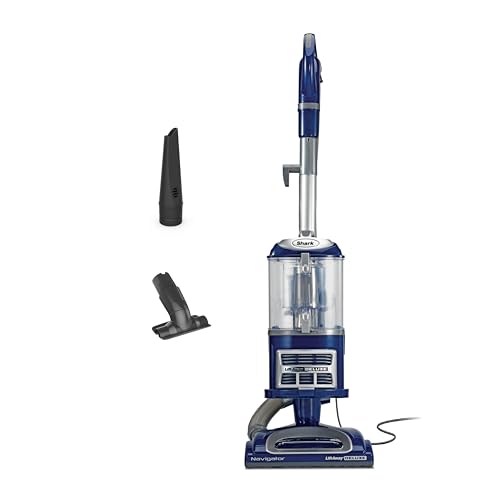
Shark Navigator Lift-Away NV360 delivers powerful suction with HEPA filtration and swivel steering. Perfect for pet hair and allergens. See full expert review.
2. Bissell Pet Hair Eraser Allergen Lift-Off 39883
Rating: 4.5 stars
Bissell built the 39883 specifically for allergen removal, and the engineering choices reflect that priority at every level. The HEPA Sealed Allergen System seals the entire filtration path rather than simply inserting a HEPA filter into an otherwise standard vacuum body. The sealed architecture means exhaust air is genuinely clean.
The tangle-free brush roll maintains consistent suction performance session after session without the degradation caused by hair accumulation. For households with pets — where dander compounds the dust mite allergen load — the 39883’s Scatter-Free Technology is a notable addition: it controls airflow during hard floor vacuuming so that lightweight allergen-laden debris gets captured rather than pushed ahead of the cleaning path.
The XL 1-liter dust tank reduces how frequently you need to perform the allergen-releasing act of emptying the bin, and the one-touch empty mechanism minimizes handling. The included TurboEraser pet tool is motorized, making it effective for extracting allergens from upholstery and mattress surfaces.
Read our full Bissell Pet Hair Eraser Allergen Lift-Off review

Bissell Pet Hair Eraser Allergen Lift-Off with HEPA filtration, tangle-free brush roll, and scatter-free tech. Built for pet owners. See our expert review.
3. Shark Navigator NV352 Lift-Away
Rating: 4.4 stars | 30,000+ reviews
The NV352 is the NV360’s sibling and shares the same Anti-Allergen Complete Seal Technology with HEPA filtration — delivering the same sealed-system allergen capture at a slightly different configuration and price point. At approximately 12.5 lbs it is noticeably lighter than the NV360, which matters if you plan to carry the detached pod through multiple rooms or up stairs repeatedly.
More than 30,000 reviews over years of production provide strong evidence that the sealed housing maintains its integrity through normal consumer use. This is not a trivial point: a vacuum that passes air quality tests on day one but develops housing gaps after six months of use is not a reliable long-term allergy management tool.
The 5-year limited warranty is among the longest in this category, which provides meaningful assurance for a product you are counting on to protect your respiratory health. Brushroll shutoff and swivel steering round out a package that handles the full range of allergy-relevant cleaning scenarios.
Read our full Shark Navigator NV352 review

Shark Navigator NV352 Lift-Away upright vacuum with HEPA filter, swivel steering, and anti-allergen technology. Ideal for carpet, stairs, and bare floors.
4. KARDV V06 Cordless Stick Vacuum
Rating: 4.4 stars
For those who prefer a cordless format — or who need a secondary vacuum for quick daily allergy maintenance between full upright sessions — the KARDV V06 is the strongest sealed-HEPA cordless option in this guide. Its fully sealed multi-layer HEPA filtration captures 99% of particles larger than 0.1 micrometers, which covers the full size range of dust mite fecal pellet fragments.
The 500W motor delivers 40Kpa of suction in MAX mode, which is sufficient for meaningful allergen extraction from low and medium-pile carpet. The V-shaped anti-tangle brush roll with LED floor illumination helps identify and capture debris in darker areas — dust and pet dander accumulate in corners and under furniture edges where light rarely reaches during normal cleaning.
The 1.5-liter dust cup is exceptionally large for a cordless stick vacuum, which translates to fewer emptying events and less allergen disturbance per cleaning session. The two included HEPA filters mean you always have a clean, dry filter ready when one is drying after washing — a practical consideration that many allergy-focused buyers overlook until they own the product.
Read our full KARDV V06 review

KARDV V06 cordless stick vacuum with 500W motor, 40Kpa suction, 60-min runtime, and LED display. 8-in-1 design for pet hair and hard floors. Full review here.
5. LEVOIT LVAC-200 Cordless Stick Vacuum
Rating: 4.3 stars
The LEVOIT LVAC-200 rounds out this list with a 5-stage filtration system designed for allergy-relevant particle capture, including pet dander and fine dust. Its tangle-resistant roller design addresses a maintenance problem with direct allergen implications: hair-bound brush rolls reduce cleaning effectiveness precisely where the allergen load is highest — in carpet fibers — and require manual removal that releases trapped particles back into the environment.
With up to 50 minutes of runtime in standard mode, the LVAC-200 handles the full allergy management cleaning routine in a single session: bedroom floors, living areas, and stairs. The one-click dust bin emptying minimizes allergen disturbance during the often-overlooked emptying step. Washable and reusable filters keep the filtration system effective without ongoing replacement costs.
The LVAC-200 is well-suited as either a primary vacuum in apartments and smaller homes, or as a complement to a full-size upright for above-floor allergen removal in larger homes.
Read our full LEVOIT LVAC-200 review

LEVOIT LVAC-200 cordless stick vacuum with tangle-resistant roller, 50-min runtime, and 5-stage filtration. Ideal for pet hair and hard floors. See full review.
Home Environment Strategy: Vacuum Selection Is Only Part of the Solution
Buying the right vacuum is a critical step, but effective dust allergy management requires a layered approach. The vacuum addresses allergens already distributed through the home. These additional measures reduce the allergen load at its source.
Mattress and pillow encasements. The single highest-impact intervention for dust mite allergy sufferers. Allergen-proof encasements with pore sizes under 10 micrometers physically block mites and their fecal pellets from colonizing the sleep surface and from escaping into your breathing zone while you sleep. You spend eight hours per night with your face inches from your mattress — it is the highest-priority dust mite habitat in the home. Use encasements rated specifically for dust mite allergen control, not just waterproof mattress covers.
Humidity control. Dust mites cannot survive when relative humidity falls below 45 to 50 percent. They require humidity above 55 percent for reproduction and survival. In climates where indoor humidity routinely exceeds 55 percent, a whole-home or room-level dehumidifier meaningfully suppresses mite population growth. This reduces the total allergen load that vacuuming must manage.
Washing bedding in hot water. Washing bed linens, pillowcases, and duvet covers weekly in water at or above 130°F (54°C) kills dust mites and washes out their allergen deposits. Cool water washing significantly reduces but does not eliminate the mite population. If you are using allergen-proof encasements, the encasements themselves need regular washing as well.
Hard flooring where feasible. Carpets are the single largest dust mite reservoir in most homes because they provide both physical substrate and humidity retention that supports mite populations. Where replacing carpet is an option — particularly in bedrooms — hard flooring dramatically reduces the resident mite population. Area rugs on hard floors are easier to wash than wall-to-wall carpet.
Cleaning frequency. A sealed HEPA vacuum used weekly is meaningfully more effective than the same vacuum used monthly. Dust mite allergens accumulate continuously. Consistent, frequent vacuuming with a sealed-system machine keeps the airborne and surface allergen load below the threshold that triggers symptoms in many sufferers.
Air purification. A HEPA air purifier in the bedroom captures allergens that become briefly airborne during sleep movement and bed-making. It does not replace vacuuming, but it provides a continuous filtration layer that vacuuming sessions alone cannot.
Frequently Asked Questions
Does vacuuming make dust allergies worse?
It can, if you are using a vacuum without a sealed HEPA system. Standard vacuums disturb settled allergens and exhaust a fraction of captured particles through housing leaks and inadequate filtration. A sealed HEPA vacuum captures and retains allergens rather than redistributing them. The practical test: if you feel worse during or immediately after vacuuming, your current vacuum is likely exhausting allergens into the air you breathe.
What is the difference between HEPA and “HEPA-type” filtration?
True HEPA filtration meets the standard of capturing 99.97% of particles at 0.3 micrometers. “HEPA-type” or “HEPA-style” filters do not meet this standard — they are marketing terms for filters that perform at a lower capture efficiency. For dust allergy management, only true HEPA filtration provides the particle capture needed. Always verify the product description says “true HEPA” and, ideally, “sealed system.”
Can a robot vacuum help with dust allergies?
A robot vacuum running daily can significantly reduce the surface allergen load that accumulates between manual vacuuming sessions. However, most robot vacuums do not include sealed HEPA systems, and their smaller form factor means the filter media and housing tolerances are often less allergy-focused. Use a robot vacuum for daily maintenance and a sealed-HEPA upright for thorough weekly cleaning of carpet and above-floor surfaces.
How often should I replace or wash the HEPA filter?
A clogged filter reduces both suction and filtration efficiency — and a degraded filter provides less allergen capture. Wash washable HEPA filters every one to three months depending on use intensity. Replace non-washable HEPA filters according to the manufacturer’s schedule, typically every 6 to 12 months. Always let washable filters dry completely (24 hours minimum) before reinstalling — a damp filter grows mold, which is itself an allergen.
Should I wear a mask while vacuuming with a HEPA vacuum?
If you are highly sensitized, wearing an N95 respirator while vacuuming is a reasonable additional precaution even with a sealed HEPA system, because any vacuum disturbs allergens during the physical act of cleaning. Allergen levels transiently rise even with excellent equipment. Another practical option: have a non-allergic household member do the vacuuming while the allergy sufferer is out of the room, allowing 20 minutes for the air to settle before returning.
Is a bagged or bagless vacuum better for dust allergies?
Both can work effectively if the system is properly sealed. Bagless vacuums require careful dust cup emptying — ideally outdoors or directly into a sealed trash bag — to avoid allergen release. Bagged vacuums using sealed, self-closing HEPA bags allow you to remove and discard the allergen load without direct contact. For highly sensitive individuals, a bagged vacuum with sealed HEPA bags can reduce the allergen exposure during the emptying step, though the overall allergen capture during vacuuming depends on the housing seal quality, not bag versus bagless design.
Do vacuum filters need to be the same brand as the vacuum?
Using the manufacturer’s own replacement filters is recommended for sealed-system vacuums. Third-party filters may not form the same precise gasket seal against the housing, creating the bypasses that a sealed system is designed to eliminate. This is a case where the cost savings from generic filters are not worth the allergen management compromise.
Conclusion
Dust allergy management through vacuuming rests on a single principle: capture allergens completely and do not put them back into the air. A vacuum with a HEPA filter that is not sealed into a properly designed housing is, for practical allergy purposes, little better than vacuuming with no filter at all.
The five vacuums in this guide — led by the Shark Navigator NV360 and the Bissell Pet Hair Eraser Allergen Lift-Off 39883 — have the sealed-system architecture that makes the difference between cleaning that aggravates symptoms and cleaning that actually reduces your allergen exposure.
Pair your sealed HEPA vacuum with allergen-proof mattress encasements, weekly hot-water bedding washing, and humidity control below 50 percent, and you have a comprehensive strategy that addresses dust mite allergens both at the source and throughout the cleaning process. That combination is what separates symptom relief that lasts from temporary improvement that disappears the moment you disturb a surface.
Ready to Find Your Perfect Vacuum?
Browse our expertly reviewed vacuum cleaners and make an informed decision
Browse All Vacuums