Best Vacuum for Dust Mites: HEPA-Sealed Picks to Reduce Allergens
Dust mites live in mattresses, carpets, and upholstery — and regular vacuums just recirculate their allergens. Find the best vacuum for dust mites with true HEPA filtration.
Table of Contents
- What Are Dust Mites and Why Are They in Your Bed
- Why Regular Vacuums Make the Problem Worse
- HEPA Filter vs HEPA-Sealed: The Critical Difference
- What to Look for in a Vacuum for Dust Mites
- How to Vacuum a Mattress for Dust Mite Control
- The 5 Best Vacuums for Dust Mites
- Dust Mite Control Beyond Vacuuming
- Frequently Asked Questions
- Conclusion
Your mattress is not just a place to sleep. According to research published in the Journal of Allergy and Clinical Immunology, a single used mattress can harbor anywhere from 100,000 to 10 million dust mites. That figure is not an exaggeration meant to alarm. It is a straightforward consequence of biology, and it explains why so many people with allergies or asthma wake up congested, sneezing, or with irritated eyes despite keeping a clean home.
The challenge is this: most vacuums make the problem worse. Standard vacuums without sealed filtration systems pull allergens off surfaces and then exhaust a portion of them directly back into the air you breathe. If you are going to vacuum for dust mite control, the tool you choose matters as much as how often you use it.
This guide breaks down the science of dust mites, explains what a vacuum actually needs to do to help, and reviews five top-rated vacuums with genuine HEPA filtration that are suited for allergen reduction in the home.
What Are Dust Mites and Why Are They in Your Bed
Dust mites are microscopic arachnids in the family Pyroglyphidae. They are eight-legged, invisible to the naked eye at roughly 0.2 to 0.3 millimeters in length, and they do not bite or burrow. They are, however, one of the most significant indoor allergen sources in the world, affecting an estimated 1 to 1.2 billion people globally according to the World Allergy Organization.
Here is the critical biological detail that most people get wrong: it is not the mites themselves that cause allergic reactions. It is their fecal pellets and shed body fragments. A single dust mite produces approximately 20 fecal pellets per day and lives for roughly 30 to 100 days. Over a lifetime, each mite produces two hundred times its own body weight in waste. This waste contains a group of proteins — most notably the protein Der p 1 from the species Dermatophagoides pteronyssinus — that trigger IgE-mediated immune responses in sensitized individuals.
These protein particles are extremely small, typically 10 to 40 microns in diameter, and lightweight enough to become airborne when disturbed. Vacuuming, making the bed, or even rolling over during the night can launch these particles into the breathing zone.
Where dust mites live:
- Mattresses and box springs (the primary reservoir)
- Pillows and duvet covers
- Upholstered furniture, particularly fabric sofas
- Wall-to-wall carpet, especially in bedrooms
- Stuffed animals and fabric toys
- Curtains and heavy drapes
Dust mites require warmth and humidity to survive and reproduce. They thrive at temperatures between 68 and 77 degrees Fahrenheit (20 to 25 degrees Celsius) and relative humidity above 70 percent. They feed almost exclusively on shed human skin cells, which accumulate most densely in areas where people spend long stationary periods — which is precisely why the mattress is the single largest reservoir in any home.
They cannot drink water and instead absorb moisture from the surrounding air through specialized glands. This dependency on ambient humidity is one of the only environmental levers available for population control, and it is why managing indoor humidity below 50 percent is consistently recommended by allergists.
Dust mites cannot be fully eliminated from the home environment. They are part of the indoor ecosystem and will return wherever conditions support them. The realistic goal is population reduction and allergen load management — and that is where vacuuming with the right equipment becomes clinically meaningful.
Why Regular Vacuums Make the Problem Worse
This is the part that surprises most people. Running a standard vacuum cleaner over a dusty mattress or carpet does not reduce the allergen load in your breathing space. In many cases, it increases it.
Standard vacuums — those without sealed HEPA filtration — draw air through the machine, separate large particles into a dustbin, and exhaust the filtered air back into the room. The problem is that the particles responsible for dust mite allergy are very small, typically between 10 and 40 microns for intact fecal pellets and even smaller when those pellets fragment. Standard filter systems, including generic foam filters and washable fabric filters, cannot reliably capture particles this fine. A significant fraction of the allergen load passes straight through the filtration and exits through the exhaust.
A 2001 study in the journal Clinical and Experimental Allergy found that vacuuming with a non-HEPA vacuum significantly increased airborne Der p 1 concentrations for up to 20 minutes following use. The act of vacuuming was effectively an allergen dispersal event rather than an allergen removal event.
The issue is not just filtration efficiency in isolation. Even a vacuum fitted with a true HEPA filter can fail if the filter is not part of a sealed system. Air follows the path of least resistance. If there are gaps between the filter and the housing, at the dustbin connection point, or anywhere along the airpath, uncleaned air will bypass the filter entirely and escape directly from those gaps. This is the difference between a vacuum that has a HEPA filter and one that is HEPA-sealed.
HEPA Filter vs HEPA-Sealed: The Critical Difference
The term “HEPA” is defined by a performance standard, not a certification logo. A true HEPA filter must capture at least 99.97% of airborne particles at 0.3 microns — the most penetrating particle size, sometimes called the Most Penetrating Particle Size (MPPS). Particles larger and smaller than 0.3 microns are captured at even higher efficiency because of diffusion and inertial impaction effects.
This is sufficient to capture Der p 1 particles, Der f 1 particles, and most other dust mite allergen carriers. The filter itself is not the problem.
The problem is the system around it. A HEPA filter sitting in a housing that leaks is not protecting your air. Marketing language like “contains a HEPA filter,” “HEPA-style filter,” or simply “HEPA-type” often signals that the filtration media meets the particle capture specification in isolation, but the system as a whole has not been tested or sealed.
What you need for dust mite allergen control is a sealed system — one where the entire airpath from the suction inlet to the exhaust is sealed against air leakage. Shark calls this their “Anti-Allergen Complete Seal Technology.” Dyson describes their approach as “whole-machine HEPA filtration.” These terms indicate that the complete vacuum has been engineered and tested as a sealed unit, not just the filter component.
For allergy sufferers, the distinction between “has a HEPA filter” and “sealed HEPA system” is the difference between a vacuum that might help and one that demonstrably will.
What to Look for in a Vacuum for Dust Mites
Sealed HEPA filtration system. This is non-negotiable. The filter must be part of a tested, sealed airpath. Look for whole-machine HEPA certification or manufacturer language describing a sealed system.
Suction power. Dust mites and their fecal matter penetrate deep into mattress fibers, carpet pile, and upholstery fabric. You need meaningful suction — not just surface pickup. Look for at minimum 15 kPa of suction for specialized mattress vacuums, or strong airwatts for floor vacuums.
Upholstery and mattress tools. The standard floor nozzle is not optimized for fabric surfaces. A dedicated upholstery tool with a flat suction head is essential for sofas and chairs. A mattress nozzle or wide flat head helps with consistent coverage on sleep surfaces.
Motorized brush agitation. For carpets and dense upholstery, passive suction is less effective than suction combined with mechanical agitation. A motorized brushroll physically dislodges particles embedded below the surface layer.
UV-C light (specialized mattress vacuums). Some dedicated mattress vacuums include UV-C light at the 253.7 nm wavelength. This wavelength disrupts the DNA of microorganisms and has demonstrated effectiveness against dust mites in laboratory settings. It is a supplementary feature, not a replacement for suction and filtration, but it adds meaningful value for mattress-focused cleaning.
Thermal output (specialized mattress vacuums). Dust mites are killed at temperatures above approximately 130 to 140 degrees Fahrenheit (55 to 60 degrees Celsius) sustained for two minutes or more. Some specialized mattress vacuums produce heated air at this range, adding a third layer of control alongside suction and UV-C.
Dust cup capacity. For thoroughness, you will be vacuuming mattresses, upholstered furniture, carpets, and curtains. A larger capacity reduces interruptions.
How to Vacuum a Mattress for Dust Mite Control
Mattress vacuuming is one of the highest-impact cleaning activities available for dust mite allergen reduction, but technique matters.
Strip the bed completely before vacuuming. Remove sheets, mattress covers, and pillowcases and wash them immediately at 130 to 140 degrees Fahrenheit (the minimum temperature required to kill dust mites). Do not shake them out in the bedroom.
Use the correct attachment. A flat upholstery tool or dedicated mattress nozzle is significantly more effective than a floor nozzle. The flat head maintains consistent contact with the fabric surface, maximizing suction per square inch.
Work in overlapping parallel passes. Move slowly — approximately six to eight inches per second — in overlapping rows across the entire mattress surface. Work the seams, edges, and corners carefully, as these areas accumulate particularly high concentrations of debris.
Vacuum both sides. If you can flip or rotate your mattress, vacuum both surfaces. The underside of a mattress can harbor significant mite populations, particularly in humid climates.
Vacuum the pillow surfaces separately. Pillows are a concentrated reservoir. Use the upholstery attachment on all exposed pillow surfaces.
Do not return bedding immediately. Allow the mattress to air for at least 15 to 20 minutes before remaking the bed.
Frequency. For dust mite allergy sufferers, weekly mattress vacuuming is the evidence-based recommendation. Monthly vacuuming is meaningful but insufficient as a primary control strategy.
The 5 Best Vacuums for Dust Mites
1. FEPPO Mattress Vacuum Cleaner with UV-C Light and HEPA
Rating: 4.4/5 (1,422 reviews)
The FEPPO is purpose-built for the problem this article addresses. It combines four independent mite-reduction technologies in a single corded handheld unit: 16 kPa suction, 30,000 RPM mechanical tapping agitation, UV-C light at the optimal 253.7 nm wavelength, and 140-degree Fahrenheit heated dry air output. Together, these create an environment inside the fabric that is hostile to dust mites at multiple levels simultaneously.
The 500-watt motor and high-frequency tapping mechanism work in concert to penetrate mattress layers beyond what passive suction achieves. The UV-C light activates only when the vacuum’s gravity-sensing wheels are in contact with a surface — a thoughtful safety mechanism that prevents accidental UV exposure when the unit is lifted or repositioned.
The HEPA filtration system captures 99.97% of particles as small as 0.3 microns, and the dual dust cup structure prevents filter clogging by pre-separating larger debris from fine particles. This sustains suction performance across an entire mattress surface without requiring mid-session maintenance.
At 3.8 pounds with a 16.4-foot cord, it covers a king-size mattress without repositioning. This is not a general-purpose floor vacuum — it is a dedicated mattress and upholstery tool, and that specialization is a strength, not a limitation.
Best for: Primary mattress cleaning, allergy sufferers who want targeted UV-C and heat alongside HEPA filtration.
View the FEPPO Mattress Vacuum on VacuumExperts

FEPPO UV-C mattress vacuum with 16Kpa suction, 140°F heat, and HEPA filtration removes 99.97% of particles. Shop now for healthier sleep!
2. Teant Mattress Vacuum with UV-C Light and HEPA Filtration
Rating: 4.4/5 (925 reviews)
The Teant is the FEPPO’s closest competitor in the dedicated mattress vacuum category, and it brings several distinctive features that make it worth considering alongside the FEPPO rather than simply as an alternative.
Where the FEPPO operates at a fixed 30,000 RPM tapping speed, the Teant’s Hyper Helix Motor produces 33,000 RPM tapping and offers two selectable power levels — 12 kPa for regular maintenance and 16 kPa for deep cleaning sessions. The addition of an anion (negative ion) generator at the air outlet adds a layer of air purification that helps neutralize odors and reduce airborne particle levels in the immediate cleaning environment.
The LED display provides real-time performance feedback that the FEPPO lacks, showing when an area has been sufficiently cleaned. The dual dust cup design separates hair from fine debris to prevent clogging, which is practically useful when cleaning pillows or upholstered surfaces that accumulate longer fibers.
The corded 16.4-foot design again ensures consistent full-power performance across an entire bed without battery concerns. The included spare HEPA filter is a practical touch that reduces long-term ownership costs.
Best for: Users who want adjustable suction levels and real-time cleaning feedback alongside UV-C sanitization for mattress-specific allergen control.
View the Teant Mattress Vacuum on VacuumExperts

Teant mattress vacuum with 16KPa suction, 253.7nm UV-C light, 149F hot air, and HEPA filtration for deep bed cleaning. Great for allergy sufferers.
3. Shark Rotator Pet Upright Vacuum ZU102
Rating: 4.4/5 (12,979 reviews)
The Shark Rotator Pet ZU102 is the strongest all-around upright vacuum on this list for households where dust mite control needs to extend beyond the mattress to carpets, area rugs, and upholstered furniture throughout the home.
Its Anti-Allergen Complete Seal Technology combined with HEPA filtration achieves 99.99% particle capture — the highest efficiency rating among the upright vacuums reviewed here. The “Complete Seal” designation is meaningful: Shark has engineered and tested the entire airpath as a sealed unit, meaning particles captured at the inlet do not escape through gaps in the housing or around the filter seal.
The 2.9-liter 3XL dust cup capacity is a practical advantage for thorough allergen-reduction cleaning sessions that span multiple rooms and surface types. The PowerFins HairPro self-cleaning brushroll maintains suction and agitation performance over time without hair accumulation degrading effectiveness. The extendable hose provides up to 12 feet of reach for above-floor cleaning on stairs and upholstery.
The included pet multi-tool is also well-suited to upholstery cleaning for dust mite purposes — the motorized brush head agitates fabric fibers to lift embedded allergen material before the suction carries it away.
Best for: Whole-home allergen control in households with carpet, where the mattress vacuum handles bedding and the ZU102 handles floors and upholstery.
View the Shark Rotator Pet ZU102 on VacuumExperts

Shark Rotator Pet ZU102 upright vacuum with PowerFins HairPro self-cleaning brushroll, Odor Neutralizer Technology, HEPA filtration, and 3XL dust cup.
4. Shark Navigator Lift-Away NV360
Rating: 4.4/5 (52,141 reviews)
The Shark Navigator NV360 is the most widely owned vacuum on this list, and its sustained popularity across more than 52,000 customer reviews reflects genuine long-term satisfaction rather than novelty. For dust mite control, it delivers the fundamentals reliably: Anti-Allergen Complete Seal technology with a true HEPA filter that traps 99.9% of dust and allergens, consistent suction across carpet and hard floors, and a Lift-Away detachable pod that makes cleaning stairs, upholstery, and other above-floor surfaces straightforward.
The NV360 is not the most powerful vacuum on this list, nor does it have the most advanced feature set. What it offers is proven reliability, a sealed filtration system that actually performs as described, and the Lift-Away functionality that makes it practical for cleaning the mattress and furniture surfaces where dust mite populations are highest — not just floors.
The included upholstery tool is adequate for sofa surfaces and chair cushions. For dedicated mattress cleaning, pairing this vacuum with one of the specialized mattress vacuums listed above provides the most comprehensive approach.
Best for: Budget-conscious buyers who want a proven sealed HEPA upright that handles floors and above-floor cleaning throughout the home.
View the Shark Navigator NV360 on VacuumExperts
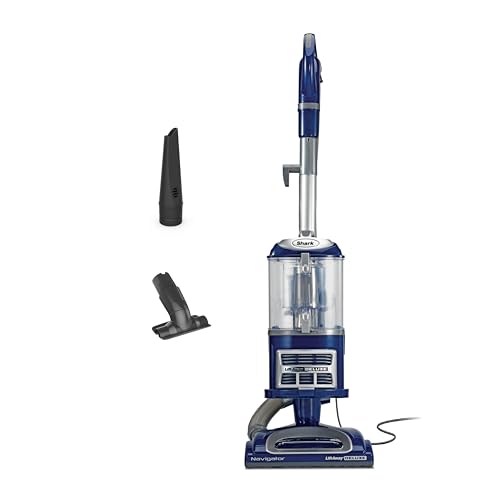
Shark Navigator Lift-Away NV360 delivers powerful suction with HEPA filtration and swivel steering. Perfect for pet hair and allergens. See full expert review.
5. Dyson V8 Plus Cordless Vacuum
Rating: 4.0/5 (4,724 reviews)
The Dyson V8 Plus earns its place on this list through the strength of its filtration architecture. Dyson’s whole-machine HEPA filtration captures 99.99% of particles at 0.3 microns, and the “whole-machine” descriptor is substantive — the entire sealed airpath from inlet to exhaust is certified, not just the filter component in isolation. For allergy sufferers who want engineering-backed assurance rather than marketing claims, this matters.
The V8 Plus is a cordless stick vacuum that converts to a handheld unit with a single click, which makes it genuinely practical for mattress and upholstery cleaning. The Hair Screw Tool attachment — a conical brush bar that spirals hair and debris directly into the vacuum without tangling — works very effectively on mattress surfaces, pillows, upholstered headboards, and fabric chairs. The Motorbar cleaner head handles carpets and hard floors with the same unit.
The 40-minute runtime in standard mode is sufficient for a complete bedroom cleaning session covering the mattress, base, and floor in a single charge. The relatively compact dustbin is the V8 Plus’s primary practical limitation for heavy allergen removal sessions, but the sealed filtration means what enters the bin stays there.
Best for: Cordless flexibility with whole-machine certified HEPA filtration, particularly for users who want one vacuum to handle floors, mattress surfaces, and upholstery without swapping machines.
View the Dyson V8 Plus on VacuumExperts

Dyson V8 Plus cordless vacuum with Motorbar cleaner head, 40-min runtime, whole-machine HEPA filtration, and Hair screw tool for pet hair removal.
Dust Mite Control Beyond Vacuuming
Vacuuming with a sealed HEPA system is the most impactful active cleaning step for dust mite allergen reduction, but it works best as part of a broader environmental management strategy.
Wash bedding at the right temperature. The clinical threshold for killing dust mites in laundry is 130 to 140 degrees Fahrenheit (55 to 60 degrees Celsius) sustained for at least two minutes. Standard warm wash cycles at 104 degrees Fahrenheit (40 degrees Celsius) do not reliably kill mites. If your water heater is set below this temperature or your washing machine does not reach it, mite-denaturing laundry additives containing benzyl benzoate or eucalyptus oil have demonstrated efficacy in peer-reviewed studies. Wash sheets, pillowcases, and duvet covers weekly.
Use allergen-impermeable encasements. Mattress and pillow encasements with a pore size of 10 microns or less prevent dust mites from entering or exiting the sleeping surface. A clinical review in the Cochrane Database of Systematic Reviews identified allergen encasements as one of the single most effective allergen-reduction interventions available. They do not eliminate existing mite populations inside the mattress, but they create a physical barrier between the mite habitat and the sleeping surface. Encasements should cover the mattress, box spring, and all pillows.
Control indoor humidity. Dust mites cannot survive in environments with relative humidity consistently below 40 to 50 percent. A dehumidifier in the bedroom — particularly in humid climates or during summer months — removes the moisture that mites depend on for survival. This is a passive, ongoing control strategy that complements active cleaning.
Remove or reduce carpet in the bedroom. Hard flooring (wood, tile, laminate) harbors substantially fewer dust mites than wall-to-wall carpet because carpet provides a warm, fiber-embedded microhabitat that closely resembles the structure of a mattress. If allergen reduction is a health priority, the bedroom is the highest-impact room for flooring decisions.
Reduce clutter on horizontal surfaces. Books, magazines, decorative objects, and soft furnishings on shelves and bedside tables accumulate dust and provide supplemental mite habitat. Minimizing these surfaces reduces the total allergen reservoir available in the room.
HEPA air purifier. A bedroom air purifier with a sealed HEPA filter continuously captures airborne allergen particles disturbed by movement and normal activity. It works in parallel with surface vacuuming, addressing the airborne component of allergen load rather than the surface-deposited component.
Frequently Asked Questions
Does vacuuming kill dust mites?
No. Standard vacuuming does not kill dust mites. Vacuums are suction-based tools that remove mites and their fecal matter mechanically from surfaces. Live mites that remain in the material after vacuuming will continue to reproduce. Specialized mattress vacuums with UV-C light at 253.7 nm and heated air output at 130 to 140 degrees Fahrenheit do add kill mechanisms, but even these should be understood as population and allergen reduction tools rather than complete eradication systems. The goal of vacuuming for dust mite control is to reduce the allergen load, not to sterilize the mattress.
Can a HEPA vacuum capture dust mite allergens?
Yes, provided the vacuum is part of a sealed system. Der p 1 and Der f 1 allergen proteins are carried on particles typically ranging from 10 to 40 microns in size for intact fecal pellets, and smaller when those pellets fragment into aerosol-range particles. True HEPA filtration captures 99.97% of particles at 0.3 microns and higher efficiency at larger sizes. The critical qualifier is that the HEPA filter must be part of a sealed airpath — if air can bypass the filter through housing gaps or poor seals, the filter’s particle capture efficiency is irrelevant.
How often should I vacuum for dust mite control?
For individuals with diagnosed dust mite allergy or allergic asthma, the evidence-based recommendation is weekly vacuuming of bedroom carpets, weekly mattress vacuuming, and monthly attention to upholstered furniture. The frequency of floor vacuuming in other rooms can follow normal household needs. More important than frequency is using the correct tool — a sealed HEPA vacuum used weekly is significantly more effective than a non-sealed vacuum used daily.
Is a dedicated mattress vacuum necessary, or will a regular vacuum work?
A sealed HEPA upright or stick vacuum with a flat upholstery attachment can meaningfully reduce allergen load on mattress surfaces. Dedicated mattress vacuums add mechanical tapping agitation (which dislodges deeper embedded material), UV-C light, and in some cases heated air — all of which extend the cleaning action beyond what suction alone achieves. For individuals with moderate to severe dust mite allergy, the multi-mechanism approach of a dedicated mattress vacuum provides demonstrably more thorough allergen reduction. For individuals without allergy, a regular sealed HEPA vacuum with an upholstery tool is adequate for general hygiene.
Do HEPA vacuums help with dust mite allergies?
Yes. Multiple clinical studies have found that consistent use of vacuums with sealed HEPA filtration is associated with reduced airborne allergen levels and improved allergy symptoms compared to standard vacuums. A 2011 paper in the Journal of Allergy and Clinical Immunology found that vacuuming with HEPA-filtered equipment as part of a comprehensive environmental management protocol reduced dust mite allergen levels significantly versus control conditions. The key qualifier from the research is that vacuuming alone, without other environmental controls such as mattress encasements and humidity management, is insufficient as a standalone intervention.
What is the difference between HEPA-filtered and HEPA-sealed?
A HEPA-filtered vacuum contains a filter medium that meets the 99.97% capture standard at 0.3 microns. A HEPA-sealed vacuum is one where the entire machine — housing, seals, filter connections, and exhaust — has been tested as a complete unit to ensure no air bypasses the filter. The practical difference is that a HEPA-filtered vacuum with housing gaps can still exhaust unfiltered air through those gaps, while a HEPA-sealed system does not. For allergy control purposes, only a sealed system provides reliable protection.
Can I vacuum a memory foam mattress?
Yes. Memory foam mattresses can be vacuumed safely with a flat upholstery attachment. Avoid using a motorized brushroll directly on the foam surface, as aggressive agitation can damage the foam structure over time. A dedicated mattress vacuum with a flat suction head and tapping mechanism (rather than a spinning brushroll) is the appropriate tool. Allow the memory foam to air fully after vacuuming before replacing bedding.
Conclusion
Dust mites are a permanent feature of the indoor environment, and the science is clear that their fecal proteins are among the most potent indoor allergens affecting millions of people. The good news is that the tools to meaningfully reduce exposure are accessible and practical.
The most important principle to take away from this guide is that not all HEPA vacuums are equal. A vacuum that contains a HEPA filter and a vacuum built around a sealed HEPA system are fundamentally different products for allergen control purposes. For dust mite management, sealed systems from brands that have engineered and tested the complete airpath — not just the filter in isolation — are the only category that reliably delivers on the promise of cleaner air.
For focused mattress cleaning, the FEPPO and Teant mattress vacuums bring UV-C sanitization and thermal elements that extend mite control beyond what suction alone can accomplish. For whole-home allergen management across carpets, floors, and upholstery, the Shark Rotator Pet ZU102 and Shark Navigator NV360 offer proven sealed HEPA performance at different price points. The Dyson V8 Plus provides certified whole-machine HEPA filtration in a cordless format for users who need flexibility across multiple surface types.
Pair whichever vacuum you choose with allergen-impermeable mattress encasements, weekly hot-water laundry, and humidity control below 50 percent, and you have a comprehensive, evidence-based approach to dust mite allergen reduction that will produce measurable results.
Ready to Find Your Perfect Vacuum?
Browse our expertly reviewed vacuum cleaners and make an informed decision
Browse All Vacuums