Best Vacuum for Elderly With Limited Mobility: Lightweight and Robot Picks
Vacuuming shouldn't be a physical struggle. Find the best vacuums for elderly people with limited mobility — from featherweight stick vacuums to fully automated robot options.
Table of Contents
- Best Vacuum for Elderly With Limited Mobility: Lightweight and Robot Picks
- The Physical Challenges Vacuuming Poses for Older Adults
- Three Approaches by Mobility Level
- What to Look For in a Vacuum for Elderly Users
- The Robot Vacuum as an Independence Tool
- Top 5 Vacuums for Elderly With Limited Mobility
- A Guide for Caregivers: Buying a Vacuum for a Parent or Grandparent
- Frequently Asked Questions
- Conclusion
Best Vacuum for Elderly With Limited Mobility: Lightweight and Robot Picks
Falls and overexertion are among the leading causes of injury in adults over 65. According to the CDC, falls account for more than 3 million emergency room visits among older adults each year — and household tasks that require reaching, bending, and carrying heavy objects are a significant contributor. Vacuuming sits near the top of that list. A standard upright vacuum weighs between 10 and 20 pounds, requires continuous pushing and pulling across multiple rooms, and involves bending to empty the dustbin, wrapping a cord around a hook, and carrying the machine up and down stairs.
For an elderly person managing joint pain, reduced grip strength, balance issues, or post-surgical recovery, that is not just inconvenient. It is genuinely dangerous.
The right vacuum changes this equation entirely. A three-pound stick vacuum removes the lifting hazard. A robot vacuum removes the need to stand at all. Choosing the correct tool for your specific mobility situation is not about luxury — it is a practical safety decision. This guide breaks down the physical challenges involved, matches each mobility level to an appropriate vacuum type, reviews the best specific models on the market, and offers guidance for caregivers buying for a parent or grandparent.
The Physical Challenges Vacuuming Poses for Older Adults
Understanding why standard vacuums are problematic helps clarify exactly what to look for in a replacement. These are the five most common physical barriers:
Joint Pain and Inflammation
Osteoarthritis and rheumatoid arthritis are extremely common in adults over 65, affecting hands, wrists, knees, hips, and shoulders. Vacuuming with a heavy upright requires gripping a handle tightly, pushing and pulling repetitively, and maneuvering around furniture — all of which load inflamed joints and can trigger pain flares that last for days afterward.
Reduced Grip Strength
Hand grip strength declines naturally with age. Research published in the Journal of Hand Surgery shows that grip strength peaks in the mid-thirties and decreases steadily afterward, with the decline accelerating after age 65. Many traditional vacuums have narrow, hard handles that require sustained pinching force and trigger-style power buttons that demand precise motor control — both of which become genuinely difficult with weakened grip.
Balance and Stability Issues
Pushing a heavy machine while walking requires balance and coordination. A cord that crosses the floor creates a trip hazard. Reaching across furniture, pulling the vacuum backward, or pivoting sharply to change direction are all movements that can compromise balance and lead to falls, particularly on hard floors.
Difficulty Bending and Kneeling
Emptying a floor-level dustbin, replacing a bag, unclogging a brush roll, or reaching under low furniture requires bending at the waist or kneeling — movements that can be painful or impossible for people with bad knees, hip replacements, spinal stenosis, or lower back problems.
Fatigue and Cardiovascular Limitations
Vacuuming an average home takes 20 to 40 minutes of continuous moderate physical effort. For elderly individuals managing heart conditions, COPD, or simply reduced stamina, this level of sustained exertion carries risk. A lighter vacuum reduces the physical load; a robot vacuum eliminates it.
Three Approaches by Mobility Level
There is no single correct answer for every elderly person. The right vacuum depends on the degree of limitation and what specific activities are most difficult. Here is a practical framework:
Mildly Limited: Lightweight Stick Vacuum
If you can walk and stand comfortably but want to reduce strain from heavy lifting and pushing, a lightweight cordless or corded stick vacuum is the right choice. Models in the 2.5 to 5 pound range are dramatically easier to handle than traditional uprights. Look for corded models if battery management is confusing or inconvenient; look for cordless models if cords are a tripping hazard or if moving between rooms is a priority.
Moderately Limited: Sit-Down Canister Vacuum
If standing and pushing for extended periods is difficult but you are capable of short supervised cleaning sessions, a canister vacuum allows you to sit in a chair and pull the hose with minimal body movement. The unit stays on the floor and moves easily on wheels, requiring no lifting. Suction power is typically excellent. This approach works well for cleaning upholstered furniture, mattresses, and other above-floor surfaces where a robot vacuum cannot reach.
Significantly Limited: Robot Vacuum Only
If walking around with any cleaning tool is genuinely unsafe, painful, or exhausting, a robot vacuum is the appropriate solution. You set a schedule through a smartphone app or remote control, and the machine cleans the floor automatically — returning to its charging dock when finished. Premium models with self-emptying bases require almost no intervention at all, with maintenance intervals measured in weeks rather than days. For an elderly person living alone, a robot vacuum can be a genuine safety device, not just a convenience.
What to Look For in a Vacuum for Elderly Users
Weight Under 6 Pounds (Ideally Under 4)
This is the most important specification. Under 4 pounds means the vacuum can be lifted with one hand without loading the shoulder. Under 6 pounds is still manageable for most users but requires two hands for carrying. Anything over 8 pounds starts to create meaningful risk.
Ergonomic, Wide-Diameter Handle
A wider, rubberized or padded handle reduces the grip force needed to hold the vacuum. Physical therapists consistently recommend larger-diameter tool handles for people with hand weakness or arthritis — the same principle applies to vacuum handles. Avoid models with thin, hard plastic grips or narrow trigger-style switches that require precise finger pressure.
Swivel Steering
A vacuum head with swivel steering pivots in response to gentle wrist movement rather than requiring the user to muscle the machine around corners. This dramatically reduces torque on wrist and elbow joints and makes navigation around furniture almost effortless.
Easy-Empty Dustbin at Standing Height
The dustbin should be emptied by pressing a single button — not by twisting, prying, or bending down. Look for bins that release from the top or side of the vacuum and can be emptied while holding the machine over a trash can in an upright position, without requiring you to crouch or reach down.
No Cord Tripping Hazard
Cords running across the floor are fall hazards, particularly on smooth hard floors. If a corded vacuum is preferred, choose models with short, flexible cords and plan the cleaning path carefully. Cordless vacuums eliminate the hazard entirely. Robot vacuums have no trailing cords by design.
Simple, Single-Button Operation
Avoid vacuums with multiple mode settings, suction adjustment dials, or complicated attachment systems. The fewer steps between picking up the vacuum and it being on and working, the better. A large, clearly labeled power button that activates with a full palm or finger press is the gold standard.
Self-Charging for Robot Vacuums
Any robot vacuum recommended for elderly users should return automatically to its dock and recharge without human intervention. This removes the need to remember battery levels or handle charging cables.
The Robot Vacuum as an Independence Tool
There is a deeper reason to consider a robot vacuum beyond simple convenience, and it deserves a direct conversation.
For elderly people living alone, the ability to maintain a clean home without physical assistance is a meaningful measure of independence. When vacuuming becomes too difficult or unsafe to do personally, many older adults face a difficult choice: rely on family members or paid caregivers to do it, or allow floors to accumulate dirt, dust, and allergens that worsen respiratory conditions and create slip hazards.
A robot vacuum breaks that binary. It operates on a schedule, requires no standing or walking, and can be controlled via a simple voice command through Amazon Alexa or Google Assistant — meaning an elderly person who finds smartphone apps difficult can simply say “Alexa, start the vacuum.” Models with self-emptying bases go even further, reducing the hands-on maintenance requirement to once every few weeks.
The cost of a quality robot vacuum is often comparable to a single month of weekly cleaning service. For families managing a parent’s care budget, a robot vacuum is frequently the most cost-effective way to ensure clean floors year-round.
Top 5 Vacuums for Elderly With Limited Mobility
1. Eureka NES100 Lightweight Corded Stick Vacuum — Best Under 3 Pounds
View the Eureka NES100 | Rating: 4.1 stars | Weight: 2.75 lbs
The Eureka NES100 is the answer when weight is the primary concern. At 2.75 pounds, it is among the lightest full-function stick vacuums available at any price point. The entire machine can be lifted with two fingers and carried between floors without any meaningful effort. This makes it the right choice for elderly users who still want to vacuum independently but cannot manage heavier machines.
Despite its minimal weight, the NES100 delivers consistent corded suction on hard floors, tile, and low-pile carpets. The swivel-steering floor nozzle glides around furniture legs and chair bases with only the lightest wrist guidance. The 3-in-1 convertible design lets you detach the upper unit for handheld use on stairs, upholstery, and tight spaces — without introducing any complexity to normal floor cleaning.
The self-standing design means you never need to prop the vacuum against a wall or bend to pick it up off the floor. The bagless dust cup is detachable and emptied upright, and the washable filter eliminates trips to the store for replacements.
The corded design gives a small advantage for elderly users who prefer not to manage batteries: plug it in and it works, every time, at full power.
Ideal for: Elderly users with mildly limited mobility who want the absolute lightest stick vacuum for daily floor maintenance on hard floors and area rugs.
Mobility-specific strengths:
- 2.75 lbs total weight — easiest to lift and carry of any stick vacuum in this guide
- Swivel head reduces wrist effort during maneuvering
- Self-standing so no bending to retrieve from the floor
- No batteries to charge or replace
- Simple single-button operation

Eureka NES100 3-in-1 corded stick vacuum at just 2.75 lbs. Powerful suction for carpet, hard floors, and pet hair. Converts to handheld for stairs and cars.
2. Bissell Featherweight 2033M — Best Budget Stick for Daily Pickups
View the Bissell Featherweight 2033M | Rating: 4.2 stars | Weight: 3.6 lbs
The Bissell Featherweight 2033M is one of the most purchased stick vacuums in the United States, and the reason is straightforward: it weighs 3.6 pounds, costs very little, and does exactly what it promises. For elderly users who need a lightweight daily-use vacuum for hard floors and low-pile carpet, it is one of the most practical options on the market.
The 3-in-1 convertible design works as a stick vacuum for full-floor cleaning, a handheld for grabbing crumbs off countertops or pet hair off chairs, and a stair cleaner when you detach the handheld unit. The control scheme could not be simpler: one power switch, one floor nozzle, one crevice tool. There is nothing complicated to learn or configure.
The bagless dust cup releases cleanly, and because the unit is so light, emptying it is a one-handed operation performed at standing height. The washable filter is user-maintained without any tools.
One honest limitation: the Featherweight is not designed for deep carpet cleaning or large debris. It performs best on bare floors and thin rugs where its lightweight design and simple motor shine. For heavily carpeted homes, the Shark Rocket below is a better fit.
Ideal for: Elderly users in apartments or homes with mostly hard floors who need an affordable, ultra-simple backup vacuum for daily cleanups.
Mobility-specific strengths:
- 3.6 lbs — light enough for true one-handed use
- No settings to configure, one power switch
- Empties at standing height with button release
- Converts to handheld for stairs and furniture without complex disassembly
- Low price point makes replacement easy if needed

Bissell Featherweight 2033M is an ultra-lightweight 3-in-1 bagless stick vacuum for hard floors, carpet, and stairs. Converts to hand vac with crevice tool.
3. Shark Rocket HV301 Ultra-Light Stick Vacuum — Best for Carpeted Homes
View the Shark Rocket HV301 | Rating: 4.5 stars | Weight: Under 9 lbs
The Shark Rocket HV301 occupies a different category than the ultralight models above. At under 9 pounds, it is heavier — but it also delivers significantly more powerful suction that can genuinely deep-clean low- to medium-pile carpet, not just skim the surface. For elderly users whose homes are predominantly carpeted, it represents the best balance between cleaning power and reduced weight compared to a full upright.
The HV301’s key feature for limited-mobility users is swivel steering, which is genuinely excellent. The vacuum head pivots fluidly in all directions, requiring only light wrist guidance to navigate around chair legs, baseboards, and tight corners. Many users report that it handles like a model half its weight because the steering system removes the need to apply any pushing force to turn.
The corded design ensures consistent, fade-free suction — no worrying about battery levels mid-clean. The vacuum converts from stick to handheld without tools by releasing a single clip, making floor-to-above-floor transitions simple. The 5-year limited warranty is notably generous and reduces the total cost of ownership.
For users who want powerful cleaning without the bulk of a full upright, and who have reasonable upper-body strength for a sub-9-pound machine, the Shark Rocket is a strong choice.
Ideal for: Elderly users with mildly limited mobility living in carpeted homes who need thorough deep cleaning, not just surface pickup.
Mobility-specific strengths:
- Swivel steering requires minimal wrist and arm effort to maneuver
- Full carpet-cleaning capability reduces the need for multiple cleaning passes
- Converts to handheld without tools
- Consistent full-power corded suction — no battery management
- 5-year warranty for long-term peace of mind
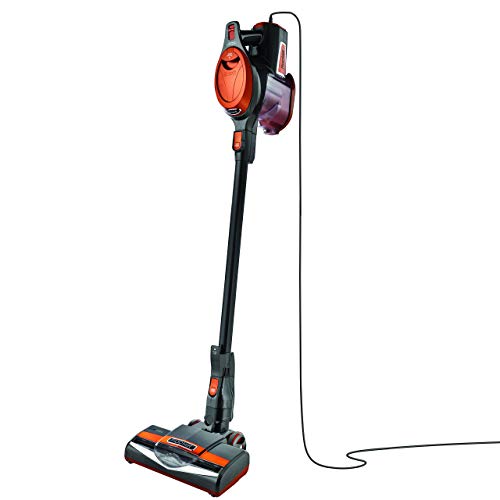
Shark Rocket HV301 ultra-lightweight corded stick vacuum with swivel steering. Under 9 lbs, converts to handheld. Read our in-depth expert review!
4. Tikom G8000 Max Robot Vacuum and Mop — Best Robot Vacuum for Most Elderly Users
View the Tikom G8000 Max | Rating: 4.4 stars | Weight: 5.29 lbs (does not need to be carried)
The Tikom G8000 Max is the top robot vacuum recommendation for elderly users who want thorough, hands-free floor cleaning at a price that does not require a significant financial outlay. It covers the essential bases well: 5000Pa suction handles pet hair and embedded dirt on both hard floors and carpets, the 2-in-1 vacuum and mop function cleans hard floors in a single pass, and the 150-minute battery life covers most homes completely without interruption.
For elderly users, the critical specification is operational simplicity. The G8000 Max supports four control methods — smartphone app, remote control, voice commands via Alexa and Google Assistant, and manual button operation on the unit itself. This flexibility is important: if app navigation is challenging, a user can start and stop the vacuum by voice command or with the included remote. No bending, no carrying, no cord management.
The ultra-slim 2.99-inch profile allows the G8000 Max to clean under sofas, beds, and low-clearance furniture that would require bending and reaching with a handheld vacuum. It returns to its charging dock automatically and restores to full power without any intervention.
One consideration: the G8000 Max does not feature LiDAR or camera-based room mapping, meaning it navigates via sensors rather than a pre-planned route. This is slightly less efficient than premium mapping robots but has a practical advantage for elderly users — there is no app setup required for room mapping, no virtual boundary drawing, and no tech hurdles before the vacuum will simply run.
Ideal for: Elderly users with moderate to significant mobility limitations who want hands-free daily floor maintenance with minimal setup and simple voice or remote operation.
Mobility-specific strengths:
- Zero carrying, pushing, or physical effort required during operation
- Voice command compatible (Alexa and Google Assistant)
- Remote control included for non-app users
- Self-charging with auto-return to dock
- Slim profile reaches under furniture without user bending
- Combined vacuum and mop eliminates a second cleaning task

Tikom G8000 Max robot vacuum and mop combo delivers 5000Pa suction, 150-min runtime, and 4 cleaning modes for hard floors, carpets, and pet hair.
5. ROPVACNIC S1 Robot Vacuum and Mop — Best Robot for App-Comfortable Users
View the ROPVACNIC S1 | Rating: 4.5 stars | Weight: 7.3 lbs (does not need to be carried)
The ROPVACNIC S1 delivers 5200Pa of maximum suction — slightly stronger than the Tikom G8000 Max — in a similarly slim 3-inch profile that slides under furniture effortlessly. It earns its place on this list because of its electronically controlled water flow mopping system, which is meaningfully more sophisticated than the simple passive mop pad found on budget robot vacuums. The four-stage water flow adjustment means mopping is actually effective on tile and sealed hardwood, not just a wet cloth being dragged across the floor.
For elderly users who are comfortable using a smartphone (or have a family member who can handle initial setup), the S1’s app and Alexa compatibility provide maximum scheduling flexibility. You can set the robot to run every morning while you have breakfast, then return to its dock before you need to walk through the room — a genuinely useful arrangement for fall prevention.
The anti-tangle brush design performs well in homes with pets or long-haired occupants, reducing the maintenance frequency. Self-charging is automatic. The included spare HEPA filter and side brushes reduce the need for immediate accessory purchases.
As a newer brand, ROPVACNIC has less long-term track record than Eufy or Tikom, and the absence of a self-emptying base means manual dustbin emptying every few cleaning sessions. Both are worth knowing before purchase.
Ideal for: Elderly users or their family caregivers who want strong robot vacuum suction combined with effective mopping in a single self-charging unit.
Mobility-specific strengths:
- 5200Pa suction — strong enough to reduce cleaning frequency
- Effective mopping with electronically controlled water flow eliminates a second tool
- Alexa and Google Assistant voice control
- Self-charging with auto-dock return
- Slim 3-inch profile reaches under low furniture
- Anti-tangle brush minimizes maintenance tasks
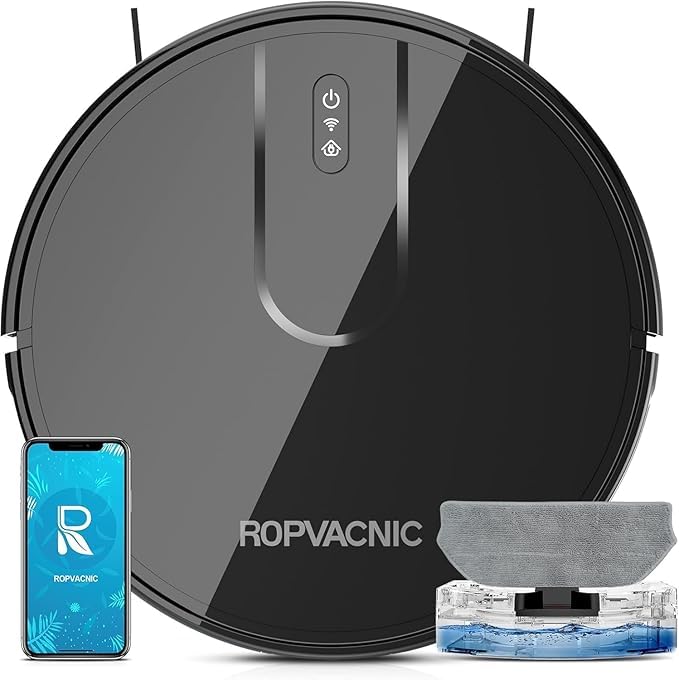
ROPVACNIC S1 robot vacuum and mop combo with 5200Pa suction, smart app control, Alexa compatible, and self-charging. Ideal for pet owners.
A Guide for Caregivers: Buying a Vacuum for a Parent or Grandparent
If you are purchasing a vacuum as a gift or practical solution for an elderly family member, a few considerations will help you choose well.
Assess the home before you buy. A robot vacuum works far better in a home with clear floor space than one with many rugs, door thresholds, or cluttered pathways. Visit or ask about the layout before committing. Single-level homes with open floor plans are ideal for robot vacuums. Multi-story homes may need a lightweight stick for the second floor paired with a robot for the main level.
Consider their tech comfort level honestly. Robot vacuums with full app integration are powerful but can be frustrating for users uncomfortable with smartphones. If your parent or grandparent does not use a smartphone regularly, choose a model that can be operated by voice command or remote control without ever opening an app. The Tikom G8000 Max and eufy RoboVac both work well with remote controls or voice assistants as the primary interface.
Match the vacuum to the worst day, not the best. When someone with limited mobility is having a good day, they may be able to manage a slightly heavier or more complex machine. When they are having a difficult day — with pain, fatigue, or dizziness — they need a vacuum they can use safely at their worst. Choose based on the harder days.
Buy a model that is easy to maintain. Complex maintenance tasks — replacing bags, cleaning brush rolls, managing multiple filter types — will either fall to the caregiver or will not get done. Robot vacuums with washable dustbins, bagless stick vacuums with rinse-clean filters, and models with clearly color-coded components are the easiest to maintain independently.
Look for a simple return and warranty policy. Every person’s physical situation is different, and what works in a store or in a review may not work in practice for a specific user. A strong warranty and a straightforward return policy reduce the cost of a poor fit.
Frequently Asked Questions
What is the best robot vacuum for an elderly person living alone?
For someone living independently, the priority is maximum automation with minimum required intervention. The Tikom G8000 Max is the top recommendation: it combines strong suction, combined vacuuming and mopping, voice and remote control, and automatic charging without needing app setup. If the person is comfortable with a smartphone, the ROPVACNIC S1 offers slightly stronger suction and better mopping. For the most hands-off experience with the longest maintenance intervals, look at premium self-emptying models from Roborock or Shark, which can go weeks without needing attention.
What is the lightest stick vacuum available?
Among quality, full-function stick vacuums, the Eureka NES100 at 2.75 pounds and the Bissell Featherweight 2033M at 3.6 pounds are among the lightest on the market. Both are corded models, which contributes to their minimal weight by eliminating the battery pack. If you specifically need a cordless option, expect the lightest practical models to start around 4 pounds.
What is the best cordless vacuum for arthritic hands?
The ideal cordless vacuum for arthritic hands needs a large-diameter handle, a large easy-press power button, and a weight under 5 pounds. Look for models with a rotating or swivel head to reduce wrist torque. The Eureka Blaze NES215A (4 lbs, swivel steering, single-button operation) and lightweight cordless models from Bissell and Eureka perform well in this category. If grip strength is severely limited, a robot vacuum that eliminates hand-held operation entirely is the most accommodating long-term solution.
Is a robot vacuum practical in a home with thick rugs?
Standard robot vacuums struggle with high-pile rugs, shag carpeting, or rugs with thick fringe that can wrap around the brush roll. In a home with thick carpeting, the robot may slow down, get stuck, or provide incomplete coverage. For such homes, a lightweight stick vacuum for carpeted areas paired with a robot for hard-floor rooms or open areas is often the best combined approach. If using a single tool, a powerful upright-style robot or a lightweight stick vacuum is more reliable on deep pile.
Can elderly users with tremors use a stick vacuum safely?
Tremors present a specific challenge: lightweight vacuums with longer handles can amplify shaking at the floor head. For users with significant hand tremors, look for stick vacuums with a low center of gravity and a wide, stable floor nozzle that maintains contact without precise hand control. A robot vacuum avoids the issue entirely and is often the safest recommendation for users with tremors. If a handheld vacuum is needed for spot cleaning, a small, compact model with a short handle provides more control than a full-length stick.
Does a robot vacuum work on multiple floor types?
Yes. Most current robot vacuums, including both models reviewed above, transition automatically between hard floors and low- to medium-pile carpet without manual adjustment. The suction power typically increases automatically when the robot detects carpet via sensor. Very thick rugs (over half an inch in pile height) can be challenging, and thick rug fringe can jam brush rolls. For mixed-floor homes with standard area rugs and hard floors, a mid-range robot vacuum handles the transition reliably.
How often does a robot vacuum need maintenance?
For everyday use, the dustbin should be emptied every one to three cleaning sessions depending on home size and pet presence. The filter should be cleaned by tapping or rinsing every two to four weeks. Brush rolls should be checked monthly for hair tangles. Models with self-emptying bases extend the dustbin interval to once every 30 to 60 days. Compared to the daily or weekly effort of manual vacuuming, robot vacuum maintenance is minimal and can often be handled by a visiting family member during routine check-ins.
Conclusion
The right vacuum for an elderly person with limited mobility is not the one with the most horsepower or the most features. It is the one that can be used safely and consistently — on the good days and the difficult ones. For most users, that means one of two things: a stick vacuum light enough to carry without strain and simple enough to operate with compromised grip, or a robot vacuum that removes the need to carry anything at all.
The five models in this guide represent the best available options across both categories. The Eureka NES100 and Bissell Featherweight are standout lightweight stick vacuums for users who want to remain physically involved in cleaning. The Shark Rocket steps up for carpeted homes where surface-skimming is not enough. And the Tikom G8000 Max and ROPVACNIC S1 provide hands-free automation for users whose mobility limitations make active cleaning unsafe.
Regardless of which model you choose, the investment is ultimately in something more important than clean floors. It is in the ability to maintain a home safely, independently, and without unnecessary pain or risk of injury — which is worth choosing carefully.
Ready to Find Your Perfect Vacuum?
Browse our expertly reviewed vacuum cleaners and make an informed decision
Browse All Vacuums