Best Vacuum for Fine Dust: HEPA-Sealed Picks That Capture Sub-Micron Particles
Fine dust particles smaller than 10 microns bypass most vacuum filters and re-enter the air. Find the best vacuum for fine dust with truly sealed HEPA filtration.
Table of Contents
- What Is Fine Dust, and Why Does It Matter?
- HEPA Filtration: What the Standard Actually Means
- HEPA Filter vs. HEPA-Sealed System: The Critical Distinction
- Filtration Ratings Explained: H10, H13, and H14
- What to Look For When Buying a Vacuum for Fine Dust
- The Case for Bagged Vacuums When Fine Dust Is the Priority
- The 5 Best Vacuums for Fine Dust
- Frequently Asked Questions
- Conclusion
Most vacuum owners believe they are cleaning their homes. In reality, many of them are redistributing the problem. A standard vacuum without a properly sealed filtration system pulls fine dust particles from your floors, runs them through a low-grade filter, and exhausts a portion of those particles directly back into your breathing air. If you or anyone in your household suffers from allergies, asthma, or respiratory sensitivities, using the wrong vacuum may genuinely be making indoor air quality worse — not better.
This guide focuses specifically on the best vacuum for fine dust: particulate matter so small that it bypasses most household filters and lingers in suspension long after the vacuum is put away. Understanding what fine dust actually is, how filtration systems work, and what separates a true HEPA-sealed machine from a marketing claim will help you choose a vacuum that removes particles rather than recirculates them.
What Is Fine Dust, and Why Does It Matter?
Fine dust is not the visible gray buildup on a bookshelf. It refers to airborne particulate matter measured in microns — specifically PM10 (particles up to 10 micrometers in diameter) and PM2.5 (particles up to 2.5 micrometers). To put this in scale, a single human hair is approximately 70 microns wide. PM2.5 particles are roughly 28 times smaller than that.
Sources of indoor fine dust include:
- Skin cells and dander (human and animal)
- Pollen tracked in from outside
- Combustion byproducts from cooking and candles
- Mold spores and fungal fragments
- Dust mite fecal particles and body fragments
- Fine sand, cement, and construction debris
- Printer toner and paper fiber
What makes PM2.5 and PM10 dangerous is not just their size — it is their behavior. Particles in this range do not settle quickly under gravity. They remain suspended in air for hours or even days, which means they are available for inhalation throughout the day, not just while vacuuming. According to the U.S. Environmental Protection Agency and the World Health Organization, long-term exposure to PM2.5 is associated with cardiovascular disease, reduced lung function, aggravated asthma, and premature mortality.
When you run a vacuum that exhausts fine particles back into the air, you are not just failing to remove them — you are actively agitating settled particles and creating a fresh suspension of airborne dust that can take several hours to resettle.
HEPA Filtration: What the Standard Actually Means
HEPA stands for High Efficiency Particulate Air. A filter that meets the HEPA standard must capture at least 99.97% of particles at the most-penetrating particle size (MPPS), which is 0.3 microns. This value — 0.3 microns — is sometimes misunderstood. It is not the smallest particle the filter catches; it is actually the hardest particle size for the filter to capture. Particles both smaller and larger than 0.3 microns are captured at higher efficiency rates due to different physical mechanisms (diffusion, interception, and impaction).
What this means in practice: a genuine HEPA filter, when properly constructed and installed, captures not just fine dust but an extraordinary range of biological and chemical particulate, including dust mite allergens, mold spores, pet dander, and pollen.
The problem is that “HEPA filter” tells you nothing about the rest of the vacuum.
HEPA Filter vs. HEPA-Sealed System: The Critical Distinction
This is the most important concept in choosing a vacuum for fine dust, and it is the one most often overlooked in product marketing.
A vacuum can contain a legitimate, certified HEPA filter while simultaneously leaking unfiltered air — and therefore unfiltered fine dust — through gaps in its housing, around the filter frame, through the dust cup seal, or past the motor exhaust. Independent testing has consistently shown that many consumer vacuums labeled “HEPA” exhaust a measurable concentration of fine particles. The filter works; the system does not.
A HEPA-sealed system (sometimes called an Anti-Allergen Complete Seal system) means that every air pathway inside the vacuum is sealed so that all air drawn in by the motor must pass through the filtration media before being exhausted. There are no bypass gaps, no housing leaks, no unsealed seams. The entire vacuum is engineered as a closed filtration system.
When comparing vacuums, the phrase to look for is not “HEPA filter” but “sealed system” or “complete seal” or “sealed filtration.” If the manufacturer does not specify sealed construction, assume the system leaks.
Filtration Ratings Explained: H10, H13, and H14
HEPA filters are rated under the European standard EN 1822 and the similar ISO 29463 standard. The most relevant grades for household vacuums are:
H10: Captures 85% of particles at 0.3 microns. Not a true HEPA filter by strict definition, but often sold as one in budget products. Acceptable for general cleaning but inadequate for allergy and fine dust control.
H11: Captures 95% of particles at 0.3 microns. A step up, but still not the standard recognized by most medical and allergy organizations.
H13 (True HEPA): Captures 99.97% of particles at 0.3 microns. This is the benchmark standard used by allergy specialists, clean rooms, and reputable vacuum manufacturers. The majority of quality consumer vacuums that advertise HEPA filtration aim for H13.
H14: Captures 99.995% of particles at 0.3 microns. This level is used in hospital operating theaters and pharmaceutical manufacturing. Some premium German-engineered vacuums, including models from Miele and Sebo, approach or meet H14 in their complete filter systems.
For practical purposes, any sealed vacuum with H13 filtration or the equivalent “99.97% at 0.3 microns” specification is appropriate for fine dust control in a residential setting. The sealed housing matters more than whether a vacuum achieves H13 vs. H14.
What to Look For When Buying a Vacuum for Fine Dust
1. A Fully Sealed System The single most important specification. Look explicitly for “sealed system,” “Anti-Allergen Complete Seal,” “S-Class filtration,” or equivalent manufacturer language confirming that all airflow passes through filtration.
2. Filter Replacement Schedule HEPA filters lose efficiency as they clog with trapped particles. Most manufacturers recommend filter replacement every 12 months under normal use, though high-allergen households may need more frequent replacement. Check the cost and availability of replacement filters before purchasing — some proprietary filter systems are expensive and difficult to source.
3. Bagless vs. Bagged for Fine Dust This debate matters more for fine dust than for any other cleaning scenario. When you empty a bagless dust cup, you are handling and potentially inhaling a concentrated mass of fine particles. Even with careful technique, dust cups release measurable particulate during emptying. Bagged vacuums, particularly those with self-sealing bags, allow you to remove the entire waste container without directly contacting the debris. For households with serious allergy or asthma concerns, bagged vacuums are the more hygienically sound choice for fine dust.
4. Suction Consistency Bagged vacuums lose suction gradually as the bag fills. Bagless models with multi-stage cyclonic separation maintain more consistent suction between emptying cycles. Neither design is decisively superior, but understanding how your vacuum’s suction varies over a cleaning session affects how thoroughly fine particles are actually captured from your floors and surfaces.
5. Brushroll Agitation A vacuum without brushroll agitation will not effectively loosen fine particles embedded in carpet fibers. However, aggressive brushroll action on hard floors can temporarily suspend fine dust that would otherwise be quietly vacuumed up. Hard floor cleaning for fine dust benefits from lower agitation combined with strong suction.
The Case for Bagged Vacuums When Fine Dust Is the Priority
Vacuum industry marketing heavily favors bagless designs because they appear more convenient and have lower operating costs. For fine dust specifically, this framing deserves scrutiny.
Studies conducted by asthma and allergy researchers have consistently shown that the emptying process for bagless vacuums generates significant secondary emissions of the particles the vacuum was supposed to remove. In one study published by the UK’s Allergy UK organization, bagless vacuum emptying was associated with measurable increases in airborne allergen levels in the room.
Bagged vacuums with sealed, self-sealing bags avoid this entirely. The bag acts as a secondary filter layer, trapping particles within a contained structure. When the bag is removed — ideally outdoors — the seal closes automatically, preventing re-release. For households where indoor air quality is a genuine health concern, this is not a minor consideration.
Premium bagged systems from manufacturers like Miele use multi-layer bags with electrostatically charged inner walls that actively attract and hold fine particles rather than simply blocking them.
The 5 Best Vacuums for Fine Dust
The following vacuums were selected based on documented HEPA-sealed or equivalent filtration, verified customer ratings of 4.0 or above, and suitability for fine dust capture across different household use cases.
1. Shark Navigator UV730 Lift-Away HairPro Upright Vacuum
Rating: 4.5/5 (1,040 reviews)
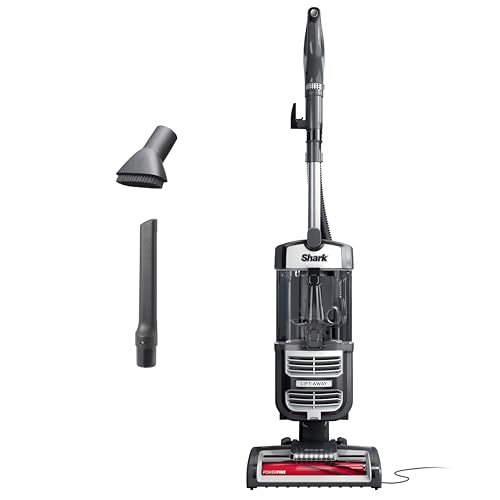
The Shark Navigator UV730 is the most refined version of Shark’s proven Navigator line and one of the most capable consumer upright vacuums for fine dust capture. Its Anti-Allergen Complete Seal system is the defining feature: Shark engineered every component of the UV730’s air pathway to prevent bypass leakage, ensuring that exhaust air has passed through the HEPA filter before leaving the machine.
The PowerFins HairPro self-cleaning brushroll handles carpet-embedded fine particles without requiring manual maintenance to remove tangles. LED headlights illuminate floor surfaces, revealing fine dust layers on hard floors that are otherwise invisible under overhead lighting. The Lift-Away detachable pod extends fine dust cleaning to upholstery, stairs, and above-floor surfaces — the areas most likely to harbor settled PM2.5 and PM10 particles that were originally suspended and redeposited.
At 13.5 lbs with swivel steering, the UV730 is manageable across whole-house cleaning sessions without fatigue. The 0.8-quart dust cup is adequate for most cleaning runs, though users with large carpeted areas should expect to empty it during extended sessions.
Best for: Households with carpets and hard floors who want the most capable Shark Navigator with complete filtration integrity.
View the Shark Navigator UV730 on VacuumExperts
Shark Navigator UV730 Lift-Away upright vacuum with PowerFins HairPro brushroll, HEPA filtration, and LED headlights. Ideal for pet hair. Expert review inside.
2. Miele Guard M1 Parquet XL Bagged Canister Vacuum
Rating: 4.6/5 (394 reviews)
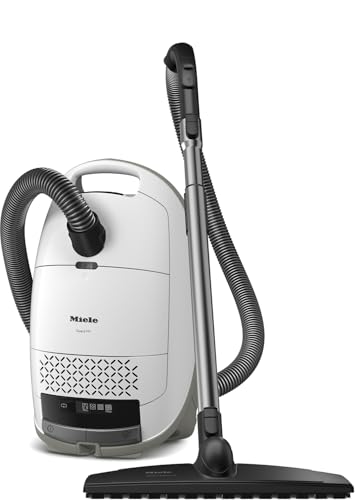
The Miele Guard M1 Parquet XL represents the gold standard for fine dust capture in a residential vacuum. As a bagged canister with Miele’s proprietary AirClean Plus filtration and HyClean bags, it addresses fine dust from collection through disposal — the complete lifecycle that many vacuums handle poorly.
Miele’s HyClean bags are constructed with multiple filtration layers, including an electrostatically charged inner surface that actively retains fine particles rather than simply blocking them by size exclusion. The AirClean Plus filter at the exhaust stage provides a final layer of filtration for the small percentage of sub-micron particles that pass through the bag. The result is an exhaust airstream that is demonstrably cleaner than any bagless competitor’s output.
The Parquet Twister XL floorhead is specifically engineered for hard floors, moving across wood, tile, and laminate without agitating surface particles into suspension. The 1200W German-engineered motor delivers exceptional suction across four adjustable levels, and the 36-foot operating radius means you can clean most rooms without switching outlets.
For allergy sufferers or anyone with serious respiratory concerns, the Miele Guard M1 offers something no bagless vacuum can match: the ability to vacuum, remove the bag, and dispose of all captured fine particles without any direct contact or secondary emission event.
Best for: Hard floors, allergy sufferers, and households where indoor air quality is the primary concern. The definitive bagged option.
View the Miele Guard M1 Parquet XL on VacuumExperts
Miele Guard M1 Parquet XL bagged canister vacuum with 1200W motor, HEPA-grade filtration, and Parquet Twister XL floorhead. Perfect for hard floors.
3. Shark Navigator NV360 Lift-Away Deluxe Upright Vacuum
Rating: 4.4/5 (52,141 reviews)
With more than 52,000 verified customer ratings, the Shark Navigator NV360 is one of the most tested consumer vacuums in the market. Its sustained popularity is not incidental: the NV360 delivers genuinely effective fine dust performance at a price point accessible to most households.
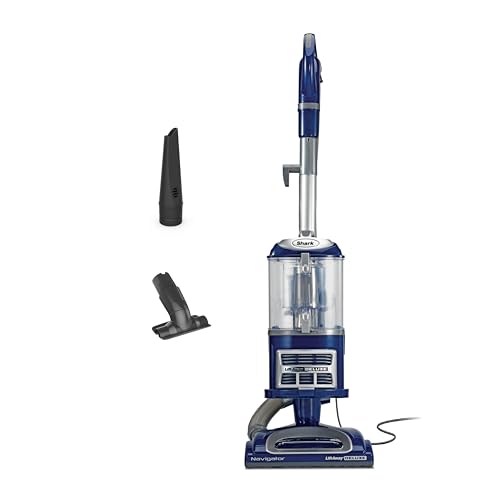
The Anti-Allergen Complete Seal with HEPA filtration is the same technology found in Shark’s more expensive models. All exhaust air passes through the sealed system, and the HEPA filter captures 99.9% of dust and allergens down to the 0.3-micron threshold. For fine dust capture, this is the specification that matters, and the NV360 delivers it consistently.
The Lift-Away design enables above-floor cleaning of upholstered surfaces, curtains, and under-furniture areas — all of which are significant reservoirs of settled fine dust. The brushroll shutoff allows the NV360 to transition from carpets to hard floors without scattering fine particles that the brushroll would otherwise sweep into the air.
At 16 lbs with a 0.9-quart dust cup, the NV360 is a straightforward, no-compromise upright. It does not have the self-cleaning brushroll of newer Shark models, but for households without significant hair-tangle concerns, it is a reliable, proven fine dust performer with an exceptional track record.
Best for: Budget-conscious buyers who want proven HEPA-sealed performance without paying for premium features.
View the Shark Navigator NV360 on VacuumExperts
Shark Navigator Lift-Away NV360 delivers powerful suction with HEPA filtration and swivel steering. Perfect for pet hair and allergens. See full expert review.
4. Shark Navigator ZU561 Lift-Away Speed Upright Vacuum
Rating: 4.4/5 (12,979 reviews)
The Shark Navigator ZU561 occupies the space between the accessible NV360 and the premium UV730, adding a self-cleaning brushroll to the proven Lift-Away platform while maintaining the Anti-Allergen Complete Seal filtration system.
The self-cleaning brushroll is relevant to fine dust capture because a clogged or tangled brushroll loses agitation efficiency, which in turn reduces its ability to loosen fine particles embedded in carpet fibers. By automatically removing hair wrap, the ZU561 maintains consistent brushroll performance session after session — meaning its fine dust capture on carpets remains effective over time without user intervention.
At 13.4 lbs, the ZU561 is slightly lighter than the NV360 while adding the maintenance advantage of the self-cleaning mechanism. The HEPA-sealed system is identical in specification to other Navigator models, capturing 99.9% of dust and allergens throughout the complete air pathway.
With nearly 13,000 reviews at a 4.4 rating, the ZU561 has a substantial real-world validation record. It is a strong all-around choice for households with both carpet and hard floors, pets, and recurring fine dust concerns.
Best for: Mixed-surface households with pets who want self-cleaning brushroll maintenance combined with proven sealed HEPA filtration.
View the Shark Navigator ZU561 on VacuumExperts
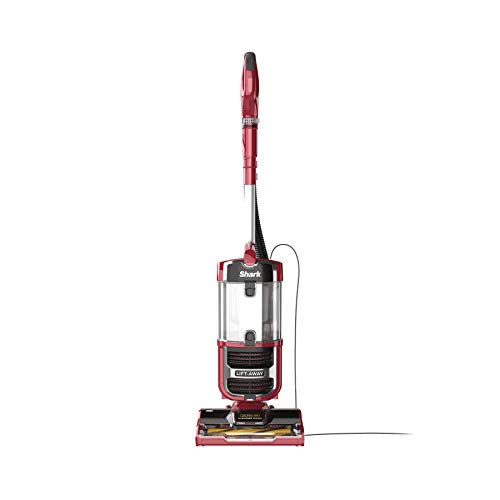
Shark Navigator Lift-Away Speed ZU561 with self-cleaning brushroll and HEPA filter. Lightweight upright vacuum for pet hair on carpets and hard floors.
5. Sebo Dart Upright Vacuum with S-Class Filtration
Rating: 4.3/5 (89 reviews)
The Sebo Dart is a premium German-engineered bagged upright that approaches fine dust filtration with the rigor of an industrial system. Its S-Class filtration — Sebo’s designation for their complete sealed filtration standard — captures 99.97% of particles down to 0.3 microns, meeting the same threshold as H13 HEPA while applying it to the entire sealed air pathway rather than just the filter element.
The Sebo Dart uses Aerapure bags with a 0.92-gallon capacity and the self-sealing bag collar design that prevents fine dust release during bag changes. Combined with the sealed housing, fine particles captured during vacuuming remain captured through disposal — a hygiene chain that very few bagless vacuums can replicate.
The ET-1 electric powerhead with four-level height adjustment delivers effective carpet agitation across pile depths, and the machine converts to a portable canister for above-floor cleaning without requiring separate attachments. Sebo’s 7-year motor warranty and 5-year parts and labor warranty reflect a level of manufacturing confidence that is unusual in the consumer vacuum market.
The Sebo Dart carries a higher price point than the Shark models, and its relatively modest review count reflects its positioning as a specialist product rather than a mass-market choice. For households where indoor air quality, allergy management, and long-term ownership costs are the primary factors, the Sebo Dart is one of the most defensible purchases in the fine dust vacuum category.
Best for: Serious allergy and asthma households, hard floor and low-pile carpet homes, and buyers who prioritize long-term reliability over upfront cost.
View the Sebo Dart on VacuumExperts
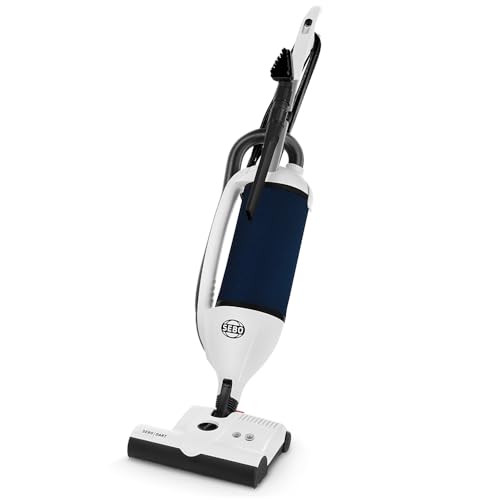
The Sebo Dart upright vacuum features a 7-year motor warranty, ET-1 powerhead, S-Class HEPA filtration & German engineering. Perfect for pets & carpets. Shop now!
Frequently Asked Questions
What does “HEPA-sealed” actually mean?
A HEPA-sealed vacuum is one where the entire air pathway — from the intake through the dust collection chamber, filter, and exhaust — is constructed to prevent air from bypassing the HEPA filter. In a non-sealed vacuum, gaps in the housing allow some air to exit without passing through filtration. A HEPA-sealed system eliminates those bypass pathways so that 100% of exhaust air has been filtered. The distinction is whether the vacuum contains a HEPA filter versus whether the vacuum is a HEPA filtration system.
Can my vacuum actually make indoor air quality worse?
Yes. A vacuum with inadequate filtration or a non-sealed housing draws fine particles from surfaces into its air stream, passes them through a filter that cannot capture all of them, and exhausts the uncaptured fraction into the room air. Studies measuring particle counts before and after vacuuming with non-HEPA vacuums have documented increases in airborne PM2.5 and PM10 immediately following use. A sealed HEPA system removes particles from both surfaces and air rather than recirculating them.
How does fine dust relate to PM2.5 and PM10?
PM2.5 and PM10 are regulatory air quality measurements. PM2.5 refers to particles with an aerodynamic diameter of 2.5 micrometers or less; PM10 refers to particles 10 micrometers or less. Both categories fall within what is broadly called “fine dust.” A vacuum with H13 HEPA filtration operating within a sealed system captures particles in both ranges effectively, since the 0.3-micron HEPA threshold is substantially finer than PM2.5.
Should I choose a bagged or bagless vacuum for fine dust?
For fine dust specifically, bagged vacuums offer a meaningful advantage: the waste is contained and disposable without direct exposure. Bagless dust cups, regardless of filtration quality, release measurable fine dust during emptying. If allergy or asthma management drives your choice, a bagged vacuum from Miele or Sebo with a self-sealing bag system is the more hygienically complete solution. If convenience is more important and you take care during dust cup emptying (ideally outdoors), a quality bagless vacuum with a sealed HEPA system like the Shark Navigator line performs well.
How often should I replace the HEPA filter?
Most manufacturers recommend replacing HEPA filters every 12 months under normal household use. In high-allergen environments — homes with multiple pets, residents with severe allergies, or areas with high outdoor PM2.5 — consider replacement every 6 months. A heavily loaded HEPA filter does not simply stop working; it maintains filtration efficiency but increases airflow resistance, which reduces the vacuum’s suction and agitation performance. Check your vacuum’s specific guidance and factor replacement filter cost into your purchase decision.
Is “True HEPA” different from regular HEPA?
“True HEPA” is a marketing term, not a certified standard. It generally refers to a filter that meets the H13 specification of 99.97% efficiency at 0.3 microns, as opposed to H10 or H11 filters that are sometimes sold under the HEPA label without meeting this threshold. The term has no regulatory meaning in the United States, so the safest approach is to look for explicit specification of “99.97% at 0.3 microns” rather than relying on terminology alone.
Do I need a vacuum with a high suction rating for fine dust?
Suction power (measured in air watts, pascals, or kPa) affects how effectively the vacuum lifts particles from surfaces. For fine dust on hard floors, moderate suction is sufficient because fine particles have low mass. For fine dust embedded in carpet, higher suction combined with effective brushroll agitation is necessary to dislodge particles from the pile before the air stream can capture them. The filtration system determines whether captured particles stay captured; the suction and brushroll determine whether embedded particles are captured in the first place. Both matter.
Conclusion
Fine dust is invisible, pervasive, and genuinely hazardous at sustained exposure levels. Most households have no shortage of fine dust sources — dander, pollen, dust mite debris, outdoor particulate tracked indoors — and the right vacuum removes those particles from the indoor environment permanently. The wrong vacuum recirculates them.
The dividing line is not price, brand, or suction rating. It is whether the vacuum operates as a sealed filtration system. A HEPA filter inside a leaking housing is a marketing claim, not a health tool. A sealed HEPA system, whether in a bagged Miele canister or a Shark Navigator upright, genuinely improves indoor air quality with every use.
For most households, the Shark Navigator UV730 or NV360 offers the best combination of proven sealed HEPA performance and practical value. For households where indoor air quality is a medical concern, the Miele Guard M1 or Sebo Dart provides the more complete hygiene solution through bagged containment, sealed filtration, and premium build quality designed for decades of use.
Whatever you choose, prioritize the sealed system over every other specification on the label.
Ready to Find Your Perfect Vacuum?
Browse our expertly reviewed vacuum cleaners and make an informed decision
Browse All Vacuums