Best Vacuum for Garage 2026: Wet-Dry Picks for Workshop & Auto
Best vacuums for garages — powerful wet-dry picks that handle sawdust, automotive debris, and liquid spills on concrete floors.
Table of Contents
Your garage is not a living room. It is a working space — and working spaces make serious messes. Sawdust from a table saw drifts into every corner. Automotive fluids drip onto concrete. Nails, screws, and metal shavings scatter across the floor after a project. Drywall dust from a renovation clouds the air and settles on every surface. Dirt and mud track in from the driveway. If you try to tackle any of this with the same vacuum you use on your bedroom carpet, you will be shopping for a replacement within weeks.
Garage cleaning demands a different kind of machine — one built for heavy debris volumes, liquid spills, metal fragments, and the kind of fine particulate dust that kills ordinary vacuum motors. In 2026, the best vacuums for garage use combine powerful suction with wet-dry versatility, large-capacity tanks, durable construction, and filtration systems that handle fine dust without clogging. This guide breaks down exactly what to look for and identifies the top picks for every kind of garage user, from the weekend DIYer to the serious workshop operator.
What Makes a Garage Vacuum Different
A garage environment creates cleaning challenges that fall into four distinct categories, and a proper garage vacuum needs to address all of them.
Heavy coarse debris: Screws, nails, wood chips, gravel, and broken glass are all regular garage floor hazards. Standard household vacuums use delicate brush rolls and lightweight impellers that can be damaged or jammed by hard fragments. A real garage vacuum uses heavy-duty intake paths and, in true wet-dry models, no brush roll at all — just direct suction that ingests nearly anything you point it at.
Fine workshop dust: Sawdust, drywall compound, sanding dust, and concrete grinding particles are among the most destructive substances a vacuum can encounter. They clog filters rapidly, bypass weak filtration systems and coat motors internally, and in the case of fine wood or drywall dust, can create genuinely hazardous air quality. Garage vacuums need multi-stage filtration — ideally HEPA — and filter designs that stay effective through extended sessions.
Liquid spills: Coolant, motor oil, spilled beverages, rainwater tracked in, and puddles from a wet project are all standard garage realities. A wet-dry capable vacuum handles all of these without damage, using a float valve or separate operation mode that protects the motor from liquid ingestion.
Long duty cycles: A garage session is not a two-minute kitchen counter cleanup. You might be vacuuming up the aftermath of a full woodworking session, detailing a vehicle, or cleaning up after drywall installation. Garage vacuums need larger tanks, more sustained suction, and the motor durability to run hard for extended periods.
Key Features to Look For
Wet-Dry Capability
The single most important feature for a garage vacuum is the ability to handle both dry debris and liquid spills. True wet-dry machines use a sealed motor chamber and a separate collection tank, with a float mechanism that cuts suction before liquid can reach the motor. If your garage sees any automotive fluids, cleaning solutions, or rainwater, wet-dry is a must-have, not a nice-to-have.
Tank Capacity
Garage sessions generate large debris volumes. A vacuum with a 16 oz handheld cup will need emptying constantly, interrupting your workflow and reducing efficiency. Look for tanks in the 4-gallon range or larger for true workshop and automotive use. Larger tanks also mean less filter-clogging frequency — fine dust distributes more evenly across a bigger collection chamber.
Motor Power
Peak horsepower ratings can be marketing-inflated, but airflow specifications — measured in CFM (cubic feet per minute) — are more reliable. For garage use, look for 40+ CFM in cordless handheld models and 5+ HP peak ratings in corded shop-style vacuums. Sustained suction through a full dirty filter is more important than peak numbers on a clean machine.
Metal and Heavy-Duty Attachments
Standard plastic accessories from household vacuums break when they contact nails, screws, and coarse aggregate. Garage-grade hoses, wands, and nozzles use thicker-walled construction, metal fittings, and reinforced materials that hold up to the mechanical demands of workshop use.
HEPA Filtration
For fine dust environments — especially if you work with MDF, drywall, or concrete — HEPA filtration capturing 99.97% of particles at 0.3 microns is important both for equipment longevity and your health. Fine silica and wood dust are respiratory hazards with cumulative effects. HEPA-capable garage vacuums pay for themselves in motor longevity and personal safety.
Cordless Compatibility with Power Tool Ecosystems
If you already own cordless power tools from DEWALT, Milwaukee, Makita, or RYOBI, a vacuum that uses the same battery platform eliminates the need for dedicated charging infrastructure and lets you grab the vacuum from any workbench without hunting for a power outlet or dragging an extension cord.
Top 6 Vacuums for Garage Use in 2026
1. DEWALT 20V Cordless Hand Vacuum DCV501HB — Best Overall Garage Handheld
Rating: 4.7/5 — 6,136 reviews
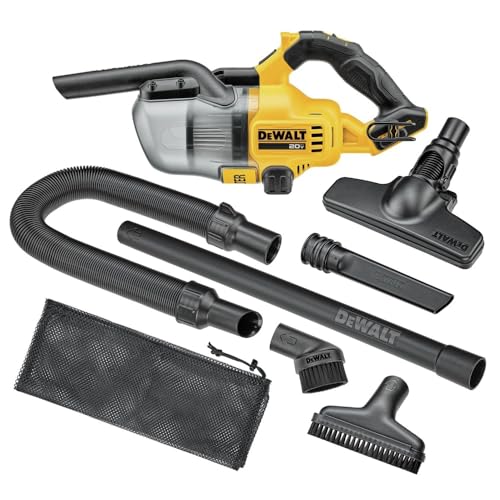
The DEWALT DCV501HB is the best-reviewed garage-capable vacuum in our database, and its specifications explain why. Delivering 46 CFM of suction — a figure more commonly associated with corded workshop models than handheld cordless units — it handles the full range of garage debris: sawdust, drywall dust, screws, nails, metal shavings, and the fine particulate left behind by grinding or cutting concrete.
The true HEPA filter captures 99.97% of particles at 0.3 microns, making it one of the safest options for fine-dust environments like MDF cutting, drywall sanding, or ceramic tile work. It is OSHA Table 1 compliant for housekeeping rules, a designation that matters in professional workshop settings and speaks to the seriousness of its filtration engineering.
Six included attachments cover the full range of garage and vehicle cleaning scenarios: extension tube, flexible hose, crevice nozzle, round brush, gulper brush, and floor nozzle. The ambidextrous belt clip and LED work light are details that reveal this was designed by people who actually use tools in garages and on job sites.
The 20V MAX battery platform is the most widely adopted cordless tool ecosystem in North America, meaning most serious workshop users already have batteries on hand. At 3.3 lbs without battery, it is comfortable to hold through extended sessions.
Best for: Workshop debris, nail and screw pickup, post-construction cleanup, automotive detailing
Pros:
- 46 CFM — class-leading airflow for a handheld unit
- True HEPA filtration, OSHA compliant
- 6 attachments included, LED work light
- 20V MAX battery ecosystem compatibility
- 3-year limited warranty
Cons:
- Dry only — not suitable for liquid spills
- Battery sold separately
View the DEWALT DCV501HB on our site
2. Hoover GUV L2310 ProGrade 5-Gallon Garage Utility Vacuum — Best Dedicated Garage Design
Rating: 3.8/5
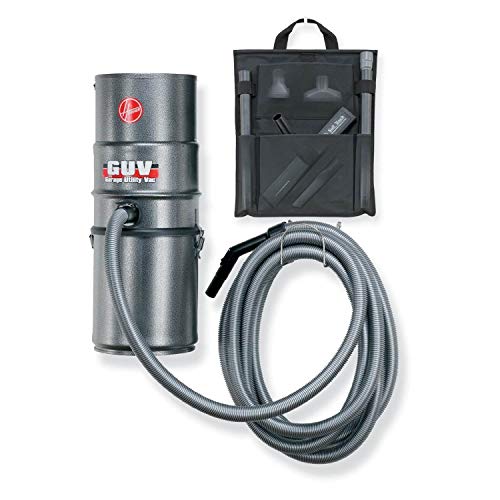
The Hoover GUV ProGrade L2310 is the only vacuum in this guide designed exclusively for garage and workshop environments, and its engineering reflects that specialization in a way no general-purpose tool can match. The defining feature is its hanging mount design: instead of sitting on your already-crowded garage floor, it attaches to a wall bracket or overhead beam, keeping the floor clear and keeping the vacuum instantly accessible wherever you work.
The 5-gallon capacity is the largest in this guide and enables genuinely extended cleaning sessions without interruption. A full day of woodworking, a vehicle restoration project, or a weekend renovation cleanup can proceed from start to finish without stopping to empty the canister. When emptying is necessary, the canister detaches cleanly for hygienic disposal.
ProGrade suction handles both fine workshop particulate and coarse debris effectively, maintaining consistent airflow through the filling cycle rather than tapering off as the tank fills. The durable construction is built for the temperature fluctuations, mechanical vibration, and incidental impacts that are part of daily workshop life.
Best for: Dedicated garage workshops, woodworking shops, spaces where floor area is at a premium
Pros:
- Hanging mount keeps garage floor clear
- 5-gallon capacity for extended uninterrupted sessions
- Purpose-built for garage and workshop environments
- Hoover brand reliability with over a century of vacuum engineering
Cons:
- Requires wall or beam installation
- Limited published specs for motor power and filtration type
- Very few verified reviews available
View the Hoover GUV L2310 on our site
3. Milwaukee M18 Cordless Compact Vacuum 0882-20 — Best for Milwaukee Tool Users
Rating: 4.4/5 — 191 reviews

Milwaukee’s M18 tool ecosystem is the standard in professional trades, and the 0882-20 compact vacuum integrates seamlessly into that platform without compromise. At 40 CFM, it sits just below the DEWALT in raw airflow performance, but the 4-foot hose — longer than most handheld competitors — dramatically improves reach under vehicles, into tight compartments, and along floor edges where debris accumulates.
HEPA filtration handles the fine dust generated by concrete work, drywall finishing, and wood cutting. The clear transparent canister with bottom-release emptying makes it obvious when the unit needs emptying and makes the emptying process fast and mess-free — a real advantage when you are mid-project and do not want to pause longer than necessary.
The two included extension wands plus floor tool and crevice tool provide solid attachment coverage for both floor sweeping and tight-space access. The compatibility with all M18 batteries means contractors and serious DIY users with existing Milwaukee tools can add this vacuum to their kit without any new battery investment.
Best for: Trades professionals, Milwaukee ecosystem users, job site and shop dual use
Pros:
- 40 CFM professional-grade suction
- Full M18 battery ecosystem compatibility
- 4-foot hose for extended reach
- HEPA filtration for fine construction dust
- Clear bottom-release canister for easy emptying
Cons:
- Battery not included
- More compact capacity than dedicated shop vacuums
View the Milwaukee M18 0882-20 on our site
4. Makita XLC02ZB 18V LXT Cordless Vacuum — Best for Makita Users / Best Reviewed
Rating: 4.5/5 — 4,044 reviews

With over 4,000 reviews at a 4.5-star average, the Makita XLC02ZB has the deepest validation base of any product in this guide. That level of confirmed real-world performance matters in a product category where marketing claims are easy to make — actual results over thousands of units are harder to fake.
The 18V LXT platform is Makita’s core professional cordless ecosystem, with battery compatibility spanning hundreds of tools. The compact 18-3/4 inch design functions as both a stick vacuum for floor sweeping and a handheld for surfaces, vehicle interiors, and above-floor cleaning — the form factor flexibility that makes it genuinely useful across the full range of garage tasks.
Bagless two-stage cloth filtration handles the kind of mixed debris a garage generates: construction dust, workshop shavings, pet hair from the family dog who wanders into the shop, and general grit from concrete floors. The 33-minute runtime with a 5.0Ah battery is one of the longer runtimes available in a cordless workshop vacuum, enabling full sessions without battery swaps on larger garages.
Best for: Makita tool users, garages with mixed debris, users who prioritize proven performance
Pros:
- 4,044 reviews at 4.5 stars — most validated product in this guide
- Compatible with all Makita 18V LXT batteries
- 33-minute runtime (with 5.0Ah battery)
- Flexible stick-and-handheld dual configuration
- Durable professional-grade build
Cons:
- Battery sold separately
- Two-stage cloth filtration is not HEPA-rated
View the Makita XLC02ZB on our site
5. RYOBI 18V ONE+ Cordless Handheld Vacuum RHV18 — Best Value for Garages
Rating: 4.5/5 — 915 reviews

The RYOBI ONE+ platform is the most accessible entry point into a professional cordless tool ecosystem, with over 200 tools sharing the same 18V battery. For garage users who already own RYOBI power tools — circular saws, drills, sanders — the RHV18 adds vacuum capability to that existing investment at a price point well below the DEWALT or Milwaukee alternatives.
The 1,100 L/min airflow and 34 air watts of sustained suction handle standard garage cleaning scenarios effectively: sawdust cleanup, post-drilling debris, car interior vacuuming, and general workshop maintenance. The dual-filter washable system eliminates ongoing filter replacement costs, making the total cost of ownership lower than disposable-filter competitors over a year of regular use.
At just 2.1 lbs without battery, it is the lightest option in this guide — an advantage for overhead cleaning, car interior detail work, and extended one-handed sessions where fatigue accumulates. The 600 ml dust capacity is modest compared to dedicated shop vacuums but appropriate for the between-project spot cleaning that handhelds are used for most frequently.
Best for: RYOBI ecosystem users, budget-conscious garage owners, light-to-medium duty workshop cleanup
Pros:
- Compatible with 200+ RYOBI ONE+ 18V tools
- 1,100 L/min airflow for reliable workshop pickup
- Ultra-light at 2.1 lbs for comfortable extended use
- Washable dual-filter eliminates replacement filter costs
- Strong value proposition in its price range
Cons:
- 600 ml dust capacity requires more frequent emptying than larger units
- 34 air watts is lower than professional-tier alternatives
- Battery not included
View the RYOBI RHV18 on our site
6. THINKWORK 20V Cordless Handheld Vacuum — Best Wet-Dry Option for Garages
Rating: 4.1/5 — 72 reviews

The THINKWORK W6191 earns its place in this guide by doing something none of the other five products can: it handles liquid spills. With true wet-and-dry capability in a compact handheld form factor, it bridges the gap between a full-size shop vac and a dry-only handheld, offering 10,000 Pa of suction power alongside a 400 ml dry capacity and 120 ml wet capacity.
For garages where liquid spills are a regular occurrence — coolant drips, spilled fluids during oil changes, or water tracked in on rainy days — the wet-dry capability is transformative. The dual washable HEPA filters maintain fine-dust performance across both wet and dry modes. The 150W motor running at 30,000 RPM delivers suction that punches above the weight class expected from a unit this size.
Compatibility with Makita 20V lithium-ion batteries gives users in that ecosystem extended runtime options beyond the included battery. The 6-month warranty is shorter than the professional-tier options above, reflecting its more accessible price point. But for a garage user whose primary frustration is not having a vacuum that can handle both the sawdust from a woodworking session and the drip pan from the next oil change, the THINKWORK fills a real gap.
Best for: Garages with automotive work, liquid spill cleanup, users who need true wet-dry in a portable format
Pros:
- True wet-dry capability handles both liquid spills and dry debris
- 10,000 Pa suction from a 150W motor
- Dual washable HEPA filters
- Compact handheld form for vehicle interiors and tight spaces
- Compatible with Makita 20V batteries for extended runtime
- Battery and accessories included
Cons:
- 120 ml wet capacity is small — frequent emptying needed for larger spills
- 6-month warranty shorter than professional alternatives
- Newer product with fewer long-term performance reviews
View the THINKWORK W6191 on our site
Garage Vacuum vs. Home Vacuum: When You Need Each
This question comes up constantly, and the answer is almost always: both, for different jobs.
When a garage-specific vacuum is the right tool
Use a dedicated garage or shop vacuum when you are dealing with:
- Post-project cleanup: After woodworking, drywall, tile cutting, or metalworking, the volume of debris and the fineness of the dust exceeds what home vacuums are designed to handle safely. Running fine sawdust through a household vacuum motor repeatedly will shorten its lifespan significantly.
- Liquid spills: Antifreeze, motor oil, transmission fluid, or water pooling on concrete. Never use a dry-only vacuum for this — the results range from ruined motor to genuine electrical hazard.
- Metal debris: Screws, nails, staples, wire fragments, and metal shavings. These can puncture household vacuum hoses, jam brush rolls, and damage impellers. Shop vac intakes are designed for this.
- Concrete floor cleaning: The abrasive particulate from concrete surfaces accelerates wear on household vacuum components designed for carpet and smooth hard floors.
- Extended sessions: A 45-minute garage cleanout after a full weekend of work. Household vacuums are not thermally designed for sustained high-demand operation.
When a home vacuum is the right tool
Bring the home vacuum into the garage when you are dealing with:
- Pet hair and general dust: If the garage is also used as a utility room or the family dog sleeps there, a standard vacuum with a brush roll is more effective for upholstered surfaces and light dust.
- Car interior detailing on carpet sections: The brush rolls and soft attachments of a household vacuum do a better job on vehicle carpet fibers than a rigid shop vac nozzle.
- Finished garage spaces: Garages converted to workshops, home gyms, or offices with carpet or finished floors can use the same vacuum as the rest of the house for routine maintenance.
The most practical solution
For most homeowners, the best setup is a purpose-built garage vacuum — one of the cordless ecosystem models above — kept at the workbench for immediate post-project cleanup, combined with a handheld or stick vacuum stored in the house for quick car cleanups and light garage maintenance. The two tools are not redundant; they address different kinds of messes in different ways.
Garage Cleaning Routine and Organization Tips
A good garage vacuum is only as effective as the cleaning routine behind it. The garages that stay genuinely clean and organized use a few consistent practices that make cleanup faster and more effective.
Clean during, not just after. The most productive approach to garage cleanup is incremental: vacuum the table saw deck and floor after each cutting session rather than waiting until the end of the day when sawdust has spread to every surface and corner. A cordless handheld vacuum makes this easy — grab it, clean, hang it back up, continue working.
Use the right nozzle for each surface. The crevice tool for along the base of the workbench and tool chest, the floor nozzle for open concrete, the round brush for tool surfaces and shelving. Matching the attachment to the surface improves collection efficiency and reduces how many passes are needed.
Establish a filter cleaning schedule. A clogged filter reduces suction dramatically and strains the motor. For regular workshop use, tap or rinse the filter every 2-3 sessions. For fine-dust environments (MDF, drywall), check it every session. A clean filter means consistent full-power suction on every use.
Address liquid spills immediately. Oil and automotive fluids left on concrete can soak in and become extremely difficult to remove. A wet-dry vacuum applied immediately captures most of the spill before absorption occurs. Follow up with an absorbent compound or degreaser on any residual staining.
Keep the floor clear. Garage cleanup is dramatically faster when the floor is not an obstacle course of hoses, cords, and stored items. Wall-mounted storage for tools, pegboard for accessories, and ceiling hooks for hoses and cords eliminate the most common barriers to quick floor vacuuming.
Do a full quarterly deep clean. Beyond regular maintenance sweeps, schedule a thorough quarterly clean that includes high surfaces (dust settles on top of tool chests, shelving, and overhead storage), behind and beneath large equipment, and the vacuum’s own filter and collection tank. Fine dust accumulates invisibly in these locations and becomes a larger problem if left unchecked.
Label and organize debris disposal. Workshop waste is not all the same: metal shavings and nails should be separated from sawdust for disposal purposes, and used automotive fluids require proper disposal at designated facilities. Building disposal separation into your cleanup routine prevents compliance issues and makes overall garage maintenance easier.
Frequently Asked Questions
Can I use a regular vacuum in my garage?
For light-duty tasks — vacuuming a finished garage floor, cleaning car seats, picking up light dust — a regular vacuum can work. For workshop debris, concrete floors, metal fragments, or liquid spills, a standard household vacuum is the wrong tool. The debris types, debris volumes, and sustained run times of garage use will damage or wear out a household vacuum significantly faster than normal home use. A dedicated garage vacuum pays for itself in the longevity of the equipment it replaces.
What size vacuum do I need for a garage?
For a two-car garage with regular workshop use, a 4-5 gallon capacity vacuum allows extended sessions without constant emptying. For a single-car garage used primarily for storage with occasional light projects, a high-powered cordless handheld with a 400-600 ml cup is sufficient for between-project maintenance. The key variable is how much debris volume your typical session generates.
Do I need a wet-dry vacuum for a garage?
If you do any automotive work, work with water-based materials, or your garage is exposed to weather (water intrusion, tracked-in wet debris), a wet-dry vacuum is strongly recommended. If your garage is dry-only — finished woodworking, hobby projects, light storage — a dry-only vacuum with HEPA filtration is sufficient and may offer better fine-dust performance.
Can garage vacuums handle nails and screws?
Yes — this is one of the primary advantages of shop-style and professional handheld garage vacuums. Their intake paths are designed without the brush rolls and soft components that get jammed or damaged by metal fragments. The DEWALT DCV501HB specifically lists screws and nails as target debris in its product specifications.
How often should I clean my garage vacuum’s filter?
For fine-dust environments (sawdust, drywall, concrete grinding), clean or tap the filter after every session. For general mixed debris, every 2-3 sessions is appropriate. Most garage vacuum filters are washable — rinse, allow to fully dry (24 hours), and reinstall. Running the vacuum with a wet filter will damage the motor.
Is cordless or corded better for garage use?
Corded shop vacuums offer larger capacity, sustained power, and no battery management concerns — ideal for large garages with a fixed cleaning station. Cordless handhelds offer the flexibility to move around the entire garage and vehicle without cord management, making them faster for most day-to-day cleanup tasks. Many serious garage users keep both: a corded unit at the workbench for heavy sessions, and a cordless handheld for quick pickups.
Can I vacuum my car in the garage with these vacuums?
Yes — all six vacuums in this guide are suitable for vehicle interior cleaning. The DEWALT DCV501HB and Milwaukee M18 0882-20 include crevice tools and extension wands specifically designed for the narrow spaces in vehicle interiors. The THINKWORK’s wet-dry capability adds the ability to clean wet floor mats or spilled beverages directly. The RYOBI RHV18’s light weight makes it particularly comfortable for the extended overhead and reach-in positions involved in thorough vehicle detailing.
Our Top Pick
For most garage owners in 2026, the DEWALT 20V Cordless Hand Vacuum DCV501HB is the best single choice: class-leading 46 CFM suction, true HEPA filtration, OSHA compliance, six attachments, and the reliability of the most widely adopted cordless tool platform in the market. If you already own 20V MAX tools, the case is even stronger.
For users who need wet-dry capability in a compact form, the THINKWORK W6191 is the standout option. For those already invested in the Milwaukee M18 or Makita 18V LXT ecosystems, the Milwaukee 0882-20 and Makita XLC02ZB respectively are the natural choices. And for a dedicated large-garage workshop station, the Hoover GUV L2310’s hanging mount design and 5-gallon capacity represent a fundamentally different and highly practical approach to the problem.
Whatever your garage setup, the right vacuum makes the difference between a workspace that stays clean and one that gradually becomes too cluttered and dusty to work in safely. The options above cover every scenario — choose the one that fits your tools, your workflow, and your mess.
Ready to Find Your Perfect Vacuum?
Browse our expertly reviewed vacuum cleaners and make an informed decision
Browse All Vacuums