Best Vacuum for Labrador Retriever Hair: Top Picks for Lab Owners (2026)
Tired of yellow and black Lab hair everywhere? We tested the best vacuums for Labrador Retriever hair — rated for suction, HEPA filtration, and brush tangle prevention.
Table of Contents
- Best Vacuum for Labrador Retriever Hair: Top Picks for Lab Owners (2026)
- Understanding Labrador Retriever Hair
- What to Look For in a Vacuum for Labrador Hair
- The 5 Best Vacuums for Labrador Retriever Hair in 2026
- Quick Comparison Table
- Lab Hair Vacuuming Tips
- Frequently Asked Questions
- The Bottom Line
Best Vacuum for Labrador Retriever Hair: Top Picks for Lab Owners (2026)
Labrador Retrievers have held the title of America’s most popular dog breed for over three decades. It is not hard to understand why — they are affectionate, energetic, easy to train, and endlessly patient with families. What the breed descriptions tend to downplay is what it actually feels like to live in a Lab household: the fine, short hairs coating every couch cushion, the fur ground into carpet fibers, the dust-colored clouds that billow out when you finally move the coffee table.
Labs are heavy shedders. Not the dramatic, clump-falling kind of heavy shedding you see with a Husky or a Saint Bernard — Lab shedding is relentless and fine. Their short, dense coats produce individual hairs that are just long enough to embed themselves into carpet and upholstery but short enough to pass right through an inadequate filter and back into the air you breathe. During the two annual “coat blows” — typically spring and fall — the volume of shed hair roughly doubles for four to eight weeks. Owners of yellow Labs deal with the added challenge that the pale fur is nearly invisible on light floors and painfully visible on every dark surface in the house. Black Lab owners face the inverse problem.
A vacuum built for human hair, light dust, or even most pets will underperform in a Lab household. This guide explains exactly why, what to look for, and which vacuums have proven themselves with the real demands of Lab ownership.
Understanding Labrador Retriever Hair
Before buying a vacuum, it helps to understand precisely what you are up against. Lab hair has a few specific properties that separate it from other shedding dog breeds.
The Double Coat
Labrador Retrievers have a dense double coat consisting of two distinct layers. The outer coat is composed of short, relatively coarse guard hairs that repel water and provide a degree of weather insulation. Beneath it lies a thick, soft undercoat that functions as the dog’s primary insulation layer. During normal year-round shedding, both layers contribute to the fur you find on your floors. During seasonal coat blows, the undercoat releases en masse — sometimes in visible waves that seem disproportionate to a short-haired dog.
Why Short Hair Is Harder Than It Looks
There is a common misconception that short-haired dogs are easier to vacuum up after than long-haired breeds. In practice, the opposite is frequently true. Long fur like that of a Golden Retriever lies on the surface where it is visible and relatively easy to vacuum. Lab fur, at roughly 0.5 to 1.5 inches in length, penetrates carpet pile and lodges at the base of fibers rather than sitting on top. It anchors itself in woven upholstery and requires genuine agitation — not just suction — to dislodge. Standard vacuum heads that rely primarily on airflow without a powered brush roll will largely fail to remove it.
Dander vs. Hair
Hair is what you can see. Dander — tiny flakes of dried skin cells — is what triggers allergic reactions, and Labs produce a significant amount of it. Dander particles are microscopic and attach to hair fibers, airborne dust, and every surface in the house. A vacuum that captures visible hair but exhausts unfiltered air will recirculate dander throughout the room as you clean, potentially making allergy symptoms worse rather than better. Sealed HEPA filtration is the only effective solution.
Shedding Seasons
Labs shed year-round, but twice annually the shedding intensifies dramatically during the seasonal coat blow. For most Labs, this happens in spring (typically March through May) as the winter undercoat releases, and again in fall (September through November) as the coat transitions for colder weather. During these periods, a vacuum that handles normal maintenance cleaning may struggle to keep pace. Larger dustbins, higher suction power, and more frequent emptying all become necessary.
What to Look For in a Vacuum for Labrador Hair
Suction Power That Handles Dense, Embedded Fur
Lab hair anchors itself at the base of carpet fibers. Surface-level suction — the kind that handles dust and loose debris — is not sufficient. For upright vacuums, look for strong sealed-system suction rather than relying on raw wattage claims alone. Air watts are a more reliable indicator of actual cleaning performance than motor wattage. For cordless stick vacuums, suction specifications above 20kPa are generally adequate; models in the 25kPa to 40kPa range perform noticeably better on embedded carpet fur.
Brush Roll Design for Short, Dense Fur
A motorized brush roll is essential — passive suction alone will not pull embedded Lab hair out of carpet pile. The specific design matters too. Densely bristled brush rolls can become clogged with shorter fur more quickly than bristle-free or rubber-finned alternatives. Self-cleaning brush rolls that prevent or minimize hair wrap offer a clear practical advantage. Even if a vacuum is not self-cleaning, an easy-access brush roll cover that lets you clear accumulated hair in seconds is worth prioritizing over designs that require tools or disassembly.
HEPA Filtration and Sealed System Design
Lab dander is a potent allergen. An effective HEPA filter traps particles as small as 0.3 microns, capturing dander, pollen, and fine hair fragments. Critically, the filter alone is not sufficient — the vacuum housing needs to be sealed so that unfiltered air cannot escape around the filter and back into the room. Look for “sealed HEPA system” or “Anti-Allergen Complete Seal” designations rather than vacuums that merely include a HEPA filter in an unsealed housing.
Large Dustbin Capacity
During peak shedding periods, a half-liter dustbin fills quickly. Stopping to empty mid-session is frustrating and reduces cleaning efficiency, particularly when embedded hair requires multiple slow passes. A dustbin of one liter or larger is preferable for most Lab households. For uprights, a capacity of 0.9 quarts to 2.9 liters keeps interruptions to a minimum during heavy coat blow weeks.
Ease of Emptying
Lab fur compresses inside dustbins but tends to escape in a cloud when the bin is opened over a trash can. Vacuums with bottom-release bins that drop contents cleanly and without hands-on contact with the collected fur are significantly more pleasant to maintain. This becomes especially relevant for household members with pet allergies.
Attachments for Furniture and Stairs
Labs spend a considerable amount of time on furniture and will colonize any upholstered surface given the chance. A motorized pet brush tool — distinct from a simple upholstery nozzle — provides powered agitation that lifts embedded short hair from fabric much more effectively than a passive attachment. Stair grooves and the spaces behind couch cushions are classic fur accumulation points that a flexible hose and crevice tool can reach.
The 5 Best Vacuums for Labrador Retriever Hair in 2026
1. Bissell CleanView Swivel Pet Upright (Model 2252) — Best Overall
Rating: 4.4 stars | Reviews: 105,257 | Best for: Whole-home cleaning across carpet and hard floors
View the Bissell CleanView Swivel Pet Upright
The Bissell CleanView Swivel Pet is the most reviewed pet vacuum on the market for good reason, and its performance is especially well-suited to the specific challenges of Lab hair. At 105,257 reviews with a 4.4-star rating, it has been validated across more real-world pet households than virtually any competing model.
The triple-action brush roll is the core of what makes this vacuum effective for Labs. Rather than relying on a single row of bristles, the system uses a combination of brushing, lifting, and suction to address hair that has penetrated carpet fibers. Standard vacuums skim the top of the pile; the CleanView Swivel Pet’s brush roll agitates the full depth of carpet loops where Lab hair tends to anchor. Scatter-free technology at the floor nozzle prevents debris from being pushed sideways on hard floors — a common problem when vacuuming the fine, lightweight hair that Labs shed on tile and hardwood.
Swivel steering makes navigating around furniture comfortable even during extended sessions, and at 12.5 pounds it is lighter than many full-size uprights. The edge-to-edge cleaning path reaches along baseboards where Lab fur gathers in visible drifts. Every Bissell purchase contributes to the Bissell Pet Foundation’s homeless pet rescue work.
Lab-Specific Strengths:
- Triple-action brush roll designed to extract embedded short pet hair from carpet pile
- Scatter-free nozzle technology prevents fine Lab hair from dispersing on hard floors
- Multi-cyclonic suction maintains performance as the dustbin fills during heavy shedding
- Specialized pet brush tool included for upholstery and furniture surfaces
Pros:
- Triple-action brush roll loosens, lifts, and removes embedded pet hair from carpets
- Scatter-free technology prevents debris from scattering on hard floors
- Responsive swivel steering for excellent maneuverability around furniture
- Edge-to-edge cleaning reaches dirt along baseboards and in corners
Cons:
- Fewer included accessories compared to some competitors at higher price points
- Corded design requires outlet switching in large homes
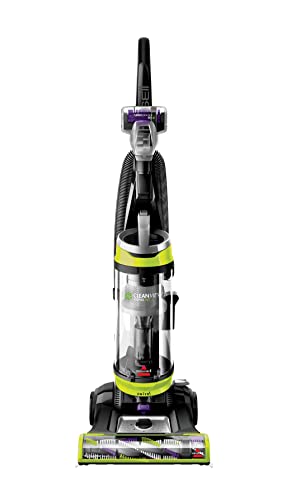
Bissell CleanView Swivel Pet 2252 upright vacuum with triple action brush roll and scatter-free technology. Designed for pet homes. Buy now!
2. Shark Navigator Lift-Away Deluxe NV360 — Best HEPA Upright for Dander Control
Rating: 4.4 stars | Reviews: 52,141 | Best for: Allergy households and multi-surface homes
View the Shark Navigator NV360
For Lab owners where dander allergies are a concern — and with Labs ranking among the top allergen-producing breeds, that is a significant portion of households — the Shark Navigator NV360 is the essential recommendation. Its Anti-Allergen Complete Seal Technology pairs a true HEPA filter with a fully sealed housing, ensuring that 99.9% of captured dust and allergens stay inside the machine rather than being exhausted back into the room.
The Lift-Away design is the feature that elevates the NV360 beyond a standard upright. One press of the release button detaches the canister pod from the floor head, converting it into a portable cleaning unit you can carry to stairs, lift over furniture, or take directly to the couch for upholstery work. This matters specifically for Lab owners because Lab fur distributes itself vertically as well as horizontally — it settles on stair carpet, embeds in couch cushions, and gathers in the corners of closets at the back of shelving.
The brushroll shutoff feature lets you transition from carpet mode to hard floor mode without changing attachments. On hard floors, disabling the brush roll prevents fine Lab hair from being scattered rather than captured. The 0.9-quart dust cup is adequate for most sessions, though owners with multiple Labs or during coat blow season may find themselves emptying it more frequently than once per room.
Lab-Specific Strengths:
- Anti-Allergen Complete Seal with HEPA traps 99.9% of fine dander particles
- Lift-Away pod reaches stairs, furniture, and tight corners where Lab fur accumulates
- Brushroll shutoff prevents scattering fine short hair on hard floors
- Swivel steering for efficient navigation around furniture
Pros:
- HEPA-sealed Anti-Allergen Complete Seal system traps 99.9% of dust and allergens
- Lift-Away detachable pod makes cleaning stairs, under furniture, and above-floor surfaces easy
- Brushroll shutoff enables seamless transitions between carpet and hard floor cleaning
- Large 0.9-quart dust cup minimizes how often you need to stop and empty
Cons:
- At 16 lbs, heavier than cordless stick options for extended above-floor work
- Corded design limits range and requires outlet switching between rooms
- Does not include a motorized pet tool attachment for deep upholstery cleaning
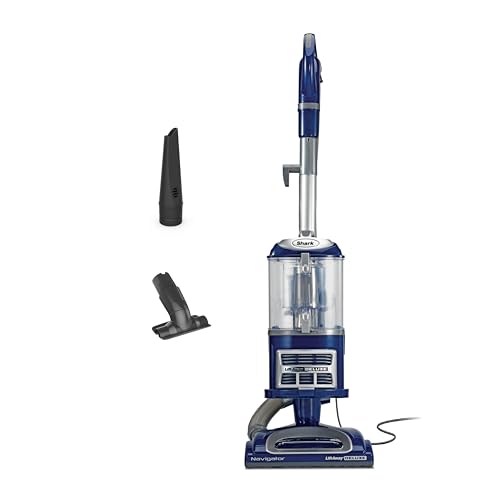
Shark Navigator Lift-Away NV360 delivers powerful suction with HEPA filtration and swivel steering. Perfect for pet hair and allergens. See full expert review.
3. Shark Rotator Pet Upright ZU102 — Best for Power and Dustbin Capacity
Rating: 4.4 stars | Reviews: 12,979 | Best for: High-shedding households and coat blow season
View the Shark Rotator Pet ZU102
The Shark Rotator Pet ZU102 is built for the households where Lab shedding becomes a genuinely demanding problem — multiple dogs, heavy coat blows, or anyone who has ever filled two dustbins in a single vacuuming session. Its 3XL dust cup holds 2.9 liters, which is more than three times the capacity of many competitor uprights and transforms seasonal cleaning from a stop-and-start frustration into a continuous, uninterrupted session.
The PowerFins HairPro brushroll is the most Lab-relevant technology on this list. PowerFins use flexible rubber fins rather than traditional bristles, which maintain continuous floor contact and pull short dense hair up from the base of carpet fibers with exceptional efficiency. The self-cleaning mechanism actively prevents hair wrap during operation — an important quality when vacuuming the kind of dense, short fur that accumulates around the base of bristles in standard brush rolls. In practice, this means the ZU102 maintains consistent suction performance across an entire cleaning session rather than degrading as hair accumulates.
The sealed HEPA filtration system traps 99.99% of particles down to 0.3 microns, and an included Odor Neutralizer cartridge addresses the ambient pet odor that inevitably transfers to vacuum exhaust air in households with Labs. The extendable hose provides up to 12 feet of reach for above-floor work, and the Pet Multi-Tool attachment handles upholstered surfaces with powered agitation. The five-year limited warranty provides unusual durability assurance for a pet-specific vacuum.
Lab-Specific Strengths:
- PowerFins HairPro self-cleaning brushroll prevents wrap from short dense Lab fur
- 2.9-liter dustbin handles the volume of coat blow season without constant emptying
- Anti-Allergen Complete Seal HEPA filtration traps 99.99% of dander particles
- Odor Neutralizer cartridge addresses pet odor in vacuum exhaust
Pros:
- PowerFins HairPro and self-cleaning brushroll eliminate hair wrap issues
- Anti-Allergen Complete Seal HEPA filtration traps 99.99% of dust and allergens
- 3XL capacity 2.9L dust cup reduces emptying frequency significantly
- Extendable hose provides up to 12 feet of reach for above-floor cleaning
Cons:
- Odor Neutralizer cartridge requires periodic replacement
- At approximately 15 lbs, not the lightest option for carrying between floors

Shark Rotator Pet ZU102 upright vacuum with PowerFins HairPro self-cleaning brushroll, Odor Neutralizer Technology, HEPA filtration, and 3XL dust cup.
4. Dyson V11 Animal Cordless Vacuum — Best Premium Cordless Option
Rating: 4.4 stars | Reviews: 12,321 | Best for: Multi-surface homes and owners who dislike cord management
The Dyson V11 Animal is the cordless recommendation for Lab owners who want full-power performance without the cord constraint — and who are willing to pay a premium for it. The Hyperdymium motor delivers suction power that competes directly with corded uprights, and the whole-machine HEPA filtration captures 99.99% of particles at 0.3 microns across the entire sealed vacuum system, not just at the filter stage.
The V11’s intelligence is what separates it from basic cordless stick vacuums. Built-in floor-detection sensors automatically adjust suction power and motor speed when transitioning between surfaces — higher agitation and suction on carpets where Lab hair embeds, reduced power on hard floors where the goal is capture rather than scatter. This matters practically because Lab households typically have mixed flooring, and manually adjusting settings between rooms interrupts cleaning momentum.
Up to 60 minutes of runtime in standard mode is sufficient to vacuum a 2,000 to 3,000 square foot home in a single charge. The High Torque cleaner head maintains floor contact across surface transitions, and the included mini-motorized tool provides powered upholstery cleaning — critical for the couch cushions and car seats where short Lab hair embeds rather than sitting loose on the surface. The LCD screen displays real-time runtime estimates, which helps with session planning during intensive coat-blow cleaning days.
Lab-Specific Strengths:
- Intelligent suction adapts automatically between carpet and hard floor modes
- Whole-machine HEPA-level sealed filtration captures fine dander throughout the system
- Mini-motorized tool lifts embedded short Lab hair from upholstery and car seats
- 60-minute runtime covers large homes without mid-session recharging
Pros:
- Automatically adapts suction and speed to different floor types via intelligent sensors
- Up to 60 minutes of runtime is sufficient for large multi-room homes
- Whole-machine HEPA-level filtration captures 99.99% of particles as small as 0.3 microns
- Mini-motorized tool effectively removes embedded pet hair from upholstery and stairs
Cons:
- 60-minute runtime achieved only on lower suction modes; high-power mode reduces battery life significantly
- Premium price point is substantially higher than competing cordless options
- At 3,030 grams, heavier than budget stick vacuums
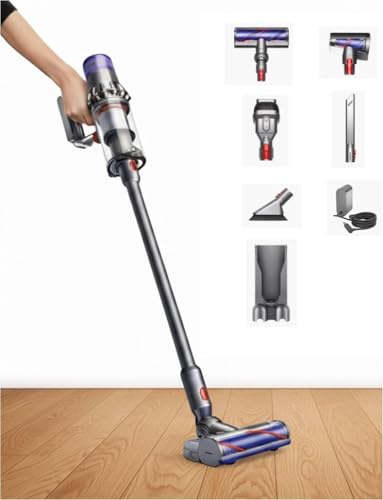
The Dyson V11 Animal offers up to 60 min runtime, auto-adapting suction, and 99.99% filtration. Built for homes with pets. See why it leads the pack!
5. LEVOIT LVAC-300 Cordless Stick Vacuum — Best Budget Cordless with HEPA
Rating: 4.3 stars | Reviews: 12,449 | Best for: Budget-conscious owners who need HEPA filtration in a cordless format
The LEVOIT LVAC-300 fills an important gap in the Lab vacuum market: a genuinely HEPA-filtered cordless stick vacuum that does not require a premium budget. Most budget cordless vacuums use foam or cyclone filtration that captures visible debris but allows fine dander and hair particles to pass through. The LVAC-300’s HEPA filter captures 99.99% of particles down to 0.3 microns — the same specification as units costing significantly more.
The third-generation tangle-resistant brushroll addresses the specific challenge of maintaining consistent performance when vacuuming short, dense fur. While Lab hair is shorter than the fur that wraps catastrophically around bristle-style brush rolls, it still accumulates around the axle and hub of standard rollers over time. The LVAC-300’s roller design channels hair away from wrap-prone areas, which translates to more consistent suction performance between cleaning sessions and less time spent clearing the brush roll.
At 6.6 pounds and in a stick configuration, it is significantly easier to carry upstairs, maneuver through a car interior, or clean tight spaces compared to a full-size upright. Up to 60 minutes of runtime in Eco mode covers most Lab households in a single charge. The included mini motorized brush attachment handles upholstery and fabric surfaces with powered agitation. For owners who are primarily managing daily fur maintenance between periodic deep-cleaning sessions, the LVAC-300 handles the task well at a fraction of the cost of the Dyson V11.
Lab-Specific Strengths:
- True HEPA filtration at a budget-accessible price point for dander control
- Tangle-resistant brushroll handles short dense Lab fur without constant maintenance
- Lightweight stick design ideal for frequent quick sessions and car vacuuming
- Mini motorized brush captures embedded fur from upholstery surfaces
Pros:
- HEPA filtration captures 99.99% of particles down to 0.3 microns
- Up to 60 minutes of runtime in Eco mode on a single charge
- Third-generation tangle-resistant brushroll minimizes hair wrap maintenance
- Lightweight design under 6.6 lbs for easy one-handed use
Cons:
- Turbo mode runtime is limited to approximately 12 minutes
- Not ideal for deep-pile or high-pile carpets at lower power settings
- Dust cup capacity may require frequent emptying during heavier shedding sessions

LEVOIT LVAC-300 cordless stick vacuum with HEPA filter, 60-min runtime, tangle-resistant brush, and powerful 12,000 RPM motor for pet hair and hard floors.
Quick Comparison Table
| Vacuum | Category | Rating | Reviews | Dustbin | HEPA | Self-Cleaning Brush | Best For |
|---|---|---|---|---|---|---|---|
| Bissell CleanView Swivel Pet 2252 | Upright | 4.4 | 105,257 | Standard | No | No | Best overall value |
| Shark Navigator NV360 | Upright | 4.4 | 52,141 | 0.9 qt | Yes (sealed) | No | Dander/allergy households |
| Shark Rotator Pet ZU102 | Upright | 4.4 | 12,979 | 2.9 L | Yes (sealed) | Yes | High-volume shedding |
| Dyson V11 Animal | Cordless Stick | 4.4 | 12,321 | Standard | Yes (whole-machine) | No | Premium cordless |
| LEVOIT LVAC-300 | Cordless Stick | 4.3 | 12,449 | Standard | Yes | Anti-tangle | Budget HEPA cordless |
Bissell CleanView Swivel Pet 2252 upright vacuum with triple action brush roll and scatter-free technology. Designed for pet homes. Buy now!
Lab Hair Vacuuming Tips
Establish a Frequency Routine
The single most effective thing Lab owners can do is vacuum consistently rather than sporadically. Lab hair accumulates on a daily basis, and allowing it to build up for more than a few days means it works progressively deeper into carpet fibers with every footstep. Letting it sit on upholstery allows static charge to build, anchoring the hair more stubbornly with each passing day.
During non-shedding periods, vacuuming high-traffic areas three to four times per week and doing a full whole-home vacuum once per week maintains reasonable fur levels. During coat blow season — the spring and fall transitions that typically run four to eight weeks — increasing to daily vacuuming of main living areas is not excessive. A robot vacuum running nightly handles this cadence without requiring additional effort.
Vacuum in Two Directions on Carpet
Lab hair aligns with foot traffic patterns and the orientation of carpet fibers. Vacuuming in a single direction captures only a portion of what is embedded. Running the vacuum in perpendicular strokes — first north-south, then east-west — addresses hair that the first pass misses. This technique is especially effective in bedroom areas and hallways where Labs nap and where deep carpet saturation builds over time.
Address Furniture Systematically
Fabric sofas and armchairs require a different approach than hard flooring. Before using a motorized upholstery attachment, run a slightly damp rubber glove or a rubber-tipped pet hair brush across the fabric surface. The friction generates static that pulls embedded short Lab hair to the surface, where the vacuum can capture it rather than pushing it deeper into the weave. After the initial pass, use the motorized pet brush attachment in multiple directions rather than a single sweep.
Removable couch cushion covers that can be shaken outside and washed weekly dramatically reduce the accumulation in the primary fur-collecting areas. Lab owners who do not use washable covers will find the fabric eventually reaches a level of fur saturation that no vacuum can fully address.
The Car Requires Special Attention
Car interiors are among the most difficult Lab hair challenges. The combination of fabric upholstery, heated seats, and confined space creates conditions where short Lab hair embeds exceptionally deeply and distributes evenly across every surface. A full-size vacuum with a standard hose is awkward and often inadequate for car seat crevices.
The most effective approach: use a rubber pet hair removal brush to sweep all upholstered surfaces before introducing a vacuum. This surfaces the embedded hair into a manageable pile. Follow with a cordless handheld unit or a stick vacuum attachment that reaches seat seams and the gaps between console components. For floor mats, removing them from the car entirely before vacuuming allows gravity to assist.
Maintain Your Vacuum for Consistent Performance
Lab hair is demanding on vacuum systems. Several maintenance habits preserve performance:
Check and clear the brush roll every two to three uses during peak shedding. Even self-cleaning or anti-tangle designs benefit from a visual inspection and occasional manual clearing of accumulated hair at the axle. Use small scissors to cut hair wrapped near the center hub before pulling it free.
Empty the dustbin before it reaches visual capacity, not after. A full dustbin reduces airflow through the cyclone or filter system, which cascades into reduced suction at the floor head. Keeping the bin at no more than two-thirds full maintains peak performance.
Clean or rinse washable filters monthly during normal periods, and every two weeks during coat blow season. Hold filters over a trash bag and tap them to dislodge accumulated fine hair and dust before rinsing with water if they are washable. Allow them to dry completely before reinserting — reinstalling a damp filter reduces airflow and can promote mold growth inside the vacuum housing.
Frequently Asked Questions
How often should I vacuum if I have a Labrador Retriever?
During normal shedding periods, vacuuming three to four times per week for high-traffic areas and once weekly for a full whole-home deep clean is sufficient for most Lab households. During spring and fall coat blows — which typically run four to eight weeks and during which shedding volume roughly doubles — daily vacuuming of living areas and a full whole-home vacuum twice per week is the more realistic requirement. A robot vacuum running nightly handles the daily maintenance automatically.
What is the best robot vacuum for a Labrador Retriever?
Robot vacuums work best as daily maintenance tools for Lab households rather than as deep-cleaning replacements for a full-size upright. A robot vacuum set to run every evening keeps daily fur accumulation from building up between weekly deep-clean sessions. Look for models with suction power above 2,500 Pa, rubber-finned brush rolls rather than bristle rolls (which resist short hair wrap more effectively), and auto-empty base stations that prevent the small onboard bin from filling mid-run.
Cordless vs. upright: which is better for Lab hair?
It depends on home size and primary use case. Corded uprights like the Bissell CleanView Swivel Pet and Shark Navigator NV360 deliver consistent full-power suction for whole-home carpet cleaning without battery concerns — the better choice for deep cleaning large carpeted spaces. Cordless stick vacuums like the Dyson V11 Animal and LEVOIT LVAC-300 offer greater maneuverability and flexibility for mixed surfaces, stairs, furniture, and car interiors. Most Lab owners benefit from owning both: a corded upright for weekly deep sessions and a cordless stick or handheld for daily quick passes and above-floor fur.
Do I need a HEPA filter for Labrador Retriever dander?
If anyone in the household experiences pet allergies, asthma, or respiratory sensitivities, sealed HEPA filtration is not optional — it is essential. Lab dander is a significant allergen and becomes airborne easily during normal activity in the home, not just during vacuuming. A vacuum without sealed HEPA filtration will capture visible hair while exhausting dander-laden air back into the room, actively recirculating the particles that cause reactions. The Shark Navigator NV360, Shark Rotator ZU102, Dyson V11 Animal, and LEVOIT LVAC-300 all feature true HEPA-level filtration. Even for households without diagnosed allergies, HEPA filtration produces meaningfully better indoor air quality.
Why does my vacuum struggle with Lab hair compared to other pet hair?
Short, dense fur behaves differently from longer hair shed by breeds like Golden Retrievers. Lab hair penetrates carpet pile deeply rather than lying on the surface, requires genuine mechanical agitation from a powered brush roll to dislodge, and is fine enough to pass through lower-quality filtration systems. Vacuums designed for general use or even basic pet use often underperform because their brush rolls lack the contact density to dislodge short embedded fur, and their filtration does not trap fine hair fragments. A vacuum with a motorized brush roll, strong sealed-system suction, and HEPA filtration addresses all three failure points.
How do I keep Lab hair from clogging my vacuum’s brush roll?
Self-cleaning brush rolls — like the PowerFins HairPro system in the Shark Rotator ZU102 — actively resist wrap from short fur during operation. For vacuums without this feature, the most effective habit is checking the brush roll every two to three sessions and clearing accumulated hair before it becomes a dense clog. Use scissors to cut any wrapped hair near the axle hub before pulling it free by hand. Avoid waiting until you notice suction loss — by the time hair wrap is affecting performance, the brush roll is already significantly impaired.
Should I use my vacuum for both carpet and hard floors with a Lab?
Yes, but use the appropriate setting or attachment for each. Lab hair on hard floors requires a different approach than embedded carpet fur. On tile, hardwood, and vinyl, the brush roll can scatter lightweight fur sideways before the suction captures it. Vacuums with brush roll shutoff (like the Shark NV360) let you disable the spinning brush for hard floors, relying on suction alone to capture loose fur without scattering. On carpet, the brush roll should be engaged at full speed for maximum embedded hair extraction.
The Bottom Line
Labrador Retrievers are exceptional dogs that happen to be exceptional shedders. The right vacuum does not just manage the mess — it transforms Lab ownership from a constant cleaning burden into a manageable weekly routine.
For most Lab households, the recommendation matrix looks like this:
- Best overall for whole-home cleaning: Bissell CleanView Swivel Pet 2252 — 105,257 reviews back its real-world performance
- Best for allergy and dander control: Shark Navigator NV360 — sealed HEPA system with Lift-Away flexibility
- Best for high-volume shedding households: Shark Rotator Pet ZU102 — 2.9-liter dustbin and self-cleaning PowerFins brush roll
- Best premium cordless: Dyson V11 Animal — intelligent surface detection and whole-machine HEPA filtration
- Best budget cordless with HEPA: LEVOIT LVAC-300 — genuine HEPA filtration at an accessible price
The most effective approach for a Lab household combines a powerful corded upright for weekly deep carpet cleaning with a lightweight cordless unit for daily quick passes, furniture, and car duty. Pair that system with a consistent brushing routine that captures loose undercoat before it reaches your floors, and the endless Lab shedding problem becomes a solved one.
Your Lab will still leave fur on everything. But with the right vacuum, that is simply a minor inconvenience rather than a way of life.
Bissell CleanView Swivel Pet 2252 upright vacuum with triple action brush roll and scatter-free technology. Designed for pet homes. Buy now!
Ready to Find Your Perfect Vacuum?
Browse our expertly reviewed vacuum cleaners and make an informed decision
Browse All Vacuums