Best Vacuum for Mold: HEPA-Sealed Picks That Capture Spores Safely
Vacuuming mold without HEPA filtration spreads spores and worsens the problem. Find the best vacuum for mold remediation with sealed HEPA that captures spores at the source.
Table of Contents
- The Problem With Vacuuming Mold the Wrong Way
- Mold Spore Science: What You Are Actually Dealing With
- When You Can Vacuum Mold and When You Cannot
- Why Sealed HEPA Filtration Is the Minimum Standard for Mold Vacuuming
- What to Look For in a Vacuum for Mold
- The 5 Best Vacuums for Mold (HEPA-Sealed Picks)
- Mold Vacuum Protocol: How to Do It Safely
- When to Call Professionals
- Frequently Asked Questions
- Conclusion
The Problem With Vacuuming Mold the Wrong Way
Most people vacuum mold exactly the wrong way. They see a patch of visible surface mold on a bathroom tile, a basement floor, or a window sill, and they reach for their standard upright vacuum to clean it up quickly. What they do not know is that a standard vacuum without sealed HEPA filtration may actually make the situation significantly worse.
When a conventional vacuum passes over a mold colony, it does not just remove the mold you can see. The machine’s airflow also disturbs millions of microscopic spores, launching them into suspension in the air inside the vacuum. Because non-HEPA vacuums and unsealed HEPA vacuums contain gaps, cracks, and filter media that cannot capture particles as small as mold spores, those spores are exhausted back out through the vacuum’s exhaust port and distributed throughout the room. Within hours, spores that were once confined to a single patch have settled on every horizontal surface in the space.
This is not a minor concern. The EPA, OSHA, and the New York City Department of Health all note that mold disturbance can lead to significant increases in airborne spore concentrations, with direct consequences for respiratory health. Vacuuming mold without proper filtration can turn a small, localized problem into a whole-room contamination event.
If you are going to vacuum mold at all, and there are specific situations where this is the correct approach, the vacuum you use must have sealed HEPA filtration meeting at minimum the H13 standard. There is no workaround, and the vacuum’s price tag does not matter nearly as much as whether its filtration system is genuinely sealed from intake to exhaust.
Mold Spore Science: What You Are Actually Dealing With
To understand why sealed HEPA filtration is not optional, it helps to understand what mold spores are and how they behave.
Mold spores range in size from approximately 1 to 100 microns in diameter, depending on the species. Common indoor molds such as Cladosporium, Aspergillus, and Stachybotrys (commonly called black mold) produce spores that typically fall in the 2 to 20 micron range. By comparison, a human hair is roughly 70 microns wide. These spores are invisible to the naked eye.
Under normal indoor conditions, mold spores are present in virtually every indoor environment at low concentrations. The problem begins when a mold colony is disturbed. A study published in the journal Indoor Air found that mechanical disturbance of mold colonies can increase airborne spore concentrations by orders of magnitude within seconds, and those elevated concentrations can persist for hours as spores slowly settle back onto surfaces.
Spores at the smaller end of the size spectrum are the most concerning for human health because they can travel deep into the lower respiratory tract. The larger spores, while less dangerous from a respiratory standpoint, still present the problem of surface recontamination when they settle out of the air.
Prolonged or repeated exposure to elevated indoor mold spore concentrations has been associated with a range of health effects, including allergic rhinitis, asthma exacerbations, hypersensitivity pneumonitis, and in immunocompromised individuals, more serious fungal infections. The Occupational Safety and Health Administration classifies mold remediation in areas greater than 100 square feet as a task requiring full respiratory protection and containment protocols.
The critical takeaway: when you disturb a mold colony with a vacuum, even a small one, you are generating an aerosol of biologically active particles. Your filtration system must be capable of capturing and retaining those particles without allowing any to pass through the machine and back into your breathing air.
When You Can Vacuum Mold and When You Cannot
Not every mold situation calls for professional remediation, but not every situation is appropriate for DIY vacuuming either. Understanding the difference is essential for both effective remediation and personal safety.
Situations Where Vacuuming With a HEPA Vacuum Is Appropriate
Surface mold on hard, non-porous surfaces. Small colonies of visible mold on bathroom tile, sealed concrete, glass, metal, or glazed ceramic can often be addressed with a sealed HEPA vacuum followed by disinfection with an EPA-registered disinfectant. The key word is small: most guidance from the EPA considers areas under 10 square feet to be within the scope of careful DIY remediation. Hard surfaces do not absorb mold the way porous materials do, which means the mold colony is more fully accessible at the surface.
Post-remediation cleanup. After a professional or carefully conducted DIY remediation, a HEPA vacuum is an essential tool for removing residual debris, mold fragments, and settled spores from hard surfaces before applying disinfectants.
Mold on hard-surface flooring. Tile, vinyl, sealed concrete, and sealed hardwood with surface-only mold (not mold that has penetrated into the material) can be addressed with a HEPA vacuum as part of a remediation process.
Situations Where Professional Remediation Is Required
Areas larger than 10 square feet. The EPA’s guidance explicitly recommends professional remediation for mold covering areas greater than 10 square feet. Large infestations indicate a persistent moisture source and likely deeper penetration into building materials.
Mold on porous materials. Drywall, carpet, ceiling tiles, insulation, and wood that has developed mold growth cannot be effectively remediated by vacuuming. The mold mycelium (the root structure) penetrates deep into porous materials and cannot be removed from the surface. These materials typically require removal and disposal.
Active water intrusion. If there is an ongoing moisture source that has not been resolved, any remediation you perform will be temporary at best. The mold will return.
Health vulnerabilities in the household. Infants, elderly individuals, people with compromised immune systems, and individuals with respiratory conditions should not be present during mold remediation, and their households should strongly consider professional services regardless of colony size.
Black mold (Stachybotrys chartarum). This species produces mycotoxins in addition to spores and requires the strictest containment and removal protocols. DIY remediation is not advisable.
If you are uncertain whether your situation falls within appropriate DIY scope, err on the side of caution and consult a certified mold inspector (look for IICRC certification) before proceeding.
Why Sealed HEPA Filtration Is the Minimum Standard for Mold Vacuuming
HEPA stands for High Efficiency Particulate Air. A filter certified to the H13 HEPA standard captures at least 99.97% of particles at 0.3 microns, which is the most penetrating particle size (MPPS) for fibrous filter media. Because mold spores are considerably larger than 0.3 microns, a true H13 HEPA filter will capture them with even higher efficiency, typically greater than 99.99%.
The filter rating alone, however, is not sufficient for safe mold vacuuming. The word sealed is equally important. An unsealed vacuum system allows air to bypass the HEPA filter through gaps in the housing, hose connections, canister seams, or poorly fitted filter frames. These bypass paths mean that even a vacuum with a certified HEPA filter will exhaust some portion of unfiltered air, and in the context of mold spore capture, “some unfiltered air” is not acceptable.
Look for vacuums that specifically describe a sealed system, anti-allergen complete seal, or whole-machine filtration. These terms indicate that the manufacturer has designed the vacuum so that all air must pass through the filtration system before it is exhausted. The intake air path and the exhaust air path are isolated, and there are no gaps through which contaminated air can escape.
Additionally, for mold applications, a bagged vacuum presents certain advantages over bagless designs. When you empty a bagless vacuum’s dust cup, you create a second aerosolization event: the collected mold spores become briefly airborne again as they fall into the trash. Bagged vacuums allow you to seal and dispose of the bag without disturbing the contents. If you are using a bagless vacuum for mold remediation, empty it immediately outdoors into a sealed plastic bag.
What to Look For in a Vacuum for Mold
Sealed HEPA filtration (H13 minimum). As discussed, the seal matters as much as the filter rating. Verify that the vacuum explicitly claims a fully sealed filtration system rather than just a HEPA filter.
Strong, consistent suction. Adequate suction is necessary to lift spores and mold fragments from hard surfaces without simply blowing them sideways. Look for vacuums with at least 150 air watts for cordless models or strong CFM ratings for handheld units designed for fine particle capture.
Crevice tool and small attachments. Mold often grows in corners, grout lines, around caulk, and in other tight spaces. A set of narrow attachments lets you work into these areas precisely.
Easy, sealed filter and bag replacement. Filters used for mold remediation should be changed more frequently than under normal use. Ease of replacement, and the ability to replace the filter without disturbing the collected spores, is important.
Washable or replaceable filters. For ongoing use, washable filters are convenient, but after a significant mold remediation job, consider replacing the filter entirely rather than washing and reinserting it.
Build quality and housing integrity. Cheap vacuums with poor quality gaskets, seams, and fit may claim HEPA filtration but fail to maintain a truly sealed system under actual use. Established brands with documented sealed system engineering are generally more reliable in this regard.
The 5 Best Vacuums for Mold (HEPA-Sealed Picks)
The following vacuums were selected for their genuine sealed HEPA filtration systems, strong suction performance, and practical suitability for mold remediation tasks. Ratings reflect verified user feedback.
1. DEWALT 20V Cordless Handheld Vacuum DCV501HB
Rating: 4.7/5 | True HEPA 99.97% at 0.3 microns | 46 CFM airflow
The DEWALT DCV501HB earns the top recommendation for mold remediation use because it combines the two things that matter most in this application: a certified true HEPA filtration system capturing 99.97% of particles at 0.3 microns, and 46 CFM of airflow that is powerful enough to capture fine spores from hard surfaces without relying solely on contact suction. It is notable that DEWALT built this unit with OSHA Table 1 housekeeping compliance in mind, making it one of the few handheld vacuums explicitly designed for environments where fine particle containment is a regulatory and health priority.
The handheld form factor is well-suited to mold remediation because it gives you precise control over the cleaning head. You are not maneuvering a large upright around a bathroom or crawl space; you are directing a compact, lightweight tool exactly where the mold is located. The six included attachments, particularly the crevice nozzle and round brush, allow you to work into grout lines, corners, and around plumbing fixtures where mold commonly colonizes.
Built on the DEWALT 20V MAX battery platform, it is compatible with batteries that existing DEWALT tool owners may already own. The rugged housing is designed for jobsite conditions and will not deteriorate from the kind of targeted, careful use required in mold remediation. The belt clip adds hands-free convenience when you need both hands free to move or prepare surfaces.
The one significant limitation for mold applications is that the battery is sold separately. Plan for this additional cost. Runtime with a 5Ah battery is approximately 21 minutes of continuous operation, which is sufficient for most small-area mold remediation tasks.
Best for: Targeted mold remediation on hard surfaces in bathrooms, basements, crawl spaces, and around plumbing.
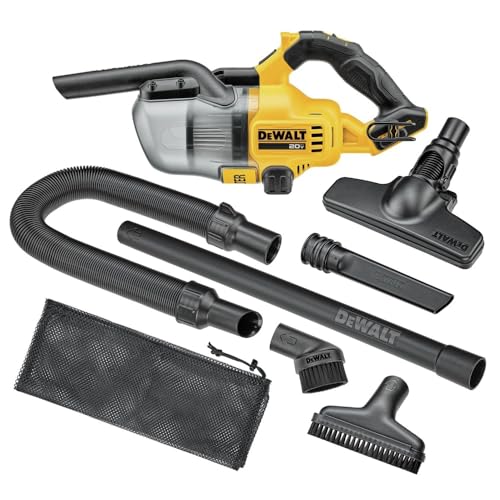
DEWALT 20V cordless handheld vacuum with HEPA filter, LED light, 6 attachments, and 46 CFM suction. Built for jobsites, workshops, garages, and vehicles.
2. Bissell Pet Hair Eraser Allergen Lift-Off 39883
Rating: 4.5/5 | HEPA Sealed Allergen System | XL 1-liter dust tank
View the Bissell Pet Hair Eraser Allergen Lift-Off
The Bissell Pet Hair Eraser Allergen Lift-Off 39883 is the strongest full-size upright choice for mold vacuuming applications. Bissell engineered this machine around a fully sealed HEPA allergen system, meaning the entire vacuum housing is designed so that all air passes through the HEPA filtration before being exhausted. This is not simply a HEPA filter inserted into a conventional housing; the system is designed as a sealed unit from the ground up, which is exactly the architecture required for safe spore capture.
The Lift-Off pod design is particularly valuable in mold remediation scenarios. Many mold growth locations, under sinks, behind appliances, in basement corners, are not accessible to a standard upright operating in floor mode. The detachable Lift-Off canister with extension wand converts the machine into a portable unit that can be directed into tight, awkward spaces without moving furniture or contorting the machine.
The XL 1-liter dust tank offers meaningful capacity for extended cleanup sessions, and the one-touch empty mechanism allows for quick, contained disposal. The tangle-free brush roll and scatter-free technology on hard floors help ensure that mold debris is captured rather than blown sideways during cleaning passes.
For households dealing with recurring moisture issues, this is a practical all-purpose vacuum that serves daily cleaning duties effectively and can be pressed into service for mold remediation when needed. Bissell’s filtration system is well-documented and has earned trust from allergy and asthma communities for its genuine sealed performance.
Best for: Homeowners who need a capable all-purpose upright that can handle both routine cleaning and mold remediation on hard floors and in hard-to-reach spaces.

Bissell Pet Hair Eraser Allergen Lift-Off with HEPA filtration, tangle-free brush roll, and scatter-free tech. Built for pet owners. See our expert review.
3. Shark Navigator Lift-Away Deluxe NV360
Rating: 4.4/5 | HEPA Anti-Allergen Complete Seal | Captures 99.9% of dust and allergens
View the Shark Navigator NV360
The Shark Navigator NV360 has a long track record as one of the most recommended vacuums for allergy and asthma sufferers, largely because of its Anti-Allergen Complete Seal system. The sealed design means that captured particles, including mold spores, cannot leak back out through housing gaps or filter seams. With 52,000+ verified ratings averaging 4.4 stars, the NV360’s filtration system has been tested by real-world users with genuine sensitivity to airborne particles.
For mold applications, the NV360’s Lift-Away feature is its most practically useful attribute. Detaching the pod allows you to take a compact, maneuverable cleaning unit into the specific areas where surface mold has developed, directing the hose and attachments with precision rather than trying to maneuver a full-size upright in a small bathroom or closet.
The machine’s corded design is an advantage for mold remediation work because it provides consistent, uninterrupted suction without any concern about battery depletion mid-task. Mold remediation should be done efficiently and without stops if possible, to minimize cumulative spore disturbance time. A corded vacuum that maintains constant suction from start to finish supports this.
At a price point that is among the more accessible for a genuine sealed HEPA vacuum, the NV360 is the recommendation for budget-conscious buyers who still need a properly sealed filtration system. Do not accept a cheaper vacuum that lacks the sealed system architecture, regardless of the price savings; the point of the sealed system is that the cost of getting it wrong is borne by your health.
Best for: Budget-conscious buyers who need a proven sealed HEPA vacuum with good versatility for both mold remediation and everyday home cleaning.
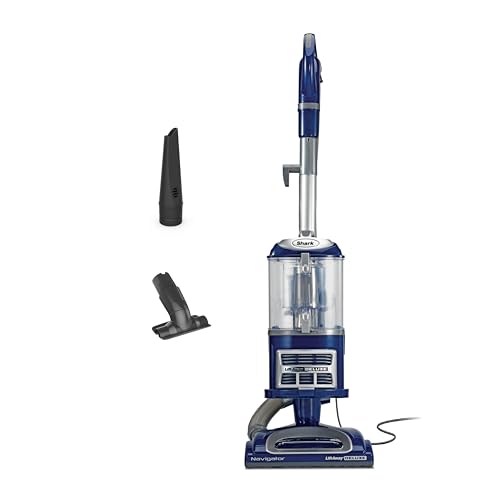
Shark Navigator Lift-Away NV360 delivers powerful suction with HEPA filtration and swivel steering. Perfect for pet hair and allergens. See full expert review.
4. Shark AZ2002 Vertex Powered Lift-Away Upright Vacuum
Rating: 4.3/5 | Anti-Allergen Complete Seal with HEPA | 1,344 watts | 30-foot cord
The Shark AZ2002 Vertex is the most powerful full-size upright in this comparison, rated at 1,344 watts with an 11.8-amp motor and a 30-foot power cord that provides exceptional reach without outlet changes. For mold remediation across larger hard-surface areas, such as a flood-affected basement or a crawl space with significant surface mold coverage, the Vertex provides the sustained suction power and range to handle an extended job without stopping.
The Powered Lift-Away is a meaningful upgrade over standard Lift-Away designs. When you detach the pod, the motorized nozzle remains powered, meaning you are not switching from powered suction to passive airflow for under-furniture or tight-space cleaning. This distinction matters in mold remediation because passive suction may not be sufficient to reliably capture all spores from a contaminated surface; the motor-driven airflow is more consistently effective.
The Anti-Allergen Complete Seal with HEPA filtration captures 99.9% of dust and allergens at 0.3 microns or larger. The DuoClean PowerFins brushroll, while primarily useful for carpet, can be locked to off for hard floor work where agitation would be counterproductive for mold spore capture.
The 1-quart dust cup should be emptied into a sealed plastic bag outdoors when used for mold remediation, as with any bagless vacuum in this application. The LED headlights on the nozzle are a practical feature for identifying mold growth in dark corners and under-furniture zones.
Best for: Larger homes with extended hard-surface areas affected by surface mold, where sustained suction power and range are priorities.

Shark AZ2002 Vertex upright vacuum with DuoClean PowerFins, self-cleaning brushroll, Powered Lift-Away, and HEPA filtration. Ultimate power for pet hair and deep cleaning.
5. Dyson V11 Origin Cordless Stick Vacuum
Rating: 4.4/5 | Whole-machine HEPA filtration | 99.99% at 0.3 microns | 185 AW suction
The Dyson V11 Origin stands apart from the other picks in this list because of its whole-machine filtration architecture. Rather than relying on a HEPA filter at a single point in the airflow path, Dyson engineers the entire vacuum body as a sealed system. Every internal component and connection point is integrated into the sealed filtration design, and the machine is tested to confirm that 99.99% of particles at 0.3 microns are captured in Boost mode.
For mold remediation purposes, this whole-machine approach provides a higher degree of confidence than vacuum designs where the HEPA filter is one component among several that could potentially allow bypass. When the entire machine is validated as a single sealed system, the risk of exhaust leakage at the filter frame, housing seams, or accessory connections is minimized.
The 185 air watts of suction in Boost mode is the strongest cordless performance in this comparison and provides aggressive spore capture from hard surfaces. The cordless format is genuinely useful in mold remediation scenarios where power cords could contact contaminated surfaces or where the remediation area is not close to an electrical outlet. At 6.6 pounds, it is light enough to use in elevated or awkward positions without fatigue.
The LCD screen’s real-time runtime display is a practical feature during remediation: you always know exactly how much cleaning time remains and can plan accordingly to avoid stopping mid-task. The bin emptying mechanism, a point-and-shoot release, does generate some dust when emptied, so this should be done outdoors into a sealed bag after mold remediation use.
Runtime in Boost mode is significantly shorter than the advertised 60 minutes (which applies in Eco mode), so for large-area jobs the Vertex or NV360 with their corded designs may be more practical.
Best for: Homeowners who want the highest-confidence whole-machine sealed HEPA filtration in a cordless format, particularly for medium-sized remediation tasks where outlet access is limited.

Dyson V11 Origin cordless stick vacuum offers 185AW suction, 60-min runtime, Motorbar cleaner head, and HEPA filtration. See our full expert breakdown.
Mold Vacuum Protocol: How to Do It Safely
If you have confirmed that your mold situation is within the scope of DIY vacuuming (small area, hard surface, no active water intrusion, no highly porous materials involved), follow this protocol carefully.
Before you start:
- Wear an N95 respirator at minimum. An N100 or P100 half-face respirator is preferable. Standard dust masks are not sufficient.
- Wear nitrile or rubber gloves. Double-glove if the mold area is significant.
- Wear safety goggles without ventilation holes to prevent spores from contacting your eyes.
- Wear disposable coveralls or clothing that you will immediately wash or dispose of after the task.
- Close HVAC vents in the affected room and turn off the HVAC system. This prevents the system from drawing disturbed spores into the ductwork and distributing them throughout the building.
- Open a window to the exterior if possible, but do not create airflow across the mold colony. The goal is to provide an exhaust path for disturbed air, not to blow spores around the room.
During vacuuming:
- Work slowly and deliberately. Fast, sweeping passes disturb more spores; slow, controlled passes allow the vacuum’s airflow to capture them before they travel far.
- Vacuum in one direction, away from yourself, to reduce the chance of disturbed spores settling on you.
- Use the crevice tool for grout lines, corners, and tight spaces. Do not use a large floor head where a narrow attachment will work better.
- Do not vacuum wet mold. The filter will clog immediately, suction will drop, and wet mold does not vacuum effectively. Let wet areas dry, or address the moisture source first, before proceeding.
- Overlap your vacuum passes by 50% to ensure complete coverage of the affected surface.
After vacuuming:
- Immediately follow vacuuming with an EPA-registered disinfectant appropriate for the surface type. Vacuuming removes the visible colony but does not sterilize the surface; disinfection is necessary to address remaining spores and hyphae.
- For bagless vacuums: carry the vacuum outdoors before opening the dust cup. Empty into a sealed plastic bag, seal it immediately, and dispose of it in the outdoor trash. Do not empty indoors.
- For bagged vacuums: remove the bag with gloves on, seal it in a plastic bag without opening the bag itself, and dispose of it in the outdoor trash.
- Replace or wash the HEPA filter after mold remediation use. After a significant remediation task, consider replacing the filter entirely rather than washing it.
- Wipe down the exterior of the vacuum with a damp cloth and disinfectant before storing it.
- Wash all clothing immediately on the hottest safe setting, or place in a sealed plastic bag for disposal if the exposure was significant.
- Shower and wash your hair before moving to other areas of the building.
When to Call Professionals
Vacuuming mold is never appropriate as the sole remediation method for anything beyond a small, well-defined colony on a hard, non-porous surface. Call a certified mold remediation professional (look for IICRC S520 certification) in the following situations:
- The affected area exceeds 10 square feet.
- Mold is present on drywall, carpet, insulation, ceiling tiles, or structural wood.
- There is or has been a sewage backup or black water intrusion involved.
- Mold is present in your HVAC system or ductwork.
- You have identified or suspect Stachybotrys chartarum (black mold with a slimy appearance).
- Any occupant of the household is immunocompromised, has chronic respiratory conditions, or is an infant.
- You have done DIY remediation but mold has returned in the same location within a few weeks, indicating an unresolved moisture source.
- You are buying or selling a property with known mold history.
Professional remediators use industrial-grade HEPA air scrubbers, negative air pressure containment, and specialized equipment that goes well beyond what any consumer vacuum can provide. The cost of professional remediation is significant but substantially less than the cost of treating health consequences or addressing structural damage from inadequate remediation.
Frequently Asked Questions
Can any HEPA vacuum be used for mold, or does it need to be specifically sealed?
The vacuum must be specifically sealed. A HEPA filter alone is insufficient if the vacuum housing allows air to bypass the filter through gaps, seams, or poorly fitted connections. Look for vacuums that explicitly describe a sealed system, whole-machine HEPA filtration, or anti-allergen complete seal. These designations indicate that the manufacturer has designed and tested the machine to prevent bypass air from reaching the exhaust.
Can I use a shop vac for mold remediation?
A standard shop vac without HEPA filtration should never be used on mold. Shop vacs move very high volumes of air, which means they aerosolize spores very effectively and exhaust unfiltered air in large quantities. Some shop vacs accept HEPA filter upgrades, but even those must be evaluated for sealed housing before use on mold. HEPA-rated shop vacs used in professional remediation are a different category from typical consumer shop vacs.
How often should I replace the HEPA filter after using the vacuum for mold?
Replace the filter after any significant mold remediation task. Even if the filter appears to have capacity remaining, the spores and mold fragments embedded in the filter media represent an ongoing contamination risk if the filter is later disturbed. If the vacuum is used routinely in a home with known mold issues, inspect and replace filters on a monthly basis.
Will vacuuming mold spread it to other parts of my house through the vacuum exhaust?
Yes, this is exactly the risk that a properly sealed HEPA vacuum is designed to prevent. A sealed HEPA system captures the spores inside the vacuum rather than exhausting them back into the air. An unsealed vacuum or a non-HEPA vacuum will indeed spread spores through its exhaust, which can lead to secondary colonization in other areas of the house.
Can I vacuum mold off carpet or fabric furniture?
No. Carpet and fabric furniture are porous materials, and mold that has colonized them has penetrated below the visible surface layer. Vacuuming will remove some surface spores but will not address the mycelium that has grown into the material. In most cases, mold-affected carpet and upholstered furniture must be removed and discarded. This is a situation that requires professional assessment.
Is it safe to use my regular vacuum again after using it for mold remediation?
If you used a properly sealed HEPA vacuum and followed the filter replacement and exterior cleaning protocol described above, the vacuum can generally be returned to normal use. If you used an unsealed or non-HEPA vacuum on mold, the vacuum itself may now be a source of spore contamination in your home. Consider professional cleaning of the vacuum or, depending on the extent of the exposure, replacing it.
Does vacuuming mold kill it?
No. Vacuuming removes visible mold colonies and disturbed spores from surfaces, but it does not kill mold. Mold that is captured in the vacuum filter is still biologically active; this is one reason why proper filter disposal is important. Vacuuming must always be followed by application of an EPA-registered disinfectant to the cleaned surface. The disinfectant inactivates remaining spores and hyphae that the vacuum could not physically remove.
Conclusion
Vacuuming mold safely requires a genuinely sealed HEPA filtration system, deliberate technique, full personal protective equipment, and an honest assessment of whether the situation is within the scope of DIY remediation. A sealed HEPA vacuum is a tool in a larger process, not a complete solution on its own.
Of the options reviewed here, the DEWALT DCV501HB stands out for targeted remediation work due to its OSHA-compliant true HEPA filtration and professional-grade 46 CFM suction. The Bissell Pet Hair Eraser Allergen Lift-Off 39883 and Shark Navigator NV360 are the strongest practical options for homeowners who need a sealed HEPA vacuum that doubles as an everyday machine. The Shark AZ2002 Vertex provides the greatest raw power for larger tasks, and the Dyson V11 Origin offers the highest filtration confidence in a cordless format.
Regardless of which vacuum you choose, the unsealed exhaust of a standard vacuum around a mold colony is a hazard. Invest in the right tool, follow proper safety protocols, and know when a situation has moved beyond the appropriate scope of DIY remediation. Your respiratory health is not worth the savings.
Safety disclaimer: The information in this article is educational in nature and is not a substitute for professional mold assessment, remediation, or medical advice. Mold exposure can cause serious health consequences. If you have any doubt about the scope, species, or safety of a mold situation in your home, consult a certified mold inspector (IICRC-certified) before taking any action. Always consult a physician if you or a household member is experiencing respiratory symptoms potentially related to mold exposure.
Ready to Find Your Perfect Vacuum?
Browse our expertly reviewed vacuum cleaners and make an informed decision
Browse All Vacuums