Best Vacuum for Persian Rugs: Clean Without Damaging Delicate Fibers
Persian and Oriental rugs are valuable and delicate. Using the wrong vacuum can damage their fibers and fringe. Find the best vacuum for Persian rugs that cleans safely.
Table of Contents
- Best Vacuum for Persian Rugs: Clean Without Damaging Delicate Fibers
- Understanding Persian Rugs: Construction, Value, and Vulnerability
- What Damages Persian Rugs During Vacuuming
- What to Look For in a Vacuum for Persian Rugs
- Canister vs. Upright for Persian Rugs
- The 5 Best Vacuums for Persian Rugs
- Persian Rug Vacuuming Schedule and Care Guide
- Frequently Asked Questions
- Conclusion
Best Vacuum for Persian Rugs: Clean Without Damaging Delicate Fibers
A genuine Persian rug is not a floor covering. It is a textile artwork — one that took months or years to produce, uses hand-dyed wool tied knot by knot onto a cotton or silk foundation, and can represent anywhere from a few hundred to tens of thousands of dollars in value. Running the wrong vacuum across one is not a minor inconvenience. It is how valuable rugs get destroyed quietly, one cleaning session at a time, until the pile is matted, the fringe is shredded, and the dyes have been stressed past the point of recovery.
The problem is that most households own exactly one vacuum, and that vacuum was selected for carpet or hard floors. It runs a spinning brush roll at maximum speed, produces maximum suction, and is designed to dig aggressively into dense synthetic pile. That approach is exactly wrong for a hand-knotted Persian rug. The consequences — pulled knots, fringe entanglement, dye abrasion, pile distortion — are irreversible without expensive professional intervention.
This guide explains what makes Persian rugs structurally vulnerable, what specific vacuum behaviors damage them, and which features to require in any vacuum you use on them. It closes with five concrete product recommendations, each selected from real product data for their specific suitability to delicate, hand-knotted textiles.
Understanding Persian Rugs: Construction, Value, and Vulnerability
Hand-Knotted vs. Machine-Made
The distinction that matters most for vacuuming purposes is not age or origin — it is whether the rug is hand-knotted or machine-made.
Hand-knotted rugs are built by tying individual wool or silk knots around pairs of warp threads, one knot at a time, across the entire width of the rug. A typical 9x12 hand-knotted Persian rug may contain several million individual knots. Each knot is anchored only by its own tension against the warp structure. There is no adhesive backing, no secondary substrate, no mechanical lock between the pile and the foundation beyond the knot itself. This means the pile fibers are vulnerable to being pulled, loosened, or extracted by any mechanical force applied perpendicular to the surface.
Machine-made rugs are produced by mechanically inserting tufts of fiber into a pre-woven or pre-punched backing, then applying a heavy latex or adhesive coating to lock them in place. The secondary backing makes these rugs far more tolerant of aggressive vacuuming. Many of the vacuuming recommendations designed for machine-made rugs will genuinely damage hand-knotted ones.
If you cannot determine whether your rug is hand-knotted, look at the back. A hand-knotted rug shows the pattern on its reverse surface in muted tones, with visible knot structure. A machine-made or tufted rug shows a backing fabric or latex layer on the reverse, hiding the pile construction entirely.
Wool Pile: The Primary Material Concern
The vast majority of Persian and Oriental rugs use wool as their primary pile fiber, with cotton for the structural warp and weft. Wool has specific properties that affect how it should be cleaned:
- Natural lanolin content lubricates wool fibers and gives them resilience, but this protective layer is sensitive to heat, excessive friction, and alkaline chemical cleaners.
- Wool absorbs and holds fine particles — dust, soil, and debris work their way down through the pile toward the foundation over time. This means suction-based cleaning, which draws particles upward and out, is far more effective and far safer than brush-based agitation.
- Wool fibers can felt when subjected to combined heat, moisture, and mechanical pressure. A spinning brush roll creates all three of these conditions simultaneously. Repeated exposure flattens and mats the pile in ways that cannot be reversed.
- Natural dyes used in traditional Persian rugs are applied at the fiber level rather than printed on the surface. They are more stable than synthetic dyes in some respects, but they are also sensitive to sustained UV exposure, alkaline cleaners, and abrasion that removes the dyed outer surface of fiber strands.
The Fringe Problem
Fringe on Persian and Oriental rugs is not decorative trim sewn onto the edge — it is the structural warp threads of the rug itself, left exposed and finished at each end of the weave. Cutting, damaging, or pulling the fringe compromises the structural integrity of the entire rug. Fringe threads are typically cotton, relatively thin, and absolutely certain to be pulled into a rotating brush roll if the vacuum comes within reach of them. No amount of careful technique prevents this once the fringe is within the suction field of an active brush roll. You need a vacuum that allows you to completely stop the brush roll rotation before approaching the fringe ends of the rug.
What Damages Persian Rugs During Vacuuming
Understanding the specific failure mechanisms helps explain why the right vacuum matters so much.
The Rotating Brush Roll
A brush roll spinning at 3,000 to 6,000 RPM on a rug surface is doing three things simultaneously: it is agitating the pile fibers mechanically, it is creating friction heat at the fiber tips, and its bristles are sweeping individual fibers in directions counter to their natural lay. On dense synthetic carpet, this is productive — it breaks embedded dirt loose from the pile. On hand-knotted wool, it gradually abrades the fiber surface, raises the cuticle of wool strands (which causes them to felt and mat), and exerts lateral force on knots that have no adhesive backing to resist it.
Over time, this produces a condition that rug dealers and restorers call “tracking” — visible lines of worn, crushed, or matted pile along the most frequently vacuumed paths. Tracked pile loses its sheen, its resilience, and eventually its color as the outermost fiber surface is removed by repeated abrasion.
Excessive Suction on Low-Density Pile
Persian rugs are not wall-to-wall carpet. Their pile density, while impressive by weaving standards, is far lower than most residential broadloom. When a vacuum set to maximum suction is applied directly to Persian rug pile, the vacuum attempts to draw the pile itself into the suction channel. The result is pile distortion — fibers are pulled upward, knots are stressed, and repeated over time, pile fibers are loosened from the knot structure and eventually extracted. This is why antique rugs with lower knot density than new production pieces are particularly vulnerable, and why adjustable suction is not a luxury feature for Persian rug vacuuming but a functional requirement.
Fringe Entanglement
As described above, fringe is the single fastest-damage mechanism during vacuuming. A brush roll that catches even a single fringe thread will immediately pull it tight, draw it into the rotating mechanism, and either break it, unravel the weft structure it is attached to, or pull a section of the rug border into the vacuum head. This happens in a fraction of a second and cannot be prevented by being careful — only by keeping rotating brush mechanisms away from fringe entirely.
Over-Vacuuming and Traffic Direction
Even with a properly configured vacuum, cleaning a Persian rug too frequently or always in the same direction causes accelerated wear. Natural wool pile has a “lay” — a direction in which the fibers naturally lean. Always vacuuming against the pile lay stresses the knot structure from the same angle on every pass. Vacuuming with the pile lay is gentler and more effective. Alternating direction weekly is ideal.
What to Look For in a Vacuum for Persian Rugs
Suction-Only Mode or Brush Roll Shutoff
This is the single most important feature for Persian rug safety. A brush roll that cannot be turned off — independently of the vacuum’s suction — is not safe to use on a hand-knotted rug. Period. Look for a clearly labeled “brush off” or “suction only” mode that completely stops brush rotation while maintaining suction for dust pickup.
Adjustable Suction
Maximum suction is appropriate for embedded dirt in broadloom carpet. For Persian rug pile, you want enough suction to lift dust and surface particles without attempting to pull the pile itself. An adjustable suction control — whether a dial, slider, or electronic setting — lets you dial the vacuum back to a safe level for the rug surface you are cleaning.
Fringe Guard or Attachments That Keep the Brush Away
Some vacuums include fringe guard attachments that prevent fringe threads from being drawn into the vacuum path. At minimum, you need the ability to switch to a bare attachment or hose end for the fringe sections of the rug, relying entirely on suction without any mechanical contact.
Low-Agitation Floor Head
Even with the brush roll off, some vacuum floor heads create enough suction seal against the rug surface to pull pile out of shape. A wider, more open floor head — particularly the type found on canister vacuums — distributes suction more gently and maintains less aggressive contact pressure with the rug surface than the sealed, heavy heads of most upright vacuums.
Canister vs. Upright Design
The vacuum’s form factor matters as much as its features for Persian rug work. Canister vacuums generally apply less mechanical pressure to the rug surface because the motor and body weight sit on the floor rather than pressing down through the floor head. The floor head is lighter, the hose allows you to maintain fine control over angle and pressure, and you can easily switch to a bare suction nozzle for fringe areas. This physical separation of power unit from cleaning head is why experienced rug dealers and conservators almost universally recommend canister vacuums for valuable rugs.
Canister vs. Upright for Persian Rugs
The choice between canister and upright affects more than convenience — it directly affects how safely you can clean a Persian rug.
Canister vacuums excel here for several reasons. The cleaning head is physically separate from the motor and suction unit, making it lightweight and easy to control. The wand and hose allow you to vary the angle of the cleaning head to the rug surface, reducing suction seal and the pulling force on the pile. Reaching fringe areas is easy: you simply remove the floor head and use the hose end, applying brief, directed suction passes to fringe sections without any brush contact. Suction-only attachments that work equally well for this purpose come standard with most canister vacuums. Finally, canister vacuums allow for extremely precise suction control because the dial or slider is directly on the unit body and easy to adjust during cleaning.
Upright vacuums with brush roll shutoff are a practical choice when a canister is not available or not preferred. The critical requirements are a genuine, complete brush roll shutoff (not just a height adjustment), adjustable suction, and a floor head that is not so heavy that it compresses and distorts the rug pile under its own weight. Modern upright vacuums from brands like Shark that include both a brush shutoff and suction control can be used safely on Persian rugs when configured correctly. They are generally easier to maneuver across a large rug than a canister vacuum in day-to-day use, which is why they appear in these recommendations alongside canisters.
The absolute categories to avoid: robotic vacuums (which cannot be configured with the nuance Persian rugs require and whose brush rolls run continuously), and any upright without a brush shutoff, regardless of other features.
The 5 Best Vacuums for Persian Rugs
1. Eureka NEN180 Bagless Canister Vacuum
Rating: 4.2/5 | Type: Canister
The Eureka NEN180 is the most Persian-rug-appropriate choice in this lineup for one specific reason: its stepless suction control knob. Unlike vacuums with two or three suction presets, this knob allows continuous, fine adjustment of suction power across its entire range. For a hand-knotted wool rug, this matters enormously. You can find the exact suction level that lifts surface dust and small debris without putting any tension on the pile, then hold that setting for the entire cleaning session.
The NEN180 is a traditional canister design with all the advantages that format brings to Persian rug care. Its 960W motor generates 16 kPa of suction — strong enough for thorough cleaning, controllable enough for delicate surfaces. The foot-activated floor mode switch lets you toggle between the motorized brushroll (which you would never use on a Persian rug) and the suction-only smooth cleaning mode, without bending down or interrupting your cleaning stroke. The three-stage HEPA filtration captures 99.9% of particles as small as 0.3 microns, meaning the dust and fine debris you extract from the rug stays inside the vacuum.
The 2-liter washable dust cup eliminates recurring bag costs and is large enough that you can clean a full-room Persian rug without stopping to empty it. At 13.2 pounds with a 17-foot retractable cord, it is light enough to pull comfortably through any room. The included dusting brush and crevice tool allow precise fringe work using suction only.
Why it works for Persian rugs: Continuous suction adjustment, foot-activated suction-only mode, lightweight canister head, HEPA filtration, affordable entry point for serious rug care.
Specifications: Canister | 960W motor | 16 kPa suction | 2L dust cup | HEPA 3-stage filtration | 13.2 lbs | 17-ft retractable cord

Eureka NEN180 lightweight bagless canister vacuum with 16 kPa suction, HEPA filtration, and 2L dust cup. Ideal for carpets and hard floors. Full expert review.
2. Kenmore Elite 81714 Pet Friendly Bagged Canister Vacuum
Rating: 4.0/5 | Type: Canister
The Kenmore Elite 81714 is the premium canister option for households that have both a Persian rug and other demanding cleaning challenges — specifically, homes with pets and allergy sufferers. Its 2-motor system delivers powerful, consistent suction while the Ultra Plush Nozzle uses directed airflow rather than aggressive mechanical agitation to penetrate floor surfaces. For Persian rug cleaning, the nozzle can be used at reduced suction settings to draw dust gently upward through the pile without disturbing the knot structure.
The most important feature here is the HEPA-certified filtration system, which captures 99.97% of dust and allergens in a fully sealed design. Persian rugs trap significant quantities of fine dust, pet dander, and household particles deep in their pile. Extracting this material with a vacuum that exhausts it back into the room — through a non-HEPA filter or a poor seal — negates much of the benefit of cleaning. The 81714’s sealed HEPA bag system ensures every particle extracted from the rug stays contained through disposal.
The telescoping aluminum wand extends to 10 feet total reach and supports multiple attachments. For fringe work, the crevice nozzle or dusting brush provides safe suction-only cleaning of the vulnerable rug edges without any brush contact. The motorized Pet PowerMate attachment is set aside entirely for Persian rug use — it belongs on upholstery and carpet, not hand-knotted textiles. The 26-foot retractable cord is genuinely useful for large room-sized rugs, eliminating mid-session outlet changes.
Why it works for Persian rugs: Premium sealed HEPA-certified filtration, airflow-based suction nozzle (not brush-dependent), complete suction-only attachment options, authoritative 2-motor performance with variable approach.
Specifications: Canister | Bagged | 2-Motor system | HEPA Certified 99.97% | 26-ft retractable cord | 10-ft telescoping wand | 22 lbs

Kenmore Elite 81714 bagged canister vacuum with Pet PowerMate, HEPA filtration, 2-motor system, and retractable cord. Perfect for pet hair. Read the full review.
3. Shark Navigator Lift-Away Deluxe NV360 Upright Vacuum
Rating: 4.4/5 | Type: Upright
View the Shark Navigator NV360
The Shark Navigator NV360 is the most accessible upright vacuum in this guide, and it qualifies specifically because it has a genuine, clearly labeled brushroll shutoff that completely stops roller rotation while maintaining full suction. This is the foundational safety feature for Persian rug use, and the NV360 delivers it at a price point that makes it realistic for households that want proper rug care without a large investment.
The Lift-Away detachable pod is the feature that makes the NV360 genuinely versatile for rug work. Detach the canister with one button press and the pod becomes a portable suction unit with the hose and attachments — functionally equivalent to a canister vacuum for fringe areas and edge work. The included upholstery tool allows careful, low-contact suction passes along rug borders where fringe threads begin. Anti-Allergen Complete Seal Technology paired with a true HEPA filter traps 99.9% of dust and allergens, which is critical when extracting fine particles from wool pile.
The NV360 with its brush roll switched off and suction set to a comfortable level for your specific rug is a safe and effective cleaning tool for Persian rugs. At approximately 16 pounds with swivel steering, it is maneuverable enough to work across a large rug without the physical effort of heavier uprights. The 0.9-quart dust cup is adequate for normal cleaning sessions, though heavy cleaning of a large rug may require one empty during the session.
Why it works for Persian rugs: Brushroll shutoff confirmed and clearly labeled, Lift-Away pod enables canister-style fringe work, HEPA sealed filtration, widely available and affordable.
Specifications: Upright | Brushroll Shutoff | Anti-Allergen HEPA Seal | 0.9-qt dust cup | 16 lbs | Swivel steering | Corded
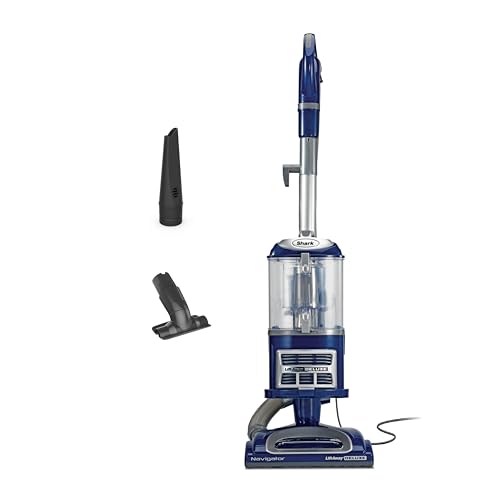
Shark Navigator Lift-Away NV360 delivers powerful suction with HEPA filtration and swivel steering. Perfect for pet hair and allergens. See full expert review.
4. Shark Navigator Lift-Away Speed ZU561 Upright Vacuum
Rating: 4.4/5 | Type: Upright
View the Shark Navigator ZU561
The Shark ZU561 is the upgraded Lift-Away option and brings a key additional feature that matters directly for Persian rug care: an adjustable suction control slider. On a Persian rug, you need both the ability to turn the brushroll completely off and the ability to reduce suction from maximum. The ZU561 provides both. The suction slider lets you dial power up or down mid-session, transitioning from a moderately powered pass across the rug field to lighter suction near fringe sections without stopping or switching modes.
The self-cleaning brushroll is the headline feature of this model, and while it has no relevance during Persian rug cleaning (since you will have the brush switched off), it is genuinely valuable in a household where the same vacuum is also used on carpet or upholstery. The brushroll maintains itself during those cleaning sessions, ensuring you always have a fully operational vacuum rather than a clogged or reduced-performance one.
The Lift-Away pod delivers the same portable suction capability as the NV360, allowing you to detach for fringe-section work and edge detail. The Anti-Allergen Complete Seal with HEPA filtration performs at the same 99.9% particle capture level. The ZU561 weighs approximately 13.5 pounds — slightly lighter than the NV360 — and its LED headlights illuminate the rug surface during cleaning, revealing fine dust and debris that would otherwise be invisible against the rug pattern. At its moderate price premium over the NV360, the dual controls (brush shutoff plus suction adjustment) justify the difference for serious rug owners.
Why it works for Persian rugs: Both brushroll shutoff and adjustable suction control, Lift-Away fringe-cleaning capability, HEPA sealed filtration, LED headlights for detail visibility, self-cleaning brush for mixed household use.
Specifications: Upright | Brushroll Shutoff + Suction Slider | Self-Cleaning Brushroll | Anti-Allergen HEPA Seal | 13.5 lbs | LED headlights | 0.8-qt dust cup | Corded
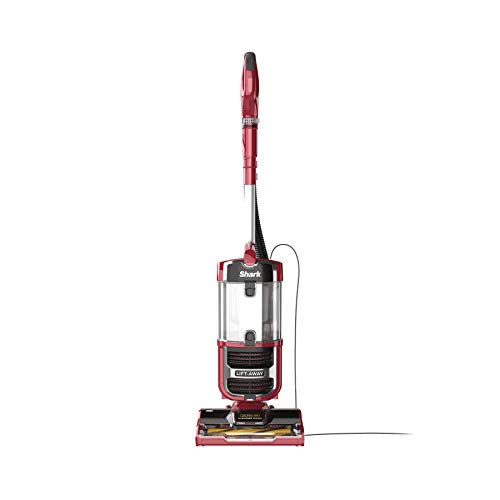
Shark Navigator Lift-Away Speed ZU561 with self-cleaning brushroll and HEPA filter. Lightweight upright vacuum for pet hair on carpets and hard floors.
5. Shark Rotator Lift-Away LA502 Upright Vacuum
Rating: 4.3/5 | Type: Upright
The Shark LA502 is the most technically sophisticated upright in this selection and the right choice for households with both Persian rugs and particularly demanding everyday carpet. Its DuoClean PowerFins dual-brushroll system is the performance feature that distinguishes it: the PowerFin roller and soft roller combination delivers thorough cleaning on carpets and hard floors during regular household use. For Persian rug sessions, this system is switched off entirely — the LA502’s brushroll shutoff disables the DuoClean system completely, and the vacuum operates in suction-only mode.
The HEPA filtration with Anti-Allergen Complete Seal traps 99.9% of particles. At 12.3 pounds it is the lightest full-feature upright in this lineup, which matters for the careful, deliberate cleaning movements that Persian rug vacuuming requires. A lighter vacuum is easier to control, applies less downward pressure to the rug surface when in use, and causes less rug displacement. The Lift-Away pod with easy-release foot pedal allows one-handed conversion to portable canister mode — useful for detailed fringe work and edge cleaning where the full upright configuration is too large to maneuver precisely.
The included crevice tool and upholstery tool provide suction-only cleaning options for rug borders and fringe sections. Swivel steering makes it easy to work across the full width of a large rug without repositioning your body repeatedly. For a household that wants one high-performance vacuum that genuinely serves both aggressive everyday carpet cleaning and careful Persian rug maintenance, the LA502 provides that range more successfully than anything else in this price category.
Why it works for Persian rugs: Brushroll shutoff disables DuoClean system completely, lightest upright at 12.3 lbs for better surface control, Lift-Away pod for fringe work, HEPA sealed filtration, superior everyday performance when brush is active.
Specifications: Upright | DuoClean PowerFins with Brushroll Shutoff | Anti-Allergen HEPA Seal | 12.3 lbs | Swivel steering | LED headlights | Corded

Shark Rotator Lift-Away LA502 upright vacuum with DuoClean PowerFins, HEPA filtration, and self-cleaning brushroll for pet hair. Expert review and full specs.
Persian Rug Vacuuming Schedule and Care Guide
How Often to Vacuum a Persian Rug
The correct frequency depends on the rug’s location and use:
- Low-traffic areas (bedrooms, formal rooms): Once every one to two weeks.
- Moderate-traffic areas (living rooms, dining rooms): Once a week.
- High-traffic entries and hallways: Two to three times per week, but use particularly gentle settings and alternate direction frequently.
Over-vacuuming at high frequency with an improperly configured vacuum causes more cumulative damage than under-vacuuming. When in doubt, vacuum less frequently with proper settings rather than more frequently with aggressive settings.
Direction of Pile
Before vacuuming a Persian rug, determine its pile direction by running your hand across the surface in both directions. In one direction, the pile feels smooth and the rug looks brighter or more lustrous. In the other direction, the pile feels rough and the rug looks slightly darker. The smooth direction is “with the pile.” The rough direction is “against the pile.”
Vacuum with the pile for routine maintenance — it removes dust effectively and causes the least stress on knot structure. Occasionally vacuum against the pile (perhaps once a month) to dislodge embedded particles that have settled at the base of the pile. Never vacuum exclusively against the pile, and always follow any against-the-pile pass with a with-the-pile pass to restore the pile lay.
Handling the Fringe
The fringe sections at each end of the rug should be vacuumed separately and carefully:
- Switch to your vacuum’s bare hose end or a suction-only attachment (no brush of any kind).
- Reduce suction to its minimum effective level — enough to lift dust but not enough to pull individual threads.
- Hold the hose end slightly above the fringe, not pressed directly onto it.
- Move slowly along the fringe in a direction parallel to the threads, not perpendicular to them.
- Never allow the hose to seal directly against the fringe — maintain a small air gap to prevent individual threads from being pulled into suction.
If your fringe is already loose or damaged, stop vacuuming it until you can have it professionally assessed. Continued vacuuming of loose fringe accelerates structural damage to the rug border.
Professional Cleaning Frequency
Even with careful regular vacuuming, Persian rugs accumulate deep-set grit, body oils, and particulate matter that vacuum cleaning cannot fully remove. Professional hand washing by a qualified rug cleaning specialist is recommended every three to five years for most household rugs. Rugs in high-traffic areas or homes with pets may benefit from professional cleaning every two years.
Do not use residential carpet cleaning equipment, steam cleaners, or wet-extraction machines on Persian rugs. The combination of water, heat, and mechanical pressure these machines apply will cause dye migration, shrinkage, and foundation distortion that professional restorers may not be able to fully correct.
Frequently Asked Questions
Can you vacuum a Persian rug at all?
Yes, you can and should vacuum a Persian rug regularly — but only with the right technique and the right equipment. Regular vacuuming with proper settings removes the fine grit and dust particles that, if left to accumulate, work their way down to the rug’s cotton foundation and act as an abrasive every time the rug is walked on. The key is using suction only (no rotating brush), appropriate suction level for the pile density, and keeping all mechanical components away from the fringe. Done correctly, vacuuming extends the life of a Persian rug. Done incorrectly, it destroys it.
How often should a Persian rug be vacuumed?
For most household settings, once a week in rooms with regular foot traffic, and once every one to two weeks in low-traffic rooms. Frequency should be reduced rather than increased if you notice any pile distortion, fringe loosening, or color change in the vacuum’s dust cup that suggests dye abrasion is occurring. Vacuum less with proper settings rather than more with improper ones.
Is it safe to vacuum the fringe on a Persian rug?
Only with specific precautions. The fringe should never come into contact with a rotating brush roll under any circumstances. Using the bare hose end or a gentle suction-only attachment with reduced suction, held slightly above and parallel to the fringe, is generally safe. Alternatively, the fringe can be left unvacuumed and instead straightened by hand or cleaned by a professional as part of periodic rug washing. Many rug conservators recommend leaving fringe to professional cleaning entirely and excluding it from home vacuuming.
What is the difference between cleaning wool and synthetic Persian-style rugs?
Hand-knotted wool rugs require the gentlest approach: suction only, minimal suction power, no brush roll contact. Machine-made synthetic rugs (which are sold as “Persian-style” or “Oriental-inspired” and are far more common at lower price points) are generally far more durable and tolerant of standard vacuum settings. The key identifier, as discussed in the body of this guide, is whether the rug is hand-knotted (pattern visible on the back) or machine-made (backing material visible on the back). Treat any rug with a hand-knotted back as delicate, regardless of whether it is labelled as Persian, Oriental, Turkish, Indian, or any other origin.
Will a robot vacuum damage a Persian rug?
Almost certainly yes, for any rug of significant value. Robotic vacuums are designed to operate at fixed suction levels with continuously running brush rolls, and their navigation systems do not distinguish between a $5,000 hand-knotted Persian rug and a $50 machine-made area rug. Fringe is a particular hazard — a robot vacuum encountering rug fringe will pull it into its brush and either stop with the fringe tangled around the mechanism, or continue until it tears the fringe free. Even on the pile field, the continuous brush roll action of a robot vacuum applied repeatedly to the same hand-knotted surface causes cumulative damage that is not immediately visible but becomes apparent over months and years.
Should you shake or beat a Persian rug instead of vacuuming?
Shaking and beating are traditional cleaning methods that predate modern vacuums, and they remain effective at removing deeply embedded grit from hand-knotted rugs. Taken outside and beaten with a clean rug beater or the back of a broom, a Persian rug releases particles that accumulate near the foundation — particles that no home vacuum can fully extract. This is not a replacement for regular vacuuming (which handles surface dust far more efficiently) but a useful supplement every few months for rugs under heavy use. Never beat a rug on the pile side — only on the back.
Can you use a vacuum with strong suction on a Persian rug if you turn the brush off?
Brush shutoff is necessary but not sufficient for Persian rug safety. Even with the brush fully off, excessive suction can pull pile fibers upward and stress the knot structure, particularly in antique rugs with lower knot density and older, more brittle fiber. Adjustable suction is the second required feature. A vacuum with brush shutoff but no suction control should be used at its lowest effective setting, and any sign of the rug surface lifting or distorting during vacuuming is a signal to reduce suction further or switch to a lighter attachment.
Conclusion
The right vacuum for a Persian rug is not the most powerful vacuum or the most feature-rich one. It is the vacuum that gives you the most precise control over the two variables that determine rug safety: brush contact and suction level.
Of the five vacuums reviewed here, the Eureka NEN180 offers the most granular suction control at the most accessible price, making it the canister recommendation for dedicated rug care. The Kenmore Elite 81714 is the premium canister option for households that also need sealed HEPA performance for allergen management. Among uprights, the Shark ZU561 stands out for having both brush shutoff and an adjustable suction slider — the critical dual-control combination that makes it genuinely safe for Persian rug use without compromise.
What all five share is the feature set that actually protects hand-knotted rugs: the ability to stop the brush roll completely, the ability to reduce suction to an appropriate level, and filtration good enough to contain what the rug releases during cleaning. Applied with the technique described in this guide — with the pile, avoiding the fringe, at appropriate frequency — any of these vacuums will extend the life and preserve the beauty of a Persian rug for decades.
The rugs themselves, built to last generations, deserve exactly that level of care.
Ready to Find Your Perfect Vacuum?
Browse our expertly reviewed vacuum cleaners and make an informed decision
Browse All Vacuums