Best Vacuum for Pollen Allergies 2026: True HEPA Filtration Picks
Best vacuums for pollen allergies with true HEPA filtration and sealed systems to capture and contain pollen particles effectively.
Table of Contents
- Best Vacuum for Pollen Allergies 2026: True HEPA Filtration Picks
- What Pollen Does Inside Your Home
- True HEPA vs. HEPA-Style: The Difference That Decides Everything
- Key Features to Look for in a Pollen Allergy Vacuum
- The 6 Best Vacuums for Pollen Allergies in 2026
- Quick Comparison: Pollen Allergy Vacuums at a Glance
- Pollen Season Vacuuming Tips
- Frequently Asked Questions
Best Vacuum for Pollen Allergies 2026: True HEPA Filtration Picks
Pollen season arrives and, within days, every surface in your home is coated in a fine yellow-green film you cannot quite see but absolutely feel. Windows you cracked open for an hour let in millions of pollen grains. Your shoes and clothing drag it across every floor you walk on. Your pet rolls in it outside and delivers it straight to the couch. Pollen does not stay outside — it settles onto carpets, upholstery, bedding, and hard floors, and it waits there for your immune system to find it.
Vacuuming during pollen season sounds like the logical response. And it is — but only if your vacuum is actually designed to capture and contain pollen rather than recirculate it. Most vacuums do a reasonable job collecting pollen from surfaces. The problem comes at the exhaust. A vacuum without a sealed HEPA system aerosolizes a portion of everything it collects, launching fine pollen particles back into the breathing zone. For someone with a pollen allergy, this transforms a cleaning session into a prolonged allergen exposure event.
This guide explains exactly what pollen does inside your home, what vacuum features matter for containing it, the important distinction between True HEPA and HEPA-style filters, and which specific models will genuinely reduce your pollen burden rather than redistribute it.
What Pollen Does Inside Your Home
Tree pollen grains typically range from 10 to 100 micrometers in diameter — large enough to settle quickly out of outdoor air, but small enough to ride clothing fibers, pet fur, and shoe soles through your front door without resistance. Grass pollen tends to run 25 to 35 micrometers. Ragweed, the most aggressive allergenic pollen in North America, measures approximately 17 to 19 micrometers.
Once indoors, pollen concentrates in predictable places. Entry zones — doormats, hallways, and foyers — accumulate the heaviest deposits. Carpets act as reservoirs because their fiber structure traps pollen grains at depths beyond what light foot traffic disturbs. Upholstered furniture, particularly near windows and doors, collects pollen that drifts in on air currents. Hard floors accumulate pollen near baseboards and under furniture where air movement is minimal.
Every time someone walks across a pollen-contaminated carpet, sits on the couch, or opens a door, a burst of pollen becomes briefly airborne. This is called resuspension, and it is why pollen allergy sufferers often feel worse indoors during high-pollen periods even without any obvious source of fresh exposure. The allergen load has been building in floors and soft furnishings for weeks.
Vacuuming disrupts this accumulated reservoir — which is exactly what you want — but a vacuum without proper sealed filtration re-aerosolizes fine pollen fragments as fast as it captures the larger grains. The net result can be a temporary spike in airborne allergen levels immediately following a vacuuming session.
True HEPA vs. HEPA-Style: The Difference That Decides Everything
This distinction is arguably the most important technical concept for allergy sufferers to understand before purchasing a vacuum, and it is frequently obscured by marketing language.
True HEPA (High Efficiency Particulate Air) is a specific, defined standard. To meet it, a filter must capture at least 99.97% of airborne particles at 0.3 micrometers in diameter — the so-called “most penetrating particle size” (MPPS) at which particle capture efficiency is at its minimum. Pollen grains, which are typically 15 to 100 micrometers, are vastly larger than 0.3 microns, meaning a True HEPA filter captures them at even higher efficiency, often exceeding 99.99%. A True HEPA filter bears a certification confirming it meets this standard, and it is labeled accordingly.
HEPA-style, HEPA-type, or HEPA-like filters are marketing terms with no regulatory definition. They may capture particles at substantially lower efficiency — 85%, 90%, or somewhere in that range — at particle sizes that are never precisely specified by the manufacturer. For large pollen grains, a HEPA-style filter will capture the majority. But for the sub-20 micrometer fragments that become airborne when pollen grains break apart, efficiency drops considerably. These fine pollen fragments, called pollen-food allergy syndrome allergens by researchers, are the particles most likely to reach the lower respiratory tract.
The sealed system is equally important. A vacuum with a genuine True HEPA filter installed in a leaky housing is not a sealed HEPA system. Air under suction pressure will find every gap in the housing, every poorly gasketed joint, and route fine particles around the HEPA media entirely. Look explicitly for language like “sealed system,” “Anti-Allergen Complete Seal,” or “whole-machine HEPA filtration” — language that confirms the entire airflow path is sealed so all exhaust air must pass through the HEPA filter before leaving the machine.
The combination you need: True HEPA certification + sealed housing = genuine allergen containment.
Key Features to Look for in a Pollen Allergy Vacuum
Sealed HEPA filtration. As explained above, the filter and the housing must work together. Neither alone is sufficient.
Strong motorized brush roll for carpet. Pollen embedded in carpet fibers requires mechanical agitation to dislodge, not just suction. Upright and canister vacuums with powered brush rolls outperform cordless stick models for carpet allergen extraction. If you have significant carpet coverage, this matters more than portability.
Whole-home coverage versatility. Pollen does not confine itself to floors. Attachments for upholstery, crevice cleaning, and above-floor surfaces allow you to address every pollen-accumulating surface in a single cleaning session. A Lift-Away pod or flexible hose with attachments dramatically increases a vacuum’s pollen-removal effectiveness.
Large dust cup capacity. During peak pollen season, the sheer volume of material you remove from floors increases significantly. A larger dust cup means fewer interruptions to empty, which reduces the number of times you must open the vacuum and risk releasing collected allergens.
Hygienic emptying. Every time you empty a bagless dust cup, you briefly expose collected pollen to the air. One-touch emptying mechanisms that deposit debris directly into a sealed trash bag minimize this exposure window.
Washable filters. Pollen loads a filter faster than ordinary household dust. A washable HEPA filter means you can maintain filtration efficiency through peak season without repeatedly purchasing replacement filters.
The 6 Best Vacuums for Pollen Allergies in 2026
These six vacuums were selected based on the presence of True HEPA filtration within a genuinely sealed system, overall suction performance for carpet and hard floors, whole-home cleaning versatility, and verified customer ratings from thousands of real households.
1. Shark NV501 Rotator Professional Lift-Away Upright Vacuum
Rating: 4.4/5 (44,242 reviews)
View the Shark NV501 Rotator on VacuumExperts
The Shark NV501 Rotator is one of the most validated upright vacuums available for allergen control, with over 44,000 verified ratings and a consistent 4.4-star average that reflects years of real-world performance across allergy-sensitive households. Its Anti-Allergen Complete Seal Technology pairs with a true HEPA filter to trap 99.9% of dust and allergens as small as 0.3 microns — and critically, the sealed housing ensures every particle the vacuum captures stays inside rather than leaking back through housing gaps.
For pollen season, the NV501’s Lift-Away functionality is genuinely valuable. Press a button and the canister pod detaches from the floor nozzle, giving you a portable cleaning unit that can reach upholstery, drapery, shelves, and window ledges — all of the above-floor surfaces where pollen accumulates in the hours after it blows in. The included wide upholstery tool, dusting brush, and crevice tool cover virtually every surface where pollen settles.
Advanced swivel steering makes navigating around furniture effortless, and LED headlights mounted on the nozzle illuminate pollen deposits in shadowy areas under furniture that you would otherwise miss. At 4.4 stars across tens of thousands of ratings, the NV501 earns its reputation as the most cost-effective sealed HEPA upright available.
Best for: Households prioritizing a proven sealed-HEPA system across both carpet and hard floors with above-floor cleaning versatility.
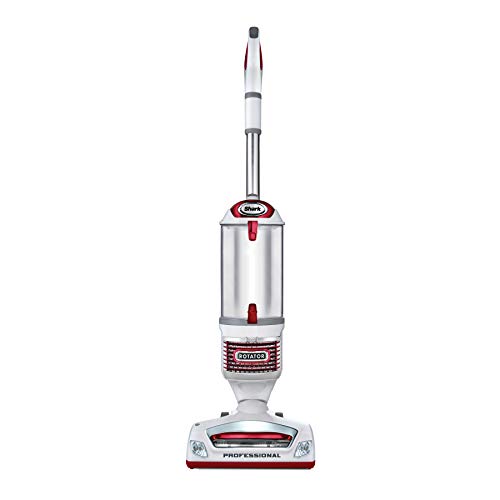
Shark NV501 Rotator Professional Lift-Away upright vacuum features HEPA filtration, swivel steering, LED headlights, and a detachable pod for portable cleaning.
2. Shark Navigator Lift-Away Deluxe NV360 Upright Vacuum
Rating: 4.4/5 (52,141 reviews)
View the Shark NV360 Navigator on VacuumExperts
With over 52,000 ratings — the largest verified review base of any vacuum on this list — the Shark Navigator NV360 has established itself as one of the most trusted allergy vacuums at its price point. The HEPA-sealed Anti-Allergen Complete Seal system traps 99.9% of dust and allergens, and the fully sealed housing prevents pollen from leaking back out through gaps during operation or when the machine vibrates.
The NV360’s brushroll shutoff is an important feature for mixed-surface pollen control. With the brushroll engaged, the vacuum digs into carpet fibers to extract embedded pollen. With the brushroll disengaged, it glides across hardwood, tile, and laminate — capturing pollen that has settled near baseboards and in low-traffic areas — without scattering lightweight pollen grains ahead of the cleaning head.
The 0.9-quart dust cup provides adequate capacity for a full cleaning session, and the Lift-Away pod detaches for portable above-floor cleaning. At approximately 16 pounds, it is not the lightest option, but for a corded sealed-HEPA upright at this price tier, it represents exceptional value for pollen-season cleaning.
Best for: Budget-conscious allergy sufferers who want a proven sealed HEPA system with the largest community of verified user feedback available.
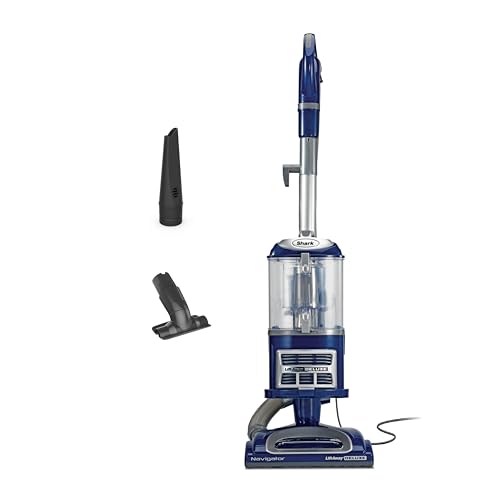
Shark Navigator Lift-Away NV360 delivers powerful suction with HEPA filtration and swivel steering. Perfect for pet hair and allergens. See full expert review.
3. Shark Rotator Pet Upright Vacuum ZU102
Rating: 4.4/5 (12,979 reviews)
View the Shark Rotator ZU102 on VacuumExperts
The Shark Rotator ZU102 raises the filtration specification one level above the NV360 and NV501 — its Anti-Allergen Complete Seal with HEPA captures 99.99% of dust and allergens, a meaningful step up for households where pollen loads are severe. The sealed system architecture is identical to other Shark models in this lineup: every airflow pathway is sealed so exhaust passes exclusively through the HEPA media.
The ZU102’s PowerFins HairPro brushroll, designed primarily for pet hair, has a secondary benefit for pollen control: its fin-shaped paddles maintain continuous contact with carpet surfaces, agitating fibers more thoroughly than conventional bristle rolls and dislodging embedded pollen grains that suction alone cannot reach. The self-cleaning mechanism keeps the brushroll clear during extended cleaning sessions.
The 2.9-liter 3XL dust cup capacity is the largest of any model in this comparison, which is practically important during pollen season when the volume of material removed from floors increases substantially. An extendable hose provides up to 12 feet of reach for above-floor cleaning of upholstered furniture, drapery, and window ledges where pollen collects. Swivel steering enables smooth navigation through furnished rooms.
Best for: High-pollen households with heavy carpet coverage that need the highest Shark filtration rating (99.99%) and maximum dust cup capacity for extended sessions.

Shark Rotator Pet ZU102 upright vacuum with PowerFins HairPro self-cleaning brushroll, Odor Neutralizer Technology, HEPA filtration, and 3XL dust cup.
4. Bissell Pet Hair Eraser Allergen Lift-Off Upright Vacuum 39883
Rating: 4.5/5 (1,804 reviews)
View the Bissell Pet Hair Eraser Allergen Lift-Off on VacuumExperts
The Bissell Pet Hair Eraser Allergen Lift-Off 39883 earns the highest rating of any model on this list at 4.5 stars. Its HEPA Sealed Allergen System is not merely a HEPA filter inserted into a standard housing — the entire vacuum system is sealed so captured pollen, dust, and allergens stay locked inside. This design philosophy is particularly important for pollen allergy sufferers because a sealed system prevents the fine pollen fragments that break apart inside the dust cup from migrating back through housing seams during operation.
Bissell’s Scatter-Free Technology addresses a common frustration when vacuuming pollen from hard floors: the airflow pattern of many vacuums blows lightweight pollen grains forward ahead of the cleaning head instead of capturing them. Scatter-Free Technology uses controlled airflow to capture debris on hard surfaces without this scattering effect, meaning each pass actually removes pollen rather than repositioning it.
The XL 1-liter dirt tank with one-touch emptying allows for extended pollen-season cleaning sessions, and the Lift-Off detachable pod with extension wand provides portable access to stairs, furniture, and above-floor surfaces. The included TurboEraser Pet Tool is a motorized attachment that extracts pollen embedded in upholstery fibers — a critical surface for pollen accumulation that most floor-only vacuums completely miss.
Best for: Households that need Scatter-Free Technology for hard floor pollen control alongside a sealed HEPA system, with the highest overall user rating in this comparison.

Bissell Pet Hair Eraser Allergen Lift-Off with HEPA filtration, tangle-free brush roll, and scatter-free tech. Built for pet owners. See our expert review.
5. Shark AZ2002 Vertex Powered Lift-Away Upright Vacuum
Rating: 4.3/5 (10,240 reviews)
View the Shark AZ2002 Vertex on VacuumExperts
The Shark AZ2002 Vertex is Shark’s most powerful upright vacuum, and that additional power makes it the strongest choice on this list for households with deep-pile or high-traffic carpet where pollen has settled deep into fiber structures over multiple weeks of accumulation. Its Anti-Allergen Complete Seal with HEPA filtration matches the sealed architecture of the NV501 and NV360, trapping allergens at 99.9% efficiency in a fully sealed airflow path.
The DuoClean PowerFins system is the performance differentiator. Two brushrolls work in tandem: a soft front roller engages hard floors to capture fine pollen particles without scattering them, while the PowerFins brushroll digs deep into carpet fibers with greater agitation than a conventional single-brush design. For households that have gone several weeks without deep vacuuming — common in the early weeks of spring pollen season before symptoms prompt action — this dual-brushroll system removes significantly more embedded pollen per pass than standard designs.
The Powered Lift-Away mode is the Vertex’s most distinguishing feature compared to standard Lift-Away models: when you detach the pod, the brushroll remains motorized. This means under-furniture cleaning retains full agitation power rather than relying on passive suction alone, which matters when you are targeting pollen deposits beneath sofas and low-clearance furniture. LED headlights reveal hidden pollen accumulation along baseboards and under furniture in low-light areas.
Best for: Larger homes with heavily trafficked carpet who need maximum extraction power and full motorized cleaning under furniture.

Shark AZ2002 Vertex upright vacuum with DuoClean PowerFins, self-cleaning brushroll, Powered Lift-Away, and HEPA filtration. Ultimate power for pet hair and deep cleaning.
6. Dyson Ball Animal 3 Upright Vacuum
Rating: 4.2/5 (2,341 reviews)
View the Dyson Ball Animal 3 on VacuumExperts
The Dyson Ball Animal 3 represents a different engineering philosophy from the Shark models above, but arrives at the same destination for pollen control. Its whole-machine HEPA filtration system is a sealed architecture in which all air drawn into the machine — from the floor nozzle, through the cyclone separator, past the motor, and out the exhaust — passes through the HEPA filter. No internal pathways bypass the HEPA stage. This is the definition of a genuinely sealed whole-machine HEPA system.
The Radial Root Cyclone technology separates particles from the airstream through centrifugal force before they reach the filter, which maintains consistent suction throughout cleaning sessions by reducing filter clogging. During peak pollen season, when the volume of material being vacuumed is highest, this pre-separation step helps the Dyson maintain strong suction where lesser vacuums begin to weaken as the filter loads up.
At 290 air watts, the Ball Animal 3 delivers the highest suction measurement of any model on this list, translating to superior pollen extraction from deep-pile carpet and high-traffic areas. The de-tangling Motorbar cleaner head transitions seamlessly between carpet and hard floors, and Ball technology steering enables smooth navigation around furniture with minimal physical effort. The three suction modes allow you to dial up maximum power for contaminated carpets and dial back for delicate area rugs.
At approximately 17.3 pounds it is the heaviest model here, and the premium price reflects Dyson’s engineering. For households that demand the highest suction performance with a whole-machine sealed HEPA system, the Ball Animal 3 is the most powerful pollen-control vacuum on this list.
Best for: Large homes with deep-pile carpet and high pollen loads that demand maximum suction alongside a premium whole-machine sealed HEPA system.

Dyson Ball Animal 3 upright vacuum delivers 290AW suction with de-tangling Motorbar head, Ball technology steering, 3 suction modes, and HEPA filtration.
Quick Comparison: Pollen Allergy Vacuums at a Glance
| Model | Filtration | Sealed System | Rating | Best For |
|---|---|---|---|---|
| Shark NV501 Rotator | Anti-Allergen Complete Seal + HEPA | Yes | 4.4/5 | Best overall value, 44K reviews |
| Shark NV360 Navigator | HEPA Anti-Allergen Complete Seal | Yes | 4.4/5 | Budget pick, 52K reviews |
| Shark Rotator ZU102 | Anti-Allergen Complete Seal HEPA (99.99%) | Yes | 4.4/5 | Highest Shark filtration rating |
| Bissell Allergen Lift-Off 39883 | HEPA Sealed Allergen System | Yes | 4.5/5 | Highest user rating overall |
| Shark Vertex AZ2002 | Anti-Allergen Complete Seal + HEPA | Yes | 4.3/5 | Maximum carpet extraction power |
| Dyson Ball Animal 3 | Whole-machine HEPA | Yes | 4.2/5 | Highest suction, premium pick |
Pollen Season Vacuuming Tips
Vacuum in the morning before air circulation peaks. Outdoor pollen counts are typically highest in the late morning and early afternoon on dry, windy days. If you leave windows open at any point, pollen enters the home primarily during this window. Vacuuming in the early morning before you open windows — or immediately after you close them — removes the previous day’s accumulation before fresh pollen enters.
Increase vacuuming frequency to every two to three days. During ordinary months, weekly vacuuming is adequate for most households. During peak pollen season — typically March through June for trees, May through August for grasses, and August through October for ragweed — the rate of pollen accumulation outpaces weekly cleaning. Every two to three days is a more appropriate interval for allergy sufferers during peak season.
Wear a mask while vacuuming. This recommendation seems counterintuitive if you have a sealed HEPA vacuum, but the act of the vacuum head disturbing carpet fibers briefly resuspends particles that have not yet been collected. Even with sealed HEPA exhaust, the turbulence at the cleaning head creates a brief local aerosol of dislodged debris. An N95 or KN95 mask eliminates this exposure almost entirely. Leave the room for 20 to 30 minutes after vacuuming to allow any resuspended particles to settle.
Vacuum upholstered surfaces, not just floors. Sofas, armchairs, ottomans, and fabric headboards accumulate pollen at similar rates to carpeted floors. If your vacuum does not include an upholstery attachment, a significant portion of the household pollen load remains untouched by your cleaning routine. Every model on this list includes appropriate above-floor attachments — use them.
Empty the dust cup outside. Even with a sealed HEPA system, opening the dust cup releases some captured material into the immediate air. Empty the dust cup directly into a trash bag outside your home, or at minimum over a trash can immediately before tying the bag and removing it. Never shake the dust cup or blow into it.
Close windows and doors for at least two hours before vacuuming. Vacuuming with windows open during high pollen periods means the air being exhausted by your vacuum — even HEPA-filtered air — is being replaced by pollen-laden outdoor air. Let the indoor environment settle before cleaning.
Replace or wash your vacuum filter before pollen season begins. A partially clogged HEPA filter operates at reduced filtration efficiency and reduces suction, both of which compromise pollen control. Starting pollen season with a clean filter is a simple step with a measurable impact on performance.
Frequently Asked Questions
Do I need a True HEPA vacuum specifically for pollen, or will any HEPA vacuum work?
You need True HEPA certification plus a sealed system. Pollen grains themselves are large (15 to 100 microns) and are captured by even modest filtration. The problem is sub-20 micrometer pollen fragments — broken pieces of pollen grains that become airborne during vacuuming — which are far more penetrating. True HEPA filtration at 99.97% efficiency for 0.3-micron particles captures these fragments effectively. A “HEPA-style” filter with unspecified, lower efficiency does not.
Can I use a robot vacuum during pollen season instead of an upright?
Robot vacuums are useful for daily maintenance — capturing fresh pollen before it embeds deeply — but most current robot vacuum models do not offer sealed HEPA filtration systems comparable to the upright vacuums on this list. For thorough weekly deep cleaning during peak pollen season, a sealed HEPA upright with a motorized brush roll removes significantly more pollen from carpet than a robot vacuum. Using both in combination — robot for daily surface maintenance, sealed HEPA upright for twice-weekly deep cleaning — provides the most comprehensive control.
Is a bagless or bagged vacuum better for pollen allergies?
Both can be effective with appropriate design. Bagged vacuums with sealed HEPA bags allow you to remove the entire bag without opening it, which minimizes allergen release during disposal. Bagless vacuums require you to open the dust cup, which releases some captured material regardless of design quality. If you choose bagless, look for one-touch emptying that deposits contents into a trash bag without requiring you to handle the cup directly, and empty outdoors.
How often should I replace the HEPA filter?
Most manufacturers recommend replacing sealed HEPA filters every 12 months under normal use. During pollen season, filter loading accelerates — if you notice a reduction in suction or the filter appears heavily coated, wash it (if washable) or replace it sooner. Always allow a washed filter to dry completely for a minimum of 24 hours before reinstalling. A damp filter placed back in a vacuum creates conditions for mold growth and can damage the motor.
Does vacuuming make pollen allergies worse?
Vacuuming with a sealed HEPA vacuum consistently reduces the total pollen burden in your home and improves long-term symptom control. The brief local resuspension of pollen at the cleaning head during vacuuming can cause temporary symptom spikes, which is why wearing an N95 mask during vacuuming and leaving the room for 20 to 30 minutes afterward is recommended. With proper precautions, regular vacuuming with a sealed HEPA machine is one of the most effective steps an allergy sufferer can take to reduce indoor allergen loads.
Can pollen from outside come back into the home after I vacuum?
Yes, and this is why closing windows and doors before vacuuming matters. The pollen you remove is replaced quickly if the home is open to outdoor air during high-pollen periods. For maximum effectiveness, vacuum with windows closed, keep windows closed for several hours around peak pollen times (typically mid-morning to early afternoon), and change outdoor clothing when entering the home during high-pollen days.
Will any vacuum on this list capture pollen from hard floors without blowing it around?
The Bissell Pet Hair Eraser Allergen Lift-Off 39883 has the most explicit hard-floor anti-scatter design with its Scatter-Free Technology. The Dyson Ball Animal 3’s motorized Motorbar head also transitions effectively to hard floors without significant scatter. On any upright vacuum, disengaging the brushroll when transitioning to hard floors reduces scatter by eliminating the turbulence created by the spinning brush.
Pollen season is not a condition you simply endure. The right sealed HEPA vacuum, used with appropriate frequency and technique, measurably reduces the allergen load in your home — which translates directly into reduced symptom frequency and severity. Every model on this list offers genuine sealed-system HEPA filtration backed by thousands of verified reviews. The right choice depends on your floor types, home size, and budget, but any of the six will deliver a level of pollen control that standard vacuums simply cannot match.
Ready to Find Your Perfect Vacuum?
Browse our expertly reviewed vacuum cleaners and make an informed decision
Browse All Vacuums