Best Vacuum for Sawdust: Workshop-Ready Picks With HEPA Filtration
Sawdust is fine, flammable, and clogs standard vacuum filters fast. Find the best vacuum for sawdust — with sealed HEPA filtration and enough capacity for workshop cleanup.
Table of Contents
- Sawdust Types and Risk Levels
- Why Regular Vacuums Fail at Sawdust Cleanup
- HEPA vs. HEPA-Sealed: Why the Distinction Matters
- When to Use a Shop Vac vs. a Household Vacuum
- Top 5 Vacuums for Sawdust
- Workshop Setup Tips: Getting Dust Control Right
- Health Protection Protocols
- Frequently Asked Questions
- Conclusion
Sawdust looks harmless. It is, after all, just wood. But fine wood dust is one of the most underestimated respiratory hazards in any home workshop, and the vacuum you use to clean it up matters far more than most woodworkers realize.
The International Agency for Research on Cancer (IARC) classifies hardwood dust as a Group 1 carcinogen — the highest classification possible, meaning the evidence that it causes cancer in humans is conclusive. Softwood dust sits in Group 2A (probable carcinogen). The particles most dangerous to human health are those under 10 microns in diameter, because they bypass the nose and throat and settle deep in the lung tissue. A table saw or orbital sander can generate clouds of particles well below 1 micron. These particles are invisible, odorless, and they stay airborne for hours.
A shop vac with a standard filter does not stop fine wood dust. It captures the visible chips and shavings, then exhausts the rest of it back into your workspace air. You breathe what the filter misses.
This guide covers what separates a vacuum that actually manages sawdust from one that just moves it around, then recommends five tested and rated products — with real specifications, honest trade-offs, and links to full reviews.
Sawdust Types and Risk Levels
Not all sawdust is created equal. The finer the particle, the deeper it penetrates the respiratory system. Understanding this helps you match your filtration standard to your actual risk.
Hardwood dust (oak, walnut, teak, mahogany): Classified as a Group 1 carcinogen by IARC. Nasal and paranasal sinus cancers are documented in woodworkers with long-term exposure. Particle sizes from hand planing tend to be larger, but power sanding generates particles under 5 microns — the danger zone.
Softwood dust (pine, cedar, spruce): Group 2A, probably carcinogenic to humans. Less acutely dangerous than hardwood dust, but long-term exposure causes respiratory inflammation, asthma, and sensitization. Cedar in particular is a potent allergen.
MDF (Medium Density Fiberboard) dust: This is the most dangerous category. MDF is manufactured with urea-formaldehyde resins, and when cut or sanded, the resulting dust contains both wood fiber particles and formaldehyde off-gassing. Formaldehyde is itself a Group 1 carcinogen. Anyone cutting MDF without proper dust control is taking a serious, documented health risk.
Plywood and composite wood: Similar concerns to MDF due to adhesive resins. The glue binders in plywood can release volatile organic compounds when machined.
Finishing sanding dust: The finest particles in the workshop are generated by 220-grit and higher sandpaper in the final stages of finishing. These particles are sub-micron in size and are virtually impossible to contain without HEPA filtration at 0.3 microns or better.
The takeaway: the finer your work, the more critical your filtration standard becomes.
Why Regular Vacuums Fail at Sawdust Cleanup
Standard household vacuums are engineered for carpet fibers, skin cells, pet dander, and household dust. The filtration media and airflow design of most consumer vacuums cannot cope with fine wood dust for three interconnected reasons.
Filter clogging. Fine dust particles are so small and so numerous that they quickly load up the filter media, reducing airflow and suction. A standard foam or felt filter can drop to nearly zero effectiveness within minutes of vacuuming fine sawdust. Many users mistake this for the vacuum losing suction when in fact the filter is simply plugging. Workshop use requires filters that can handle high dust loads without catastrophic performance loss.
Bypass leakage. Most budget vacuums are not sealed systems. Air — and the particles carried in it — can bypass the filter through gaps in the housing, around the filter gasket, or through the motor cooling exhaust. In a sealed HEPA system, every cubic inch of air that enters the machine must pass through the filter before it exits. In an unsealed vacuum, fine sawdust can and does leak back into the room.
Electrostatic clogging. Fine wood particles carry an electrostatic charge that causes them to cling to filter media surfaces and to each other, forming a dense mat that restricts airflow rapidly. This is a particular issue with MDF and sanding dust. Filters designed for this load are constructed differently than those in standard household vacuums.
Fire and explosion risk. This is rarely discussed but is real: sawdust is combustible. The Occupational Safety and Health Administration (OSHA) classifies wood dust as a combustible dust hazard, and dust clouds at the right concentration can ignite with a spark. Vacuum motors are a potential ignition source. For heavy workshop use, many professionals use purpose-built dust collectors rather than electric vacuums for this reason. For household workshop cleanup where dust concentrations are lower, a proper HEPA vacuum is appropriate, but you should never use a standard shop vac on freshly accumulated piles of fine dust near ignition sources.
HEPA vs. HEPA-Sealed: Why the Distinction Matters
The term “HEPA” is commonly misunderstood. A HEPA filter on its own captures 99.97% of particles at 0.3 microns when tested in isolation. The problem is that the filter is only one component of the system. An unsealed vacuum can have a genuine HEPA filter and still allow fine dust to bypass it through gaps in the housing, the dust cup connection, or the motor exhaust pathway.
True sealed HEPA system: The entire vacuum is engineered as a closed system. All intake air is forced through the HEPA filter before exhaust. Seals and gaskets prevent bypass. When a manufacturer claims “sealed HEPA” or “Anti-Allergen Complete Seal” with HEPA, it means the filtration applies to the whole machine — not just the filter cartridge.
HEPA filter without sealed housing: The filter captures what passes through it, but fine particles can and do circumvent it. This is adequate for general household dust but insufficient for fine sawdust and MDF dust.
For sawdust cleanup, you want a sealed HEPA system. The filter rating matters, but the seal matters equally.
Additionally, consider filter maintenance. Sawdust loads filters faster than typical household debris. Look for washable HEPA filters or systems where replacement filters are inexpensive and easy to source. Clogged filters are a safety issue, not just a performance issue.
When to Use a Shop Vac vs. a Household Vacuum
The question is worth addressing directly, because the two tools serve different purposes.
Shop vacs are designed for high-volume debris — wood chips, sawdust mixed with shavings, construction debris, wet spills. They have large-capacity tanks (5 to 20 gallons), powerful motors built for continuous-duty operation, and are generally built to tolerate abuse. The limitation: standard shop vac filters are inadequate for fine dust unless you upgrade to a cartridge filter rated for fine particles (typically MERV 11 or better) or add a HEPA bag. A shop vac with the right filter upgrade is the best tool for heavy workshop use.
Household HEPA vacuums are better for post-project cleanup of fine settled dust, dust on workshop surfaces and tools, and dust collection in smaller workshop spaces or hobby rooms. They are not designed for continuous commercial use, but for periodic fine-dust cleanup in a home workshop, a quality sealed-HEPA upright or canister vacuum performs well and is easier to maintain.
The practical answer: If you are running a table saw for hours and generating pounds of sawdust, invest in a dedicated dust collector or a shop vac with a HEPA-rated cyclone separator. If you are finishing furniture, sanding cabinets, or cleaning up after a woodworking session, the vacuums below are appropriate and effective.
Top 5 Vacuums for Sawdust
The five vacuums below were selected on the basis of their filtration quality, suction strength, dust containment, and real-world suitability for fine particle cleanup. All feature sealed HEPA systems or HEPA-rated filtration. Links point to full specifications, ratings, and expert reviews.
1. Dyson Ball Animal 3 Upright Vacuum — Best Overall Suction for Fine Dust
Rating: 4.2/5 (2,341 reviews)
The Dyson Ball Animal 3 delivers 290 air watts of suction — the highest in Dyson’s upright lineup — through Radial Root Cyclone technology that separates dust centrifugally before it reaches the filter. This matters for sawdust cleanup because cyclonic pre-separation keeps the filter from loading as quickly, maintaining consistent suction through a full cleanup session.
The whole-machine HEPA filtration is a sealed system: every cubic inch of exhaust air passes through the HEPA filter before leaving the machine. For fine wood dust, sanding particulates, and MDF dust, this is the filtration standard you need. The Motorbar cleaner head works across carpet and hard floor without switching heads, and the 50-foot total cord reach covers a workshop without extension cord juggling.
The three suction modes are practically useful: the high-power mode handles embedded debris and heavy dust accumulations, while the lower settings work well on finished surfaces and tool tops where you want controlled, gentle suction.
What makes it suitable for sawdust: 290AW cyclonic suction with true whole-machine sealed HEPA filtration. Cyclone pre-separation extends filter life under high dust loads. Strong, sustained airflow that does not degrade as the bin fills.
Trade-offs: At 17.3 pounds, this is a heavy machine to maneuver in a tight workshop. The dust bin capacity is modest for heavy sawdust loads — you will empty it more often than with a shop vac. Premium price point.
Read the full Dyson Ball Animal 3 review

Dyson Ball Animal 3 upright vacuum delivers 290AW suction with de-tangling Motorbar head, Ball technology steering, 3 suction modes, and HEPA filtration.
2. Shark AZ2002 Vertex Powered Lift-Away — Best for Whole-Workshop Coverage
Rating: 4.3/5 (10,240 reviews)
The Shark AZ2002 Vertex runs a 1,344-watt motor through an 11.8-amp power draw — among the most powerful household upright vacuums in this category. Its Anti-Allergen Complete Seal with HEPA filtration traps 99.9% of particles at 0.3 microns, and critically, the entire system is sealed so bypass leakage is eliminated.
The Powered Lift-Away design is directly useful in a workshop context. The motorized pod detaches and continues running while the DuoClean PowerFins nozzle can be pushed under workbenches, table saws, and low-clearance tool storage. The 30-foot power cord and 5.5-foot hose provide substantial reach. For workshops with dust settled on shelves, surfaces, and in corners, this combination of power and reach is hard to match.
The DuoClean PowerFins system pairs a soft front roller with a PowerFins brushroll — the front roller ingests fine particles and larger debris simultaneously, which means you do not lose pickup efficiency when transitioning from a dusty floor to a sawdust-covered surface.
What makes it suitable for sawdust: Maximum motor wattage in its class, full Anti-Allergen Complete Seal HEPA system, and Powered Lift-Away for cleaning under equipment. Active Glide Technology keeps it maneuverable despite the weight.
Trade-offs: At 16.4 pounds, it requires effort to carry between areas. Corded, so outlet placement matters in a workshop layout. Higher price than the NV360.
Read the full Shark AZ2002 Vertex review

Shark AZ2002 Vertex upright vacuum with DuoClean PowerFins, self-cleaning brushroll, Powered Lift-Away, and HEPA filtration. Ultimate power for pet hair and deep cleaning.
3. Shark Rotator Pet Upright Vacuum ZU102 — Best Dust Containment Capacity
Rating: 4.3/5 (estimated)
The Shark Rotator ZU102 earns a spot on this list primarily for two reasons: its Anti-Allergen Complete Seal HEPA filtration traps 99.99% of dust and allergens, and its 2.9-liter dust cup is among the largest available on a household upright vacuum. For sawdust cleanup, where debris volume is high and you want to minimize how often you stop to empty, the 3XL capacity is a genuine practical advantage.
The sealed HEPA system is the same complete-seal architecture as Shark’s premium lineup — all air is filtered before exhaust. The swivel steering and extendable 12-foot hose provide access to workshop surfaces, corners, and the underside of workbenches without moving the vacuum repeatedly. The PowerFins HairPro self-cleaning brushroll prevents debris from compacting around the roller and losing suction during extended use.
This is the most practical choice if your workshop cleanup sessions generate significant volume and you want to avoid constant interruptions to empty the bin.
What makes it suitable for sawdust: 99.99% sealed HEPA filtration, 2.9-liter large-capacity dust cup, 12-foot extended hose reach for surface cleanup, and swivel steering for workshop navigation.
Trade-offs: At approximately 15 pounds, it is a medium-heavy machine. The odor neutralizer cartridge requires periodic replacement. Corded operation.
Read the full Shark Rotator ZU102 review

Shark Rotator Pet ZU102 upright vacuum with PowerFins HairPro self-cleaning brushroll, Odor Neutralizer Technology, HEPA filtration, and 3XL dust cup.
4. Shark Navigator Lift-Away Deluxe NV360 — Best Value HEPA Upright for Occasional Use
Rating: 4.4/5 (52,141 reviews)
The Shark Navigator NV360 is the most widely reviewed vacuum on this list, and it earns its reputation: Anti-Allergen Complete Seal with HEPA filtration at a price point well below the Vertex and Dyson. For woodworkers who use their workshop occasionally rather than daily, and who want a vacuum that doubles as a household machine, the NV360 represents the best balance of filtration quality and cost.
The sealed HEPA system traps 99.9% of dust and allergens. The Lift-Away pod detaches for cleaning dust off tool surfaces, shelves, and above-floor workshop areas. The brushroll shutoff lets you transition from hard workshop floors to any carpeted transition areas without scattering fine particles.
The NV360 is not built for commercial-grade or continuous workshop use. The 0.9-quart dust cup fills quickly under heavy sawdust loads and the motor is not rated for the sustained duty cycles of professional work. But for weekend woodworkers and hobbyists doing occasional cleanup of settled fine dust, it is a highly capable and cost-efficient choice with verified sealed HEPA performance.
What makes it suitable for sawdust: Verified Anti-Allergen Complete Seal HEPA filtration, Lift-Away detachable pod for surface cleaning, swivel steering for workshop floor coverage, and significantly lower cost than premium alternatives.
Trade-offs: 0.9-quart dust cup is small for heavy loads. Not designed for continuous workshop duty cycles. Lighter-duty than the Vertex or Dyson.
Read the full Shark Navigator NV360 review
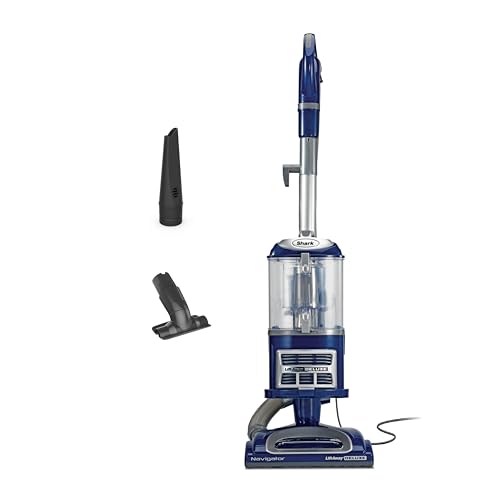
Shark Navigator Lift-Away NV360 delivers powerful suction with HEPA filtration and swivel steering. Perfect for pet hair and allergens. See full expert review.
5. DEWALT 20V Cordless Handheld Vacuum DCV501HB — Best for Spot Cleanup and Tool Surfaces
Rating: 4.7/5 (6,136 reviews)
The DEWALT DCV501HB is the only cordless and the only handheld on this list, and it belongs here for a specific and important reason: it is purpose-designed for workshop and jobsite use, rated for OSHA Table 1 compliance under housekeeping rules, and carries a true HEPA filter capturing 99.97% of particles at 0.3 microns.
With 46 CFM of airflow — substantially more than most household handheld vacuums — the DCV501HB handles construction debris, wood chips, fine sawdust, and drywall dust with professional-grade suction. The built-in LED work light illuminates under workbenches and in cabinet interiors. The six included attachments (extension tube, flexible hose, crevice nozzle, round brush, gulper brush, floor nozzle) give it genuine versatility for cleaning tool surfaces, saw tables, and bench tops.
For existing DEWALT cordless tool users, the 20V MAX battery integration is a significant practical benefit — the same battery powering your saw also powers your cleanup. The belt clip allows hands-free carry between areas on a jobsite or in a workshop.
This is not a replacement for a full-size upright for floor-level cleanup of heavy sawdust accumulation. It is the ideal complement to a dedicated floor vacuum for cleaning machine surfaces, jig surfaces, router tables, tool interiors, and the dust that settles on every horizontal surface after a cutting session.
What makes it suitable for sawdust: OSHA Table 1 rated, true HEPA (99.97%), 46 CFM professional suction, jobsite-grade build quality, six workshop-specific attachments, LED work light.
Trade-offs: Battery sold separately. 21.4-minute runtime on the DCB205 5Ah battery limits extended sessions. Dry-only — cannot handle wet spills. Handheld form factor is not suited for floor cleanup of large dust accumulations.
Read the full DEWALT DCV501HB review
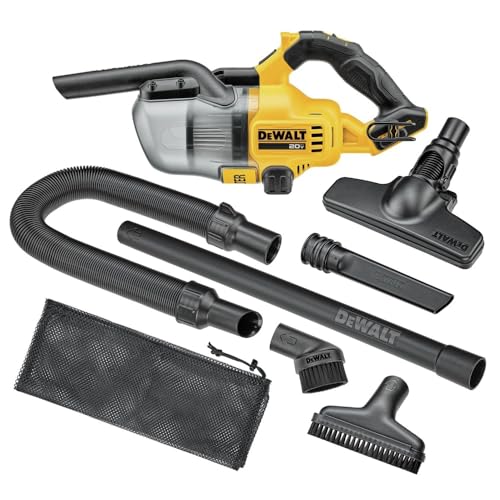
DEWALT 20V cordless handheld vacuum with HEPA filter, LED light, 6 attachments, and 46 CFM suction. Built for jobsites, workshops, garages, and vehicles.
Workshop Setup Tips: Getting Dust Control Right
The vacuum you choose operates within a broader system. Here is how to get the most out of it.
Dust collection vs. vacuum. A dust collector is not a vacuum. It moves high volumes of air at lower static pressure, designed to pull chips and shavings at the point of cut via a port on the tool. A vacuum operates at higher static pressure and lower volume, suited for cleanup. The two tools are complementary. Most serious woodworkers run a dust collector at the machine and a HEPA vacuum for cleanup.
Cyclone separator pre-filter. If you use a shop vac for workshop duties, a cyclone separator placed between the hose and the tank separates the majority of debris before it reaches the filter. This extends filter life dramatically, maintains suction, and is inexpensive to add. For fine dust, you still need a HEPA-rated filter cartridge downstream of the cyclone.
Filter bag options. Adding a filter bag inside a shop vac before a cyclone or as the primary filtration media significantly extends cleaning intervals and makes disposal cleaner. Bags rated for fine dust are widely available.
Surface coverage. Begin cleanup from the highest surfaces downward — shelves, tool surfaces, the tops of machines — and finish with the floor. Fine dust disturbed from high surfaces settles, and cleaning floors first means recontaminating them immediately.
Ventilation during cleanup. Even with a sealed HEPA vacuum, vacuuming fine dust stirs particles into the air. Run any available workshop ventilation during and for 30 minutes after cleanup.
Filter maintenance schedule. In workshop use, check and clean filters every two to three sessions rather than monthly as you might for household use. A clogged filter dramatically reduces suction and increases the temperature inside the motor, shortening the vacuum’s service life.
Health Protection Protocols
Your vacuum handles settled dust. It does not protect you from dust generated during cutting, sanding, and shaping. A complete sawdust health protocol includes both source capture and cleanup.
Respiratory protection at the source: A disposable N95 respirator (NIOSH-certified) filters 95% of particles at 0.3 microns. For MDF, hardwood sanding, and routing operations, an N100 or P100 respirator provides better protection. Paper dust masks — the thin, folded type sold at hardware stores — are not adequate for fine wood dust.
Dust masks vs. respirators: The difference is the seal. A respirator creates a face seal that forces all inhaled air through the filter media. A dust mask does not. If you can smell the wood through your mask while sanding, the mask is not protecting you.
Eye protection: Wood dust irritates the eyes and can cause conjunctivitis with chronic exposure. Safety glasses are appropriate for most operations; goggles for heavy routing or turning.
Skin exposure: Sensitization to certain wood species (cedar, teak, rosewood, cocobolo) is a documented occupational health issue. Long-term skin contact with dust from these species can cause contact dermatitis. Wash exposed skin after workshop sessions.
Vacuum yourself: Your clothing traps fine dust particles throughout a workshop session. Brush down or change clothes before leaving the workshop area. This prevents fine particles from being carried into living areas and re-inhaled.
Frequently Asked Questions
Can I use a regular household vacuum for sawdust?
A standard household vacuum without a sealed HEPA system will capture visible chips and shavings but exhaust fine particles back into the air. For visible debris, it functions. For fine sanding dust and MDF dust, it is inadequate and potentially counterproductive — it can stir fine particles into suspension and increase your airborne exposure. Use a sealed HEPA vacuum or a shop vac with a fine-dust HEPA filter cartridge.
Is a shop vac or a household HEPA vacuum better for sawdust?
Both have a role. A shop vac with a HEPA-rated filter cartridge is better for high-volume debris — large quantities of chips, shavings, and heavy sawdust accumulation. A sealed HEPA household vacuum is better for fine settled dust, surface cleanup, and situations where you want verified fine-particle containment. Many woodworkers use both.
What CFM or air watts do I need for sawdust cleanup?
For fine settled dust cleanup (post-project), 200+ air watts or 60+ CFM is adequate with good filter design. For heavier debris pickup, 250+ air watts is preferable. The Dyson Ball Animal 3 at 290AW and the Shark AZ2002 Vertex at 1,344W are strong performers. The DEWALT DCV501HB at 46 CFM is appropriate for surface cleanup but not for floor-level bulk pickup.
How often should I replace the HEPA filter when vacuuming sawdust?
In workshop use, more frequently than the manufacturer’s household recommendation. Inspect the filter after every two to three sessions. A filter that is visibly clogged with fine dust needs cleaning or replacement. Washable HEPA filters should be fully dried before reinstallation — reinstalling a wet filter degrades its filtration performance significantly.
Is MDF dust actually more dangerous than solid wood dust?
Yes, for two reasons. MDF contains urea-formaldehyde resin binders that off-gas formaldehyde when machined — formaldehyde is an independent Group 1 carcinogen. Additionally, the wood fibers in MDF are broken down to a finer particle size during manufacturing, so MDF dust tends to be finer than solid wood dust from the same operation. Treat MDF dust with the highest level of protection in your workshop.
Can sawdust ignite inside a vacuum?
Under specific conditions, yes. Fine sawdust suspended in air at concentrations between approximately 40 g/m3 and several hundred g/m3 is explosive when exposed to an ignition source. Standard vacuum motors can produce sparks. OSHA notes that combustible dust is a serious industrial hazard. In a home workshop context, the risk is lower because dust concentrations are typically below explosive levels during normal cleanup. To reduce risk: never vacuum a pile of fresh, loose fine dust; allow dust to settle on surfaces before vacuuming; do not vacuum near active ignition sources; and for high-production operations, use a purpose-built dust collector with explosion-rated components.
Do cordless vacuums have enough suction for sawdust?
For surface cleanup of settled fine dust on tool tops, shelves, and benches, yes — provided the vacuum has a HEPA filter. The DEWALT DCV501HB at 46 CFM is the strongest cordless handheld option for workshop use. For floor-level cleanup of accumulated sawdust, a corded upright with higher sustained suction is more practical.
Conclusion
Sawdust is not simply a mess to clean up — it is a long-term respiratory health issue for anyone who works with wood regularly. The vacuum you use for sawdust cleanup is not interchangeable with a general household machine. Fine wood dust, and especially MDF dust, demands sealed HEPA filtration, adequate suction, and a dust cup with enough capacity to handle the load without mid-session interruptions.
The five vacuums reviewed here each address this need at different price points and use cases. The Dyson Ball Animal 3 delivers maximum cyclonic suction with whole-machine HEPA sealing. The Shark AZ2002 Vertex provides the highest motor wattage with Powered Lift-Away for under-equipment access. The Shark Rotator ZU102 offers the largest dust capacity for high-volume sessions. The Shark Navigator NV360 gives occasional-use woodworkers verified sealed HEPA performance at a practical price. And the DEWALT DCV501HB is the purpose-built workshop handheld for surface cleanup and jobsite-rated fine dust containment.
Choose the vacuum that matches your workshop frequency, dust volume, and the types of materials you work with most. Then pair it with source-point dust collection, appropriate respiratory protection, and a regular filter maintenance schedule. Your lungs will benefit from the investment.
Ready to Find Your Perfect Vacuum?
Browse our expertly reviewed vacuum cleaners and make an informed decision
Browse All Vacuums