Best Vacuum for Tile Floors: Grout Lines, Hard Surfaces, and Pet Hair
Tile floors hide dirt in grout lines and scatter debris when you push it. Find the best vacuum for tile floors that picks up every particle without scratching the surface.
Table of Contents
- Why Tile Floors Are Harder to Vacuum Than They Look
- Tile Types and Their Specific Cleaning Needs
- What to Look for in a Vacuum for Tile Floors
- Robot Vacuums on Tile: An Excellent Match
- The Best Vacuums for Tile Floors
- Vacuuming Before Mopping: Why the Order Matters
- Frequently Asked Questions
- Conclusion
Tile floors look clean right up until you get down on your knees and look sideways at the light. What you see is a film of grit in every grout line, fine dust sitting in the texture of natural stone, and a scatter pattern of crumbs that your broom pushed around without actually collecting. That is not a housekeeping failure. It is an equipment problem.
Most vacuums are optimized for carpet. They use spinning brush rolls and aggressive suction that were designed to dig into pile — not glide cleanly over a hard, flat surface. On tile, those same brush rolls can fling debris forward before the suction head has a chance to capture it. Stiff bristles scratch polished porcelain. Wheels without soft coatings leave micro-marks on natural stone. And standard nozzles ride over grout channels rather than pulling out what is trapped inside them.
The best vacuum for tile floors solves all of those problems at once. It captures without scattering. It reaches grout lines without scratching the tile surface. It handles the full range of debris you actually encounter — from pet hair to fine dust to tracked-in sand — and it does it consistently without requiring you to make three passes over the same spot.
This guide covers everything you need to make the right choice: why tile demands a different approach, what the floor type itself determines about your vacuum requirements, which features actually matter, and five real-product recommendations drawn from models with thousands of verified reviews.
Why Tile Floors Are Harder to Vacuum Than They Look
The challenge with tile is structural. A tiled floor is not a single flat plane — it is a grid of hard surfaces interrupted by narrow channels of grout, which is softer, more porous, and recessed several millimeters below the tile face. Dirt behaves very differently across those two surfaces.
Grout lines trap debris. Sand, pet hair, food particles, and dust settle into grout channels and stay there because there is nothing to push them out. A regular broom bristle cannot reach the bottom of a grout line. A carpet vacuum nozzle rides over it entirely. The debris compresses over time and begins to stain the grout a shade darker than it started.
The smooth surface scatters debris forward. On carpet, fibers slow down particles so suction has time to grab them. On tile, debris sits loosely on a frictionless surface. A brush roll spinning at full speed creates a small air current in front of the nozzle that pushes light particles — crumbs, pet dander, dust bunnies — forward faster than the suction can collect them. You end up chasing debris across the room rather than picking it up. This is why scatter-free or hard-floor-specific nozzle designs matter.
Hard surfaces require a soft touch. Polished porcelain, glazed ceramic, and natural stone can be scratched by hard plastic wheels, metal trim pieces, and stiff bristle brush rolls. Once a tile surface is scratched, it traps more dirt in those scratches, which makes it look perpetually dull regardless of how often you clean it.
Static charge moves fine dust. Tile floors, particularly when dry, can generate static. Fine particles cling to the floor surface or to the vacuum nozzle rather than being drawn into the airstream. Vacuums with sealed suction paths and proper filtration handle this better than open-system designs.
Tile Types and Their Specific Cleaning Needs
Not all tile floors are the same. The material your floor is made from influences which vacuum features matter most.
Ceramic tile is the most common residential tile. It has a hard, fired surface and is usually glazed. It scratches less easily than natural stone but is still vulnerable to abrasive particles ground in by brush rolls over time. The grout used with ceramic tile is typically relatively smooth and benefits from suction that can penetrate the channel.
Porcelain tile is denser and harder than ceramic. It is less porous and resists staining better, but the surface can be highly polished — in some cases to a mirror finish. Any scratch on a polished porcelain floor is immediately visible. This makes soft-touch wheels and a brush roll shutoff feature especially important.
Natural stone — marble, travertine, slate, limestone, and similar materials — is the most demanding surface. Stone is porous and can be chemically damaged by the wrong cleaning products. It can also have uneven surfaces, particularly honed or tumbled finishes, that collect debris in the texture itself. On these floors, suction consistency matters more than agitation, and the vacuum should not be dragging any hard components across the surface.
Luxury Vinyl Tile (LVT) behaves more like hard floor than tile in a traditional sense, but its surface is softer and more vulnerable to gouging. Vacuums with the softest wheels and gentlest brush rolls are the right choice here.
What to Look for in a Vacuum for Tile Floors
Hard Floor Nozzle or Brush Roll Shutoff
The single most important feature is the ability to disable or remove the spinning brush roll when you are on a hard surface. Most modern upright vacuums include a hard floor mode that either stops the brush roll entirely or switches to a different floor head. Stick vacuums designed for hard floors often come with a flat suction nozzle that does not spin at all. Either approach eliminates the scatter problem.
Rubber Seals and Soft Rollers for Grout
Some vacuum heads use soft rubber strips or rollers — rather than stiff bristles — to channel air along the floor. These soft components conform slightly to grout lines, creating a seal that forces airflow to pull debris out of the channel rather than riding over it. Robotic vacuums in particular tend to use this design effectively.
No-Scratch Wheels and Housing
Check that the vacuum’s wheels are soft rubber or silicone and that no hard plastic or metal trim will contact your floor surface during normal use. This matters most for natural stone and polished porcelain. Look at the underside of the nozzle before you buy.
Strong, Sealed Suction
Tile vacuums benefit from higher airflow rather than higher brush agitation. The suction needs to be strong enough to lift debris from grout channels without the mechanical assistance that a brush roll provides on carpet. HEPA-sealed systems maintain suction integrity better than open-channel designs.
Low Profile and Maneuverable Head
Tile floors often run through kitchens, bathrooms, entryways, and laundry rooms — spaces with more furniture legs, door frames, and transitions than open living areas. A vacuum that steers easily and whose head sits low enough to go under appliances and cabinetry will cover the floor completely rather than leaving a border of uncleaned tile around every obstacle.
Pet Hair Performance
Pet hair behaves differently on tile than on carpet. On hard floors, it collects into large mats in corners and along baseboards, and wraps around any spinning brush. A vacuum that handles pet hair on tile should either avoid brush roll contact with the floor entirely (preventing wrap) or use a self-cleaning brush roll design that does not jam.
Robot Vacuums on Tile: An Excellent Match
If you have tile floors throughout most or all of your home, a robot vacuum is worth serious consideration alongside or instead of a traditional machine. Tile is actually the surface that robot vacuums perform best on. Here is why.
Robot vacuums run their navigation software most accurately on hard, flat, reflective surfaces. Tile gives their sensors consistent readings. The floor is flat, obstacles are easy for sensors to detect, and there is no pile to confuse the cleaning head’s height sensors. Robots can achieve near-total coverage on tile in a single run.
Most robot vacuums use rubber brush rolls or combination rubber-and-bristle rolls that are well suited to hard floors. Their low-profile design puts suction right at floor level, which is ideal for picking up the thin layer of grit that accumulates on tile. And because robots run daily or on a schedule, they prevent the buildup that makes grout lines look dark in the first place.
For homes with both tile and carpet, a two-machine approach works well: a robot vacuum handles the tile areas daily, and an upright or stick handles carpet on a less frequent schedule. For homes that are predominantly tile, a good robot vacuum paired with a stick vacuum for detail work is often the most practical combination.
The Best Vacuums for Tile Floors
The following five vacuums are selected from models with high review counts and ratings at or above 4.0 stars. Each has been evaluated for its specific suitability on tile and hard floor surfaces.
1. Bissell CleanView Swivel Pet Upright Vacuum
Rating: 4.4 stars (105,257 reviews) | Category: Upright
The Bissell CleanView Swivel Pet 2252 is the most reviewed vacuum on this list for a reason. Over a hundred thousand people have bought it, rated it, and written about it — and the consensus is consistently positive. For tile floors specifically, its most important feature is Scatter-Free Technology, which Bissell engineered specifically to prevent the forward-scatter problem that affects most upright vacuums on hard surfaces. The nozzle captures debris on contact rather than pushing it forward.
The triple action brush roll is designed for carpet but can be managed on hard floors, and the swivel steering gives you the maneuverability to get around furniture legs and into kitchen corners. Edge-to-edge cleaning reaches debris along baseboards, which is where grout lines tend to accumulate the most pet hair. At 12.5 lbs, it is light enough for most users to handle comfortably.
For tile floors in a home with pets, this is a standout budget-to-mid-range choice. The scatter-free nozzle design directly addresses the most common complaint about vacuuming hard floors.
View the Bissell CleanView Swivel Pet Upright
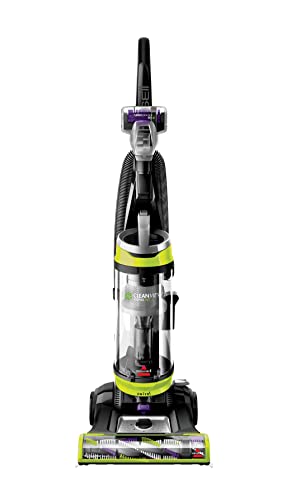
Bissell CleanView Swivel Pet 2252 upright vacuum with triple action brush roll and scatter-free technology. Designed for pet homes. Buy now!
2. Shark Navigator Lift-Away Deluxe NV360
Rating: 4.4 stars (52,141 reviews) | Category: Upright
The Shark Navigator NV360 is built around one feature that matters particularly on tile: brush roll shutoff. With the press of a button, you can stop the brush roll entirely and convert the vacuum to pure suction mode for hard floors. This eliminates scatter, eliminates the risk of the brush roll grinding debris into grout lines, and makes it safe to use on polished surfaces without leaving swirl marks.
The Lift-Away detachable pod is a practical tile-floor feature because tile often runs under appliances, into narrow bathroom spaces, and along baseboards where an upright footprint is too large. Detach the pod and use the hose and crevice tool to pull debris out of grout channels along walls and around toilet bases. The HEPA Anti-Allergen Complete Seal captures 99.9% of dust and allergens — which matters on tile because there is no pile to trap particles before they become airborne.
At 16 lbs, it is among the heavier options here, but the combination of brush roll shutoff, Lift-Away versatility, and HEPA filtration makes it one of the most complete hard-floor upright vacuums available.
View the Shark Navigator Lift-Away NV360
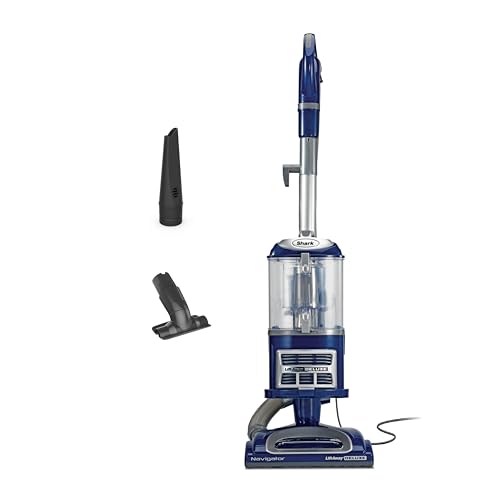
Shark Navigator Lift-Away NV360 delivers powerful suction with HEPA filtration and swivel steering. Perfect for pet hair and allergens. See full expert review.
3. Shark Rotator NV752 Powered Lift-Away TruePet
Rating: 4.4 stars (44,242 reviews) | Category: Upright
The Shark Rotator NV752 steps up from the NV360 with powered Lift-Away capability — meaning the brush roll continues spinning even when the pod is detached. For tile floors, the more significant upgrades are the LED headlights built into both the nozzle and the handheld unit, and the advanced swivel steering system.
Headlights reveal the fine layer of dust and grit on tile that is genuinely invisible under standard room lighting. You can see exactly what you are picking up and whether the grout lines have been cleared. The advanced swivel steering is noticeably smoother than budget alternatives, which matters on large continuous tile areas like open-plan kitchen floors where you are making many directional changes.
Like the NV360, the NV752 offers brush roll shutoff for hard floor mode. The sealed HEPA filtration is particularly useful in tile-heavy homes because hard floors recirculate fine particles into the air more readily than carpet. The included Pet Power Brush handles the pet hair accumulation that collects in tile corners.
View the Shark Rotator NV752 Lift-Away TruePet

Shark Rotator NV752 Powered Lift-Away TruePet upright vacuum with HEPA filter, swivel steering, LED headlights, and pet power brush for deep cleaning.
4. Eureka Blaze 3-in-1 Stick Vacuum
Rating: 4.1 stars (78,356 reviews) | Category: Stick
The Eureka Blaze is designed specifically for hard floors. Its name is not incidental — this vacuum was built for the smooth-surface cleaning scenario. At 4 lbs, it is light enough to carry from room to room without effort, and its capture nozzle design directly addresses scatter: the nozzle channels air around falling debris and pulls it in before it can roll away.
The swivel steering on the Blaze is one of its standout physical characteristics. On tile floors with kitchen islands, dining table legs, and bathroom fixtures to navigate, the ability to steer the head without repositioning your grip is a genuine time-saver. The 18-foot cord covers a substantial floor area per outlet, which matters when your tile runs continuously through an open kitchen and dining room.
This is the right choice for someone who wants a lightweight, purpose-built hard-floor vacuum without upright bulk. It converts to a handheld for stairs and furniture cleaning, and the washable HEPA filter means ongoing costs are minimal. It is not a deep-carpet vacuum — but on tile, it performs above its price point.
View the Eureka Blaze 3-in-1 Stick Vacuum
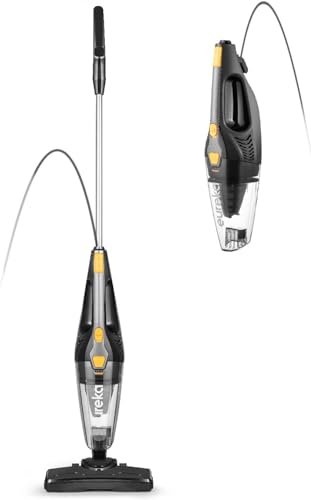
Eureka Blaze lightweight 3-in-1 stick vacuum with swivel steering and powerful suction for hard floors. Only 4 lbs with washable filter. Shop now!
5. Bissell Featherweight 3-in-1 Stick Vacuum (2033M)
Rating: 4.2 stars (116,086 reviews) | Category: Stick
The Bissell Featherweight 2033M has the highest review count of any vacuum on this list by a significant margin. It weighs 3.6 lbs. That combination — extreme popularity and extreme lightness — reflects a real use case: the person who wants to do a quick pass over tile floors daily without lugging out a full upright.
For tile floors, the Featherweight performs well on everyday debris pickup. Fine dust, crumbs, pet hair on hard surfaces — it handles all of these without the scatter issues that plagued older lightweight designs. The 3-in-1 configuration lets you remove the wand and use the handheld unit to vacuum along the grout lines near baseboards or pull debris out from between appliances.
It is not the most powerful vacuum on this list, and its small 0.67-liter dust cup fills quickly when you are doing a whole-house tile floor. But for daily maintenance between deeper cleans, or for a smaller apartment with tile throughout, the Featherweight earns its reputation. At its price point, it is difficult to argue against it as a secondary or backup machine.
View the Bissell Featherweight 3-in-1 Stick Vacuum

Bissell Featherweight 2033M is an ultra-lightweight 3-in-1 bagless stick vacuum for hard floors, carpet, and stairs. Converts to hand vac with crevice tool.
Vacuuming Before Mopping: Why the Order Matters
A common mistake with tile floors is mopping before vacuuming — or skipping the vacuum step entirely and going straight to a wet mop. The problem is that mopping does not remove solid debris. It moves it. Fine grit gets pushed deeper into grout channels. Pet hair becomes wet and bonds to the tile surface. Crumbs turn into a sticky paste. Mopping over unvacuumed tile creates more work than it saves.
The correct sequence is always: vacuum first, then mop. The vacuum removes all loose debris, grit, and surface dust. The mop then works on what is actually left — the stuck-on residue, the oil from cooking, the foot traffic film — which is what it is designed to clean.
For grout specifically, a good vacuuming session with a sealed-suction machine removes the loose particles that make grout look dark. Then a targeted grout brush application with diluted cleaning solution, followed by a rinse mop, addresses the staining. This two-step process restores grout color more effectively than any single tool.
If you use a steam mop, the same principle applies. Steam breaks down residue but cannot remove solid particles before it encounters them. Vacuum first, steam second.
Frequently Asked Questions
Can you vacuum tile floors?
Yes, and you should. Sweeping a tile floor with a broom redistributes fine dust rather than removing it, and leaves grout lines untouched. A vacuum with the appropriate hard floor setting — particularly one with brush roll shutoff or a soft roller head — picks up debris that a broom cannot capture, including the fine particles inside grout channels. Regular vacuuming is the most effective single step you can take to keep tile floors genuinely clean.
Is a robot vacuum good for tile floors?
Robot vacuums are excellent on tile. They navigate hard surfaces more accurately than carpet, their low-profile design captures debris efficiently at floor level, and their daily scheduling prevents the grout staining that results from debris accumulation. Tile is one of the surfaces where a robot vacuum delivers its best performance relative to manual vacuuming.
How do I clean grout lines with a vacuum?
The most effective approach is to use a crevice tool attachment along individual grout channels, particularly in high-traffic areas. For areas where grout lines run along baseboards and walls, a crevice or detail tool pulled slowly along the channel can remove compacted debris that a standard floor head misses. Follow this with a soft brush tool or grout brush and cleaning solution for staining.
Will vacuuming scratch my tile floor?
Vacuuming will not scratch tile if the vacuum has soft rubber wheels, no exposed metal or hard plastic trim pieces on the nozzle, and the brush roll is either turned off or replaced with a soft roller head. Stiff bristle brush rolls spinning at full speed can grind particles into polished porcelain and cause micro-scratches over time. Always use hard floor mode on smooth tile surfaces.
What is scatter-free technology and why does it matter on tile?
Scatter-free technology refers to nozzle designs that contain the air channel around incoming debris rather than creating a forward air pressure wave that pushes light particles away from the suction path. On carpet, fibers prevent scatter, so standard nozzles work fine. On tile, particles sit on a frictionless surface and are easily pushed by the nozzle’s leading edge. Scatter-free designs — like those on the Bissell CleanView Swivel Pet — address this directly.
Can I use an upright vacuum on tile floors?
Yes, with an important caveat: the upright must have a hard floor mode with brush roll shutoff. Running a spinning brush roll on tile at full speed creates scatter and risks surface damage. Most modern uprights include this feature. The Shark Navigator NV360 and Shark Rotator NV752 both offer reliable brush roll shutoff, making them effective on tile.
How often should I vacuum tile floors?
High-traffic tile areas — kitchens, entryways, and hallways — benefit from daily or every-other-day vacuuming. In a home with pets or children, daily is more practical. Lower-traffic tile areas like bathrooms can be vacuumed every few days. The key is frequency: tile floors that are vacuumed regularly never develop the grout staining and grit accumulation that require deep cleaning to reverse.
Conclusion
The best vacuum for tile floors is not necessarily the most powerful vacuum in the store. It is the one that solves the specific problems tile creates: scatter, grout penetration, and surface protection. Those requirements point toward models with scatter-free or hard-floor nozzle designs, brush roll shutoff or soft rollers, sealed suction for fine dust, and soft-touch materials that protect polished and natural stone surfaces.
For a full-size upright with strong scatter protection, the Bissell CleanView Swivel Pet is the most proven option in its category. For brush roll shutoff and versatility on tile, the Shark Navigator NV360 is a reliable choice. For hard-floor-focused stick cleaning, the Eureka Blaze was designed specifically for this scenario. And for daily maintenance with the lightest possible machine, the Bissell Featherweight with its 116,000-plus reviews has demonstrated that simple and lightweight is often exactly right for tile.
Whatever you choose, vacuum before you mop, use hard floor mode, and check those grout lines a few times a year. Tile floors last decades when they are maintained correctly — and the right vacuum is the foundation of that maintenance.
Ready to Find Your Perfect Vacuum?
Browse our expertly reviewed vacuum cleaners and make an informed decision
Browse All Vacuums