Can You Vacuum Baking Soda? The Complete Truth (And What It Does to Your Vacuum)
Baking soda is a popular DIY carpet deodorizer — but vacuuming it can destroy your vacuum filter and motor over time. Here's the full truth and how to do it safely.
Table of Contents
- The Direct Answer: Yes — But There Are Real Risks
- Why Baking Soda Damages Vacuums: The Science Behind the Risk
- The DIY Carpet Deodorizer Appeal: Does It Actually Work?
- How to Vacuum Baking Soda Safely
- Which Vacuums Handle Baking Soda Best?
- Vacuum Recommendations for Handling Fine Particles and Baking Soda
- Alternatives to Baking Soda on Carpet
- Frequently Asked Questions
- Conclusion
Baking soda is cheap, it smells like nothing, and it sits in almost every kitchen cabinet in the country. It makes sense that people reach for it when their carpet starts to smell — sprinkle it on, let it sit, vacuum it up. Simple enough.
But here is what most people are not told: vacuuming baking soda is one of the most effective ways to silently damage your vacuum over time. The very property that makes baking soda useful as a deodorizer — its microscopic particle size — is what makes it dangerous to vacuum filtration systems. You may not notice the damage immediately, but you will notice it eventually, usually when your suction drops, your filter turns gray-white, or your motor starts to whine.
This guide covers the full picture: yes, you can vacuum baking soda, but you need to understand the risks, know how to minimize them, and use the right vacuum for the job.
The Direct Answer: Yes — But There Are Real Risks
You can vacuum baking soda from carpet. Your vacuum will pick it up. The powder will disappear from your floor. This is not in dispute.
What is in dispute is what happens inside your vacuum when you do it repeatedly.
Baking soda (sodium bicarbonate, NaHCO3) is an extremely fine powder with particles ranging from 1 to 100 microns in diameter. For reference, the finest particles are invisible to the naked eye — smaller than a human hair is wide. When you vacuum a fine powder like this, much of it makes it through the suction path and into the filtration system intact. In vacuums without sealed HEPA filtration, a significant fraction of those particles bypasses the filter entirely and gets exhausted back into the room air, or worse, works its way into the motor assembly.
Even in vacuums with proper HEPA filters, baking soda accumulates rapidly in the filter media, reducing airflow and causing suction to drop far more quickly than normal household dust would. The fine alkaline particles also cause abrasion as they pass through fan blades and motor components. Over months and years of repeated use, this mechanical wear accelerates motor degradation.
The short version: doing it once is unlikely to break anything. Doing it as a regular cleaning routine is a slow-motion way to shorten your vacuum’s life.
Why Baking Soda Damages Vacuums: The Science Behind the Risk
Understanding why baking soda is hard on vacuums requires a quick look at how vacuums actually handle fine particles.
Particle Size: The Core Problem
Standard household dust particles are typically 5 to 100 microns. Most consumer vacuum filters are designed to handle this range. Baking soda, however, includes particles down to 1 micron — fine enough to penetrate filter media that would stop larger particles with ease.
When fine sodium bicarbonate particles hit a standard paper or foam filter at high velocity, several things happen simultaneously. Larger particles are captured on the filter surface as expected. Finer particles, in the 1-5 micron range, may either pass through pores in the filter media or embed deep within the filter fibers where they resist being dislodged during cleaning. This deep embedment is what causes rapid filter degradation — the filter cannot be washed back to full performance because the soda has become integral to the filter structure itself.
How Fine Particles Bypass Standard Filters
Consumer vacuum filters have ratings, but many are not true HEPA-grade, and even among those that are, not all vacuums have sealed systems. A sealed HEPA vacuum means that all air drawn into the machine must pass through the HEPA filter before being exhausted — there are no gaps, unsealed joints, or bypass paths in the airflow. An unsealed vacuum with a HEPA filter may still have the filter itself, but fine particles can travel around it through housing gaps and reach the motor and exhaust.
This distinction — sealed versus unsealed HEPA — is the single most important factor when it comes to vacuuming baking soda safely.
Motor Abrasion from Alkaline Particles
Baking soda is a mild abrasive by nature. That is part of why it is effective as a gentle scrubbing agent in cooking and cleaning. Those same abrasive properties apply when fine particles travel through a vacuum’s fan assembly and motor at high speed.
Vacuum motors spin at thousands of RPM. When abrasive particles are consistently drawn through that airflow path, they act like microscopic sandpaper on impeller blades, brush contacts, and bearing surfaces. The damage is slow and cumulative, but it is real. Motor bearing failure is a common endpoint for vacuums that have been used heavily with fine powders.
Clogging HEPA Filters Prematurely
Even in the best-case scenario — a properly sealed HEPA vacuum — baking soda will clog your HEPA filter faster than normal use would. HEPA filters are rated to capture 99.97% of particles down to 0.3 microns, which means they catch nearly everything. That is excellent for air quality. It is less excellent for the filter’s longevity when you are feeding it tablespoons of fine powder.
A HEPA filter in a typical household may last 12 to 24 months under normal use. Vacuum baking soda regularly and that timeline can shrink significantly. HEPA filters are not cheap, and in many vacuums they are not washable (or washing them risks damaging the filter media). The hidden cost of using baking soda as a carpet deodorizer is not just the bag of baking soda — it is the accelerated filter replacement cycle.
Reduced Suction Over Time
Even if no catastrophic failure occurs, the practical consequence most users notice first is suction loss. As fine particles pack the filter media, airflow is restricted. Restricted airflow means less suction at the floor. You may find yourself making multiple passes over the same area that your vacuum used to handle in one. This is not a minor inconvenience — it represents a genuinely degraded cleaning performance that compounds with every use.
The DIY Carpet Deodorizer Appeal: Does It Actually Work?
It is worth being honest about what baking soda does and does not do before dismissing the practice entirely.
Baking soda is a genuine deodorizer. It works through a process of acid-base chemistry: many odor-causing compounds (including those from pet urine, sweat, and food) are acidic in nature. Baking soda, being alkaline, neutralizes these acids when it comes into direct contact with them. The result is actual odor elimination, not just masking.
When you sprinkle baking soda on a carpet, it settles into the pile and comes into contact with odor-causing compounds embedded in the fibers. Given enough dwell time — ideally 15 to 30 minutes, though some recommend longer — it neutralizes what it contacts.
The limitations are real, though. Baking soda can only neutralize acidic odors, not all odors. It cannot penetrate deep into carpet backing or subfloor material. And once it is vacuumed up, it takes the neutralized compounds with it, but it leaves no lasting protective effect. You will need to reapply as odors return, which means repeated exposure for your vacuum.
The appeal is understandable. But the routine application as a permanent deodorizing strategy has real costs for your cleaning equipment.
How to Vacuum Baking Soda Safely
If you choose to use baking soda on your carpet, these practices will minimize the damage to your vacuum.
Use only a thin, even layer. More baking soda does not mean more deodorizing power. A light dusting is sufficient to contact odor-causing compounds in the carpet pile. Heavy application just means more powder in your vacuum’s filtration system.
Let it sit, then let the dust settle. After applying, wait at least 15 minutes. Before you vacuum, let the baking soda settle for a few minutes so you are not immediately drawing a cloud of airborne fine particles into your intake.
Use the right vacuum. A sealed HEPA vacuum is not optional if you plan to do this with any regularity. Unsealed vacuums, cyclone-only systems without HEPA filtration, and bagless vacuums with washable foam filters are all poor choices for fine powder. Bagged vacuums are notably more forgiving, as the bag itself acts as an additional filtration layer and prevents powder from contacting the filter media as directly.
Check and clean your filter after each use. If you vacuum baking soda, inspect your filter before your next cleaning session. If it is a washable pre-motor filter, rinse it under cool water and allow it to dry completely for 24 hours before reinstalling. If it is a HEPA filter, gently tap it to dislodge surface accumulation, but avoid washing HEPA filters unless the manufacturer explicitly states they are washable.
Empty the dustbin or replace the bag promptly. Do not leave baking soda sitting in the dustbin. The alkaline powder can affect gaskets, seals, and plastic components over time.
Avoid vacuuming wet or damp baking soda. Once baking soda gets damp, it begins to harden and can create a paste-like buildup inside hoses, brush rolls, and filter housings. Always ensure carpet is completely dry before applying and vacuuming baking soda.
Which Vacuums Handle Baking Soda Best?
Not all vacuums are equally affected by fine powder. The characteristics that determine a vacuum’s suitability for this task are specific and worth understanding.
Sealed HEPA systems are the gold standard. A sealed system means every cubic inch of air that enters the vacuum must exit through the HEPA filter — no bypass paths, no gaps in housing joints. This protects the motor from abrasive particles while ensuring exhaust air is clean.
Bagged vacuums offer meaningful advantages over bagless designs. The bag itself captures the bulk of debris, including fine powder, before air reaches the main filter. When the bag is full and you replace it, you also remove the accumulated baking soda cleanly. In a bagless vacuum, fine powder collects in the dust cup and the act of emptying it can release a cloud of particles back into the room.
Higher-wattage motors tend to be more resilient to fine particle abrasion than lower-powered motors, simply because they operate with more margin before performance degradation becomes noticeable. That said, motor power is no substitute for proper filtration.
Vacuums with washable pre-motor filters (in addition to HEPA post-motor filtration) are more practical for baking soda use because you can rinse the pre-motor filter after each application and restore much of its airflow capacity.
Vacuum Recommendations for Handling Fine Particles and Baking Soda
These four vacuums combine sealed HEPA filtration with strong suction performance, making them the best options if fine powder pickup is a regular need in your home.
Shark Navigator Lift-Away Deluxe NV360
The NV360 uses Shark’s Anti-Allergen Complete Seal technology paired with a true HEPA filter, capturing 99.9% of dust and allergens in a sealed airflow path that protects the motor from fine particles. Its brushroll shutoff is a practical asset when vacuuming baking soda, allowing you to switch to a gentler suction mode on carpet without agitating and re-suspending settled powder.
The Lift-Away canister pod lets you clean stairs and tight areas as a portable unit, and at 4.4 stars across more than 52,000 reviews, its performance is well-documented. As an upright corded vacuum, it delivers sustained suction without battery limitations.
View the Shark Navigator NV360
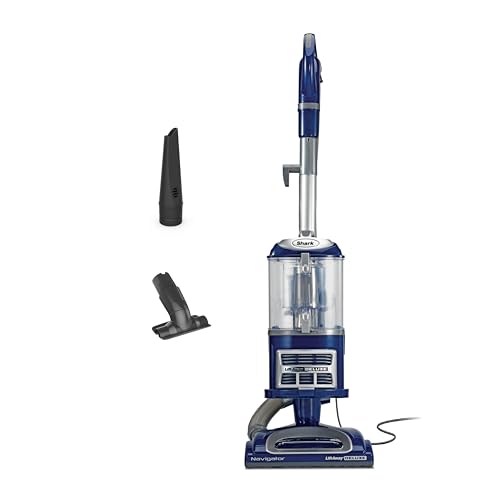
Shark Navigator Lift-Away NV360 delivers powerful suction with HEPA filtration and swivel steering. Perfect for pet hair and allergens. See full expert review.
Shark Navigator NV352 Lift-Away
The NV352 shares Shark’s sealed HEPA Anti-Allergen Complete Seal architecture with the added benefit of a lighter 12.5-lb frame — nearly four pounds lighter than the NV360. For users who vacuum baking soda regularly and need to carry the unit between rooms or up stairs, that weight difference is meaningful.
The filtration system captures 99.9% of fine particles in a sealed path, and the brushroll shutoff allows multi-surface cleaning without scattering residual baking soda powder. With 4.4 stars across more than 30,000 reviews, it is one of the more consistently reviewed uprights in its price range.
View the Shark Navigator NV352

Shark Navigator NV352 Lift-Away upright vacuum with HEPA filter, swivel steering, and anti-allergen technology. Ideal for carpet, stairs, and bare floors.
Tikom V500 Cordless Stick Vacuum
The Tikom V500 is the strongest cordless option for fine powder pickup, featuring a 7-stage HEPA cyclone filtration system rated at 99.99% particle capture. The multi-stage approach — cyclone separation followed by HEPA filtration — means that the bulk of baking soda is spun out of the airstream before it ever contacts the filter media, extending filter life significantly compared to single-stage designs.
At 40,000Pa of suction from a 450-watt motor, the V500 handles embedded powder in carpet pile effectively. Its 6-in-1 convertible design adds versatility, and the 7-stage system is one of the most thorough filtration architectures available in the cordless stick category. For households that want cordless convenience without sacrificing filtration quality, this is the recommendation.

Check out the Tikom V500 cordless stick vacuum with 40,000Pa suction, LED touch screen, wall charging dock, and 7-stage HEPA filtration. Shop smarter today!
Bissell Pet Hair Eraser Allergen Lift-Off 39883
The Bissell Pet Hair Eraser Allergen Lift-Off uses a HEPA Sealed Allergen System that traps fine particles inside the vacuum with no escape path back into the room. Its Scatter-Free Technology is a notable feature for baking soda use — it prevents debris and fine powder from being blown around on hard floors during vacuuming, which is a real problem with powerful vacuums on light powders.
The tangle-free brush roll means less maintenance when hair and fiber get into the machine alongside fine powder, and the lift-off pod provides stair and above-floor cleaning capability. At 4.5 stars across nearly 1,800 reviews, it earns consistently high marks from pet owners who deal with fine-particle cleanup as part of their regular routine.
View the Bissell Pet Hair Eraser Allergen Lift-Off

Bissell Pet Hair Eraser Allergen Lift-Off with HEPA filtration, tangle-free brush roll, and scatter-free tech. Built for pet owners. See our expert review.
Alternatives to Baking Soda on Carpet
If the risks to your vacuum are not worth it, these alternatives achieve similar or better results without the filtration tradeoff.
Commercial carpet deodorizer powders designed for vacuuming typically use coarser particle sizes than pure baking soda, which pass through vacuum filtration systems more cleanly. They are formulated with vacuuming in mind. They cost more than baking soda but protect your vacuum more effectively.
Enzyme-based carpet sprays are arguably more effective than baking soda for pet odors specifically. Enzymes break down the organic compounds in pet urine and sweat at a molecular level, eliminating the odor source rather than neutralizing surface-level acidity. These are applied as liquid sprays, allowed to dry, and require no vacuuming.
Activated charcoal odor absorbers placed in rooms (not on carpet) continuously absorb airborne odor compounds without any interaction with your vacuum. They are particularly effective in enclosed or low-ventilation spaces.
White vinegar diluted in water (a 1:1 ratio) applied as a spray to carpets and allowed to dry is effective for many household odors. Vinegar is itself an acid and can neutralize some alkaline odor compounds. Once dry, the vinegar smell dissipates and takes odors with it. No vacuuming required.
Professional carpet cleaning on an annual or semi-annual basis addresses embedded odors more comprehensively than any surface treatment. Steam cleaning or hot water extraction reaches the carpet backing and subfloor interface where odors actually originate in cases of pet accidents.
Frequently Asked Questions
Can you vacuum baking soda from carpet without damaging your vacuum?
Yes, but damage risk depends on vacuum type, frequency, and volume. A single light application vacuumed with a sealed HEPA vacuum is unlikely to cause immediate damage. Repeated heavy applications without proper filtration will degrade filter performance over time and may accelerate motor wear. The risk is cumulative, not immediate.
Will vacuuming baking soda void my vacuum warranty?
Most major vacuum manufacturers do not explicitly address baking soda use in their warranty terms, but many have exclusions for damage caused by vacuuming fine powders, plaster dust, or construction debris. If filter damage or motor failure occurs that a technician attributes to fine powder use, your warranty claim may be denied. Review your specific manufacturer’s terms before making baking soda a regular practice.
How long should baking soda sit on carpet before vacuuming?
A minimum of 15 minutes is generally recommended. Some sources suggest leaving it overnight for severe odors. However, longer dwell times do not meaningfully improve results beyond 30 minutes for typical household odors — the neutralization reaction occurs relatively quickly once contact is made. Let it sit, then allow it to settle for a few minutes before vacuuming to reduce airborne particle load.
Is baking soda safe for all carpet types?
Baking soda is generally safe for synthetic carpet fibers (nylon, polyester, olefin). It can be problematic for wool and natural fiber carpets, where the alkaline properties can affect the fiber structure over repeated applications. Always test in an inconspicuous area and consult your carpet manufacturer’s care guidelines before regular use.
What is the best type of vacuum for baking soda?
Bagged upright vacuums with sealed HEPA filtration are the safest choice. The bag captures fine powder before it reaches the main filter, and sealed HEPA ensures motor protection. Among bagless options, multi-stage cyclone systems with sealed HEPA (such as the Tikom V500) provide the next-best level of fine-particle management.
Can baking soda damage a robot vacuum?
Yes, and more severely than traditional vacuums in many cases. Robot vacuums have smaller motors, smaller filters, and less filtration capacity than full-size machines. Their compact filter systems clog rapidly with fine powders, and the small motors are particularly susceptible to abrasive particle damage. Avoid using robot vacuums to clean up baking soda.
Why does my vacuum smell like baking soda after cleaning?
A faint soda odor is normal. If the smell is persistent or strong, it suggests baking soda has accumulated in the filter, hose, or brush roll housing. Clean the filter, inspect and clean the hose interior, and check the brush roll for powder buildup. A thorough cleaning after each baking soda session prevents this buildup from becoming significant.
Conclusion
Vacuuming baking soda is not a myth or an immediate disaster. Your vacuum will pick it up. Your carpet will smell better. Nothing will visibly break.
The problem is the invisible, cumulative toll on the components doing the work — the filter media, the motor, the fan assembly. Baking soda’s microscopic particle size puts it in a category that most standard vacuum filters were not designed to handle repeatedly at any significant volume. The fine alkaline particles work their way into filter fibers, restrict airflow, and find their way to motor components where they cause slow, consistent abrasion.
If you want to use baking soda on your carpet occasionally, use it lightly, let it settle, and vacuum it with a sealed HEPA machine. Clean the filter after each use. If you want to use it as a regular routine, consider whether the alternatives — enzyme sprays, commercial carpet deodorizer powders, periodic professional cleaning — might give you better results with less cost to your equipment over time.
The vacuums that hold up best are sealed systems with multi-stage filtration. The four recommendations in this guide — the Shark Navigator NV360, Shark Navigator NV352, Tikom V500, and Bissell Pet Hair Eraser Allergen Lift-Off — all meet that standard and will give you the best chance of protecting your investment while still handling fine-particle cleanup when the occasion requires it.
Ready to Find Your Perfect Vacuum?
Browse our expertly reviewed vacuum cleaners and make an informed decision
Browse All Vacuums