Miele vs Dyson Canister Vacuum 2026: German Precision vs British Innovation
Miele vs Dyson canister vacuum — German engineering longevity vs British innovation. Which premium canister vacuum is worth the investment?
Table of Contents
- The Premium Canister Vacuum Battle: German Engineering Perfection Meets British Innovation
- Head-to-Head: The Core Differences Between Miele and Dyson Canister Vacuums
- Specific Model Comparisons
- The Bagged vs Bagless Debate for Canister Vacuums
- Miele’s Build Quality and Filter Longevity
- Who Should Choose Which?
- Frequently Asked Questions
- Final Verdict
The Premium Canister Vacuum Battle: German Engineering Perfection Meets British Innovation
Few rivalries in the home cleaning world carry as much weight as Miele versus Dyson. On one side, you have over 125 years of German manufacturing heritage, a company founded in 1899 in Gütersloh with an uncompromising commitment to longevity and precision. On the other, you have Dyson — the British engineering disruptor that upended the vacuum industry in the 1990s by eliminating the bag entirely and introducing cyclone technology to mainstream consumers.
Both brands occupy the premium tier of the canister vacuum market. Neither is cheap. Both are backed by genuine engineering innovation and legions of loyal users. But they represent fundamentally different philosophies about what a vacuum cleaner should be and how it should perform over the course of its life.
Miele believes in the long game. Their canisters are built with motors tested to last 20 years. Their filtration relies on proprietary AirClean bags that seal dust inside the moment you pull them from the machine. Their machines operate quietly, precisely, and with a level of build refinement that feels closer to a professional instrument than a household appliance.
Dyson believes in pushing the envelope. Their canisters use cyclone technology to maintain suction without bags, their Ball platform enables self-righting, agile maneuverability, and their hygienic bin ejector means you never have to touch the dirt you collect. Every Dyson canister is a statement that cleaning technology should keep advancing.
This guide breaks down the head-to-head differences across every dimension that matters — filtration, suction consistency, longevity, noise, and price — using real models from each brand to illustrate where each excels and where each falls short.
Head-to-Head: The Core Differences Between Miele and Dyson Canister Vacuums
Filtration: Miele AirClean Bags vs Dyson Bagless Cyclones
This is the most significant philosophical divide between the two brands, and it affects every other aspect of the ownership experience.
Miele’s approach centers on the AirClean FilterBag system. These are not ordinary paper bags. Genuine Miele FilterBags are multi-layer, self-sealing containers that function as the first stage of a three-tiered filtration system. When you remove a full bag from a Miele canister, a spring-loaded collar automatically closes the opening, trapping every particle of dust, pet dander, and allergen inside. You never breathe in a dust cloud at emptying time.
The three-stage AirClean system works like this: the FilterBag captures the bulk of debris; a motor protection filter intercepts fine particles that might damage the motor; and an AirClean exhaust filter captures the smallest remaining particles before air exits the machine. On models like the Complete C3 Marin, this is augmented by a HEPA Lifetime Filter rated at 99.999% efficiency — a specification that exceeds the 99.97% HEPA standard for particles as small as 0.3 microns.
The sealed system is crucial. Unlike many competitors where dirty air can leak around the filter housing, Miele’s sealed design ensures all exhaust air passes through filtration before entering the room. The result is air that is measurably cleaner after vacuuming than before — a claim Miele has consistently backed with independent testing.
Dyson’s approach eliminates bags entirely. Their Root Cyclone technology spins air at high G-forces to separate dust and debris from the airflow centrifugally. The advantage is that you never need to buy replacement bags, and you can see exactly how much debris you have collected in the transparent bin. The Big Ball Turbinehead’s washable lifetime filter captures 99.97% of fine particles across the whole machine — not just at a single filter stage.
Dyson’s hygienic bin ejector addresses the historically messy bagless emptying process. A single button push drives a mechanism that expels all collected debris in one clean motion, minimizing dust exposure. It is a genuine improvement over older bagless designs, though allergy sufferers still tend to prefer the sealed-bag approach for maximum confidence at disposal.
Verdict for allergy sufferers: Miele’s sealed bag system remains the gold standard. The self-sealing collar at removal is a feature that no amount of “hygienic ejector” engineering fully replaces when a family member has serious respiratory sensitivities.
Suction Consistency: Does Miele or Dyson Maintain Power Better?
Dyson’s cyclone technology was invented specifically to solve suction loss — the frustrating phenomenon where traditional vacuums lose cleaning power as the dust bag fills. Dyson’s cyclones maintain consistent airflow regardless of how full the bin becomes, and the Big Ball Turbinehead delivers 250 Air Watts of sustained suction from the first room to the last.
Miele’s bagged design handles suction consistency differently. Their AirClean FilterBags are made from a multi-layer material that allows consistent airflow through the bag wall even as debris accumulates. Miele vacuums do gradually experience some reduction in suction as bags approach capacity — this is physics, not a design flaw — but the 4.5-liter bag capacity of the Classic C1 models means you will empty significantly less often than a Dyson’s 0.47-gallon bin.
What this means in practice: a Dyson canister like the Big Ball Multi Floor maintains peak suction throughout a session with a nearly-full bin. A Miele Classic C1 or Complete C3 will vacuum multiple full sessions before the bag needs changing, with only modest suction variation.
Miele’s variable suction control also gives their canisters an edge for delicate surfaces. Six precise suction settings let you dial down power for silk rugs, curtains, and upholstery with confidence, then ramp back up for deep carpet work. Dyson offers suction adjustment on higher-end models but typically provides fewer granular settings.
Longevity: Miele’s 20-Year Engineering vs Dyson’s Innovation Cycle
Miele tests their motors to withstand 20 years of regular use. This is not marketing hyperbole — it is the actual specification their engineering team designs and stress-tests to. A Miele canister bought today, maintained properly with genuine FilterBags and occasional filter care, is designed to still be delivering equivalent performance in 2046.
Dyson vacuums are built to last, backed by a 5-year parts and labor warranty on models like the Big Ball Turbinehead, and many users report a decade or more of reliable service. However, Dyson’s product philosophy is more innovation-driven than longevity-focused. They release new platforms and technologies regularly, and their approach prioritizes advancing the state of the art over designing a single machine to last a generation.
For households that view vacuum cleaner investment from a total cost-of-ownership perspective, Miele’s longevity argument is compelling. A Miele Complete C3 Marin purchased for $600–$900 that lasts 20 years at an average household cleaning schedule costs less per year than replacing a mid-range vacuum every 4–5 years. The ongoing bag cost (approximately $20–$30 per pack of bags, with each bag lasting several weeks) is the cost offset in Miele’s equation.
Dyson’s washable lifetime filter on the Big Ball Turbinehead eliminates filter replacement costs entirely. No bags, no filter purchases — the only ongoing cost is emptying the bin. Over a 10-year ownership period, this is a meaningful saving compared to Miele’s consumable bag model.
Noise Levels: The Quiet German vs the Powerful Brit
Miele canister vacuums are notably quieter than most competitors, including Dyson. Their motor engineering and housing design prioritize acoustic damping, and models like the Complete C3 series operate at noise levels that allow normal conversation to continue in an adjacent room. This matters considerably for households with infants, shift-working family members, or anyone who finds prolonged vacuum noise physically fatiguing.
Dyson canisters are powerful and the Ball technology is genuinely impressive, but they produce the characteristic higher-pitched motor sound associated with cyclone technology operating at speed. They are not excessively loud by modern standards, but they are audibly louder than a Miele running at equivalent cleaning settings.
If quiet operation is a meaningful factor in your buying decision, Miele wins this category decisively.
Price: What You Pay and What You Get
Both brands occupy the premium category, but there is a meaningful price range within each:
-
Miele Classic C1 Pure Suction — entry-level Miele canister, hard floor focus, rated 4.4/5 from 7,313 reviews
-
Miele Classic C1 Turbo Team — adds TurboTeQ and Parquet floorheads, rated 4.4/5 from 3,284 reviews
-
Miele Complete C3 Calima — mid-tier, HEPA Lifetime Filter, Turbobrush and Parquet Twister, rated 4.3/5 from 478 reviews
-
Miele Complete C3 Marin — flagship with Electrobrush, HEPA Lifetime Filter, 99.999% filtration, rated 4.0/5 from 696 reviews
-
Dyson Big Ball Multi Floor (CY23) — entry Dyson canister, Carbon Fiber Turbine Head, self-righting, rated 4.0/5 from 1,452 reviews
-
Dyson Big Ball Turbinehead — flagship, 250 Air Watts, 99.97% whole-machine filtration, 5-year warranty, rated 4.4/5 from 113 reviews
Miele’s entry point (Classic C1) is accessible for a premium brand; the flagship Complete C3 Marin commands a significant investment. Dyson’s canisters cluster in the mid-to-premium range with the Turbinehead at the top.
Specific Model Comparisons
Entry Level: Miele Classic C1 Turbo Team vs Dyson Big Ball Multi Floor
The Miele Classic C1 Turbo Team is Miele’s gateway canister — one that comes with both a TurboTeQ air-driven brush for carpets and a dedicated Parquet floorhead for hardwood. At 17 lbs with a 29.5-foot operating radius and six suction levels, it delivers a complete hard floor and low-to-medium carpet cleaning solution backed by AirClean three-stage filtration. Miele’s motors in this range are built to the same 20-year standard as their most expensive models.
The Dyson Big Ball Multi Floor counters with its patented self-righting Ball technology that automatically picks the canister up when tipped, eliminating one of the most common canister vacuum annoyances. Its Carbon Fiber Turbine Head uses electrostatic carbon fibers to attract fine dust on hard floors while stiff nylon bristles handle carpet agitation — dual-function in a single tool. The hygienic dirt ejector empties the 0.47-gallon bin without requiring direct contact with debris.
Where Miele wins at this tier: filtration depth, quieter operation, superior suction fine-tuning, and a 20-year design lifespan.
Where Dyson wins at this tier: no bags to buy, self-righting convenience, hygienic hands-free emptying, and proven J.D. Power customer satisfaction scores.
Best for most buyers at entry level: Allergy sufferers and those with predominantly hard floors should lean toward the Miele Classic C1 Turbo Team. Pet owners who want no-fuss bin emptying and exceptional maneuverability will appreciate the Dyson Big Ball Multi Floor.
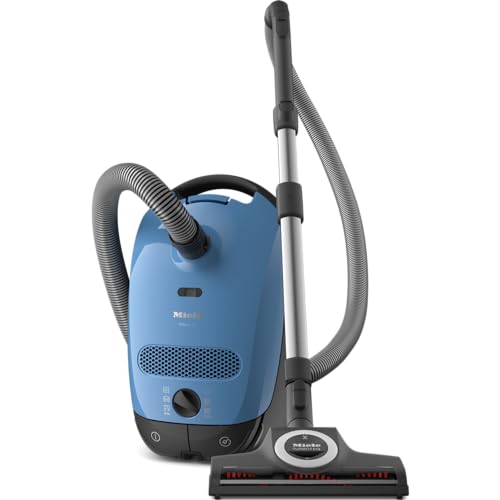
Miele Classic C1 Turbo Team bagged canister vacuum with 6 suction settings and AirClean filtration. German-engineered quality. Full expert review inside.
Mid Tier: Miele Complete C3 Calima
The Miele Complete C3 Calima represents the sweet spot of the Miele lineup for mixed-floor households. It brings the HEPA Lifetime Filter — rated at 99.999% particle capture — to a package that includes both a Turbobrush for carpets and a Parquet Twister for hard floors. The foot-operated suction controls let you adjust power without bending down, which makes a genuine ergonomic difference over extended cleaning sessions.
The sealed AirClean system prevents dust leakage even when the bag is being changed, thanks to the self-closing collar on Miele’s FilterBags. Miele’s Complete C3 series is explicitly engineered for up to 20 years of operation — a commitment to longevity that places this vacuum in a different category from most appliance purchases.
At this price point, Dyson does not offer a canister equivalent with a HEPA Lifetime Filter. The Calima’s filtration credentials and 20-year lifespan engineering make it a compelling choice for households prioritizing indoor air quality and long-term value over the convenience of bagless operation.

Miele Complete C3 Calima canister vacuum with HEPA filter, Turbobrush & Parquet head. Perfect for carpet & hard floors. Discover German-engineered cleaning.
Flagship: Miele Complete C3 Marin vs Dyson Big Ball Turbinehead
At the top of both ranges, the comparison becomes a genuine contest between two outstanding machines with different strengths.
The Miele Complete C3 Marin is Miele’s most capable bagged canister. Its HEPA Lifetime Filter achieves 99.999% filtration efficiency — the highest rating in the consumer vacuum market. The powered Electrobrush floorhead uses a motor-driven brush roll to agitate carpet fibers with a depth and thoroughness that air-driven turbo brushes cannot match. The foot-operated dial, sealed AirClean system, and Parquet floorhead for hard surfaces complete a machine designed for serious whole-home cleaning. For households with both deep carpets and hardwood floors, this is the definitive Miele canister.
The Dyson Big Ball Turbinehead delivers 250 Air Watts of consistent suction with whole-machine filtration capturing 99.97% of particles down to 0.3 microns. Its 360-degree articulating wand reaches corners and under furniture with flexibility that even Miele’s excellent wand system cannot fully match. The turbine-driven brush bar transitions from carpets to hard floors without manual adjustment. The washable lifetime filter eliminates all filter costs, and the 5-year parts-and-labor warranty is among the best in the premium canister segment. The comprehensive accessory set — turbinehead, stair tool, combination tool, stubborn dirt brush, articulating hard floor tool — rivals Miele’s flagship bundle.
What the Marin does better: 99.999% vs 99.97% filtration efficiency, sealed-bag disposal with zero allergen escape, quieter operation, 20-year longevity design.
What the Turbinehead does better: zero consumable costs (no bags), 250 Air Watts of constant suction regardless of bin fill level, self-righting Ball technology, articulating wand flexibility, hygienic bin emptying.
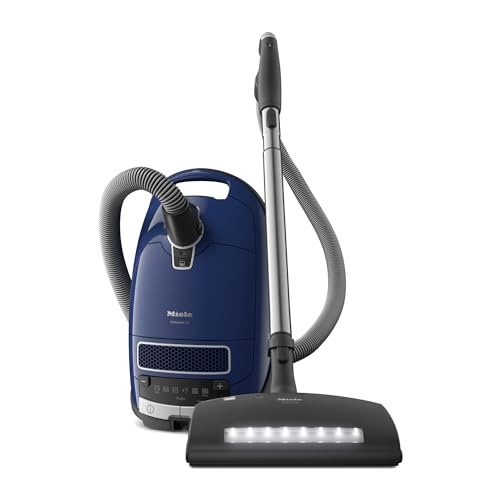
Miele Complete C3 Marin bagged canister vacuum features HEPA Lifetime Filter, Electrobrush, and 99.999% filtration for deep cleaning. See on Amazon.
The Bagged vs Bagless Debate for Canister Vacuums
The bagged versus bagless debate is more nuanced in the canister vacuum category than in uprights or stick vacuums, because canister designs are disproportionately chosen by allergy sufferers and serious long-term home cleaning buyers — exactly the demographic for whom filtration quality matters most.
The case for Miele’s bagged system:
When you vacuum a home, the debris collected in a bag includes fine dust mites, pet dander, mold spores, pollen, and other biological allergens. In a bagless design, these particles sit in the bin, and every time you open the bin to empty it, you are exposed to a concentrated cloud of everything the vacuum has collected. Dyson’s hygienic ejector significantly reduces but does not eliminate this exposure.
Miele’s AirClean FilterBags seal automatically at removal. The debris you collect stays inside a self-contained pouch with a spring-loaded closure. You remove the bag, drop it into the trash, and the entire contents remain sealed. For people with dust mite allergies, pet dander sensitivities, or compromised respiratory systems, this distinction is not cosmetic — it is clinically meaningful.
Miele’s bags also maintain consistent filtration throughout their life. The multi-layer bag material continues to filter effectively regardless of how full the bag becomes, because the walls of the bag themselves act as filter media.
The case for Dyson’s bagless system:
The environmental and economic arguments for bagless are straightforward. You never send plastic-lined disposable bags to landfill. You never run out of bags at an inconvenient moment. You never pay for replacement consumables beyond occasional filter maintenance. With Dyson’s washable lifetime filter, the total ongoing cost of ownership approaches zero once you have paid the purchase price.
Bagless also provides transparency — you can see exactly how much debris is in the bin and judge when emptying is needed without guessing at bag fullness through a small indicator window.
For households without serious allergy concerns, the bagless convenience argument carries genuine weight. Dyson’s cyclone technology is now mature enough that suction maintenance throughout a cleaning session is genuinely impressive, and the washable filter adds filtration confidence.
The verdict: For allergy sufferers, Miele’s sealed bag system remains the medically superior choice. For households focused on convenience, zero consumable costs, and still-excellent filtration, Dyson’s bagless canister is a fully defensible decision.
Miele’s Build Quality and Filter Longevity
Miele’s filter longevity claim — that their HEPA Lifetime Filter is designed to last the life of the vacuum, typically 20 years — is one of the most striking specifications in the premium vacuum market. While competitors regularly sell replacement HEPA filters at $30–$80 per unit as a revenue stream, Miele includes a filter designed to never need replacing.
The HEPA Lifetime Filter on the Complete C3 Calima and Complete C3 Marin achieves 99.999% particle capture without degradation over the vacuum’s lifespan, when used with genuine Miele AirClean FilterBags. The bags do the heavy lifting of primary dust capture, protecting the HEPA filter from excessive particulate load and maintaining its long-term performance.
This engineering philosophy extends across Miele’s build. The stainless steel telescoping wand, the precisely machined floorhead connection mechanisms, the smooth-gliding caster system, and the intuitive ergonomic controls all reflect decades of refinement aimed at a machine that performs identically at year 1 and year 15. Miele’s Immer Besser (“always better”) brand philosophy is not a slogan — it is embedded in their manufacturing tolerances and quality control standards.
Dyson’s approach to durability is different but equally serious. Their 5-year parts-and-labor warranty on the Big Ball Turbinehead is market-leading, and Dyson provides lifetime support including replacement parts for their products. Their machines are designed to be serviced and repaired, not discarded — a commitment that matters when evaluating real-world longevity.
Who Should Choose Which?
Choose Miele if you are:
An allergy or asthma sufferer. The sealed AirClean FilterBag system, HEPA Lifetime Filter at 99.999% efficiency, and whole-machine sealed design provide the most consistently allergen-safe vacuuming and disposal experience available in a consumer canister vacuum. No bagless design fully replicates the sealed-bag disposal moment for severe allergy sufferers.
A longevity seeker. If you view your vacuum as a 15–20 year household investment rather than a 3–5 year appliance replacement cycle, Miele’s engineering is designed specifically for you. The Complete C3 Marin and Complete C3 Calima are built to outlast multiple generations of competitor machines.
A quiet-operation household. Homes with infants, shift workers, or noise-sensitive family members will find Miele’s acoustic engineering a tangible daily quality-of-life benefit.
A mixed-floor home with deep carpets. The Complete C3 Marin’s Electrobrush floorhead performs deep carpet extraction that rivals professional cleaning equipment. Combined with the Parquet floorhead for hard surfaces, it is the most versatile single canister solution for demanding mixed-floor households.
Choose Dyson if you are:
A technology enthusiast. Dyson’s Ball technology, cyclone engineering, articulating wand, and hygienic bin mechanisms are genuinely innovative. If you appreciate thoughtful mechanical engineering solutions to real cleaning problems, Dyson canisters deliver satisfying ownership.
A zero-consumable-cost buyer. The Big Ball Turbinehead’s washable lifetime filter and bagless bin mean your only ongoing cost is electricity. Over a 10-year ownership period, the savings on bags versus Miele can be substantial.
Prioritizing consistent maximum suction. Dyson’s cyclone technology maintains 250 Air Watts throughout a session regardless of bin fill. For large homes where you clean multiple rooms in a single session, this engineering advantage is real.
A convenience-focused user. The hygienic ejector, self-righting Ball, and quick bin empties make Dyson canisters faster and more convenient to use and maintain in day-to-day operation.
A pet owner without severe allergies. The Carbon Fiber Turbine Head’s dual-action performance on pet hair — both on hard floors and carpets — combined with the hygienic emptying mechanism makes Dyson Big Ball canisters excellent for pet households that are not dealing with serious dander allergies.
Frequently Asked Questions
Is Miele or Dyson better for allergies?
Miele is the stronger choice for allergy and asthma sufferers. The AirClean sealed FilterBag system prevents allergen escape at emptying, the HEPA Lifetime Filter achieves 99.999% efficiency on the Complete C3 series, and the sealed whole-machine design ensures exhaust air passes entirely through filtration. Dyson’s whole-machine filtration at 99.97% is still excellent and well above the standard HEPA threshold, but Miele’s sealed-bag disposal moment is the clinically superior choice for people with severe dust mite, pet dander, or mold allergies.
Do Miele bags really last that long?
A single Miele AirClean FilterBag (4.5-liter capacity on Classic C1 models) typically lasts 4–8 weeks depending on household size, pet ownership, and cleaning frequency. A pack of 4–5 bags usually covers several months of regular vacuuming. The ongoing consumable cost is real but modest compared to the vacuum’s lifespan. Miele’s HEPA Lifetime Filter, in contrast, truly never needs replacement — it is designed and warranted for the life of the machine.
How long do Dyson canister vacuums last?
Dyson backs their Big Ball canisters with a 5-year parts-and-labor warranty and provides lifetime support for replacement parts. Many users report 10–15 years of reliable service from well-maintained Dyson canisters. This is strong durability, though it falls short of Miele’s explicit 20-year design specification and engineering standard.
Can I use a Miele canister without buying official bags?
Miele strongly recommends using genuine Miele AirClean FilterBags. Third-party bags exist but often do not replicate the self-sealing collar mechanism or the multi-layer filtration performance of official bags. Using third-party bags risks voiding your warranty and can compromise the sealed-system filtration that is Miele’s core differentiator for allergy sufferers.
Which is easier to maintain day-to-day?
Dyson canisters require less routine maintenance: empty the bin as needed, rinse the washable filter every few months, and the machine is ready. Miele requires monitoring bag fill level and ordering replacement bags before they run out. Dyson wins on day-to-day maintenance simplicity; Miele wins on the quality of the disposal experience when maintenance is actually performed.
Are Dyson canister vacuums good for carpets?
Yes. The Dyson Big Ball Turbinehead’s motor-driven brush bar performs genuine deep carpet agitation across low, medium, and higher-pile carpets. The Carbon Fiber Turbine Head on the Big Ball Multi Floor handles low-to-medium pile effectively. For very thick, high-pile carpet, Miele’s Complete C3 Marin with the Electrobrush is arguably the superior performer — powered electrobrushes outperform turbine heads on demanding carpet surfaces.
Is Miele worth the premium over Dyson?
For the right buyer, absolutely. If you have allergy concerns, prefer quiet operation, and are willing to invest in a machine designed to last 20 years, Miele’s cost-per-year over its lifetime is lower than it appears at purchase. For buyers who prioritize zero consumable costs, high-tech convenience features, and consistent maximum suction, Dyson offers outstanding value at its price point with a machine that will serve reliably for a decade or more.
Final Verdict
Miele and Dyson are the two most compelling names in the premium canister vacuum market for 2026, and neither deserves to be dismissed as simply the “other” option.
Choose the Miele Complete C3 Marin if indoor air quality is your primary concern, if you have carpets requiring serious deep extraction with an Electrobrush, and if you are buying a vacuum you expect to use for the next two decades. The 99.999% HEPA Lifetime Filter, sealed bag system, and 20-year engineering standard are without equal in the consumer canister market.
Choose the Dyson Big Ball Turbinehead if you want 250 Air Watts of consistent cyclone suction, zero consumable costs, self-righting Ball convenience, and the most comprehensive accessory set in its class — all backed by a 5-year warranty and lifetime Dyson support.
Both machines represent a premium investment that rewards buyers willing to pay for engineering that outperforms the market for years. The question is not which brand is better — it is which brand’s philosophy better matches your household’s needs.
Miele Complete C3 Marin bagged canister vacuum features HEPA Lifetime Filter, Electrobrush, and 99.999% filtration for deep cleaning. See on Amazon.
Ready to Find Your Perfect Vacuum?
Browse our expertly reviewed vacuum cleaners and make an informed decision
Browse All Vacuums