Narwal Flow Review 2026: The Robot Mop Vacuum Built for Hard Floors
Narwal Flow review — spinning mop pad technology, self-cleaning dock, and vacuuming capabilities tested for hard floor homes.
Table of Contents
- What Makes Narwal Different: The Mopping-First Philosophy
- Narwal Flow: Full Specifications Breakdown
- FlowWash Technology: Why It Matters More Than Specs
- Vacuuming Performance: An Honest Assessment
- Dock Features: Self-Emptying, Self-Washing, Self-Drying
- Best Use Cases: Who the Narwal Flow Is Built For
- Narwal Flow vs Roborock: Mopping Compared
- Narwal Flow vs Ecovacs: Where Each Excels
- The Narwal Flow in the Narwal Lineup
- Who Should Buy the Narwal Flow
- Frequently Asked Questions
- Final Verdict
Most robot vacuums treat mopping as an afterthought. Narwal built an entire company around proving that assumption wrong.
The Narwal Flow is the most advanced expression of that philosophy to date. It launches with 22,000Pa of suction, a real-time self-cleaning mop track called FlowWash, dual AI cameras that recognize over 200 object types, and a dock that washes its own mop pads in 173°F hot water then dries them with 104°F warm air. On paper it is impressive. In practice, for homes with predominantly hard floors, it is a legitimate step change in what a robot cleaner can accomplish.
This review covers everything you need to know before buying: how the FlowWash technology actually works, what the specs mean in real-world cleaning, how vacuuming holds up alongside the best dedicated robot vacuums, which homes it is genuinely built for, and how it stacks up against Roborock and Ecovacs at the same price tier. Nothing is skipped, including the honest limitations.
What Makes Narwal Different: The Mopping-First Philosophy
Narwal did not start as a vacuum company that added mopping. It started as a mopping company that added vacuuming — and that distinction shapes every product decision from the mop pad geometry to the dock hardware to the navigation priorities.
When Narwal debuted in 2019, their robot used a pair of spinning triangular mop pads. That design came from commercial floor scrubbers, not robot vacuums. The triangular shape was chosen because it allows one corner of the pad to reach into 90-degree wall joints — something circular pads are physically incapable of doing. When a round pad spins along a baseboard, it always leaves a crescent of untouched floor between the pad and the wall. A triangular pad rotating into that same corner directs a point into the gap, cleaning it in the same pass.
The Narwal Flow evolves that original concept into its most refined form. The track mop design replaces traditional stationary spinning discs with a continuously moving mop surface — a belt-driven track that feeds fresh mop material into contact with the floor while simultaneously pulling soiled material back into an onboard cleaning stage. Dirty water never gets redistributed across floors you just cleaned. It is the most direct answer yet to the oldest complaint about robot mopping: “it just spreads the dirt around.”
Narwal Flow: Full Specifications Breakdown
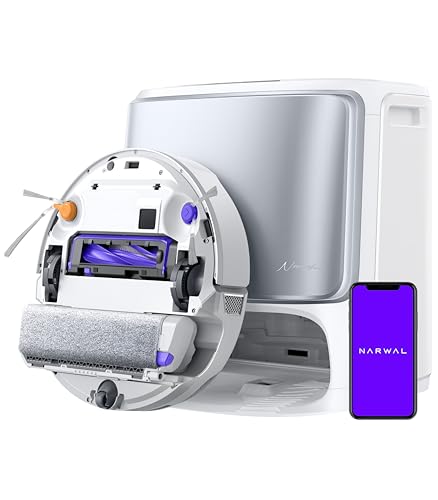
Narwal Flow robot vacuum and mop with 22,000Pa suction, FlowWash real-time self-cleaning mop, AI obstacle avoidance & self-emptying base. Shop now.
Here are the complete specifications from Narwal’s product listing, with context on what each number means for daily use:
Suction Power: 22,000Pa This is among the highest suction figures in the consumer robot vacuum category as of 2026. For context, the Narwal Freo Z Ultra delivers 12,000Pa, the Freo Z10 Ultra delivers 18,000Pa, and competitors like Roborock’s Saros series top out around 22,000Pa in their flagship models. At 22,000Pa, the Flow can pull fine dust and debris from low-pile carpets without the multi-pass repetition that lower-suction robots require.
FlowWash Real-Time Self-Cleaning Track Mop The Flow’s headline feature. Instead of spinning disc pads that clean only at the dock, the track mop continuously refreshes itself during operation. A scraper and dual water tanks work together to remove soiled water from the mop surface in real time, so the mop material touching your floor at the end of a room is as clean as the material that touched the floor at the beginning.
Mop Wash Temperature: 173°F (hot water) The dock washes mop material at 173°F — hot enough to kill most common household bacteria and break down cooking grease and pet-derived oils without requiring chemical additives. This is higher than the 167°F used by the Freo Z Ultra and substantially higher than the room-temperature or warm-water rinses used by most competing docks.
Mop Dry Temperature: 104°F (warm air) After hot-water washing, the dock circulates 104°F air across the mop material until it is dry. This step matters because damp mop pads left in a sealed dock grow mildew. The distinctive musty smell that users complain about with cheaper robot mop docks comes from exactly this — washing without drying. Narwal eliminates it.
Self-Emptying Dust Bag: 2.5L, up to 4 months The 2.5L dust bag in the base station stores compressed debris for up to four months before requiring replacement. Narwal uses an auto-compaction mechanism to maximize bag capacity, which is why a 2.5L bag can hold four months of household debris that would normally fill faster. Replacement bags are available on Amazon and from Narwal directly.
TwinAI Obstacle Avoidance: 200+ object types Dual cameras with dual onboard AI chips enable the Flow to classify and navigate around over 200 distinct object categories in real time. This includes pet waste, shoes, cables, toys, and charging cables — the obstacle types that cause the most cleaning failures and hardware damage with less capable navigation systems. The robot makes routing decisions based on object identity, not just object presence.
CarpetFocus Technology: Up to 2x boost When the Flow transitions from hard floor to carpet, CarpetFocus seals the airflow path and concentrates suction power specifically at the brush roll. Narwal claims up to 2x improvement in carpet pickup versus standard mode. For homes with area rugs on hard floors, this means the same robot that scrubs your tile can clean embedded debris from your living room rug in the same session.
EdgeReach Mop: Within 5mm of walls The mop arm extends toward baseboards to clean within 5mm of the wall. Traditional robot mops leave a 20–30mm strip of unmopped floor along every wall in the home. Over a week of daily cleaning that strip accumulates visible dust and residue. The 5mm clearance is a meaningful practical improvement.
Robot Height: 3.7 inches At 3.7 inches tall, the Flow robot passes under most standard furniture — sofas, beds, and dining chairs. It cannot clear furniture with 3.5-inch clearance or lower, so checking your specific furniture before purchase is worth doing.
Maximum Climb Height: 1.6 inches The Flow handles door thresholds and transition strips up to 1.6 inches high. Most modern home thresholds are between 0.5 and 1.0 inches, so this is rarely a practical limitation in standard residential settings.
Wi-Fi: 2.4GHz and 5GHz Unlike several Narwal models (including the Freo X Plus and Freo Z10 Ultra) that only support 2.4GHz networks, the Flow supports both bands. In homes with mesh networks or routers that broadcast on 5GHz by default, this eliminates the need to reconfigure your network during setup.
Voice Assistants: Alexa, Google Assistant, Siri, Hey Narwal The Flow integrates with all four major voice platforms. You can start, stop, pause, and dock the robot using voice commands from any of these ecosystems without opening the app.
Base Station Dimensions: 40.1 x 42.9 x 46cm The base station is compact relative to competing all-in-one docks at this feature level. Roborock’s equivalent dock stations for the Saros and Qrevo Ultra lines are frequently larger. The Flow’s dock fits in a standard hallway alcove or under a side table in most homes.
FlowWash Technology: Why It Matters More Than Specs
The FlowWash system is worth spending more time on because it addresses a specific limitation that exists in every other robot mop on the market, including Narwal’s own Freo series.
Every robot mop with spinning disc pads — Narwal Freo, Roborock Qrevo, Ecovacs Deebot X series — operates the same fundamental way: clean pads go down, pads accumulate dirt, robot returns to dock, dock washes pads, robot continues. In between dock visits, soiled mop pads are the active cleaning surface. A robot mopping a 1,500 square foot floor in one continuous session is mopping the final 500 square feet with pads that have been accumulating grease and particulate for an hour.
The visible result: streak marks. Anyone who has used a robot mop on light-colored tile in natural light has seen them — the faint parallel lines where a barely-dirty mop dragged residue from one zone into another.
FlowWash eliminates this by moving the cleaning stage from the dock to the robot. The track mop belt feeds dirty material into a compact onboard scraper and rinse system, then feeds it back out as clean material. The dock visit interval for self-cleaning is removed from the equation. The mop surface touching your floor at any moment is clean mop material regardless of how far into the session the robot is.
In practical terms: dramatically fewer streak marks on light-colored tile, genuinely effective cleaning in kitchens where cooking grease accumulates, and consistent results from the first square foot to the last.
Vacuuming Performance: An Honest Assessment
Narwal’s marketing emphasizes mopping heavily, and the vacuuming performance, while genuinely capable, should be evaluated honestly rather than inflated.
At 22,000Pa, the Flow’s suction power is competitive with category leaders. For bare hard floors — tile, hardwood, LVP, laminate — the combination of 22,000Pa suction and a rubber anti-tangle brush roll clears fine dust, pet dander, crumbs, and debris in a single pass under normal household conditions. Daily or every-other-day scheduling means floors stay consistently clean rather than requiring catch-up sessions.
For low-pile carpet and area rugs, CarpetFocus Technology provides a measurable improvement. The Flow performs respectably on standard-pile wall-to-wall carpet, removing embedded debris through multi-pass cleaning in scheduled sessions.
Where the honest limitation appears: thick pile carpet. The Flow was designed around hard floor optimization. Its brush geometry, mop clearance mechanisms, and overall cleaning pass architecture favor smooth surfaces. A dedicated robot vacuum built primarily for carpet — such as the Roborock Saros 10 or Roomba Combo Essential — will outperform the Flow on thick shag or high-pile carpet. If your home is 70% or more hard floor with incidental area rugs, the Flow handles vacuuming excellently. If your home is 50% or more medium-to-thick carpet, a vacuum-first robot is the better tool.
The anti-tangle side brushes and the rubber main roller also address the pet hair problem directly. Unlike bristle brush rolls that wrap long hair around the roller and require manual cleaning every few sessions, the Flow’s design allows hair to pass through the system without significant wrap accumulation. For multi-dog or multi-cat households on hard floors, this matters operationally — it reduces maintenance frequency substantially.
HEPA filtration is included via the dustbin filter. For allergy-sensitive households, HEPA-level particle capture at the exhaust stage means the air leaving the robot during operation is cleaner than the air going in — an important consideration for pet dander and fine dust.
Dock Features: Self-Emptying, Self-Washing, Self-Drying
The Flow’s base station consolidates four maintenance functions that would otherwise require manual intervention after every session:
Automatic mop washing with 173°F hot water occurs after each cleaning cycle. The mop track is fed through the washing stage at the dock and rinsed thoroughly before the drying cycle begins.
Automatic mop drying with 104°F warm air follows the wash. Full drying prevents mildew, bacterial regrowth, and the mold smell that accumulates in robot mop docks that wash but do not dry.
Self-emptying transfers debris from the robot’s onboard dustbin into the 2.5L base station bag. The compaction mechanism stores up to four months of household debris before the bag requires replacement. The robot’s inner bin reseats automatically after each transfer.
Automatic solution dispensing manages the cleaning fluid level using the included 200ml floor cleaning solution starter bottle. The dock monitors solution levels and alerts via the app when a refill is needed.
The net result: after the initial setup and first-run software update (required for optimal performance on first use), the Flow operates without meaningful human intervention for weeks at a time. You schedule it, it cleans, it maintains itself, it reports back through the app. The only recurring tasks are occasional bag replacement (quarterly), solution refill (as needed), and a monthly check of the side brushes for debris accumulation.
Best Use Cases: Who the Narwal Flow Is Built For
The Flow is the right choice for:
-
Hard floor homes with 70%+ tile, hardwood, LVP, or laminate. This is the robot’s design center. If mopping is your primary cleaning priority and vacuuming is secondary, the Flow’s FlowWash technology and edge-reaching mop arm deliver a quality of clean that no competitor in its class matches.
-
Kitchens that accumulate cooking grease. The combination of real-time mop self-cleaning and 173°F hot-water dock wash handles kitchen floor residue that passive or slow-rotating mop systems leave behind.
-
Homes with pets on hard floors. The anti-tangle brush system and HEPA filtration address pet hair and dander on hard floors effectively. The hot-water mop wash at 173°F also sanitizes the mop material after cleaning up paw prints and pet accidents.
-
Households with allergy sensitivities. HEPA filtration plus hot-water mop sanitation plus a sealed self-emptying dustbin minimizes particulate exposure during both cleaning and maintenance.
-
Tech-forward households. The TwinAI dual-camera system, multi-platform voice assistant support, 5GHz Wi-Fi compatibility, and detailed app mapping features appeal to users who want sophisticated automation rather than simple scheduling.
Consider alternatives if:
-
Your home is predominantly medium-to-thick carpet. A Roborock Saros 10 or Qrevo series robot vacuum dedicated primarily to vacuuming with secondary mopping will serve carpet-heavy homes better.
-
You are on a tight budget. The Flow sits at the premium tier of the robot vacuum market. The Narwal Freo X Plus at 7,800Pa and zero-tangle brush provides a capable entry into Narwal’s ecosystem at a meaningfully lower price.
-
Your home has complex multi-level layouts with many obstacles. The large base station requires a dedicated clear corner. In very cluttered homes, the navigational complexity can require more setup time than a simpler robot.
Narwal Flow vs Roborock: Mopping Compared
Roborock’s current flagship mopping systems — the Qrevo Curv and Saros 10 — are direct competitors to the Narwal Flow at a similar price point. Here is the honest comparison across the dimensions that matter most.
Mopping quality on tile and hardwood: Narwal Flow wins. The FlowWash real-time self-cleaning track mop applies clean mop material to the floor throughout the entire cleaning session. Roborock’s Qrevo series uses counter-rotating spinning mops that return to the dock periodically for cleaning — effective, but the mop is progressively dirtier between dock visits. For light-colored tile and glossy hardwood where streaks are visible, the Flow’s clean-mop-always approach produces noticeably better results.
Vacuuming quality on carpet: Roborock wins. Roborock’s roots as a vacuum company mean their carpet pickup, brush roll design, and deep-clean carpet modes are optimized for carpet performance in a way that Narwal’s hardware is not. The Saros 10’s 22,000Pa with dedicated carpet boost modes outperforms the Flow on medium-pile carpet.
Edge mopping: Narwal wins. The EdgeReach Mop arm cleaning within 5mm of walls, combined with the triangular pad geometry in the Freo series (inherited design language across the lineup), means less unmopped strip along baseboards than any Roborock current model produces.
Dock functionality: Roughly equivalent at this tier. Both brands’ flagship docks self-empty, self-wash, and self-dry. The Flow’s 173°F wash temperature is slightly higher than most Roborock dock wash temperatures (typically 104–167°F), which is a meaningful sanitation advantage for pet households.
Navigation and obstacle avoidance: Roborock’s LiDAR combined with AI cameras in the Saros series is the current industry benchmark. The Flow’s TwinAI system handling 200+ object types is competitive and effective, but Roborock’s years of LiDAR mapping refinement give the Saros series a slight edge in room mapping precision and multi-floor switching speed.
Verdict: Choose the Narwal Flow if mopping quality on hard floors is your top priority. Choose Roborock Qrevo Curv or Saros 10 if you want the best-balanced vacuum-mop performance across mixed flooring types.
Narwal Flow vs Ecovacs: Where Each Excels
Ecovacs’ DEEBOT X8 Pro Omni and T30S Pro Omni sit at a similar premium tier. The comparison highlights a different set of tradeoffs.
Ecovacs’ OZMO Turbo mopping system uses spinning disc mops with strong downward pressure and dock-based hot-water cleaning. It is an effective system that significantly outperforms flat-wipe alternatives, but it shares the limitation of all disc-based designs: mop cleanliness degrades between dock visits, and edge coverage is constrained by circular pad geometry.
AIVI 3D obstacle avoidance from Ecovacs uses structured light plus AI for obstacle recognition, which performs excellently in mixed-light conditions including low-light scenarios. The Flow’s camera-based TwinAI system requires adequate light for optimal performance — a minor but real limitation in windowless rooms or night-time scheduling without lights on.
Ecovacs’ advantage is typically found in the companion app sophistication and multi-floor management for larger homes. The DEEBOT app’s room customization and scheduling granularity is well-regarded.
Narwal’s advantage remains mopping quality and dock wash temperature. For hard floor homes prioritizing genuine scrubbing over wiping, the Flow’s FlowWash architecture is not matched by any current Ecovacs product.
The Narwal Flow in the Narwal Lineup
Understanding where the Flow sits within Narwal’s own lineup helps calibrate the buying decision.
The Narwal Freo X Plus (7,800Pa) is the entry tier — capable zero-tangle vacuum performance and reliable mopping with 6N downward mop pressure and 9mm auto mop lift. It is the right choice for buyers new to Narwal or working with a tighter budget.
The Narwal Freo Z10 Ultra (18,000Pa) offers dual AI cameras, EdgeSwing mop arm, 8N downward mop pressure, and hot-water dock washing up to 167°F. This is the mid-premium option with most of the Flow’s capability at a lower price.
The Narwal Freo Z Ultra (12,000Pa) is an alternative mid-tier option featuring the dual 1600x1200 HD camera system, 1.2kg mop downforce at 180 RPM, and 167°F hot-water dock wash. Its mop specifications are particularly strong for a mid-tier product.
The Narwal Flow (22,000Pa) is the current flagship — distinguished by its FlowWash real-time track mop (not available in any other Narwal model), 22,000Pa suction, 173°F dock wash, 5GHz Wi-Fi support, and TwinAI recognition of 200+ object types.
For homes where mopping is genuinely the primary priority and the budget supports the flagship tier, the Flow’s real-time self-cleaning mop is the differentiating reason to choose it over the Freo Z10 Ultra. For homes where vacuuming matters as much as mopping, the Freo Z10 Ultra at its price point represents excellent value.
Who Should Buy the Narwal Flow
Buy the Narwal Flow if:
- You have tile, hardwood, LVP, or laminate covering 70% or more of your home’s floor area
- You want the best robot mopping performance currently available in the consumer market
- Streaks and residue spreading are an existing pain point with your current robot or manual mop
- You have pets and prioritize hot-water mop sanitation to eliminate bacteria and odors
- You want hands-free maintenance for months at a time with a large-capacity self-emptying dock
Do not buy the Narwal Flow if:
- Your home has mostly thick carpet (a Roborock Saros or dedicated carpet robot vacuum is a better fit)
- You are looking for a budget-friendly robot vacuum (the Flow is priced at the premium tier)
- You live in a small apartment under 600 square feet (a simpler robot will serve that space well at lower cost)
- Your primary need is deep carpet vacuuming with mopping as a secondary function
Frequently Asked Questions
Does the Narwal Flow work on carpet? Yes, the Flow vacuums carpet using CarpetFocus Technology that claims up to 2x improved carpet pickup versus standard mode, and the mop arm lifts clear of carpet surfaces automatically during transitions. However, it is optimized for hard floors. On thick or high-pile carpet, a dedicated vacuum robot will outperform it.
How often does the dust bag need replacing? Narwal rates the 2.5L bag at up to four months for average household use. Homes with pets or higher dust loads will see shorter intervals — typically two to three months.
Does the mop pad need manual cleaning? The FlowWash system handles real-time mop cleaning during operation. The dock handles post-session mop washing at 173°F and drying at 104°F. Under normal use, the mop track requires no manual cleaning beyond a monthly visual inspection. Periodic replacement of the mop track material is recommended after extended use.
Can the Narwal Flow map multiple floors? Yes, the Flow supports multi-floor mapping through the Narwal app. Each floor stores its own map with room labels, no-go zones, and cleaning preferences.
What is the difference between the Narwal Flow and the Narwal Freo Z10 Ultra? The Flow’s primary advantage is FlowWash — the real-time self-cleaning track mop. The Freo Z10 Ultra uses traditional spinning disc mops that clean at the dock rather than continuously during operation. The Flow also has higher suction (22,000Pa vs 18,000Pa), higher dock wash temperature (173°F vs 140°F max), and 5GHz Wi-Fi support vs 2.4GHz only. The Freo Z10 Ultra is priced lower and is an excellent value choice if real-time mop self-cleaning is not a priority.
Is the Narwal Flow compatible with third-party cleaning solutions? Narwal recommends their own cleaning solution (included as a 200ml starter with the unit) and sells Freo X Ultra cleaning solution refills. Third-party solutions are compatible mechanically with the dock, but using non-recommended fluids can affect warranty coverage. Mild floor-safe diluted solutions are generally safe, but check Narwal’s current warranty terms before using non-Narwal products.
Does the Flow work with Alexa routines? Yes. The Flow supports Alexa, Google Assistant, Siri, and Narwal’s native “Hey Narwal” voice command platform. It integrates into Alexa routines for automated scheduling alongside other smart home devices.
How large is the base station? The base station measures 40.1 x 42.9 x 46cm. It requires a clear area for the robot to dock from the front and moderate clearance on both sides for mop washing airflow. A standard hallway alcove, a dedicated corner in a laundry room, or space under a side table in a foyer all work well.
Final Verdict
The Narwal Flow is the best robot mop on the market for homes where hard floors dominate and mopping quality is the deciding purchase criterion. FlowWash is not a marketing feature — it solves a real problem that every other robot mop in the category, including Narwal’s own previous flagship, has not fully addressed. The combination of 22,000Pa suction, real-time clean-mop operation, 173°F hot-water dock sanitization, and four-month self-emptying capacity creates a genuinely hands-free hard floor cleaning system.
Its limitations are real: it is not the right robot for carpet-heavy homes, it carries a premium price, and the base station requires dedicated space. For the right home — predominantly hard floors, daily mopping needs, pets, or allergy considerations — those limitations are easy to overlook because the actual mopping performance is in a category of its own.
If you want the best clean on hard floors without doing it yourself, the Narwal Flow is the answer in 2026.
See also: Narwal vs Roborock 2026: Which Brand Wins on Hard Floors? | Best Narwal Robot Vacuums 2026
Ready to Find Your Perfect Vacuum?
Browse our expertly reviewed vacuum cleaners and make an informed decision
Browse All Vacuums