Robot Vacuum vs Regular Vacuum 2026: Which Is Right for You?
Robot vacuum vs regular vacuum — comprehensive comparison of cleaning ability, convenience, cost, and which type belongs in your home.
Table of Contents
Few household debates generate as much genuine confusion as robot vacuum vs regular vacuum. Ask five homeowners and you will get five different opinions, usually shaped by whatever type they already own. The reality is more nuanced than any single camp admits: both types of vacuums have genuine, hard-to-replicate strengths, and the best-maintained homes often run both. This guide gives you the honest, category-by-category breakdown you need to make the right decision — or to understand why so many households have ended up with one of each.
What We Mean by “Regular Vacuum”
Throughout this guide, “regular vacuum” refers to any non-robotic vacuum that a person actively operates: upright vacuums, canister vacuums, stick vacuums, and handheld vacuums. The critical distinguishing factor is that a human guides them, applies pressure, and directs where they clean. This hands-on control is both their biggest limitation and their biggest strength.
Head-to-Head: Robot Vacuum vs Regular Vacuum in Key Categories
Cleaning Thoroughness: Regular Vacuum Wins
A robot vacuum is a remarkable automation tool. It is not, however, a substitute for a thorough deep clean performed by an attentive human operator. Here is why:
Pressure and agitation. An upright vacuum like the Dyson Ball Animal 3 delivers 290 air watts of suction paired with a motorized Motorbar brush head that a person presses firmly into carpet fibers. That combination of powered brush agitation and human-applied downward pressure extracts embedded dirt, grit, and dander that have worked their way deep into pile. A robot vacuum, by contrast, glides across the surface under its own light weight with no external pressure applied.
Edge and corner cleaning. Despite the side brushes most robots use, genuine edge cleaning remains one of their weakest areas. A corded upright or a canister vacuum with a crevice tool can be angled precisely into corners, along baseboards, and against furniture legs. You can see exactly what you are targeting and confirm the area is clean.
Staircase cleaning. This is the robot vacuum’s absolute blind spot (covered in detail below). Only a traditional vacuum can follow you up and down stairs.
The verdict: For a thorough biweekly or monthly deep clean, reach for a traditional vacuum. The Shark NV501 Rotator Lift-Away with its detachable Lift-Away pod and 44,000+ satisfied customers exists precisely because deep cleaning cannot be automated away entirely.

Dyson Ball Animal 3 upright vacuum delivers 290AW suction with de-tangling Motorbar head, Ball technology steering, 3 suction modes, and HEPA filtration.
Daily Maintenance: Robot Vacuum Wins — and It Isn’t Close
This is where the robot vacuum absolutely earns its keep. No traditional vacuum, regardless of how ergonomic or lightweight it is, can clean your floors while you are at work, asleep, or otherwise occupied. A robot vacuum can.
Set a daily 10:00 AM schedule on the Roborock Qrevo QV35A and your floors are vacuumed and mopped every single day with zero active effort from you. The Roborock’s PreciSense LiDAR maps your home methodically, its 8000Pa HyperForce suction handles hair and debris, and its all-in-one dock auto-empties the dustbin, refills the mop water tank, washes the mop pads, and dries them — all without your involvement. You could go weeks between any meaningful interaction with this machine.
For families with children, pet owners managing daily shedding, or busy professionals who want clean floors without dedicating time to them, this kind of daily automated maintenance changes the quality of life in a home dramatically. Dust levels stay lower, crumbs disappear before they attract pests, and floors simply look better more consistently.
The verdict: If daily cleaning consistency matters to you, nothing competes with a robot vacuum. The automation advantage is insurmountable.

Roborock Qrevo QV 35A robot vacuum and mop with 8000Pa suction, all-in-one dock, anti-tangle brushes, and dual spinning mops. Smart LiDAR navigation.
Pet Hair: An Honest Tie
Pet hair is one of the most common reasons people invest in both types of vacuums, and for good reason — neither type handles the full picture on its own.
Where robot vacuums excel at pet hair: Daily surface pickup. A robot running every day means pet hair never gets the chance to accumulate into the tumbleweeds that collect under sofas and along walls. Budget-friendly options like the Tikom G8000 Max deliver 5000Pa of suction and 150 minutes of runtime, enough to cover most homes thoroughly every single day and continuously harvest the fur your pets shed around the clock.
Where traditional vacuums excel at pet hair: Deep extraction from carpet pile, upholstery, and stairs. The Bissell Pet Hair Eraser Allergen Lift-Off was engineered specifically for this scenario. Its HEPA-sealed allergen system, tangle-free brush roll, Scatter-Free Technology for hard floors, and Lift-Away pod for above-floor cleaning handle the embedded hair that a robot vacuum’s light weight simply cannot dislodge from medium-to-deep carpet pile or from upholstery fibers.
The practical reality in a pet household: the robot keeps the floor presentable every day, while the upright handles the monthly deep clean of carpets, the furniture, and the stairs. Each does something the other cannot.
The verdict: Tie — each type excels at a different phase of pet hair management.

Tikom G8000 Max robot vacuum and mop combo delivers 5000Pa suction, 150-min runtime, and 4 cleaning modes for hard floors, carpets, and pet hair.
Stairs: Traditional Vacuum Only
This is not a close comparison. Robot vacuums cannot navigate stairs. Full stop.
Modern robots with drop sensors are specifically designed to detect staircase edges and reverse before falling. This safety feature is non-negotiable, and it means no robot vacuum will ever clean your carpeted stairs.
For stairs, you need a traditional vacuum with above-floor reach. The Shark NV501 Rotator’s Lift-Away pod detaches so you can carry the lightweight canister up the staircase and use the hose with attachments on each step. The Bissell Pet Hair Eraser similarly lifts away for stair use, and its included TurboEraser Pet Tool is specifically designed for pulling embedded hair from upholstered stair treads.
If you have carpeted stairs in your home, owning at least one traditional vacuum is not optional — it is necessary.
The verdict: Traditional vacuum only. No robot can compete here.
Thick Carpet: Traditional Vacuum Wins
High-pile, plush, or shag carpeting is demanding terrain for any vacuum, and robot vacuums handle it poorly for two compounding reasons. First, their lower-powered motors (even strong ones) are working against both the carpet resistance and the weight limitation of a compact design. Second, they sit low to the ground, which can cause them to struggle, slow down, or get stuck in thick pile.
Traditional upright vacuums were built for carpet from the ground up. The Dyson Ball Animal 3’s three suction modes include a dedicated high-power setting for deep and medium-pile carpets, channeling 290AW directly into the pile with a motorized Motorbar brush head pressing downward. The difference in dirt extraction from thick carpet between this machine and any robot vacuum is not marginal — it is substantial.
Some robot vacuum manufacturers specifically note that their models are not recommended for high-pile or shag carpets, or they note degraded performance in those conditions. The Tikom G8000 Max, for example, is excellent on hard floors and low-to-medium pile but less effective on deeper carpet.
The verdict: Traditional vacuum wins clearly on thick carpet. For deep-pile surfaces, a full-size upright or canister is the right tool.
Hard Floors: Robot Vacuums Are Excellent; Traditional Vacuums Are Good
This is one area where modern robot vacuums genuinely compete on an equal footing — and in some respects surpass — traditional vacuums for day-to-day maintenance.
The reasons are practical: robot vacuums run daily, they cover the entire floor area systematically, and many modern models combine vacuuming with mopping in a single pass. The Roborock QV35A’s dual 200RPM spinning mops with 30 adjustable water flow levels leave hard floors noticeably cleaner than vacuuming alone. Running this daily means food particles, fine dust, and grime on tile, hardwood, and laminate are addressed before they build up.
Traditional vacuums on hard floors are perfectly capable but are typically used less frequently. The Dyson Ball Animal 3’s Motorbar head transitions smoothly to hard floors, and the Bissell’s Scatter-Free Technology prevents the frustrating problem of lightweight debris being blown ahead of the suction path. But neither of these machines is running your floors every single day.
The verdict: For daily hard floor maintenance, robot vacuums with mopping capability have a real edge. For occasional deep cleaning of hard floors, traditional vacuums are fully adequate.
Cost: Robot Vacuums Are Usually More Expensive
Entry-level robot vacuums that are worth owning start at roughly $150 to $250. The eufy RoboVac 11S Max, one of the most consistently well-reviewed budget robots, sits in this range and delivers 100 minutes of runtime, BoostIQ auto-suction adjustment, and a 2.85-inch profile that cleans under nearly any furniture.
Premium robot vacuums with LiDAR mapping, self-emptying docks, and mopping capabilities — like the Roborock QV35A — run from $400 to $800 or more. The convenience features are real and meaningful, but the price reflects them.
By contrast, capable traditional vacuums span a much wider range. The Shark NV501 Rotator, with its 44,000+ reviews, HEPA filtration, and Lift-Away versatility, is available well under $200. Even the Dyson Ball Animal 3, a premium corded upright with 290AW of suction and a 5-year warranty, represents a one-time purchase with no recurring dock maintenance costs.
Long-term cost factors to consider:
- Robot vacuums with self-emptying docks require replacement dust bags on an ongoing basis
- Mopping pads on combo models need periodic replacement
- Both types require periodic filter replacement
- Traditional vacuums have no automatic consumables beyond filters
The verdict: Traditional vacuums offer more performance per dollar at most price points. Robot vacuums cost more for the same cleaning ability but add the irreplaceable value of automation.
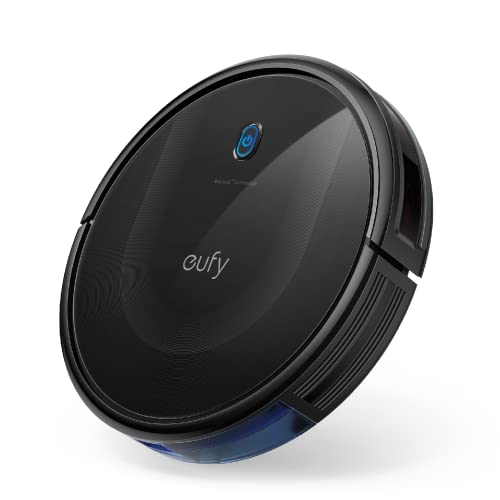
eufy RoboVac 11S Max super-thin robot vacuum with BoostIQ technology, 100-min runtime, and quiet operation. Ideal for hard floors and medium-pile carpets.
Time Savings: Robot Vacuum Wins
The economics of time are straightforward. Vacuuming a 1,500 square foot home manually takes 20 to 40 minutes, depending on the layout and how thoroughly you work edges and under furniture. If you do this twice a week, that is 40 to 80 minutes of active cleaning time every week, or 35 to 70 hours per year.
A robot vacuum running on a daily schedule requires perhaps two to five minutes of your time per week for maintenance: occasional dustbin emptying (or just bag replacement on self-emptying models), filter checks, and brush inspection. That is it.
For people who place a high monetary or personal value on their time, this calculation is decisive. The robot vacuum does not clean as thoroughly as a motivated human with a quality upright, but it cleans well enough for daily maintenance, and it does so entirely in the background.
The verdict: Robot vacuum wins the time-savings comparison by an enormous margin.
The “Both” Approach: Why Millions of Households Own One of Each
Given the category-by-category breakdown above, the most practical recommendation for most households is straightforward: own both, and let each do what it does best.
Here is how a typical two-vacuum household might divide the work:
| Task | Robot Vacuum | Traditional Vacuum |
|---|---|---|
| Daily floor maintenance | Every day, automatic | — |
| Hard floor mopping | Every day (combo models) | — |
| Weekly carpet deep clean | — | Yes |
| Monthly thorough clean | — | Yes |
| Stairs | Never | Yes |
| Furniture and upholstery | — | Yes |
| Under furniture (hard to reach) | Yes (slim profile) | With attachments |
| Pet hair daily pickup | Yes | — |
| Pet hair deep extraction | — | Yes |
The robot runs in the background keeping floors at a baseline level of cleanliness. The traditional vacuum comes out once or twice a week for a thorough pass on carpets, stairs, and above-floor surfaces. Neither machine is burdened with tasks it was not designed for, and the home stays cleaner overall than it would with either type alone.
Budget for this approach does not have to be extreme. An eufy RoboVac 11S Max for daily automation paired with a Shark NV501 Rotator for deep cleaning represents a capable two-vacuum setup that many households find genuinely transforms their home maintenance routine.
For pet owners specifically, the Tikom G8000 Max provides strong daily automated pickup of shed hair, while the Bissell Pet Hair Eraser Allergen Lift-Off handles the deep extractions from carpet, upholstery, and stairs where hair truly embeds itself. This combination addresses the full lifecycle of pet hair management that no single vacuum type can cover alone.
eufy RoboVac 11S Max super-thin robot vacuum with BoostIQ technology, 100-min runtime, and quiet operation. Ideal for hard floors and medium-pile carpets.
When to Choose Just a Robot Vacuum
A robot vacuum alone may be sufficient if:
- Your home is predominantly or exclusively hard floors (tile, hardwood, laminate)
- You have no carpeted stairs
- You live in an apartment or smaller space without thick pile carpet
- Daily maintenance consistency is your primary concern and deep cleaning is occasional
- You have the budget for a full-featured model with mopping capability like the Roborock QV35A
When to Choose Just a Traditional Vacuum
A traditional vacuum alone may be the right choice if:
- Budget is a primary constraint and you prefer one capable machine over two adequate ones
- You have significant amounts of thick or high-pile carpet
- You have multi-level stairs throughout your home
- You are comfortable with a consistent weekly cleaning schedule
- You want full manual control over every cleaning session
Frequently Asked Questions
Can a robot vacuum replace a regular vacuum entirely?
For most homes, no. Robot vacuums handle daily surface maintenance excellently but cannot match a traditional vacuum for deep carpet extraction, stair cleaning, upholstery work, or above-floor cleaning. Homes with exclusively hard floors and no stairs are the closest scenario where a robot alone might suffice.
Is robot vacuum or regular vacuum better for pet hair?
Both serve different purposes. A robot vacuum excels at daily pet hair pickup from floors, preventing accumulation before it becomes overwhelming. A traditional vacuum with strong suction and a motorized brush head is necessary for deep-extracting embedded pet hair from carpet pile and upholstery. Most serious pet owners benefit from having both.
Do robot vacuums actually clean as well as regular vacuums?
On smooth hard floors during daily maintenance cleaning, a quality robot vacuum cleans very well. On medium-to-deep pile carpet, in corners, on stairs, and on furniture, traditional vacuums clean significantly more thoroughly. The comparison is not really about which is “better” — it is about which is better suited to each specific task.
Are robot vacuums worth the higher price?
That depends entirely on how you value your time. If daily automated floor maintenance and the freedom from manual vacuuming is worth $200 to $600 to you, then yes. If you are comfortable vacuuming manually a few times per week and deep cleaning is your primary concern, a quality traditional vacuum provides better cleaning performance per dollar spent.
Do I need to robot-proof my home before running a robot vacuum?
Modern robot vacuums with obstacle avoidance sensors are reasonably good at navigating homes without extensive preparation. That said, loose cables, small objects on the floor, and lightweight items can cause issues. A quick pick-up before running the robot takes two minutes and prevents most problems.
Can robot vacuums handle multiple floor types in the same home?
Yes, this is something modern robots do well. Models like the Roborock QV35A automatically adjust suction based on floor type — ramping up on carpet and easing back on hard floors. Combo models with mopping capability lift their mop pads when carpet is detected, allowing seamless cleaning across hard floors and carpets in the same session.
How long do robot vacuums last compared to traditional vacuums?
Both types have roughly similar lifespans with proper maintenance — typically 5 to 8 years for quality models. Robot vacuums have more mechanical components (motors, sensors, dock mechanics) that can fail, while traditional vacuums are mechanically simpler. Both require regular filter and brush maintenance for optimal longevity.
The Bottom Line
The robot vacuum vs regular vacuum debate resolves cleanly when you stop thinking of it as a competition and start thinking of it as a division of labor. Robot vacuums are time-saving daily maintenance machines. Traditional vacuums are thorough deep-cleaning tools. The home that has both — a robot running every day and a quality upright brought out twice a week — is almost always cleaner than the home relying entirely on one type.
If your budget or circumstances require choosing just one, match the decision to your specific home: hard floors with no stairs favor a robot; thick carpets, multi-level homes with stairs, and households wanting maximum cleaning thoroughness favor a traditional vacuum. Either way, understanding what each type genuinely does well is the foundation of a smart purchase.
Ready to Find Your Perfect Vacuum?
Browse our expertly reviewed vacuum cleaners and make an informed decision
Browse All Vacuums