Stair-Climbing Robot Vacuum 2026: The Tech That's Finally Here
Stair-climbing robot vacuums debuted at CES 2026. Here's everything you need to know about the technology, the first models, and whether they're worth it.

Table of Contents
- Stair-Climbing Robot Vacuum 2026: The Tech That’s Finally Here
- Why Stairs Were the Final Frontier
- How Stair-Climbing Robot Vacuums Actually Work
- CES 2026: What Was Shown vs. What Is Actually Shipping
- The Challenges That Took Years to Crack
- The Best Multi-Floor Strategies Available Right Now
- Who Will Benefit Most from Stair-Climbing Robots
- Price Predictions and Release Timeline
- Frequently Asked Questions
- The Bottom Line
Stair-Climbing Robot Vacuum 2026: The Tech That’s Finally Here
For over two decades, robot vacuums have been getting smarter, quieter, and more capable — but every single one of them has stopped dead at the edge of the first step. Until now.
CES 2026 marked a genuine turning point in home robotics. For the first time, multiple manufacturers unveiled prototypes and near-production models capable of navigating staircases autonomously. The holy grail of hands-free home cleaning — a robot that handles every floor of your house without you lifting a finger — is no longer science fiction. It is engineering in motion, and it is arriving faster than most people expected.
This guide covers everything you need to know: how the technology works, what CES 2026 actually showed, the challenges that took years to solve, how today’s best multi-floor workarounds stack up, and who stands to benefit most from this leap forward.
Why Stairs Were the Final Frontier
Robot vacuums conquered hard floors, then carpet. They learned to empty themselves, mop, avoid obstacles, and map entire homes in stunning detail. But stairs presented a uniquely hostile engineering problem.
A staircase is not just a change in elevation. It is a repeating sequence of edges, drops, and vertical faces — each one a potential catastrophe for a device that cannot afford to fall. A robot vacuum weighs between 3 and 8 pounds. Dropped from even the second step, it can sustain significant damage and, more importantly, pose a hazard to anyone standing below.
For years, the industry answer was simple: robots do not go near stairs. Cliff sensors became one of the most reliable safety features in the category, keeping robots from toppling off ledges. Ironically, the very technology that made robot vacuums safe also made stair-climbing impossible. Teaching a robot to distinguish “this is a dangerous unintentional drop” from “this is a staircase I should descend” required a completely different class of sensing and decision-making.
The result was a decade-long multi-floor workaround: buy one robot per floor, run them separately, and carry dirt bins up and down yourself. It worked. It was never ideal.
How Stair-Climbing Robot Vacuums Actually Work
The CES 2026 announcements revealed two dominant design philosophies, each with real trade-offs.
Tracked Drive Systems
The most mechanically robust approach borrows from military and search-and-rescue robotics: tank-style rubber tracks instead of wheels. Tracked robots can redistribute their weight across a longer contact surface, allowing them to grip a stair tread while the chassis tilts forward or backward over the nose of each step.
The challenge with tracks is speed and efficiency on flat surfaces. Tracked robots tend to be slower and consume more power during normal cleaning runs, which means either larger batteries or more frequent docking. Several CES 2026 prototypes used a hybrid approach — motorized wheels for standard floor navigation that retract or lock when stair mode is triggered, with secondary tracked segments deploying from the undercarriage.
Wheeled Designs with Articulating Arms
The more ambitious — and more impressive — approach involves robotic arms or leg-like appendages that physically reach out to grip or brace against stair risers and treads. This design keeps the cleaning module itself relatively conventional while a separate locomotion layer handles vertical transitions.
This is the category where Roborock’s Saros Z70 deserves significant credit as a true pioneer. While the Saros Z70 is not yet a stair-climbing robot in the full sense, its OmniGrip robotic arm — capable of picking up objects, repositioning items in its path, and interacting with its physical environment — represents exactly the class of manipulation technology that stair-climbing robots require. The Saros Z70 holds a 4.4-star rating across 2,441 reviews and demonstrated that a consumer robot vacuum could integrate a functional robotic arm without becoming impractical. The stair-climbing variants announced at CES 2026 owe a direct conceptual debt to that work.
Visual and LiDAR Stair Detection
Climbing stairs safely requires knowing where the stairs are, what condition they are in, and precisely how far each step extends. The 2026 generation of stair-capable robots uses a combination of:
- Multi-plane LiDAR: Spinning or solid-state LiDAR that sweeps both horizontal and vertical planes, building a 3D point cloud of the staircase geometry in real time
- Stereo depth cameras: Dual front-facing cameras that calculate distance to each tread with sub-centimeter accuracy
- Edge detection algorithms: Neural network models trained on thousands of staircase configurations — carpet, hardwood, tile, open-back, closed-back, spiral — to classify what the robot is approaching and select the correct locomotion mode
- Floor material identification: Sensors that detect whether a tread is slippery before committing weight to it
Safety Mechanisms
The safety stack in a stair-climbing robot is not a single feature — it is a layered system. The leading designs from CES 2026 include:
- Abort protocols: If the robot detects an unexpected obstacle, surface anomaly, or loss of traction at any point during a stair transition, it halts immediately and retreats to the last stable position
- Weight redistribution: Active suspension systems that shift the robot’s center of gravity dynamically during the climb
- Redundant gripping: Multiple independent contact points so that failure of one does not result in a fall
- Home detection: If the robot cannot complete a stair sequence safely, it maps the obstruction, alerts the user via app, and returns to dock rather than attempting to force a path
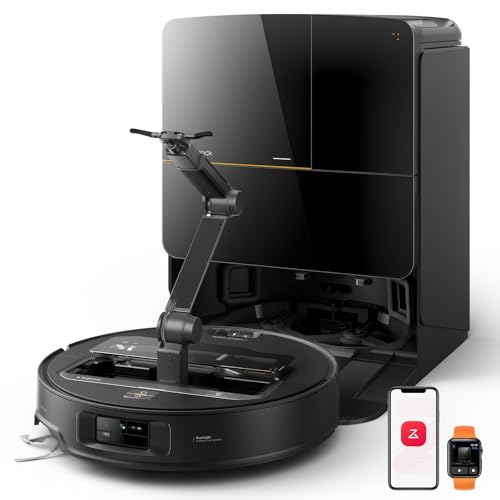
Roborock Saros Z70 features a robotic OmniGrip arm, 22,000Pa suction, hot water mopping & 10-in-1 dock. The most advanced robot vacuum available.
CES 2026: What Was Shown vs. What Is Actually Shipping
Here is where enthusiasm must meet honesty.
The CES 2026 demonstrations were real, impressive, and meaningful. But the gap between a controlled demonstration on a pristine wooden staircase and a product you can buy, run on your actual stairs, and trust to operate unsupervised is substantial.
What was shown at CES 2026:
- Multiple prototype stair-climbing robots performing ascending and descending sequences on demo staircases
- At least two major manufacturers — including one established Chinese robotics brand and one new entrant backed by significant venture capital — showing near-production hardware
- Autonomous floor-to-floor navigation in a constructed two-story demo environment
- Integration with whole-home mapping systems that treat multi-floor layouts as a single unified plan
What is confirmed to ship in 2026:
- Early access and developer units from one manufacturer, targeting smart home integrators rather than general consumers
- Limited retail availability in select Asian markets in Q3-Q4 2026
- Wide consumer availability in North American and European markets is currently projected for 2027
This is not a failure — it is the normal arc of genuinely new technology moving from prototype to product. The important shift is that the engineering problems have been solved in principle. The remaining work is manufacturability, durability testing, regulatory approval (stair-climbing robots will likely face new safety certification requirements), and cost reduction.
The Challenges That Took Years to Crack
Stair-climbing robot vacuums did not take this long to arrive because nobody thought of the idea. The concept has been in robotics research literature since the early 2000s. The delay came down to four compounding problems:
Weight vs. capability: A robot light enough to climb stairs safely struggles to carry the battery, dustbin, and motor power needed for meaningful cleaning performance. Every added component is a physics negotiation.
Stair geometry diversity: American staircases alone vary enormously — rise heights from 6 to 8.25 inches, tread depths from 9 to 11 inches, materials from polished marble to thick pile carpet. A robot that handles one configuration may fail on another.
Consumer trust and liability: A robot that falls down your stairs and injures someone is a product recall and a lawsuit. The safety bar for a stair-capable consumer device is orders of magnitude higher than for a flat-floor robot.
Cost of the required hardware: Multi-plane LiDAR, articulating mechanical arms, and active suspension are not cheap. Until component costs came down — driven largely by the EV and drone industries — the bill of materials for a stair-climbing robot was incompatible with consumer pricing.
All four of these problems have reached workable solutions simultaneously, which is why 2026 is the year this category emerged rather than 2016 or 2020.
The Best Multi-Floor Strategies Available Right Now
While the first stair-climbing robots reach early adopters, most multi-story households will continue with the current best approach: one robot per floor. Here is how the leading options compare.
eufy Omni C20 Robot — The High-Volume Choice
The eufy Omni C20 Robot Vacuum and Mop Combo has earned its place as one of the most reviewed robot vacuums on the market, with over 80,000 ratings and a 4.2-star average. Its all-in-one station handles auto-empty, auto-wash, and auto-refill, which means the robot itself requires minimal human interaction. For a one-per-floor deployment, the lower unit cost and high reliability record make this a practical anchor. The sheer volume of real-world feedback also means that edge cases — particular floor types, furniture configurations, Wi-Fi environments — are well-documented in the user community.
Roborock Q7 M5+ — The Navigation Leader
The Roborock Q7 M5+ Robot Vacuum and Mop with Self-Empty brings precision LiDAR mapping and multi-floor plan storage to a mid-premium price point, earning 4.1 stars across 14,000 reviews. For households where floor plan complexity varies significantly between levels — an open-plan ground floor versus a bedroom-dense upper floor — the Q7 M5+ handles different mapping challenges per unit. Its self-emptying base keeps maintenance infrequent, which is especially valuable if one unit is stationed on a less-used floor.
iRobot Roomba Q0120 — The Set-It-and-Forget-It Standard
With 51,000 reviews and a 4.0-star rating, the iRobot Roomba Q0120 remains one of the most trusted names in the category. iRobot’s smart navigation and scheduling system is among the most intuitive to configure for multi-unit households, particularly for less tech-savvy users. If the goal is maximum simplicity across floors with minimal setup friction, the Roomba Q0120 remains a benchmark.

eufy Omni C20 robot vacuum and mop combo with auto emptying, washing, and drying station. 7000Pa suction and 3.35-inch low profile. See the full review!
Who Will Benefit Most from Stair-Climbing Robots
When stair-climbing robots reach mainstream availability, the impact will not be evenly distributed. Certain households stand to gain dramatically more than others.
Multi-story homeowners are the obvious primary beneficiary — anyone managing a two, three, or four-story home who currently either runs multiple robots, carries a single robot between floors, or simply accepts that upper floors get less robotic cleaning attention.
Elderly users and those with mobility impairments stand to gain the most on a personal impact basis. Carrying a robot vacuum — or any vacuum — between floors is a physical demand that becomes progressively harder with age or disability. A robot that handles vertical transitions autonomously removes one of the most physically challenging aspects of home maintenance. This demographic is also among the most motivated buyers once the technology reaches reasonable pricing.
Households with open floor plan layouts that include sunken areas or split-levels — environments that current robots treat as impassable barriers — will find stair-capable navigation unlocks significant coverage they currently cannot automate.
Price Predictions and Release Timeline
Based on the CES 2026 announcements and historical patterns from other emerging robot vacuum categories (auto-empty, LiDAR navigation, robotic mops), here is a reasonable projection:
- 2026: Early access and limited retail units at $1,500–$2,500. Developer and integrator market focus.
- 2027: First mainstream consumer products in the $800–$1,200 range. Initial North American and European availability.
- 2028–2029: Second-generation products with improved reliability and reduced costs, targeting $500–$700. Multi-unit household penetration begins in earnest.
- 2030 and beyond: Stair-climbing capability becomes a standard premium tier feature, much as auto-empty did between 2020 and 2024.
These are projections, not guarantees. The pace depends heavily on how quickly safety certifications are resolved, whether any early product incidents affect consumer trust, and how aggressively established players like iRobot, Roborock, and Ecovacs respond to the new entrants who debuted at CES.
Frequently Asked Questions
Are stair-climbing robot vacuums safe?
The short answer is: the ones demonstrated at CES 2026 were engineered with multiple redundant safety systems and performed without incident in controlled conditions. The longer answer is that consumer-grade safety validation takes time. The first products will carry strict operating requirement disclosures — likely recommendations to clear stairways of obstacles, prohibitions on use with very young children or pets present on the stairs, and requirements for specific tread configurations.
A robot vacuum falling down stairs is a meaningful risk that manufacturers have taken seriously. The safety architectures described above — abort protocols, redundant contact points, active weight redistribution — exist specifically because engineers spent years on this problem. Early adopters should read all operating guidelines carefully. General consumers would do well to wait for second-generation products, which will benefit from real-world safety data.
When will stair-climbing robot vacuums be affordable?
“Affordable” is relative, but for mainstream household adoption, the target price point is around $600–$800. Based on current trajectory, that window opens around 2028. The technology premium on genuinely new robotic capability tends to compress faster than expected when multiple manufacturers enter the category simultaneously — and CES 2026 made clear that competition is already underway.
What is the current best multi-floor robot vacuum solution?
Right now, the most practical approach remains the one-robot-per-floor strategy. The eufy Omni C20 Robot offers the best combination of value and automation for most households. The Roborock Q7 M5+ is the better choice when mapping accuracy and navigation precision are priorities. If you want maximum simplicity and a proven ecosystem, the iRobot Roomba Q0120 delivers reliable performance backed by one of the deepest user communities in the category.
For anyone who wants to be close to the stair-climbing frontier without waiting, the Roborock Saros Z70 — with its OmniGrip robotic arm and 4.4-star rating across 2,441 reviews — represents the current pinnacle of robotic manipulation in a consumer vacuum. It does not climb stairs, but it is the most direct technological ancestor of the robots that will.
Will stair-climbing robots replace the one-per-floor strategy entirely?
Probably not for at least five years, and possibly never entirely. A single stair-climbing robot introduces a single point of failure for your entire home. Many households will prefer the redundancy of having dedicated units per floor, even after the technology matures. The more likely outcome is that stair-climbing capability becomes a high-end option that appeals strongly to specific households — particularly those with three or more floors, or those where physical access between floors is genuinely difficult — while the one-per-floor model remains popular for its simplicity and lower cost per unit.
eufy Omni C20 robot vacuum and mop combo with auto emptying, washing, and drying station. 7000Pa suction and 3.35-inch low profile. See the full review!
The Bottom Line
Stair-climbing robot vacuums are not vaporware. CES 2026 proved the engineering has arrived. The question now is not whether this technology will reach your home, but when — and at what price.
If you need a solution today, the multi-floor workarounds available right now are genuinely good, and the products listed above represent the best the current generation has to offer. If you can wait, the next two years will be among the most interesting in robot vacuum history.
The stairs are no longer the final frontier. They are the next chapter.
Ready to Find Your Perfect Vacuum?
Browse our expertly reviewed vacuum cleaners and make an informed decision
Browse All Vacuums