Best Bagged Vacuum 2026: Why Bagged Is Better for Allergy Sufferers
Best bagged vacuums of 2026 — clean, hygienic dust disposal and consistent suction make bagged vacuums the top choice for allergy sufferers.
Table of Contents
- Why Bagged Vacuums Are Having a Comeback
- Bagged vs. Bagless: Why Bagged Wins for Allergy Sufferers
- The Honest Downside: Bag Costs and When to Change
- The 6 Best Bagged Vacuums of 2026
- Miele’s AirClean Bag System: The Gold Standard Explained
- How to Choose the Right Bagged Vacuum for Your Home
- Frequently Asked Questions
- Final Verdict
Bagless vacuums dominated the market for the better part of two decades. Dyson made them fashionable in the late 1990s. Clear dust bins became a status symbol. Seeing the dirt you collected felt satisfying. And for a long stretch, anyone still using a bagged vacuum seemed slightly out of step with the times.
That era is ending. Quietly, and then all at once, bagged vacuums are having a serious comeback — and this time it is being driven not by nostalgia but by science, allergy research, and the growing understanding that dust containment matters as much as dust collection.
The core insight is this: you never have to touch the dust you collect. When a bagged vacuum fills up, you remove the bag, the opening self-seals, and you drop it in the trash. The allergens, the pet dander, the dust mite debris — none of it has any opportunity to re-enter your breathing air. Compare that to emptying a bagless dust cup, where opening the container over a trash bin releases a visible cloud of fine particles directly into your face. For the 50 million Americans who manage allergies or asthma, that moment of bagless emptying is not just unpleasant. It is a genuine health event.
This guide covers everything you need to know to choose the best bagged vacuum in 2026, why bagged vacuums have earned their renewed respect, and which specific models deliver the best performance based on real specifications and verified buyer ratings.
Why Bagged Vacuums Are Having a Comeback
The bagless revolution was built on a compelling promise: never buy bags again. Ongoing bag costs felt like a tax on a product you had already paid for. Transparent dust bins let you see your vacuum working. The appeal was real.
But the allergist community never stopped preferring bagged vacuums. The reasons are structural, not sentimental. Multi-layer vacuum bags function as a primary filtration stage, not merely a collection vessel. Premium bags from brands like Miele use synthetic fiber construction that captures finer particles than simple fabric or paper bags. By the time collected debris reaches the main HEPA or AirClean filter downstream, much of the fine particulate has already been stopped at the bag level. This staged filtration approach consistently produces cleaner exhaust air.
The second factor driving the comeback is the growing consumer frustration with bagless filter maintenance. Bagless vacuums require regular filter washing or replacement to maintain suction, and clogged bagless filters can force air through unintended pathways in the housing. Many buyers who switched to bagless models years ago have found that maintaining a bagless vacuum over a five-year period costs more in replacement filters and filter accessories than a comparable supply of vacuum bags would have cost.
Finally, modern bag technology has improved substantially. Miele’s HyClean bags are now manufactured with 80 percent recycled material. The self-sealing collar on Kenmore’s HEPA bags eliminates contact with collected debris during removal. What once felt like an inconvenient relic now often feels like the more thoughtful engineering choice.
Bagged vs. Bagless: Why Bagged Wins for Allergy Sufferers
The allergy argument for bagged vacuums comes down to two properties: containment during use and hygienic disposal.
Containment During Use
A quality vacuum bag is not passive storage. Multi-layer bags manufactured to HEPA-grade standards actively filter air as it passes through the bag material before reaching downstream filters. Miele’s AirClean GN bags, for example, use a micro-fiber, multi-layer construction that captures particles as fine as those targeted by HEPA filters. Every cubic inch of air that passes through the bag gets filtered twice: once at the bag and again at the exhaust filter.
Bagless cyclone systems are powerful, but they separate dust from air by centrifugal force rather than filtration. Fine particles below a certain size can evade the cyclone and reach the filter without the additional capture layer that a bag provides.
Sealed Disposal
This is the decisive advantage. When a bagged vacuum’s collection bag is full, the removal process is entirely contained. Miele’s HyClean bags have a spring-loaded collar that seals automatically the moment you remove the bag from the vacuum. Kenmore’s No-Touch bag system releases the bag with a single button press, and the self-sealing design ensures you never touch its contents.
By contrast, even the best-designed bagless emptying mechanisms expose the user to some level of fine dust during the process. The physics of opening a sealed dust container over a trash bin are unavoidable. Particles that were captured during vacuuming get displaced back into the air when the bin is disturbed.
For allergy sufferers, this is not a minor difference. Rhinitis and asthma symptoms can be triggered by dust exposure in the parts-per-million range. The sealed bag disposal process eliminates this exposure category entirely.
Suction Consistency as the Bag Fills
There is a persistent myth that bagged vacuums lose suction as the bag fills. In older designs with simple paper bags, this was partially true. Modern engineered bags are designed to maintain consistent airflow even at 75 to 85 percent capacity. Kenmore’s PowerFlow Technology, for example, specifically engineers the bag chamber geometry to sustain suction performance as the bag approaches full. Miele’s AirClean bag system uses a multi-layer construction that resists clogging across the bag’s working life.
High-quality bagless cyclone vacuums maintain suction well through the filtration system, but their filters require regular cleaning to maintain that performance. When filters are neglected — which is common in real-world use — suction drops. Bagged vacuums degrade more gracefully because the bag provides an early warning: a fill indicator tells you exactly when performance will begin to drop and the bag needs changing.
The Honest Downside: Bag Costs and When to Change
No responsible buying guide omits this. Bagged vacuums have a genuine, ongoing cost that bagless vacuums do not.
Replacement bag costs vary considerably by brand. Generic multi-pack bags for common formats like Kenmore Style C/Q can cost as little as $10 to $15 for a pack of ten. Miele’s proprietary AirClean GN or FJM bags are more expensive — typically $12 to $18 for a pack of four to five bags, or $20 to $30 for extended packs. If you vacuum heavily carpeted areas two to three times per week, you may go through four to six Miele bags per year at a cost of $25 to $45 annually. For a vacuum that will last twenty years, this is a real number worth acknowledging.
The premium bag case. Miele’s argument — and it is defensible — is that their specific AirClean bags are integral to the filtration system performance. Third-party bags that fit Miele vacuums are available at lower prices, but they do not use the same multi-layer fiber construction and may reduce filtration efficiency. If allergy management is your primary motivation for buying a Miele, using genuine Miele bags is the correct choice.
How often to change bags. Most manufacturers recommend changing the bag when the fill indicator signals approximately 75 percent capacity. Waiting until the bag is completely full forces the vacuum to work harder, increases motor wear, and in some cases can reduce suction before the indicator triggers. A practical schedule for average household use is every one to two months for a household with one to two occupants on mixed floors, or every three to four weeks for homes with pets or heavy carpet use. Kenmore’s built-in bag fill indicator removes the guesswork, which is one of the more genuinely useful features in that product line.
Storage tip. Buying bags in multi-packs reduces per-bag cost substantially. Keep two to three spare bags in the vacuum’s storage compartment (most bagged canisters include this) so a replacement is always on hand when the indicator triggers.
The 6 Best Bagged Vacuums of 2026
These six models represent the strongest performers across the bagged vacuum category in 2026, selected based on verified buyer ratings, filtration specifications, and real-world value.
1. Miele Guard M1 Parquet XL — Best Overall Bagged Canister
Rating: 4.6/5 (394 verified ratings)
View the Miele Guard M1 Parquet XL
The Miele Guard M1 Parquet XL is the top-rated bagged vacuum in our database with 394 verified buyer ratings, and it earns that position through a combination of genuine engineering excellence and thoughtful design for hard floor-dominated homes.
The 1200W German-engineered motor delivers strong, consistent suction across four adjustable power levels, all controlled via foot pedal so you never have to bend down during a cleaning session. The AirClean Plus filtration system and HyClean Air CO bags — manufactured with 80 percent recycled material — provide exceptional allergen containment. The bag’s ComfortFit collar seals automatically when removed, making disposal completely hands-free.
The signature Parquet Twister XL floorhead is purpose-built for hardwood, parquet, tile, and stone. Its extra-soft bristles and 180-degree rotation prevent scratching on sensitive finished surfaces while covering the cleaning path efficiently. The included AllTeQ Universal floorhead handles transitions between hard floors and low-pile carpeting with a foot-operated toggle switch.
Three integrated accessories — a crevice nozzle, dusting brush, and upholstery nozzle — are built into the vacuum body for immediate access. The 36-foot operating radius covers large rooms without outlet changes.
Ideal for: Hard floor homes, allergy sufferers, anyone investing in a long-term vacuum built to Miele’s 20-year standard.
Key specs: 1200W motor, four suction levels, HyClean Air CO bags, 36-ft operating radius, 14.8 lbs.
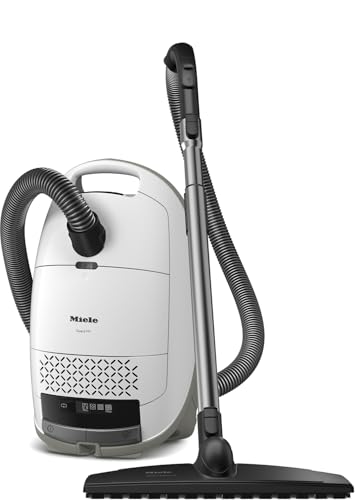
Miele Guard M1 Parquet XL bagged canister vacuum with 1200W motor, HEPA-grade filtration, and Parquet Twister XL floorhead. Perfect for hard floors.
2. Miele Complete C3 Limited Edition — Best Premium Bagged Canister
Rating: 4.5/5 (128 verified ratings)
View the Miele Complete C3 Limited Edition
The Miele Complete C3 Limited Edition in Tayberry Red represents the apex of what a bagged canister vacuum can be for a home that takes air quality seriously. The three-stage AirClean filtration system captures 99.9 percent of fine dust particles — allergens, pollen, pet dander, and microscopic debris — in a staged process that begins at the bag and ends at the exhaust filter.
Six suction power levels give you precise control for every surface type: delicate low settings for curtains and upholstery, full power for deeply embedded debris in carpet. The motor is notably quiet for its power class, making this a genuinely pleasant vacuum to use in homes where noise is a concern.
Two dedicated floorheads cover the full range of residential surfaces: the AllTeQ Universal floorhead for seamless hard floor-to-low-pile-carpet transitions, and the premium Parquet Twister for sensitive hardwood and parquet. The 36-foot operating radius with one-touch automatic cord rewind rounds out the premium package.
At 19.4 lbs and a higher price point, the C3 Limited Edition is an investment. For households where allergy management is critical and you are buying a vacuum you expect to use for the next fifteen to twenty years, it is a defensible one.
Ideal for: Allergy-sensitive households, homes with premium hard floors, buyers prioritizing long-term filtration performance.
Key specs: Three-stage AirClean filtration, 99.9% particle capture, six suction levels, AirClean GN bags, 36-ft operating radius.
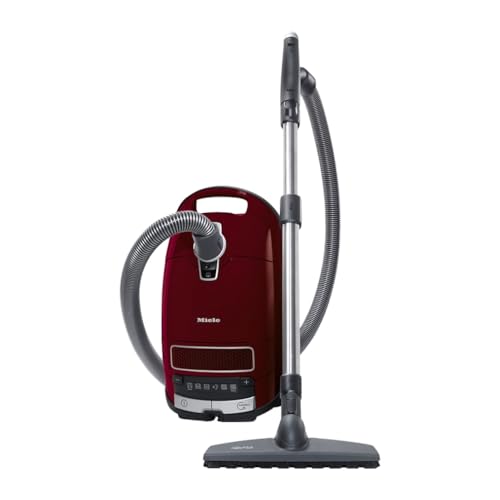
The Miele Complete C3 Limited Edition offers German-engineered AirClean filtration, 6-level suction & Parquet Twister for hard floors. Discover it today.
3. Soniclean WhisperJet C2 — Best for Ultra-Fine Particle Filtration
Rating: 4.5/5 (479 verified ratings)
View the Soniclean WhisperJet C2
The Soniclean WhisperJet C2 is the only residential vacuum on this list — or nearly any list — that offers U15 ULPA filtration as standard. While HEPA filters capture 99.97 percent of particles at 0.3 microns, ULPA at the U15 standard captures 99.999 percent of particles down to 0.12 microns. That means particles nearly three times smaller than what standard HEPA captures are stopped before they reach the exhaust air.
For immunocompromised individuals, severe asthma sufferers, or households where indoor air quality is an absolute priority, this level of filtration is genuinely meaningful rather than marketing language.
The WhisperJet name reflects the vacuum’s acoustic engineering. Soniclean’s advanced acoustic isolation technology makes the C2 among the quietest canister vacuums at any price point. The German venturi-effect engineering optimizes airflow efficiency without requiring a brute-force motor, so power translates to effective cleaning rather than noise.
The 37-foot operating radius — slightly more generous than even Miele’s offering — provides whole-room coverage from a single outlet, and the automatic cord rewind keeps storage clean. The comprehensive accessory kit includes a stainless steel telescopic wand, Technik floor tool, dusting brush, crevice tool, upholstery tool, and a dedicated tool storage wand mount.
This is the recommended choice by leading flooring and carpet manufacturers, which speaks to its surface-safe engineering credentials.
Ideal for: Severe allergy and asthma sufferers, immunocompromised households, noise-sensitive environments.
Key specs: U15 ULPA filtration (99.999% at 0.12 microns), German venturi engineering, 37-ft operating radius, 11.5 lbs, automatic cord rewind.

German-engineered Soniclean WhisperJet C2 canister vacuum with U15 ULPA filtration and whisper-quiet operation. Shop now for the cleanest home air possible.
4. Miele Guard L1 with Electro Plus Floorhead — Best Bagged Canister for Carpet
Rating: 4.4/5
View the Miele Guard L1 with Electro Plus Floorhead
Where the Guard M1 Parquet XL is optimized for hard floors, the Miele Guard L1 with Electro Plus Floorhead is the answer for homes with substantial carpet coverage. The Electro Plus Floorhead features a motorized brushroll with five carpet height settings that delivers deep-pile carpet cleaning performance comparable to upright vacuums — but with the maneuverability advantage of canister design.
The 1200W motor provides consistent, powerful suction, and the AirClean filtration system delivers the same allergen-containment standards that define Miele’s entire bagged range. HyClean bags keep disposal completely sealed and hygienic.
The combination of canister flexibility — the ability to clean stairs, above-floor surfaces, and tight spaces without switching tools — with the motorized brushroll’s carpet agitation capability makes this the most versatile bagged canister on this list. It handles deep pile carpet without compromise, transitions to hard floors with the alternate floorhead, and reaches every corner of the home with the included hose and wand accessories.
Ideal for: Mixed-floor homes with significant carpet coverage, households that want canister maneuverability with deep-carpet performance.
Key specs: 1200W motor, Electro Plus Floorhead with five carpet height settings, AirClean filtration, HyClean bags.
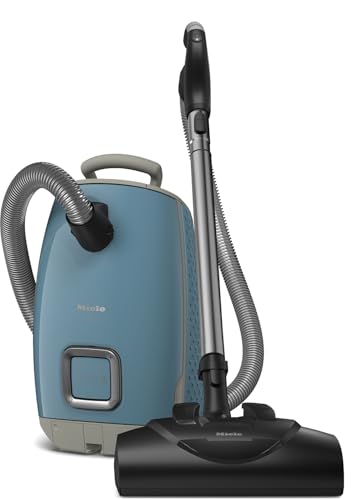
Miele Guard L1 canister vacuum with 1200W motor, AirClean filter, Electro Plus floorhead & AllTeQ universal head. Ideal for carpets, hard floors & pet hair.
5. Kenmore BU4018 Intuition Bagged Upright — Best Bagged Upright for Deep Carpet
Rating: 4.4/5 (567 verified ratings)
View the Kenmore BU4018 Intuition Bagged Upright
The Kenmore BU4018 Intuition is the highest-rated bagged upright in our database at 567 verified buyer ratings. It delivers a combination of deep carpet performance, allergy-focused features, and practical convenience that makes it the go-to recommendation for carpeted homes where a canister vacuum feels less intuitive.
The dual 2-motor system drives both the brushroll and suction independently — a setup that produces significantly better deep carpet cleaning than single-motor designs. The motorized brushroll agitates carpet fibers while the dedicated suction motor extracts loosened debris, which is the setup that consistently outperforms single-motor uprights on medium and high-pile carpet.
The HEPA filtration operates within a completely sealed air path, capturing 99.97 percent of particles at 0.3 microns with no bypass gaps in the housing. For allergy sufferers, the No-Touch Bag system is one of the most genuinely allergy-friendly disposal mechanisms available: a single button press releases the bag, which self-seals immediately, and you drop it directly in the trash without any contact with the contents.
PowerFlow Technology maintains strong suction even as the bag fills, and the built-in bag fill indicator removes guesswork about when to change. The Lift-Up design allows the cleaning pod to detach from the upright base for stair and above-floor cleaning — a practical feature that prevents you from needing a separate handheld for above-floor surfaces.
Ideal for: Carpeted homes, pet owners, allergy sufferers who prefer upright design, anyone who values no-touch bag disposal.
Key specs: Dual 2-motor system, HEPA filtration with completely sealed air path, No-Touch self-sealing bag, PowerFlow suction consistency, Lift-Up design, 14 lbs.

Kenmore BU4018 Intuition upright vacuum features lift-up pod, dual-motor suction, HEPA filter & no-touch bag system. Ideal for pet hair. Order today.
6. Kenmore Intuition BU4022 — Best Value Bagged Upright
Rating: 4.3/5
View the Kenmore Intuition BU4022
The Kenmore BU4022 Intuition delivers the core features that allergy-conscious buyers need at a lower price point than the BU4018, making it the strongest value pick in the bagged upright category.
The No-Touch self-sealing bag system for completely hygienic disposal, sealed HEPA filtration, dual-motor suction, and the Lift-Up design for above-floor cleaning are all present. If the BU4018 is the premium version, the BU4022 is its close sibling with a slightly different accessory configuration and more accessible pricing.
For households on a tighter budget who do not want to compromise on the allergen-containment properties that make bagged vacuums worth choosing in the first place, the BU4022 is the correct recommendation. The HEPA bag system traps allergens completely within the bag, the sealed housing prevents bypass, and the self-sealing disposal means the health advantages of the bagged design are fully realized even at this price point.
Ideal for: Budget-conscious allergy sufferers, carpeted homes, buyers who want the no-touch bag experience without the premium price.
Key specs: No-touch self-sealing HEPA bags, sealed HEPA filtration, Lift-Up design, dual-motor system, includes 6 HEPA bags.
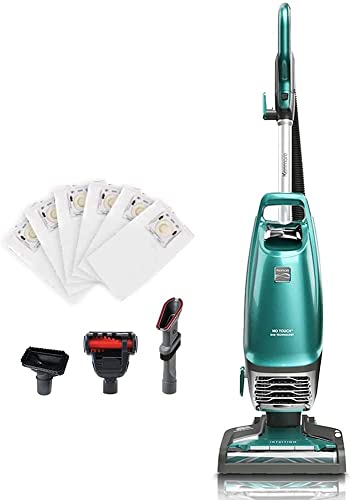
Kenmore Intuition BU4022 bagged upright vacuum with lift-up design, HEPA filtration, and 2-motor suction. No-touch bag system. Ideal for carpet and pet hair.
Miele’s AirClean Bag System: The Gold Standard Explained
Miele has built its vacuum engineering philosophy around the AirClean bag system, and understanding what makes it different helps explain why Miele commands its premium.
A standard vacuum bag is a fiber or paper pouch that collects debris. It works, but it is a passive container that begins restricting airflow as it fills and offers limited filtration of fine particles.
Miele’s AirClean bags are multi-layered, synthetic fiber constructions that function as an active filtration stage. The outer layers trap large debris. Inner micro-fiber layers capture fine dust particles, including the sub-micron allergens that would pass through simpler bag materials. The bag’s spring-loaded ComfortFit collar seals the opening automatically the moment you pull the bag free from the vacuum — the collar snaps shut without any action on your part, and the contents are sealed inside with no exposure to outside air.
The AirClean system then works in conjunction with the vacuum’s downstream motor protection filter and exhaust AirClean filter to create a three-stage filtration chain. Every cubic foot of air that passes through a Miele bagged vacuum is filtered at the bag level, at the motor protection stage, and at the exhaust stage before returning to the room. The result is exhaust air that Miele certifies as cleaner than the ambient air in many homes — a claim backed by independent filtration testing.
The Complete C3 series adds an optional HEPA AirClean Lifetime Filter (rated to 99.95 percent at 0.3 microns in H13 classification) as the exhaust stage, bringing the entire filtration chain to hospital-grade standards without any change to the bag itself. This is why the Miele Complete C3 Marin — built around the AirClean bag system with the HEPA Lifetime Filter — is the first recommendation from virtually every allergist who discusses vacuum choice with their patients.
How to Choose the Right Bagged Vacuum for Your Home
Hard floors primarily: Choose the Miele Guard M1 Parquet XL or the Complete C3 Limited Edition. The Parquet Twister floorhead family is designed specifically for surface-safe hard floor cleaning, and both models include the AllTeQ Universal floorhead for area rugs and low-pile carpet.
Mostly carpet: The Kenmore BU4018 with its dual-motor system and motorized brushroll, or the Miele Guard L1 with Electro Plus Floorhead, are the correct tools. Deep carpet cleaning requires motorized brush agitation, and these two deliver it.
Severe allergies or asthma: The Soniclean WhisperJet C2 with its U15 ULPA filtration is the only residential vacuum that goes beyond HEPA standards. If air quality is the primary driver of your purchase, this is the recommended choice.
Pets: Any Miele with an Active AirClean filter (which uses activated charcoal to neutralize pet odors, not just particles) is ideal. The Kenmore models with HEPA bags handle pet hair effectively at a lower price point.
Budget-conscious: The Kenmore BU4022 delivers sealed HEPA filtration and no-touch bag disposal without the premium price. It is the correct entry point into the bagged vacuum category for allergy sufferers who cannot justify a Miele budget.
Frequently Asked Questions
How much do replacement bags cost and where do I buy them?
Bag costs vary considerably by brand and format. Generic HEPA bags for Kenmore-format vacuums cost $10 to $20 for packs of eight to ten bags and are widely available on Amazon and at major retailers. Miele’s proprietary AirClean GN bags (fitting most Complete C3 and Classic C1 models) cost approximately $12 to $18 for a four-pack or $22 to $30 for a twelve-pack. The best prices are consistently available through Amazon, Miele’s official online store, and vacuum specialty retailers.
For Miele vacuums, the bag format (GN, FJM, U, G/N, etc.) is model-specific. Check your vacuum’s manual or the bag compartment door for the correct format before ordering. Buying in bulk — packs of twelve or more — reduces the per-bag cost substantially and ensures you always have a replacement on hand.
How often should I change the vacuum bag?
Most manufacturers recommend changing the bag when the fill indicator signals approximately 75 percent capacity. In practical terms, this translates to approximately every four to eight weeks for typical household use with one or two occupants, or every three to four weeks for homes with pets or heavy carpet use.
Do not wait until the bag is completely full. A bag that is packed beyond capacity compresses the collected debris against the bag walls, restricts airflow, reduces suction, and in some cases can cause motor strain in vacuums without adequate airflow protection.
Kenmore models with built-in bag fill indicators are the easiest to manage — the indicator does the monitoring for you. For vacuums without indicators, a monthly inspection of the bag when used for moderate cleaning is a reasonable maintenance habit.
Are third-party bags as good as OEM bags for Miele?
For basic dust collection, third-party bags that physically fit Miele vacuums work adequately. For allergy management, they do not deliver the same filtration performance. Miele’s AirClean bags use a specific multi-layer synthetic micro-fiber construction that is integral to the three-stage AirClean filtration system. Third-party bags typically use simpler construction that provides less active filtration at the bag stage. If you purchased a Miele specifically for its allergen containment properties, using genuine Miele bags is the correct choice. The additional cost — roughly $5 to $8 more per bag compared to generic alternatives — is small relative to the total value of the vacuum’s filtration system.
Can I tell when a bag is getting full without an indicator?
Yes. The most reliable indicator is a noticeable reduction in suction on surfaces that previously cleaned easily, particularly carpets. Many bagged vacuums also show a loss of the characteristic suction-hold on hard floors when the bag is near capacity. If your vacuum is leaving visible debris after a pass that it previously cleaned in one go, check the bag before investigating other causes. Visually inspecting the bag through the canister door (if the vacuum has a transparent access panel) is also straightforward on most canister designs.
Do bagged vacuums really maintain suction better than bagless?
Modern bagged vacuums with engineered bag chambers — particularly Kenmore’s PowerFlow design and Miele’s AirClean bag geometry — maintain consistent suction from a new bag to approximately 70 to 75 percent full. After that threshold, suction begins to drop measurably, which is why fill indicators typically trigger at 75 percent.
Bagless vacuums with regular filter maintenance maintain excellent suction, but the “regular maintenance” requirement is frequently underestimated. Bagless filters need cleaning or replacement at specific intervals to prevent suction loss. In real-world use, many bagless owners allow filters to become partially clogged, resulting in gradual suction degradation that is not immediately obvious. The bagged vacuum’s fill indicator creates a clearer maintenance signal and a harder deadline for action.
Are bagged vacuums better for the environment?
This is a legitimate consideration. Disposable vacuum bags create more material waste than reusable bagless dust cups. Miele has acknowledged this and moved toward bags manufactured with recycled materials — the HyClean bags now use 80 percent recycled fiber. Some manufacturers offer degradable bag options.
The counter-argument is that bagless vacuums require periodic filter replacement, and the environmental cost of filter disposal versus bag disposal is closer than the simple “reusable cup vs. disposable bag” framing suggests. On balance, if environmental impact is a primary concern, a bagless design with long-life washable filters has a marginal advantage. If allergen containment is the priority, the bagged design’s advantages for health outcomes typically outweigh the consumable footprint for allergy-affected households.
Final Verdict
Bagged vacuums in 2026 are not a compromise or a step backward. They are the technically superior choice for allergy sufferers, and the engineering advances in modern bag systems have largely eliminated the historic downsides that made bagless designs appealing.
The Miele Guard M1 Parquet XL is the strongest all-around recommendation for hard floor homes. The Kenmore BU4018 Intuition is the best bagged upright for carpeted homes. The Soniclean WhisperJet C2 is the correct choice for anyone with severe respiratory sensitivities who needs filtration beyond HEPA standards.
In every case, the core advantage is the same: when you are done vacuuming, the dust stays where you put it.
Ready to Find Your Perfect Vacuum?
Browse our expertly reviewed vacuum cleaners and make an informed decision
Browse All Vacuums