Best Robot Vacuum with Mopping 2026: Sweep and Mop in One Pass
Best robot vacuum mop combos of 2026 — sweep and mop simultaneously for spotless hard floors with minimal effort.
Table of Contents
- What Makes a Good Robot Vacuum Mop Combo?
- What to Realistically Expect from a Robot Mop
- The Best Robot Vacuum Mop Combos of 2026
- Side-by-Side Comparison
- How to Choose the Right Robot Vacuum Mop Combo
- Mopping Technology Explained: Sonic vs. Spinning vs. Drag Cloth
- Frequently Asked Questions
- Final Thoughts
Sweeping and washing your floors used to mean two separate passes — a robot vacuum run, then dragging out the mop. Robot vacuum mop combos have changed that entirely. In a single autonomous session, these machines vacuum up dust, pet hair, and crumbs, then lay down a damp mop pad to wipe away the grime left behind. The result is genuinely clean hard floors with almost zero effort from you.
The market for these combo machines has matured dramatically heading into 2026. Where earlier models simply dragged a damp cloth around with no intelligence, today’s top picks feature vibrating sonic mop pads, automatic water flow adjustment by zone, mop pads that lift themselves off the ground when the robot crosses onto carpet, and self-cleaning docks that wash and dry the pads after every session. Whether you have a modest tile kitchen or an open-plan home full of hardwood, there is a robot vacuum mop combo that fits your floors and your budget.
This guide covers the best options across all price ranges, explains the mopping technology behind each product, and sets honest expectations about what robot mopping can and cannot do.
What Makes a Good Robot Vacuum Mop Combo?
Before diving into specific products, it helps to understand the mopping features that separate an excellent combo from a mediocre one.
Water Tank Size
The onboard water reservoir determines how much floor the robot can mop before running dry. Entry-level robots carry 150–200ml, which covers a small apartment in one run. Mid-range machines push to 250–350ml, while premium models with self-refilling docks essentially have unlimited capacity since they return to the station to refill automatically.
A larger tank matters most if you have an open floor plan or want the robot to complete a full cleaning cycle without interruption. For smaller homes, a modest 200ml tank is perfectly adequate.
Sonic Vibrating Mop vs. Standard Drag Mop
The cheapest robot mop combos use a passive approach: a damp cloth is attached to the underside of the robot and dragged across the floor. This removes light surface dust and refreshes the floor, but it does not scrub.
Sonic mopping, also called vibration mopping, moves the mop pad back and forth at high frequency — some models at 200 RPM, others using oscillating mechanisms that produce hundreds of micro-strokes per minute. Sonic mopping generates genuine friction that lifts dried-on food residue, footprints, and light stains that a dragged pad cannot touch. If you have tile, LVP, or hardwood that sees regular cooking or pet traffic, sonic mopping is worth the extra investment.
Automatic Water Level Adjustment
Better robots let you assign different water output levels to different rooms via the app. You might want maximum moisture on a heavily used kitchen floor and minimal moisture near the edges of engineered hardwood. This zone-based water control prevents over-wetting sensitive surfaces while ensuring dirtier areas get a thorough wipe.
Auto Mop Lifting on Carpet
This is arguably the most important mopping feature for mixed-flooring homes. Without mop lift, a robot dragging a wet pad across carpet saturates the fibers and can leave damp patches or odors. Auto mop lifting raises the mop assembly 8–12mm when the robot detects carpet, allowing it to continue vacuuming without wetting the carpet at all. The best systems do this automatically with no zones to configure.
Self-Cleaning Mop Pads
Premium docking stations wash and hot-air dry the mop pads after every cleaning session. This eliminates the single biggest hygiene concern with robot mops: a dirty, bacteria-laden pad being dragged around your floors run after run. Self-cleaning docks use a combination of water, agitation, and heat drying to leave pads fresh and odor-free. If you run the robot daily, this feature is transformative for both convenience and hygiene.
What to Realistically Expect from a Robot Mop
Robot mops are maintenance tools, not deep cleaners. They handle:
- Light surface dirt and dust that accumulates between manual mops
- Footprints, paw prints, and everyday smudges on hard floors
- Dried light spills (coffee drips, small food residue with a sonic mop)
- Ongoing freshness on tile, LVP, hardwood, and sealed stone
They do not replace:
- A dedicated wet mop or steam cleaner for ground-in grime, sticky residue, or grout cleaning
- Heavy scrubbing of dried-on spills left for days
- Deep cleaning after renovations or large messes
Think of a robot mop combo as a tool that keeps your floors at a consistently clean baseline so that your occasional manual deep-clean sessions are faster and easier.
Best-suited homes: Hard floor dominant — tile, LVP, hardwood, laminate. Open floor plans benefit most from the hands-free convenience. Mixed-flooring homes with significant carpet benefit from auto mop lift.
The Best Robot Vacuum Mop Combos of 2026
1. Tikom L8000 Plus — Best Overall Value with Self-Emptying
Rating: 4.6/5
The Tikom L8000 Plus is one of the highest-rated robot vacuum mop combos we have reviewed, and it earns that rating by delivering premium-level features at a price that undercuts most flagship models. The 6000Pa suction handles pet hair, fine dust, and debris across all hard floors and carpets, with automatic boost detection when it encounters carpet. LiDAR navigation produces precise room maps and cleans in efficient, systematic rows rather than random patterns.
The self-emptying base holds up to 90 days of debris, meaning you genuinely do not need to touch the dustbin for three months at a time. The 2-in-1 design vacuums and mops in the same pass, and the 150-minute battery runtime means most homes — even larger open-plan layouts — are covered in a single session with auto-recharge and resume handling anything larger.
Key mopping notes: The mop pad attaches to the underside and requires manual removal or a no-mop zone if you want to vacuum carpet without wetting it. This is the primary trade-off compared to models with auto mop lift. For homes that are predominantly hard floor, it is a non-issue.
Pros:
- Self-emptying base holds 90 days of debris
- 6000Pa with carpet boost for thorough vacuuming
- LiDAR creates precise maps for efficient cleaning
- 150-minute runtime covers large homes
- 2-in-1 vacuum and mop in one pass
Cons:
- Mop pad must be manually removed before carpet cleaning without setting no-mop zones
- Self-emptying process is audible
- LiDAR turret adds height that may limit access under low furniture
Best for: Hard-floor-dominant homes wanting hands-free maintenance mopping with a class-leading value proposition.
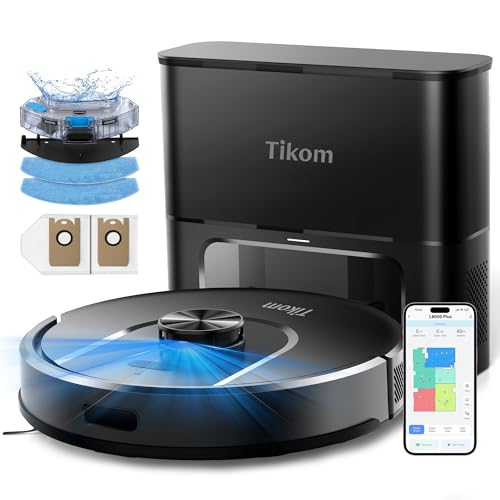
Tikom L8000 Plus robot vacuum and mop with self-emptying base, 6000Pa suction, and LiDAR navigation. 90-day hands-free cleaning for pet hair and all floors.
2. Roborock Qrevo QV 35A — Best Hands-Free Mopping System
Rating: 4.3/5
The Roborock Qrevo QV 35A is built around one of the most capable all-in-one docking stations available at its price point. The dock handles all four maintenance tasks automatically: empties the dust bin, refills the onboard water tank, washes the mop pads, and dries them with warm air. After a cleaning run, the robot returns to its dock and emerges the next morning with clean, dry pads and a full water supply, ready to repeat.
The dual 200RPM spinning mop pads are a significant upgrade over passive drag-cloth designs. The spinning action creates genuine scrubbing friction on hard floors, loosening dried food residue and footprints that a stationary pad cannot address. When the robot detects carpet, the mop assembly lifts 10mm automatically, protecting your rugs and allowing seamless transitions between surfaces.
8000Pa of HyperForce suction, PreciSense LiDAR navigation, and an SGS-certified 0% hair tangle rate on the rubber main brush round out a package designed for pet owners in particular.
Key mopping notes: Dual spinning mops at 200RPM deliver noticeably better mopping results than single-pad passive systems. The 10mm auto lift means carpet protection is handled automatically.
Pros:
- All-in-one dock empties, refills water, washes mops, and dries automatically
- Dual 200RPM spinning mops for genuine scrubbing action
- 10mm auto mop lift for seamless carpet transitions
- 8000Pa suction with SGS-certified hair-tangle-free brush
- Multi-floor mapping up to 4 levels
Cons:
- Large all-in-one dock requires dedicated floor space
- 2.4GHz WiFi only
- Ongoing cost of dust bags and replacement mop pads
Best for: Homes with both hard floors and carpet that want fully automated, wash-and-dry mop management without any manual pad maintenance.

Roborock Qrevo QV 35A robot vacuum and mop with 8000Pa suction, all-in-one dock, anti-tangle brushes, and dual spinning mops. Smart LiDAR navigation.
3. eufy E25 — Best for Deep Mopping Performance
Rating: 4.2/5
The eufy E25 distinguishes itself with the HydroJet roller mop system, which refreshes the mop pad twice per second during operation. This constant mop refreshing means the pad is always delivering clean water to the floor rather than spreading dirty water around as a traditional mop cloth eventually does. The practical result is noticeably cleaner hard floors, especially on tile and LVP in high-traffic areas like kitchens.
The all-in-one base station covers every maintenance task: auto-emptying the dustbin, self-washing the mop, hot-air drying, and automatic water refilling. With 20,000Pa of turbo suction, laser navigation, and AI obstacle avoidance trained on over 100 object types, the E25 is a fully autonomous system that handles floor care from start to finish. A 125-minute runtime ensures most homes are completed in one session.
Key mopping notes: The HydroJet roller mop is qualitatively different from a rotating pad or a drag cloth. The continuous refresh cycle produces measurably cleaner results on hard floors and makes the E25 one of the better choices if mopping performance — not just mopping convenience — is the priority.
Pros:
- HydroJet refreshes mop pad 2x per second for consistently clean mopping
- All-in-one station auto-empties, self-washes, hot-air dries, and refills
- DuoSpiral anti-tangle brushes handle pet hair without clogging
- 20,000Pa turbo suction for deep carpet extraction
- Laser navigation with AI obstacle avoidance and up to 5 floor plans
Cons:
- 2.4GHz WiFi only
- Large base station footprint
- Very high suction levels may be excessive for homes without heavy carpet
Best for: Homes where mopping quality — genuine floor cleanliness rather than just surface freshening — is the top priority alongside strong vacuuming performance.
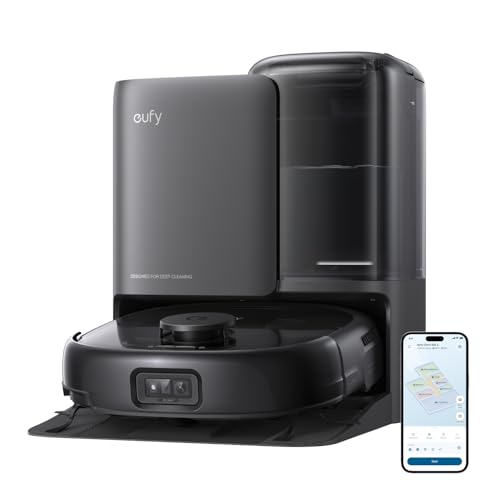
eufy E25 robot vacuum and mop combo with 20,000 Pa suction, HydroJet self-cleaning mop, all-in-one station, and laser navigation. Full expert review.
4. eufy X10 Pro Omni — Best Premium All-in-One System
Rating: 4.1/5
The eufy X10 Pro Omni was one of the robots that defined the all-in-one self-cleaning dock category, and it remains one of the most complete packages available. The Omni Station handles mop washing, mop drying with heated air, dust bin emptying, and water refilling, making it a genuinely hands-off system for weeks at a time.
The dual mop pads feature 12mm auto-lift when carpet is detected, which is 2mm more clearance than many competitors and ensures even thicker area rugs are handled without moisture transfer. 8,000Pa of suction, iPath laser navigation with AI.Map 3.0, and AI obstacle avoidance that recognizes over 100 object types make this a premium performer across all cleaning tasks. The combination of strong vacuuming, active mopping, and full dock automation has made the X10 Pro Omni a consistent recommendation since its release.
Key mopping notes: The 12mm auto-lift provides excellent carpet protection. The Omni Station’s heated mop drying prevents the mildew smell that affects robots whose pads stay wet between runs.
Pros:
- Omni Station washes, hot-air dries, empties, and refills automatically
- 12mm mop auto-lift for comprehensive carpet protection
- 8,000Pa suction with iPath laser navigation
- AI obstacle avoidance trained on 100+ object types
- Proven track record as one of the best-reviewed all-in-one systems
Cons:
- Large Omni Station footprint
- 2.4GHz WiFi only
- Premium price reflects the comprehensive feature set
Best for: Buyers who want a mature, well-tested all-in-one robot vacuum mop system at the premium tier with full dock automation.

eufy X10 Pro Omni robot vacuum and mop with 8,000 Pa suction, auto mop washing and drying, self-emptying, and AI obstacle avoidance. Full expert review here.
5. Tapo RV30 Max Plus — Best Mid-Range with Self-Emptying Dock
Rating: 4.2/5
The Tapo RV30 Max Plus hits an excellent price-to-feature ratio in the mid-range segment. It pairs a self-emptying dock with a sealed 3L dust bag that handles up to 60 days of debris, 5300Pa of adjustable suction across five power levels, and LiDAR navigation with multi-floor mapping. The 2-in-1 vacuum and mop function includes intelligent carpet avoidance during mopping mode, automatically steering clear of rugs so you do not have to configure exclusion zones manually.
Alexa and Google Home compatibility makes scheduling and room-specific cleaning commands easy from any smart speaker. The Tapo app provides zone control, water level adjustment, and scheduling with a polished interface that TP-Link has refined through their broader smart home ecosystem experience.
Key mopping notes: Mopping performance is rated as light maintenance — effective for daily freshness and preventing buildup, not for addressing accumulated grime. The carpet avoidance during mopping is a standout convenience feature at this price point.
Pros:
- Self-emptying dock with 60-day sealed 3L bag
- LiDAR with multi-floor mapping and smart carpet avoidance during mopping
- 5 adjustable suction levels up to 5300Pa
- Alexa and Google Home integration
- Polished Tapo app with zone and schedule control
Cons:
- 2.4GHz WiFi only
- Mopping limited to light maintenance cleaning
- Ongoing cost of replacement bags and mop cloths
Best for: Mid-range buyers who want a reliable self-emptying robot with mopping, smart home integration, and automatic carpet avoidance without paying premium prices.

Tapo RV30 Max Plus robot vacuum and mop with self-emptying dock, LiDAR navigation, and 5300Pa suction. 97% dust pickup rate. Read our expert review!
6. Tikom G8000 Max — Best Budget Robot Vacuum Mop Combo
Rating: 4.4/5
For buyers who want 2-in-1 vacuum and mop functionality without the premium price tag, the Tikom G8000 Max delivers strong core performance in a compact, ultra-slim 2.99-inch profile. The 5000Pa suction handles pet hair, dust, and crumbs on hard floors and low-pile carpet. The combined vacuum and mop function cleans in a single pass, and a 150-minute battery life means most apartments and mid-size homes are covered without recharging.
Four control methods — app, remote control, voice commands, and physical buttons — give flexibility without requiring a smartphone. The ultra-slim build is a genuine advantage for homes with low-clearance furniture like bed frames or under-cabinet spaces that taller LiDAR-equipped robots cannot reach.
Key mopping notes: The mopping function is basic — a damp cloth with no water flow control and no mop lift on carpet. This is an entry-level mopping implementation suited to light dust removal on hard floors, not scrubbing. Set no-mop zones via the app before running on mixed-surface homes.
Pros:
- Strong 5000Pa suction for a budget robot
- Ultra-slim 2.99-inch profile reaches under low furniture
- 150-minute runtime covers most homes in one session
- 2-in-1 vacuum and mop in a single pass
- Multiple control methods including remote and voice
Cons:
- No LiDAR mapping — less efficient random navigation
- No mop lift, no water level control
- No self-emptying dock
Best for: Apartment dwellers or hard-floor-only homes wanting an affordable, low-maintenance introduction to robot vacuum mopping without docking station complexity.

Tikom G8000 Max robot vacuum and mop combo delivers 5000Pa suction, 150-min runtime, and 4 cleaning modes for hard floors, carpets, and pet hair.
Side-by-Side Comparison
| Model | Rating | Suction | Mop Type | Auto Mop Lift | Self-Emptying | Self-Clean Mop |
|---|---|---|---|---|---|---|
| Tikom L8000 Plus | 4.6 | 6000Pa | Passive pad | No (manual remove) | Yes (90 days) | No |
| Roborock Qrevo QV 35A | 4.3 | 8000Pa | Dual spinning 200RPM | Yes (10mm) | Yes | Yes (wash + dry) |
| eufy E25 | 4.2 | 20,000Pa | HydroJet roller | Yes | Yes | Yes (wash + dry) |
| eufy X10 Pro Omni | 4.1 | 8,000Pa | Dual pad | Yes (12mm) | Yes | Yes (wash + dry) |
| Tapo RV30 Max Plus | 4.2 | 5300Pa | Passive pad | Carpet avoidance | Yes (60 days) | No |
| Tikom G8000 Max | 4.4 | 5000Pa | Passive pad | No | No | No |
How to Choose the Right Robot Vacuum Mop Combo
If your home is primarily hard floors: Any model on this list will serve you well. Prioritize mopping quality (HydroJet or spinning mops) and runtime. The Tikom L8000 Plus or eufy E25 are strong choices.
If you have a mix of hard floors and carpet: Auto mop lift is essential. The Roborock Qrevo QV 35A, eufy E25, and eufy X10 Pro Omni all handle carpet transitions automatically. The Tapo RV30 Max Plus uses carpet avoidance instead, which works well but means it skips carpeted areas entirely during mopping mode.
If daily freshness is the goal: Any model works. Budget-friendly options like the Tikom G8000 Max keep floors fresh with minimal investment. For larger homes, add a self-emptying dock to your requirements.
If deep mopping performance matters: The eufy E25’s HydroJet system and the Roborock Qrevo QV 35A’s dual spinning mops deliver noticeably better scrubbing results than passive drag-cloth implementations.
If total hands-off operation is the priority: The Roborock Qrevo QV 35A and eufy X10 Pro Omni offer the most complete self-maintenance systems, handling dust emptying, mop washing, mop drying, and water refilling automatically.
Mopping Technology Explained: Sonic vs. Spinning vs. Drag Cloth
Drag cloth / passive mop: A damp microfiber pad is fixed to the underside of the robot. Effective for light dust and surface grime. No mechanical assistance. Lowest cost implementation.
Vibrating / sonic mop: The mop pad vibrates at high frequency, typically hundreds of oscillations per minute. This generates friction that lifts dried-on residue and footprints. Most mid-range and premium robots use this approach. The Shark Matrix Plus AV2610WA is a good example of sonic mopping in practice.
Spinning mops: Two circular pads rotate continuously — typically 200RPM — creating a polishing/scrubbing motion across the floor. Used by Roborock’s Qrevo lineup. Effective for both freshening and light scrubbing.
HydroJet roller: eufy’s system uses a roller mop that refreshes itself with clean water as it moves, preventing dirty water redistribution. Produces notably cleaner results on floors that see heavy foot traffic.
Frequently Asked Questions
Do robot vacuum mop combos actually clean floors, or just wipe them?
They genuinely clean floors at a maintenance level. After vacuuming, the damp mop pad picks up fine dust the vacuum missed, removes dried footprints and light smudges, and leaves a fresh surface. Models with vibrating or spinning mops add actual scrubbing friction. They do not deep-clean tile grout or remove heavy buildup — that still requires a manual wet mop or steam cleaner.
Can I use a robot mop on all hard floor types?
Most sealed hard floors — tile, LVP, laminate, sealed hardwood, and sealed stone — are safe for robot mopping at low to medium water output. Unsealed hardwood, waxed floors, or extremely porous stone should be mopped with minimal moisture or excluded from mopping zones. Check your flooring manufacturer’s guidelines if unsure.
What happens when the robot mop rolls onto carpet?
Robots without mop lift: the damp pad touches the carpet, potentially leaving a damp patch. You should set no-mop zones or remove the pad before cleaning. Robots with auto mop lift (Roborock, eufy models above): the mop assembly rises 10–12mm automatically, protecting the carpet while the robot continues vacuuming.
How often should I run the robot mop?
For maintenance cleaning, daily or every other day works well in high-traffic homes. This prevents buildup and keeps the mop pad working on light soiling rather than fighting accumulated grime. If you run it less frequently (twice a week), clean or replace the mop pad more often.
Do the self-cleaning docks actually keep the mop pads hygienic?
Yes, noticeably. A self-washing and hot-air-drying dock eliminates the damp pad sitting in a warm dock between runs — the main cause of mildew odor. Pads still need periodic replacement (typically every 1–3 months depending on use), but the dock cleaning extends their useful life and keeps floors from being mopped with a dirty pad.
Is a robot mop combo worth it over a vacuum-only robot?
For hard-floor-dominant homes, yes. The mopping pass adds a meaningful level of floor cleanliness that vacuuming alone cannot achieve. Pet owners, households with children, and anyone who cooks frequently will notice the difference. For homes that are mostly carpet, the mopping function adds little value and a vacuum-only robot is a better investment.
How much water does a typical robot mop use per run?
Most robots use 150–300ml per standard cleaning session, depending on floor area, water level setting, and surface type. Robots connected to self-refilling docks do not have this constraint — they return mid-session to refill if needed.
Final Thoughts
The best robot vacuum mop combo for most homes in 2026 is the Tikom L8000 Plus — it delivers a high-rated, self-emptying, LiDAR-navigated 2-in-1 cleaning system at a price that makes the premium features accessible to a much wider audience.
For households where carpet is a significant factor, the Roborock Qrevo QV 35A earns the recommendation with its auto mop lift, dual spinning mops, and fully automated dock. If deep mopping performance on hard floors is the priority, the eufy E25’s HydroJet system is in a class of its own.
The key insight is this: robot vacuum mop combos work best when you set realistic expectations. Use them as daily or every-other-day maintenance tools and you will find your floors consistently cleaner than they would be with a vacuum-only robot — with almost no additional effort on your part.
Prices and ratings current as of March 2026. Products are selected based on performance, verified user ratings, and real-world mopping capability.
Ready to Find Your Perfect Vacuum?
Browse our expertly reviewed vacuum cleaners and make an informed decision
Browse All Vacuums