Best Robot Vacuum Without Mopping 2026: Clean Floors, No Wet Mess
Best robot vacuums without mopping — vacuum-only robot picks that save money and simplify maintenance without sacrificing cleaning performance.
Table of Contents
Robot vacuums that also mop are everywhere right now. Walk into any electronics store or browse any major retailer and the shelves are dominated by 2-in-1 combo machines that promise to vacuum and mop your floors in a single pass. These hybrid robots have become the default choice — and with them comes a default price tag to match.
Here is the problem: if your home is mostly carpeted, if you have tile floors you prefer to mop manually, or if you simply do not want the added complexity of a wet cleaning system, paying a $150 to $300 premium for mopping hardware you will never use makes no sense. Combo robots require wet pad management, water reservoir filling, pad washing or replacement, and regular cleaning of mop-related components inside the docking station. That is extra maintenance for a feature you never asked for.
If you just want a robot vacuum that cleans your floors thoroughly and reliably without soaking them, this guide is for you. We tested and researched the best vacuum-only robot vacuums of 2026 — machines that do one thing exceptionally well — and compiled them here alongside everything you need to know to choose the right model for your home.
Why Choose a Vacuum-Only Robot Vacuum?
The case for a vacuum-only robot is straightforward, but it is worth spelling out because the marketing around combo machines can make the mopping feature sound essential. It often is not.
Lower Purchase Price
Vacuum-only robots are consistently less expensive than their combo counterparts. A capable LiDAR-navigating robot vacuum from a reputable brand typically costs $150 to $350. An equivalent combo robot — same navigation, same suction, same dock — often runs $350 to $600 or more. When you strip away the mopping hardware, water management systems, and auto-mop-washing stations, the cost comes down substantially.
Simpler Day-to-Day Maintenance
Combo robots introduce a category of ongoing chores that vacuum-only robots simply do not have. You need to fill the water reservoir before each mopping session. You need to replace or wash mop pads when they become soiled. High-end combo docks automatically wash the mop pads, which sounds convenient — until you realize the dock itself needs to be cleaned regularly to prevent mold and odor buildup. With a vacuum-only robot, maintenance is limited to emptying the dustbin and occasionally cleaning the filter. That is it.
No Risk of Wet Damage on Carpets
Combo robots that mop and vacuum simultaneously carry a real risk of dragging a damp mop pad across carpet edges, area rugs, or low-pile runners. Even the best combo robots struggle to perfectly identify every carpet boundary in real time. Over time, repeated moisture exposure can damage carpet backing, promote mildew growth, and leave your rugs smelling musty. A vacuum-only robot eliminates this risk entirely.
Often Lighter and More Compact
Without a water tank, mop module, and related hardware, vacuum-only robots tend to weigh less and sit lower to the ground. A lower profile translates to better cleaning under beds, sofas, and low-clearance furniture — exactly where dust, pet hair, and debris accumulate most.
Longer Battery Life Per Charge
Water management and mop rotation motors consume power. Vacuum-only robots direct every watt of battery capacity to suction and navigation, which often translates to longer effective runtimes per charge.
The 6 Best Robot Vacuums Without Mopping in 2026
1. Shark AI Ultra Robot Vacuum AV2511AE — Best Overall Vacuum-Only Robot
Rating: 4.0/5 | 8,260+ reviews
The Shark AI Ultra AV2511AE is the strongest all-around pick for homeowners who want a premium vacuum-only robot with self-emptying capability, precise navigation, and powerful suction — without paying for a mopping module they do not need.
The defining feature is the Matrix Clean navigation system, which goes beyond standard back-and-forth row cleaning. Matrix Clean uses a precision grid pattern that makes multiple overlapping passes over each section of floor, ensuring that debris is captured on the first run rather than left behind. This approach makes a meaningful difference on carpet, where single-pass robots often leave embedded pet hair untouched.
Navigation is handled by a 360-degree LiDAR vision system that maps your entire home accurately and adapts to everyday changes like moved furniture. The system works in complete darkness, so scheduling an overnight clean is fully viable. Object avoidance is smooth and reliable.
For maintenance convenience, the XL self-emptying base holds up to 60 days of collected debris in a bagless compartment. After each cleaning session, the robot docks and empties automatically. The self-cleaning brushroll actively resists hair wrap, which is a genuine benefit in pet-owning households.
Control is handled through the Shark app, with voice assistant support for Amazon Alexa and Google Assistant. The Recharge and Resume function ensures complete coverage of large homes by returning to the dock to recharge mid-session and continuing from where it left off.
Best for: Pet owners, carpeted homes, larger floor plans, anyone who wants genuine set-and-forget convenience.
Pros: Matrix Clean multi-pass navigation, 60-day bagless self-empty base, LiDAR precision mapping works in darkness, self-cleaning brushroll for pet hair, Recharge and Resume for large homes.
Cons: Does not include mopping (a feature, not a flaw, in this context), periodic manual base emptying required, can occasionally struggle in very cluttered spaces.

Shark AI Ultra robot vacuum with Matrix Clean navigation, 60-day self-empty base, LiDAR mapping, and voice control. Expert review for pet owners.
2. eufy RoboVac 11S Max — Best Budget Robot Vacuum Without Mopping
Rating: 4.1/5 | 16,258+ reviews
The eufy RoboVac 11S Max is the most popular vacuum-only robot vacuum in this guide by review count, and it earns that popularity through a combination of slim design, quiet operation, and reliable everyday performance at an accessible price point.
At just 2.85 inches tall, the 11S Max is one of the thinnest robot vacuums on the market. This ultra-slim profile lets it glide beneath furniture that taller robots cannot reach — beds, sofas, dressers, entertainment centers — cleaning the hidden dust and pet hair zones that accumulate unseen. Eufy’s BoostIQ Technology automatically increases suction power within 1.5 seconds when the robot transitions from hard flooring to carpet, ensuring effective cleaning on both surface types without manual mode switching.
The 100-minute runtime on hard floors is generous for a robot at this price, and the automatic return-to-dock charging means you never need to manually recharge it. Operation is quiet enough to run while working from home, watching television, or even sleeping — something that cannot be said for many louder competitors. The anti-scratch tempered glass top cover adds a premium aesthetic touch and protects the surface from scuffing under low furniture.
This model does not require Wi-Fi or a smartphone app. A remote control handles all scheduling, mode selection, and directional control. For users who want simplicity without smart home complexity, this is a genuine advantage rather than a limitation.
Best for: Apartments and smaller homes, budget-conscious buyers, users who want simplicity without Wi-Fi or app requirements, homes with low-clearance furniture.
Pros: Ultra-slim 2.85-inch profile, BoostIQ automatic suction adjustment, 100-minute runtime, exceptionally quiet operation, anti-scratch tempered glass top.
Cons: No Wi-Fi or app control, random navigation is less efficient than LiDAR mapping, single side brush design.
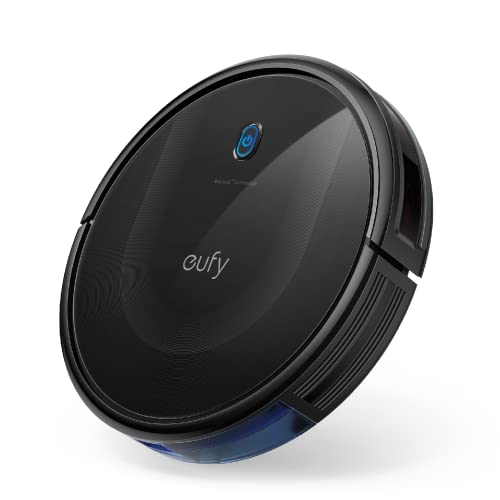
eufy RoboVac 11S Max super-thin robot vacuum with BoostIQ technology, 100-min runtime, and quiet operation. Ideal for hard floors and medium-pile carpets.
3. Lefant M210 Robot Vacuum — Best Vacuum-Only Robot for Pet Hair
Rating: 4.1/5 | 15,764+ reviews
The Lefant M210 is the top recommendation for pet owners who want a vacuum-only robot that eliminates the single most annoying maintenance task associated with robot vacuums: cleaning hair from the brushroll.
The M210 uses a brushless direct suction port instead of a spinning roller brush. Hair goes directly into the 500ml dustbin without wrapping around any mechanical component. For homes with shedding dogs, cats, or long-haired family members, this means no more pausing a cleaning session to cut and pull tangled hair from the brushroll. It is a small mechanical design choice that eliminates a genuinely frustrating chore.
Like the eufy 11S Max, the M210 sits at just 2.99 inches tall — slim enough to clean under most beds and sofas. At 11 inches in diameter, it is also one of the most compact robot vacuums on the market, navigating easily through chair legs, around table bases, and through tight passages between furniture.
Unlike the 11S Max, the M210 includes full Wi-Fi connectivity with app control via the Lefant app, plus Amazon Alexa and Google Assistant compatibility. You get scheduling, suction level adjustment, cleaning mode selection, and directional control through the app. Six distinct cleaning modes — Zigzag, Random, Spot, Edge, Schedule, and Manual — cover most practical cleaning scenarios.
FreeMove 3.0 navigation uses six infrared sensors for obstacle detection. It is not as precise as LiDAR mapping, but it performs capably in typical home layouts and prevents the robot from getting stuck or damaging furniture.
Best for: Pet owners, homes with long hair (human or animal), users who want Wi-Fi and app control at a budget-friendly price.
Pros: Brushless suction port eliminates hair tangles entirely, Wi-Fi and voice assistant integration, ultra-slim 2.99-inch profile, generous 500ml dustbin, 120-minute runtime.
Cons: Infrared navigation is less precise than LiDAR, no room mapping or room-specific cleaning, brushless design limits deep carpet cleaning on medium or high-pile surfaces.

Lefant M210 robot vacuum with brushless suction, 120-min runtime, and Wi-Fi/Alexa control. Ultra-slim design for pet hair on hard floors. Expert review inside.
4. iRobot Roomba 104 Vac — Best Mid-Range Vacuum-Only Robot
Rating: 3.8/5 | 599+ reviews
The iRobot Roomba 104 Vac represents the best entry point into iRobot’s LiDAR-mapped, app-controlled Roomba platform for buyers who want vacuum-only performance with precision navigation at a mid-range price.
The core cleaning system is iRobot’s proven 3-stage approach: an edge-sweeping brush that reaches corners and baseboards, a multi-surface rubber brush that adjusts to different floor types, and 70 times more power-lifting suction compared to the legacy Roomba 600 series. That suction figure is not just marketing — it translates to genuine deep cleaning on both hard floors and carpet, pulling embedded dirt and pet hair that lighter robots leave behind.
ClearView LiDAR navigation is the technology that separates the Roomba 104 Vac from budget infrared-sensor robots. The LiDAR system builds a precise floor plan of your home, enabling systematic row-by-row cleaning rather than random bounce navigation. You can target specific rooms through the iRobot Home app, set keep-out zones to block the robot from certain areas, adjust suction levels per room, and schedule cleaning sessions by day and time. Alexa, Siri, and Google Assistant voice control add further convenience.
Recharge and Resume ensures that large homes get complete coverage: when the battery runs low mid-session, the Roomba 104 Vac returns to its dock, recharges, and picks up exactly where it left off without any intervention.
Best for: Multi-room homes, buyers who want LiDAR precision and app control without paying flagship prices, smart home enthusiasts, homes with both carpet and hard floors.
Pros: ClearView LiDAR maps your home for systematic row-by-row cleaning, 70x suction vs. Roomba 600 series, room-by-room targeting with keep-out zones, Alexa/Siri/Google compatible, Recharge and Resume for large floors.
Cons: Charge-only dock with no self-emptying capability, requires 2.4GHz Wi-Fi network, relatively newer model with fewer long-term reviews.
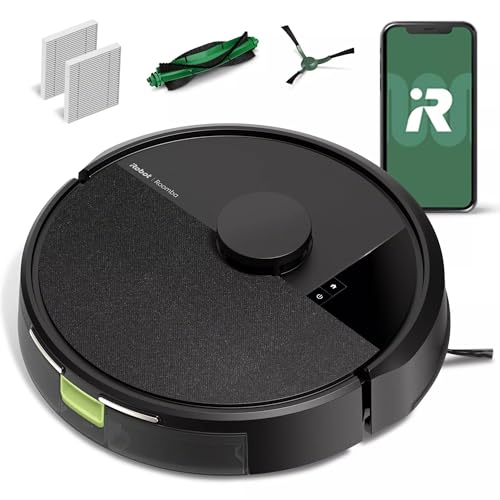
iRobot Roomba 104 Vac robot vacuum with 70X suction, ClearView LiDAR mapping, 3-stage cleaning, and smart app control. Ideal for pet hair. Expert review!
5. iRobot Roomba 205 DustCompactor — Best Premium Vacuum-Only Robot
Rating: 3.5/5 | 235+ reviews
The iRobot Roomba 205 DustCompactor is the most innovative vacuum-only robot on this list and the strongest choice for anyone who prioritizes maintenance-free operation above all else.
The defining innovation is the built-in mechanical DustCompactor — an industry first. As the robot vacuums, collected debris is continuously compressed inside the robot’s internal bin. This compaction system allows the Roomba 205 to hold the equivalent of up to 60 days of daily cleaning sessions without returning to an external emptying station. There is no bulky dock required. The robot stores itself wherever you choose — in a closet, under a bed, against a wall — while still providing the low-maintenance experience associated with premium self-emptying robots.
The battery is another standout: over three hours of runtime per charge, substantially longer than the 60 to 120 minutes typical of most robot vacuums. For large homes, this means complete coverage on a single charge with minimal need to pause and resume.
Navigation is ClearView LiDAR, the same precision mapping found in the Roomba 104 Vac, with full app control through the iRobot Home app and voice assistant support for Alexa, Siri, and Google Assistant. The 3-stage cleaning system delivers 70 times more suction than the Roomba 600 series across four selectable power levels.
The lower review count reflects that this is a relatively newer product. The 3.5 rating should be interpreted in context: early adopters of innovative new products tend to review more critically than the established user base of mature products.
Best for: Buyers who want maximum maintenance-free operation without a large dock footprint, large homes, users who want the latest iRobot technology.
Pros: Industry-first onboard DustCompactor enables 60 days without emptying, no bulky external dock required, over 3 hours battery runtime, ClearView LiDAR navigation, 70x suction with 4 selectable levels.
Cons: Premium price point, onboard bin must eventually be manually emptied, limited long-term reliability data as a newer product.
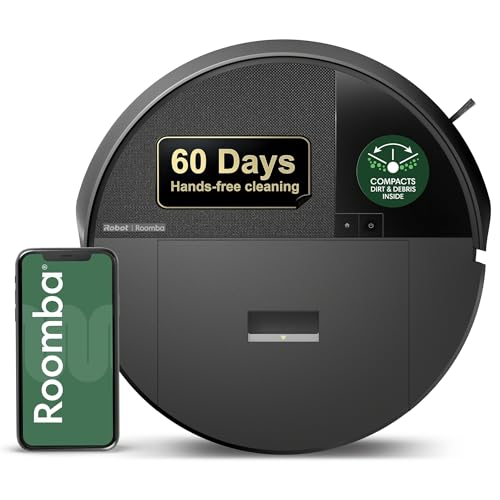
The iRobot Roomba 205 compacts dirt for 60 days without emptying, features LiDAR navigation and 70x suction power. See if it's right for your home.
6. ILIFE V2 Robot Vacuum — Best Entry-Level Vacuum-Only Robot
Rating: 4.1/5 | 4,723+ reviews
The ILIFE V2 is the most affordable recommendation in this guide and a surprisingly capable robot vacuum for hard-floor homes that need daily automated maintenance without any frills.
Like the Lefant M210, the V2 uses a tangle-free suction port that prevents hair from wrapping around the brush mechanism. For pet owners or households with long hair, this is a significant convenience advantage over roller-brush designs. The 2.99-inch slim profile matches the M210 for under-furniture reach, making it effective in the hidden dust zones beneath beds and sofas.
The 120-minute runtime is generous for a budget robot vacuum, providing full coverage of small to medium apartments on a single charge. Auto-recharge returns the robot to its dock when the battery runs low. Multiple cleaning modes — Auto, Spot, and Edge — cover the primary cleaning scenarios without unnecessary complexity.
Control is handled through a remote control (no Wi-Fi or app). For users who do not want smart home integration or are purchasing a robot vacuum for an older family member who prefers simplicity, the V2’s straightforward remote operation is a feature rather than a limitation.
ILIFE has built a long track record in the budget robot vacuum segment, and the V2 reflects that experience: solid build quality, reliable performance on hard floors, and a maintenance profile that could not be simpler.
Best for: Budget buyers, hard-floor homes, first-time robot vacuum users, users who prefer remote control simplicity over app complexity.
Pros: Tangle-free suction port prevents hair wraps, ultra-slim 2.99-inch profile, 120-minute runtime, multiple cleaning modes, auto-recharge, no ongoing costs.
Cons: Infrared sensor navigation, not effective on medium or high-pile carpet, no Wi-Fi or app connectivity.
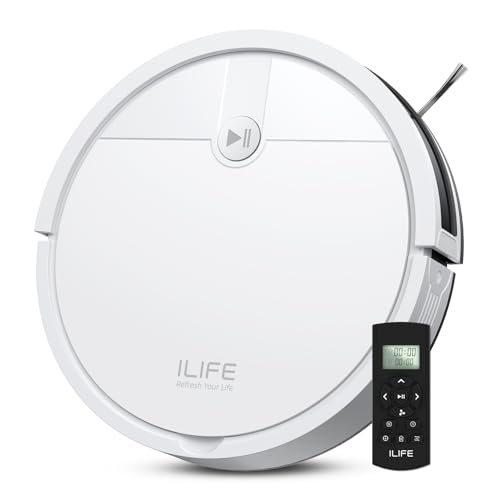
ILIFE V2 robot vacuum with tangle-free suction, 120-min runtime, and ultra-slim design. Ideal for pet hair and hard floors. Read our full expert review.
When to Choose Vacuum-Only vs. a Combo Robot
The decision between a vacuum-only robot and a combo robot is less about features and more about your specific home and cleaning habits.
Choose a Vacuum-Only Robot When:
Your home is mostly or entirely carpeted. Mopping is irrelevant on carpet. Combo robots vacuum carpet just as well as vacuum-only robots, but you pay a significant premium for a mop module that will never touch those surfaces. A vacuum-only robot delivers the same carpet cleaning results for less money.
You mop your hard floors manually — or rarely. Many homeowners who have tile or hardwood floors mop manually on a weekly or bi-weekly schedule and simply want the daily vacuuming automated. A robot vacuum handles the daily dust and debris pickup while you maintain control over when and how the floors get mopped.
You have multiple area rugs with low clearance. Combo robots can inadvertently deposit moisture on rug edges or transition zones. Vacuum-only robots remove this risk entirely.
You are on a budget. At any given price point, a vacuum-only robot will have better navigation, stronger suction, or more advanced features than a combo robot at the same price. The money you save by not paying for the mop hardware goes directly toward a better vacuum.
You want the lowest possible maintenance routine. No water tank to fill, no mop pads to wash or replace, no dock to descale or deodorize.
Choose a Combo Robot When:
You have large open areas of tile, hardwood, or luxury vinyl plank with minimal carpet. Combo robots shine in open-plan hard-floor homes where there is little risk of accidentally mopping carpet and where regular floor mopping is genuinely useful.
You want a single device to handle both vacuuming and light mopping. If you are trying to minimize the number of cleaning devices in your home and your floors are predominantly hard surfaces, a combo robot can deliver adequate mopping performance alongside vacuuming.
You have a large budget and want top-tier technology. The premium combo robots — with auto-mop-washing stations, hot water mop cleaning, and AI-based obstacle recognition — are genuinely impressive. If budget is not a constraint and you have the right floor type, they can justify their cost.
Top Features to Look for in a Vacuum-Only Robot
Navigation Technology
Navigation is the most important technical specification in a robot vacuum. It determines how thoroughly your floors get cleaned, how efficiently the robot covers your space, and how reliably it avoids obstacles.
LiDAR navigation (used in the Roomba 104 Vac, Roomba 205, and Shark AI Ultra) uses laser mapping to build precise floor plans and clean in systematic rows. It is the gold standard for thorough, efficient coverage and room-specific targeting. It works in complete darkness and adapts well to furniture changes.
Camera-based navigation uses visual sensors to map the home. Effective but can struggle in low-light conditions.
Infrared sensor navigation (used in the eufy 11S Max, Lefant M210, and ILIFE V2) detects obstacles and drop-offs but does not build a map. The robot navigates more randomly. Less efficient on large floors but perfectly adequate for apartments and smaller homes where the robot will cover the entire space regardless of path efficiency.
Suction Power
Robot vacuum suction is often expressed in pascals (Pa) or as a comparison to a reference model. For hard floors, 1,500 to 2,500Pa is generally sufficient. For carpets, look for 3,000Pa or higher, or choose a model with automatic suction adjustment (like BoostIQ on the eufy 11S Max) that increases power on carpet automatically.
Multiple suction levels are valuable: lower settings for quiet operation and battery efficiency, higher settings for deep cleaning on carpet or heavily soiled areas.
Dustbin Capacity
Standard robot vacuum dustbins hold 350ml to 600ml. For daily maintenance in smaller homes, this is sufficient. For larger homes or heavy shedding households, a larger dustbin means fewer interruptions to empty it. Self-emptying bases (present in the Shark AI Ultra and Roomba 205) extend the maintenance interval to weeks or months.
Runtime and Battery
Most robot vacuums offer 60 to 120 minutes of runtime. For homes under 1,000 square feet, this is adequate for a single session. For larger homes, look for Recharge and Resume capability, which allows the robot to automatically return to its dock, recharge, and complete the cleaning session without intervention.
Smart Features
App control, voice assistant compatibility, scheduling, room targeting, keep-out zones, and cleaning history reporting are the hallmarks of a well-connected robot vacuum. These features make a genuine difference in day-to-day usability, allowing you to clean specific rooms on demand, block the robot from certain areas, and set automated schedules without touching the robot itself.
For users who prefer simplicity, remote control models (eufy 11S Max, ILIFE V2) offer all the core scheduling and mode functionality without requiring a smartphone or Wi-Fi connection.
Self-Emptying Base
A self-emptying base collects debris from the robot’s dustbin automatically after each cleaning session. This dramatically reduces how often you need to empty the robot manually — from daily or every other day down to once every 30 to 60 days. It is the single feature that most transforms a robot vacuum from “somewhat convenient” to “genuinely hands-off.” The Shark AI Ultra includes a 60-day bagless base; the Roomba 205 achieves the same hands-free interval through its onboard compaction system without requiring an external base.
Anti-Tangle Design
For homes with shedding pets or long-haired occupants, a tangle-free or brushless suction port is a significant maintenance advantage. The Lefant M210 and ILIFE V2 both use direct suction without a roller brush, which means hair goes straight into the dustbin without wrapping around any mechanical parts. The Shark AI Ultra and Roomba 205 use rubber brushrolls with self-cleaning mechanisms that reduce but do not eliminate hair wrap.
Frequently Asked Questions
Are robot vacuums without mopping less effective than combo models?
No. Mopping capability has no effect on a robot vacuum’s suction power, navigation technology, or cleaning performance on dry floors and carpet. Vacuum-only robots from the same brand at the same price tier often have better suction or navigation than their combo counterparts because the budget is not split between two functions.
Can robot vacuums handle carpet without mopping?
Yes, and vacuum-only robots often handle carpet better than combo models because they are not carrying the weight or power draw of a mop module. Models with strong suction (70x Roomba series, Shark Matrix Clean) and automatic carpet detection (eufy BoostIQ) perform exceptionally well on low to medium pile carpet.
Do vacuum-only robots need less maintenance?
Significantly less. Without a water tank, mop pads, and mop-washing dock components, maintenance for vacuum-only robots is limited to emptying the dustbin, cleaning the filter, and occasionally removing debris from the side brush. This typically amounts to a few minutes per week.
What is the longest battery runtime on a vacuum-only robot?
The iRobot Roomba 205 DustCompactor offers over three hours of continuous runtime per charge, which is the longest of any model in this guide. Most robot vacuums offer 60 to 120 minutes, with Recharge and Resume bridging the gap for larger homes.
Can I use a robot vacuum if I have a mix of carpet and hard floors?
Yes, and most robot vacuums in this guide are designed precisely for mixed-floor homes. Models with automatic suction adjustment (eufy BoostIQ, multi-level suction on Roombas) or LiDAR-based floor detection handle transitions between surface types automatically without requiring manual mode changes.
Are vacuum-only robot vacuums good for pet hair?
Yes. The Lefant M210 and ILIFE V2 are particularly strong for pet hair due to their brushless/tangle-free suction ports. The Shark AI Ultra’s Matrix Clean multi-pass navigation and self-cleaning brushroll are also excellent for homes with heavy shedding pets. For households with multiple pets, prioritize a robot with either a brushless design or a self-cleaning brushroll to minimize maintenance.
Do I need a self-emptying base?
Not necessarily. Self-emptying bases are a convenience upgrade, not a requirement. They extend the maintenance interval from daily emptying to once every four to eight weeks. If you do not mind emptying the dustbin every day or two, a robot without a self-emptying base delivers the same cleaning results at a lower cost. If truly hands-off operation is your priority, the Shark AI Ultra (60-day bagless base) or the Roomba 205 (onboard compaction, no external base required) are the right choices.
Is a cheaper robot vacuum without mopping better than an expensive combo robot?
For carpet-heavy homes, yes — often significantly so. A $200 vacuum-only robot with LiDAR navigation will outperform a $400 combo robot on carpet because its entire cleaning system is optimized for suction rather than split between vacuuming and mopping. For predominantly hard floor homes where mopping matters, the calculation is different. But for most homes in North America with carpeted bedrooms and living rooms, a focused vacuum-only robot represents better value and better carpet cleaning than a combo machine at the same price.
Our Final Recommendation
If you want the best overall vacuum-only robot regardless of budget, the Shark AI Ultra AV2511AE delivers an outstanding combination of precision navigation, self-emptying convenience, and powerful suction with a proven track record across 8,000+ reviews.
For the best value, the eufy RoboVac 11S Max and Lefant M210 are both exceptional at their price points — the 11S Max for its ultra-slim profile and quiet operation, the M210 for its brushless anti-tangle system and Wi-Fi connectivity.
For premium buyers who want the most innovative design on the market, the iRobot Roomba 205 DustCompactor represents a genuine leap forward in hands-off maintenance with its onboard compaction system and three-hour battery runtime.
None of these robots will ever wet your carpet, deposit moisture on your area rugs, or ask you to wash a mop pad. They vacuum. They do it well. And in 2026, that focused approach often delivers better results than a machine trying to do two jobs at once.
Ready to Find Your Perfect Vacuum?
Browse our expertly reviewed vacuum cleaners and make an informed decision
Browse All Vacuums