Best Vacuum for Bamboo Floors: Scratch-Safe Picks for Eco-Friendly Flooring
Bamboo floors are eco-friendly but scratch easily. Find the best vacuum for bamboo floors that cleans effectively without dulling the finish or causing surface damage.
Table of Contents
Bamboo flooring has surged in popularity over the past decade, and for good reason. It is renewable, durable, and carries a warm aesthetic that works equally well in modern and traditional interiors. But bamboo floors are not maintenance-free. Choosing the wrong vacuum is one of the most common and costly mistakes homeowners make after installation. Stiff brush rolls, aggressive suction with no height adjustment, and plastic-edged floor heads can all leave micro-scratches that dull the finish over time, permanently degrading the look of a floor that should last for decades.
This guide cuts through the noise. We cover the different types of bamboo flooring, the specific ways vacuums cause damage, and what features actually protect your floors. Then we recommend five real vacuums with hard specs and honest trade-offs, so you can pick the one that fits your home rather than a commission-driven shortlist.
Understanding Bamboo Floor Types
Not all bamboo floors are the same. The manufacturing process has a direct impact on hardness, surface texture, and how vulnerable the floor is to vacuum-related damage.
Strand-Woven Bamboo
Strand-woven bamboo is the hardest type, with a Janka hardness rating that often exceeds 3,000 lbf, making it significantly harder than most species of hardwood oak (which sits around 1,290 lbf). The manufacturing process compresses shredded bamboo fibers under intense pressure and heat, resulting in a dense, tight-grained surface. While strand-woven bamboo can handle moderate mechanical stress better than traditional hardwood, the surface finish (polyurethane, aluminum oxide, or UV oil) is still vulnerable to abrasion from grit dragged under a hard-edged vacuum head.
Horizontal and Vertical Bamboo
Horizontal bamboo is cut so that the natural nodes of the bamboo stalk are visible, giving the floor a distinctive knuckle pattern. Vertical bamboo is cut with the stalks on end, producing a finer, more linear grain. Both types are softer than strand-woven bamboo and more prone to denting and surface scratching. A vacuum with a stiff rotating brush roll that makes direct contact with horizontal or vertical bamboo can cause visible scratching within weeks.
Engineered Bamboo
Engineered bamboo uses a thin bamboo veneer bonded to a plywood or HDF core. The veneer is often only 2 to 4mm thick, which limits how many times the floor can be refinished and means surface scratches are more consequential. The core also makes these floors more dimensionally stable in humid environments, but no more resistant to scratching at the surface level.
Surface Finishes and Their Scratch Profiles
The coating on top of the bamboo is what your vacuum actually contacts. Gloss and semi-gloss polyurethane finishes show swirl marks and micro-scratches far more readily than matte or oiled finishes. Matte and wire-brushed bamboo floors are more forgiving because the texture diffuses light and hides fine marks. Whatever the finish, the best approach is to keep the rotating brush roll from making direct, aggressive contact with the surface.
The Scratch Risk Profile of Bamboo Floors
Bamboo’s hardness is often cited as a selling point, and it is genuinely relevant for resisting impact damage from dropped objects. But hardness and scratch resistance are different properties. Scratch resistance depends primarily on surface hardness and finish quality, not the structural density of the flooring itself. The finish on most bamboo floors can be scratched by quartz particles (a major component of household dust and tracked-in grit) under as little as 200 grams of contact pressure.
This is why the vacuum matters. When a vacuum drags a spinning nylon brush roll across a bamboo floor at 3,000 RPM, it is not just cleaning. It is dragging any grit captured between the bristles directly across the finish at high speed. Even a single cleaning session with the wrong vacuum can introduce hairline scratches that scatter light and create a cloudy, dull appearance, especially under raking light from windows.
The risks are most acute at three specific points:
-
The rotating brush roll: Any vacuum designed for deep-pile carpet cleaning will have stiff, aggressive bristles that should never contact bare bamboo. The solution is a vacuum with a dedicated brush-off or hard floor mode.
-
The floor head perimeter: Cheap plastic edges or metal sole plates can drag directly on the bamboo surface. A rubber-edged or felt-lined floor head is the safer choice.
-
Transition zones: The moment the vacuum crosses from carpet to bamboo, the brush roll is still spinning at full speed. A vacuum with a manual shutoff or an auto-sensing floor head eliminates this risk.
What to Look for in a Vacuum for Bamboo Floors
Brush Roll Shutoff or Hard Floor Mode
This is the single most important feature. A brush roll shutoff lets you disengage the spinning roller completely, so the floor head glides on its wheels and the suction alone lifts debris. Some vacuums include a dedicated hard floor mode that simultaneously reduces suction and disengages the brush roll. Either approach works well on bamboo.
Soft or Natural-Fiber Brush Roll Option
If you prefer to use a brush roll (they do help dislodge fine grit from beveled edges and micro-textured surfaces), choose a vacuum that uses a softer PowerFins-style rubber roll or genuine soft-bristle brush rather than stiff nylon. Rubber fin brush rolls are significantly less abrasive than traditional bristle rolls and are increasingly common in mid-range uprights.
Low-Profile Floor Head
Bamboo floors are often installed with a micro-bevel edge between planks. Dust and fine debris collect in these channels, and a flat-bottomed floor head with no articulation will skip right over them. A low-profile head that can flex slightly as it transitions between boards does a better job of drawing debris out of the channels without the roller gouging the edges.
Suction Adjustment
High suction with no air regulation can cause a soft-brush floor head to press down on the bamboo with enough force to drag abrasive particles across the finish. Variable suction or a suction slider is a practical feature for hard floors, especially oiled or wire-brushed bamboo surfaces where even fine grit leaves visible marks.
Weight and Maneuverability
Heavy vacuums are more tiring to use on hard floors where you tend to do more back-and-forth strokes than on carpet. A vacuum under 15 lbs with swivel steering will cover bamboo floors more thoroughly because it is easier to guide into corners, along baseboards, and under low furniture.
Sealed Filtration
Bamboo floors in living areas tend to accumulate fine dust. A vacuum that exhausts unfiltered air back through the floor head can scatter fine particles across the very surface you just cleaned. A HEPA-sealed system ensures that what goes in stays in.
Best Vacuums for Bamboo Floors
1. Shark Navigator Lift-Away UV730 PowerFins HairPro
View the Shark Navigator UV730
Rating: 4.5/5 (1,040 reviews) | Type: Upright | Weight: 13.5 lbs
The UV730 is the most technically sophisticated option on this list for bamboo floor households. Its defining feature for hard floor use is the brushroll shutoff switch, which completely disengages the PowerFins HairPro roller. When the roller is off, the floor head rests on smooth plastic runners and the vacuum becomes a suction-only hard floor cleaner, which is exactly what bamboo needs.
The PowerFins roller itself is worth discussing even for hard floor contexts. Unlike traditional nylon bristle rolls, the rubber fin design is far less aggressive against hard surfaces, which means that even if you forget to flip the shutoff when transitioning from a rug to bamboo, the damage risk is considerably lower. The self-cleaning function also prevents hair from wrapping and building up into a dense mass that would otherwise drag across the floor.
At 13.5 lbs, the UV730 is light enough for extended sessions, and the swivel steering makes it easy to work around furniture legs without jarring repositioning. LED headlights mounted in the floor head reveal fine dust along baseboards and in the channels between bamboo planks, which is a genuinely useful feature on a dark-finished floor.
The Lift-Away pod detaches for stair cleaning and above-floor surfaces, adding versatility that a dedicated hard floor vacuum lacks. The HEPA Anti-Allergen Complete Seal filtration ensures that fine bamboo dust and allergens do not recirculate into the air.
Best for: Bamboo floors in homes with pets or high foot traffic, where hair wrap and fine-grit debris are ongoing concerns.
Specifications: Corded | HEPA filtration | 0.8-quart dust cup | 12 x 12 x 45.3 inches
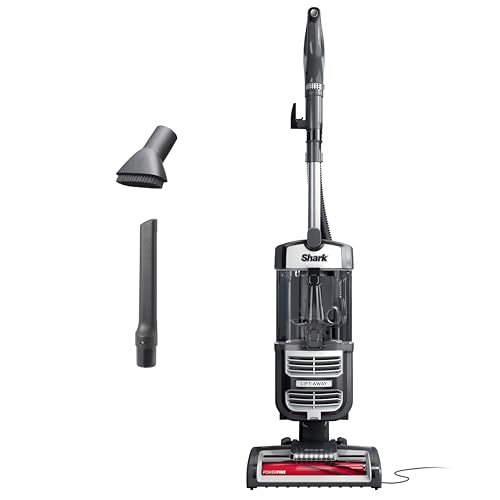
Shark Navigator UV730 Lift-Away upright vacuum with PowerFins HairPro brushroll, HEPA filtration, and LED headlights. Ideal for pet hair. Expert review inside.
2. Shark Rotator Lift-Away LA502 DuoClean PowerFins
Rating: 4.3/5 (3,907 reviews) | Type: Upright | Weight: 12.3 lbs
The LA502 brings Shark’s DuoClean technology to the bamboo floor conversation in an interesting way. The DuoClean head uses two rollers: a front soft roller that runs in direct contact with hard floors and a rear PowerFins roller that handles carpets. The soft front roller is specifically designed to pick up fine debris from bare floors without scratching, which makes the LA502 one of the better options for bamboo floors among full-size uprights.
This dual-roller system means you do not need to toggle a switch every time you cross from a bamboo section to a rug. The floor head handles the transition automatically, which reduces the risk of user error. The self-cleaning PowerFins roller prevents hair accumulation in the head, and the HEPA Anti-Allergen Complete Seal ensures that fine dust from the floor does not exit through the exhaust.
At 12.3 lbs, the LA502 is the lightest upright on this list, which helps when navigating a bamboo-floored open plan space. Swivel steering is responsive and the Lift-Away pod detaches easily with a pedal release, avoiding any need to bend down or fumble with catches.
The included pet power brush and upholstery tool add versatility for households with upholstered furniture adjacent to bamboo floors.
Best for: Open-plan homes with a mix of bamboo and rugs where frequent floor type transitions make an auto-sensing dual roller system more practical than a manual brushroll shutoff.
Specifications: Corded | HEPA Anti-Allergen Complete Seal | Swivel steering | 30.5 x 25.4 x 118.1 cm

Shark Rotator Lift-Away LA502 upright vacuum with DuoClean PowerFins, HEPA filtration, and self-cleaning brushroll for pet hair. Expert review and full specs.
3. Shark Navigator Lift-Away Speed ZU561
View the Shark Navigator ZU561
Rating: 4.4/5 (12,979 reviews) | Type: Upright | Weight: 13.4 lbs
The ZU561 is the most widely reviewed upright on this list, and its strong rating across nearly 13,000 reviews reflects consistent real-world performance. For bamboo floors, the key feature is the adjustable suction control combined with the brushroll shutoff. Dialing down suction before switching to hard floor mode reduces the pressure the floor head exerts on the bamboo surface, minimizing the risk of fine grit being dragged under the edges of the head.
The self-cleaning brushroll prevents hair buildup, and the HEPA Anti-Allergen Complete Seal system keeps the exhaust clean. Swivel steering is standard, and the Lift-Away canister detaches for stairs and above-floor cleaning.
At 13.4 lbs, the ZU561 falls in the same weight class as the UV730. The main trade-off compared to the UV730 is that the ZU561 uses a traditional self-cleaning bristle roll rather than a rubber PowerFins design, which means the hard floor brushroll shutoff is a more important habit to maintain. When the shutoff is engaged, the ZU561 performs excellently on bamboo. With the roller on and set to a high speed, it is less forgiving than the rubber-fin competitors.
The included hair removal multitool and duster crevice tool are practical additions for getting into the channels between bamboo planks and along baseboards.
Best for: Homeowners who want a proven, high-review upright with good suction control and reliable brushroll shutoff at a competitive price point.
Specifications: Corded | HEPA filtration | Bagless | Includes: Duster Crevice Tool, Hair Removal Multitool, Upholstery Tool
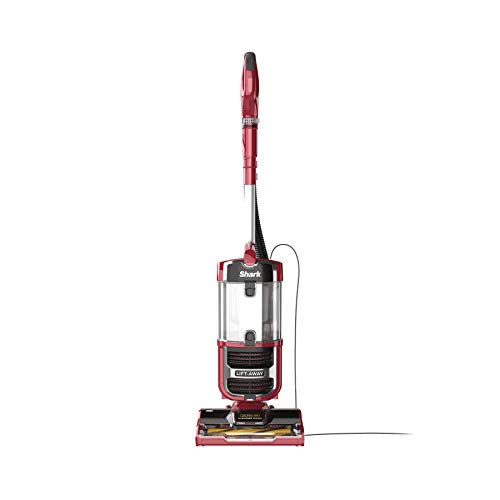
Shark Navigator Lift-Away Speed ZU561 with self-cleaning brushroll and HEPA filter. Lightweight upright vacuum for pet hair on carpets and hard floors.
4. Dirt Devil Simpli Stik Plus SD22010 3-in-1 Stick Vacuum
Rating: 4.3/5 (2,730 reviews) | Type: Stick | Weight: 3.6 lbs
The Simpli Stik Plus earns its place on this list for a specific use case: lightweight daily maintenance cleaning on bamboo floors. At 3.6 lbs, it is less than a quarter of the weight of the full-size uprights above, and for a bamboo floor household where quick passes between deeper weekly cleanings are the norm, that weight difference translates directly into actually using the vacuum more often.
Its recommended surfaces are hard floor and low-pile carpet, making it a purpose-built option for households where bamboo is the primary flooring type. The floor head is simple, with no aggressive rotating brush roll to manage, which removes the primary mechanical scratch risk associated with uprights.
The 3-in-1 design converts from a stick vacuum to a handheld unit, useful for cleaning upholstered furniture, stairs, and car interiors without reaching for a second appliance. The reusable rinsable filter eliminates replacement filter costs and is practical for dusty bamboo floor environments.
The honest trade-off is performance depth. The Simpli Stik Plus is not a replacement for a powerful upright on carpets or in a home with heavy pet hair. It does not offer HEPA filtration or an automatic cord rewind. But for a bamboo-heavy home where the priority is a grab-and-go daily vacuum that will not accidentally damage the floor, it is a genuinely sensible recommendation.
Best for: Apartments or homes with primarily bamboo flooring where a lightweight, simple daily-use vacuum is more practical than a full-size upright.
Specifications: Corded | Reusable rinsable filter | 3.6 lbs | 10 x 5.75 x 45 inches

Dirt Devil Simpli Stik Plus 3-in-1 corded stick vacuum is lightweight, bagless, and perfect for dorms and small spaces. See our full expert review and specs.
5. Bissell MultiClean Allergen Rewind Pet 3402
View the Bissell MultiClean 3402
Rating: 4.2/5 (10,930 reviews) | Type: Upright | Weight: 19.3 lbs
The Bissell 3402 is the choice for homes where allergen control and pet hair management are as high a priority as floor protection. Its HEPA Sealed Allergen System captures pet dander, dust mite debris, and fine bamboo dust before the exhaust air returns to the room. The Tangle-Free brushroll, while a stiffer design than the rubber PowerFins found in the Shark uprights, significantly reduces maintenance by preventing hair wrap that could otherwise turn into a floor-dragging abrasive.
The 25-foot cord with one-press automatic rewind is a practical standout feature: longer than most competitor cords, and the auto-rewind eliminates the cumbersome manual cord winding that turns post-cleaning cleanup into a chore. LED headlights in the floor head reveal fine pet hair and dust along bamboo grain lines that would otherwise be missed.
The weight is a genuine limitation for bamboo floor use. At 19.3 lbs, the 3402 is noticeably heavier than the other options on this list, and pushing a heavier vacuum means more force is applied to the floor head perimeter against the bamboo surface. Keeping the brushroll shutoff engaged on hard floor mode and using the suction adjustment thoughtfully mitigates this, but users with large bamboo floor areas may find the weight fatiguing over a full cleaning session.
Best for: Households with both bamboo floors and heavy pet shedding, where allergen capture and hair-management performance justify the higher weight.
Specifications: Corded | 25-ft cord with auto-rewind | HEPA Sealed Allergen System | LED headlights | Swivel steering
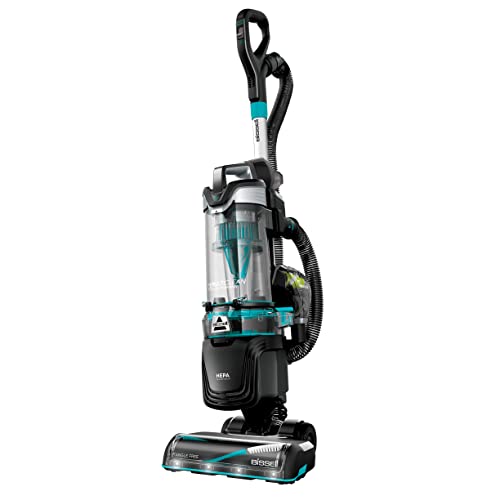
Bissell MultiClean Allergen Rewind Pet Vacuum with HEPA sealed system, auto cord rewind, and tangle-free brushroll. Ideal for pet hair and allergens. See review.
Bamboo Floor Care Tips Beyond Vacuuming
Vacuuming correctly is the most important maintenance habit, but it works best as part of a broader care routine.
Sweep before vacuuming when possible. A microfiber dry mop before vacuuming picks up surface grit that would otherwise be dragged under the vacuum floor head. This is especially worthwhile on high-traffic entry areas.
Never use a steam cleaner. Bamboo, including strand-woven varieties, is sensitive to moisture and heat. Steam forces water vapor into the joints between planks and can cause swelling, warping, and finish delamination. A dry or near-dry cleaning method is always correct for bamboo.
Use pH-neutral bamboo floor cleaner for damp mopping. When vacuuming alone does not remove sticky residue or footprint marks, a damp (not wet) microfiber mop with a pH-neutral cleaner formulated for bamboo is the appropriate tool. Wring the mop thoroughly before contact with the floor.
Place mats at all exterior entry points. The majority of grit that scratches bamboo floors is tracked in from outside. A coarse-fiber exterior mat followed by a soft interior mat captures most of it before it reaches the bamboo surface.
Felt pad all furniture legs. Vacuum-related scratching gets the most attention, but stationary furniture is responsible for a significant share of bamboo floor damage. Check felt pads periodically and replace them when they wear through.
Keep indoor humidity between 40% and 60%. Bamboo responds to humidity changes by expanding and contracting. Maintaining stable relative humidity prevents gapping and reduces stress on the finish at the plank edges, which are the first areas to show surface wear.
Frequently Asked Questions
Can I use any vacuum on bamboo floors?
Not safely. Vacuums designed primarily for carpet, with high-speed stiff brush rolls and no hard floor mode, will damage bamboo over time. You need a vacuum with either a brush roll shutoff, a soft rubber roller, or a dedicated hard floor head that can be used without a rotating brush.
Is it better to sweep or vacuum bamboo floors?
For daily maintenance, sweeping with a microfiber dry mop is the gentlest option. For thorough cleaning that captures fine dust, pet hair, and debris from plank channels and corners, vacuuming with the right machine is more effective. Many homeowners use both: a quick sweep daily and a vacuum pass weekly.
Do robot vacuums work on bamboo floors?
Some robot vacuums are safe for bamboo, particularly those with rubber brush rolls and soft side brushes. The concern is the perimeter brush: stiff side brushes spinning against bamboo baseboards and plank edges can cause scratching. Look for robot vacuums with soft rubber side brushes and an auto-adjusting suction setting for hard floors.
What brush roll setting should I use on bamboo?
The brush roll should be completely off or set to hard floor mode when cleaning bamboo. If your vacuum has only a single speed brush roll with no shutoff, it is not a suitable vacuum for bamboo flooring.
How often should I vacuum bamboo floors?
In most households, once or twice per week is sufficient for general maintenance. In homes with pets or children who track in dirt regularly, three times per week keeps grit from accumulating to the point where it causes accelerated surface wear. High-traffic entry areas benefit from more frequent attention.
Can I use a wet mop after vacuuming?
A lightly damp microfiber mop is acceptable, but the mop should be wrung out so thoroughly that it is barely damp to the touch. Pooling moisture, dripping mop heads, and steam cleaning are all damaging to bamboo and should be avoided.
Will a heavy vacuum scratch bamboo floors more than a light one?
Weight affects how much downward force the vacuum applies to the floor head, which in turn affects how hard debris particles are pressed against the bamboo surface. Lighter vacuums are inherently gentler. That said, the brush roll configuration is more important than weight: a light vacuum with an aggressive spinning brush roll is more damaging than a heavier vacuum with the brush roll completely disengaged.
Conclusion
Bamboo floors are a long-term investment, and the vacuum you use on them either protects or progressively degrades that investment over time. The most important thing to understand is that bamboo’s hardness does not protect the surface finish. You need a vacuum with a genuine brush roll shutoff or a soft rubber floor roller that can clean effectively without dragging bristles across the finish.
The Shark Navigator UV730 PowerFins is our top overall recommendation because it pairs a low-abrasion rubber PowerFins roller with a complete brushroll shutoff and HEPA sealed filtration, covering every technical basis for bamboo floor safety. The Shark Rotator LA502 is the better pick for mixed-floor homes where an auto-sensing DuoClean head handles transitions automatically. For lightweight daily use, the Dirt Devil SD22010 is a practical, floor-safe choice that removes the brush roll risk entirely.
Whatever vacuum you choose, the habits matter as much as the hardware. Engage the hard floor mode. Sweep before vacuuming in high-traffic areas. Keep grit off the floor at entry points. Done consistently, these practices will keep bamboo floors looking as good in fifteen years as they did the day they were installed.
Ready to Find Your Perfect Vacuum?
Browse our expertly reviewed vacuum cleaners and make an informed decision
Browse All Vacuums