Ecovacs vs Roborock 2026: Which Robot Vacuum Brand Is Better?
Ecovacs vs Roborock — compare navigation, mopping systems, obstacle avoidance, and value to find the best robot vacuum brand for your home.
Table of Contents
- Ecovacs vs Roborock 2026: Which Robot Vacuum Brand Is Better?
- Brand Profiles: Where Each Company Stands in 2026
- Head-to-Head: Navigation Technology
- Head-to-Head: Mopping Systems
- Head-to-Head: Obstacle Avoidance
- Model Comparisons: Real Products, Real Differences
- Which Brand Is Better for Mop-Focused Cleaning?
- Which Brand Is Better for Pure Vacuuming?
- App and Smart Home Experience
- Quick Comparison Summary
- Frequently Asked Questions
- Final Verdict: Ecovacs vs Roborock
Ecovacs vs Roborock 2026: Which Robot Vacuum Brand Is Better?
Two Chinese tech companies now define the premium robot vacuum market worldwide: Ecovacs and Roborock. Both launched from China, both sell globally, and both push flagship models with LiDAR navigation, auto-washing mop stations, and powerful suction that would have seemed impossible five years ago. But make no mistake — these are two fundamentally different engineering philosophies, and the right choice depends entirely on what your home demands.
Ecovacs built its identity around the DEEBOT line and an obsession with mopping. The OZMO roller system, TruEdge wall-hugging mop extension, and all-in-one OMNI Station reflect a brand that treats mopping as equally important as vacuuming. Roborock, by contrast, built its reputation on precision LiDAR mapping and a polished app ecosystem — then systematically improved its mopping hardware to match. Their PreciSense LiDAR navigation, ReactiveAI obstacle avoidance, and Sonic Mopping system have earned some of the highest user ratings in the entire robot vacuum category.
This guide puts both brands through a direct head-to-head analysis covering navigation, mopping systems, obstacle avoidance, self-maintaining docks, app experience, and specific model comparisons using real products available today. By the end, you will have a clear answer on which brand belongs in your home.
Brand Profiles: Where Each Company Stands in 2026
Ecovacs: The Mopping-First Engineering Philosophy
Ecovacs was founded in 1998 and introduced the DEEBOT robotic vacuum line years before most competitors entered the space. Today the brand’s premium DEEBOT X and T-series models represent a mopping-centric approach that no other manufacturer has fully replicated. The OZMO Roller — a high-pressure rotating cylinder that scrubs and self-rinses simultaneously — is the centerpiece of Ecovacs’ cleaning story, and it delivers results that flat-pad spinning mops simply cannot match.
Ecovacs invests heavily in the station experience. The OMNI Station handles hot-water mop washing, hot-air drying, automatic dust emptying, clean water refilling, and even automatic detergent dispensing on select models. The brand’s TrueMapping LiDAR navigation system creates accurate floor plans, and AIVI 3D obstacle avoidance layers computer vision on top of LiDAR to recognize over 100 household object types in real time.
Ecovacs DEEBOT strengths at a glance:
- OZMO Roller technology: scrubs at 220 RPM with continuous self-rinsing
- TruEdge edge-cleaning extends the mop to baseboards and corners
- AIVI 3D AI obstacle avoidance with 100+ object recognition
- 10-in-1 OMNI Station for fully autonomous maintenance
- ZeroTangle brush technology reduces hair maintenance by up to 90%
- TrueMapping LiDAR for precise multi-room floor plans
Roborock: The Navigation and Ecosystem Specialist
Roborock launched as a Xiaomi ecosystem partner in 2014 and quickly became the standard-setter for LiDAR-based robot vacuum navigation. Today it operates independently and ships globally, with its Saros, Qrevo, and Q-series covering every price tier. Roborock’s PreciSense LiDAR — now enhanced with RetractSense adaptive sensor height — produces maps accurate enough to assign room-by-room cleaning profiles, set polygon no-go zones, and schedule specific zones on different days of the week.
Where Roborock has surpassed expectations is its mopping evolution. Early Roborock models used passive mop attachments. Current flagship models feature dual spinning mops at 200 RPM, FlexiArm side brush extension for corner coverage, and dock-based hot-water washing that rivals the Ecovacs OMNI Station in thoroughness. The brand’s ReactiveAI system uses structured light and RGB cameras to identify and avoid 108 object types — one of the highest object recognition counts in the industry.
Roborock strengths at a glance:
- PreciSense LiDAR with RetractSense adaptive height for low-clearance furniture
- ReactiveAI obstacle avoidance: structured light + RGB camera, 108 object types
- AdaptiLift chassis: lifts up to 4 cm to cross thresholds and furniture legs
- Dual spinning mops at 200 RPM with 30 adjustable water flow levels
- FlexiArm side brush and mop extension for superior corner coverage
- Roborock App with SmartPlan 2.0 for granular cleaning customization
Head-to-Head: Navigation Technology
Ecovacs TrueMapping (LiDAR + AIVI 3D) vs Roborock PreciSense (LiDAR + RetractSense)
Both brands use LiDAR at their foundation, but they have taken the technology in different directions.
Ecovacs TrueMapping pairs a LiDAR sensor with AIVI 3D visual recognition — a combination of structured light sensors and AI image processing that builds a 3D understanding of the home, not just a 2D floor plan. On premium models like the DEEBOT X11 OmniCyclone, Time-of-Flight (ToF) sensors add a third layer of spatial sensing. The result is 1mm precision mapping and the ability to recognize objects with enough contextual accuracy to distinguish a pet food bowl from a shoe. The YIKO AI Agent on top-tier models learns your cleaning habits over time and proactively adjusts suction, water flow, and route planning room by room.
Roborock PreciSense LiDAR takes a different approach to the sensor hardware challenge. Traditional LiDAR towers extend above the robot body, preventing access under low-clearance furniture. Roborock’s RetractSense system solves this with an upward range finder that measures overhead clearance and physically retracts the LiDAR sensor under furniture while switching to a 100-degree rear field of view for navigation. In open rooms, the sensor rises and resumes 360-degree panoramic scanning. This mechanical ingenuity allows flagship Roborock models like the Qrevo CurvX and Saros 10R to reach an ultra-slim 3.14-inch profile without sacrificing navigation quality.
Verdict for navigation: This is genuinely close. Ecovacs holds an edge in object classification depth with the AIVI 3D + ToF multi-sensor stack and the YIKO AI learning layer. Roborock wins on navigation adaptability in homes with low-clearance furniture, thanks to RetractSense. For open-plan homes and mixed flooring, both perform at the highest level. For homes with platform beds, low sofas, and furniture the robot needs to reach under, Roborock’s architecture has a structural advantage.
Head-to-Head: Mopping Systems
Ecovacs OZMO Roller vs Roborock Sonic Mopping
Mopping is the most important differentiator between these two brands — and both have invested enormously in getting it right.
Ecovacs OZMO Roller Technology
The OZMO Roller is Ecovacs’ most distinctive innovation. Rather than a flat mop pad that drags passively across the floor or a pair of spinning discs that scrub in circles, the OZMO Roller is a cylindrical, high-density nylon roller that:
- Rotates at 220 RPM with 16 times the downward pressure of a standard pad mop
- Continuously rinses itself in real time while cleaning — every inch of floor contact uses a freshly cleaned surface
- Physically extends via TruEdge technology to reach wall edges, corners, and furniture baseboards
- Is hot-water washed at 167°F at the OMNI Station after each session
The result is a mopping experience that is arguably the closest a robot vacuum has come to genuine manual mopping. Dried spills, kitchen grease, and foot traffic grime are scrubbed away rather than merely dampened and spread. The self-rinsing during operation is the key advantage — Roborock’s spinning mops are washed at the dock, but between dock visits they accumulate dirty water. The OZMO Roller is always working with clean solution.
The DEEBOT T80 Omni’s OZMO Roller spins at 220 RPM and uses 16x downward pressure compared to flat pad mops. The DEEBOT X11 OmniCyclone’s updated OZMO Roller 2.0 adds a more aggressive scrubbing compound and 50% improved TruEdge corner coverage compared to the previous generation.
Roborock Sonic Mopping (Dual Spinning Mops)
Roborock’s mopping system on current flagship models centers on dual spinning mop pads that rotate at 200 RPM, complemented by the FlexiArm side brush and mop extension for corner and edge coverage. While 200 RPM is slower than the OZMO Roller’s 220 RPM, the dual-pad configuration distributes scrubbing force across a larger surface area simultaneously.
Roborock’s key mopping strengths are:
- 30 adjustable water flow levels for precise control on different floor types
- 10mm auto-lift when carpet is detected — mops retract completely, preventing rug wetting
- Hot water mop washing at the dock (up to 80°C on the Qrevo CurvX) — among the highest wash temperatures in the industry
- FlexiArm mechanical extension sweeps and mops corners that round-body robots miss
The dock-based hot water washing on models like the Qrevo CurvX reaches 80°C (176°F), which exceeds the Ecovacs OMNI Station’s 167°F wash temperature. This translates to more effective grease dissolution and bacterial elimination between sessions.
Verdict for mopping: Ecovacs wins for in-session mopping quality. The OZMO Roller’s continuous self-rinsing means dirty water never re-contaminates already-cleaned floor sections — a tangible advantage in large kitchens and dining areas. Roborock wins on post-session mop hygiene thanks to higher hot-water wash temperatures at the dock. For homes where thorough daily mopping is the primary requirement, the OZMO Roller is hard to beat. For homes where weekly deep-clean mopping plus daily vacuuming is the goal, Roborock’s system is equally capable and the hotter dock wash may produce cleaner mops long-term.
Head-to-Head: Obstacle Avoidance
Ecovacs AIVI 3D vs Roborock ReactiveAI
Both systems use a combination of structured light and RGB cameras to recognize and avoid household objects, and both achieve impressive real-world performance. The differences are in the details.
Ecovacs AIVI 3D 3.0 — available on the T80 Omni, X11 OmniCyclone, and T50 PRO Omni — uses a combination of a structured light emitter, depth camera, and AI image classification trained on over 100 object categories. The system produces 3D spatial data rather than just 2D recognition, which helps the robot understand the physical extent of objects, not just their presence. Cables that loop and extend are traced rather than simply avoided at one contact point. Shoes are recognized as discrete objects with edges the robot routes around precisely. In practice, the 1mm precision mapping means the robot’s avoidance paths are tight and efficient — it does not waste time or battery taking wide detours around obstacles.
Roborock ReactiveAI — used across the Qrevo and Saros lines — combines structured light projection with an RGB camera trained on 108 object categories. The structured light component provides reliable obstacle detection in both bright and completely dark rooms, addressing a known limitation of purely camera-based avoidance systems. In testing, the system handles real-world clutter including charging cables, pet toys, socks, and pet waste with consistent accuracy.
Verdict for obstacle avoidance: Very close. Ecovacs’ 3D spatial modeling gives a slight edge in dense clutter environments where understanding object shape and extent (not just position) matters. Roborock’s dual-sensor reliability in low-light conditions is a practical advantage for homes where the robot runs on overnight schedules. Both systems represent the current ceiling of consumer robot vacuum obstacle avoidance technology.
Model Comparisons: Real Products, Real Differences
Premium Tier: ECOVACS DEEBOT X11 OmniCyclone vs Roborock Qrevo CurvX
ECOVACS DEEBOT X11 OmniCyclone
The X11 OmniCyclone is Ecovacs’ current flagship, powered by a 100W motor generating 19,500Pa of suction with 38 CFM of airflow — a dual-metric specification that ensures the robot lifts both surface-level debris and deeply embedded carpet dirt. The OZMO Roller 2.0 with TruEdge 3.0 achieves 50% better wall-edge coverage than the previous generation, and the bagless OMNI Station is the first Ecovacs dock to use cyclonic separation rather than a disposable bag — reducing long-term consumable costs. PowerBoost GaN fast charging allows the robot to recharge during mop washing cycles and return to cleaning large homes without extended downtime.
- Suction: 19,500Pa
- Mop system: OZMO Roller 2.0 with TruEdge 3.0
- Navigation: AIVI 3D 3.0 + LiDAR + ToF
- Station: Bagless cyclonic auto-empty, hot-water mop wash, hot-air dry
- Threshold crossing: Up to 0.9 inches via TruePass 4-wheel system
The Qrevo CurvX is Roborock’s answer to the ultra-slim premium category. At 3.14 inches, it is the slimmest Roborock ever built — made possible by the RetractSense LiDAR that retracts under low-clearance furniture. The AdaptiLift chassis can raise the entire body up to 4 cm or adjust individual sections (front, rear, left, right) to cross thresholds, navigate furniture legs, and adapt to uneven floor transitions. The Multifunctional Dock 3.0 Thermo+ washes mop pads with 80°C hot water, the highest wash temperature in this comparison.
- Suction: 22,000Pa HyperForce
- Mop system: Dual spinning mops, FlexiArm extension
- Navigation: LiDAR + RetractSense + Reactive AI (108 objects)
- Station: Multifunctional Dock 3.0 Thermo+, 80°C hot water wash
- Chassis: AdaptiLift (up to 4 cm lift, individual section adjustment)
Premium tier verdict: The X11 OmniCyclone wins for mopping-focused households. The OZMO Roller 2.0’s continuous self-rinse is a genuine daily-use advantage. The Qrevo CurvX wins for homes with low-clearance furniture and demanding obstacle courses — no other robot vacuum at any price point combines a 3.14-inch profile with adaptive chassis technology and flagship-level suction.
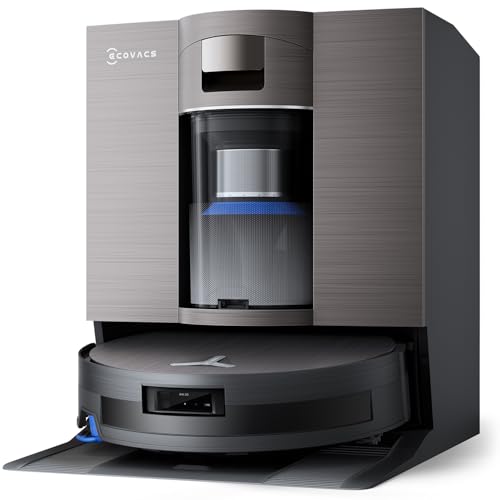
ECOVACS DEEBOT X11 OmniCyclone with 19,500Pa suction, bagless auto-empty station, OZMO Roller 2.0 self-washing mop, and AIVI 3D AI navigation for large homes.
Mid-Premium Tier: ECOVACS DEEBOT T80 Omni vs Roborock Qrevo Edge S5A
The T80 Omni brings the OZMO Roller system to a more accessible price point without compromising the core mopping technology. The roller scrubs at 220 RPM with 16x the downward pressure of a flat pad, while the 10-in-1 OMNI Station handles hot-water mop washing at 167°F, hot-air drying at 113°F, auto dust emptying, and water refilling. ZeroTangle 3.0 reduces hair tangles by 90%, making this an excellent choice for homes with pets or long-haired family members. At 18,000Pa, the T80 Omni’s suction is powerful enough for medium-pile carpets and deeply embedded debris.
- Suction: 18,000Pa
- Mop system: OZMO Roller (220 RPM, 16x pressure, TruEdge)
- Navigation: AIVI 3D 3.0 with LiDAR
- Station: 10-in-1 OMNI (167°F hot wash, 113°F hot dry, auto-empty, auto-refill)
- Brush: ZeroTangle 3.0 (90% hair tangle reduction)
The Qrevo Edge S5A is Roborock’s mid-premium workhorse, delivering 18,500Pa of suction alongside PreciSense LiDAR navigation and the FlexiArm Arc side brush — a mechanical arm that extends to sweep corners and wall edges that round-body robots routinely miss. Dual spinning mops rotate at 200 RPM, and the Multifunctional Dock 3.0 washes mop pads with hot water up to 167°F. The 2.7-liter dust bag supports over 60 days of hands-free debris collection.
- Suction: 18,500Pa
- Mop system: Dual spinning mops (200 RPM), 30 water flow levels
- Navigation: PreciSense LiDAR + Reactive Tech obstacle avoidance
- Station: Multifunctional Dock 3.0, 167°F hot water wash, 2.7L dust bag (60+ days)
- Edge cleaning: FlexiArm Arc side brush extension
Mid-premium tier verdict: The T80 Omni and Qrevo Edge S5A are the most directly comparable models in this analysis. Suction is virtually identical (18,000Pa vs 18,500Pa). Mopping edge goes to the T80 Omni for the OZMO Roller’s continuous self-rinsing. Navigation edge goes to the S5A for the FlexiArm’s mechanical corner reach. For pure mopping performance, choose the T80 Omni. For carpet-heavy homes with tight corners and complex furniture layouts, the S5A is the stronger performer.

ECOVACS DEEBOT T80 Omni robot vacuum and mop with self-cleaning OZMO roller, 18,000Pa suction, and ZeroTangle 3.0. AI navigation for pets. Full review!
Value-Premium Tier: ECOVACS DEEBOT T50 PRO Omni vs Roborock Saros 10R
The T50 PRO Omni is Ecovacs’ ultra-slim entrant, measuring just 3.19 inches tall — enabling under-furniture access that most robot vacuums cannot achieve. It combines 15,000Pa of suction with TruEdge 2.0 wall-hugging mop extension (15mm wall clearance precision), ZeroTangle 2.0, and the full 10-in-1 OMNI Station. The YIKO-GPT AI Assistant understands natural language voice and text commands, allowing conversational control beyond standard app buttons. For the price, the T50 PRO Omni delivers flagship-tier mopping in a slimmer package.
- Suction: 15,000Pa
- Profile: 3.19 inches (ultra-slim)
- Mop system: Extendable mop with TruEdge 2.0 (15mm wall precision)
- Navigation: AIVI 3D 3.0 (1mm precision, 100+ object categories)
- Station: 10-in-1 OMNI (167°F hot wash, 113°F dry, auto-empty, auto-refill, auto detergent)
- AI Assistant: YIKO-GPT natural language voice/text control
The Saros 10R is Roborock’s premium ultra-slim model, also measuring 3.14 inches thanks to the StarSight Autonomous System 2.0 — an integrated 3D sensing array that eliminates the need for a raised LiDAR tower entirely. AdaptiLift Chassis technology climbs obstacles up to 4 cm. The FlexiArm Riser extends both the side brush and mop arm into corners and edges when detected. The Multifunctional Dock 4.0 adds auto mop removal for pure vacuum sessions, 176°F hot water mop washing, 131°F hot air drying, and an integrated RGB camera for pet monitoring with two-way video.
- Suction: 22,000Pa HyperForce
- Profile: 3.14 inches (ultra-slim)
- Navigation: StarSight Autonomous System 2.0 (3D sensing, 108 obstacle types)
- Mop system: Dual spinning mops with auto-lift, FlexiArm Riser
- Station: Multifunctional Dock 4.0 (176°F wash, 131°F dry, 60-day capacity, auto mop removal)
- Extra: Built-in RGB camera, two-way audio, pet monitoring
Value-premium tier verdict: The Saros 10R’s 22,000Pa suction is a significant advantage for carpet-heavy homes. The T50 PRO Omni’s YIKO-GPT conversational AI is the more intuitive daily interface. For vacuuming-first households with pets and carpet, the Saros 10R is the stronger performer. For mop-focused households with mixed hard floors, the T50 PRO Omni delivers better daily mopping results at a slightly lower price point.

ECOVACS DEEBOT T50 PRO Omni: 15,000Pa suction, ultra-slim 3.19", TruEdge 2.0, AIVI 3D, self-emptying OMNI Station. The ultimate hands-free clean. Shop now.
Which Brand Is Better for Mop-Focused Cleaning?
Choose Ecovacs DEEBOT if mopping is your primary requirement.
The OZMO Roller’s continuous self-rinsing mechanism is the single most important mopping technology in the current robot vacuum market. It solves the dirty-water redistribution problem that affects all pad-based mops — including Roborock’s — by ensuring that every pass across your floor uses a freshly cleaned roller surface. For kitchens with daily cooking grease, dining areas with food residue, and bathrooms with soap scum and residue, the difference is visible and consistent.
TruEdge technology addresses the second-biggest mopping complaint: the dusty border that every robot mop leaves along baseboards and in corners. By physically extending the roller to wall edges, Ecovacs eliminates this gap entirely. Roborock’s FlexiArm is excellent at corner coverage, but it uses spinning pads rather than a roller — the TruEdge advantage in streak-free edge mopping remains with Ecovacs.
The OMNI Station’s hot-air drying function at 113°F is also a practical advantage: it prevents mildew and odor buildup in the roller between sessions without requiring the user to manually remove and dry mop components.
Which Brand Is Better for Pure Vacuuming?
Choose Roborock if suction power and carpet performance are your primary requirement.
Roborock’s flagship models consistently deliver higher peak suction figures: 22,000Pa HyperForce on the Saros 10R and Qrevo CurvX versus 19,500Pa on the DEEBOT X11 OmniCyclone. In practical terms, this advantage is most meaningful on high-pile carpets and rugs where debris settles deep into the fiber stack. Roborock’s AdaptiLift chassis also provides superior threshold-crossing ability — up to 4 cm of lift versus Ecovacs’ 0.9-inch (approximately 2.3 cm) TruePass system — making it more reliable in homes with deep carpet transitions and raised door thresholds.
Roborock’s RetractSense LiDAR retracting system also enables better under-furniture vacuuming coverage in homes with ultra-low-clearance sofas, platform beds, and entertainment units. If your home has substantial carpeting and furniture the robot needs to reach under, Roborock’s structural engineering gives it a genuine advantage.
App and Smart Home Experience
Both brands offer capable companion apps, but they cater to different user preferences.
Ecovacs HOME App provides room-by-room map management, customizable cleaning zones, scheduling, suction and water flow adjustment, and YIKO-GPT natural language commands on compatible models. The AI learning feature on premium DEEBOT models means the robot gradually optimizes its cleaning behavior to your home’s specific patterns. Integration with Alexa, Google Assistant, and Matter is standard across the T and X series. The interface is polished and accessible, though some users note a learning curve with advanced zone customization.
Roborock App with SmartPlan 2.0 is among the most feature-rich robot vacuum apps available. It supports polygon no-go zones, room-specific cleaning profiles (different suction levels, water flow, and brush speed per room), multi-floor map storage, cleaning history with area coverage statistics, and real-time map viewing during active cleaning sessions. SmartPlan 2.0 learns usage patterns and automatically suggests schedule optimizations. Voice control via Alexa and Google Assistant is standard, and select models support offline voice commands via the built-in “Hello Rocky” assistant.
App verdict: Roborock’s app has a slight edge in customization depth for advanced users. Ecovacs’ YIKO-GPT conversational control is more accessible for users who prefer natural language interaction over menu navigation. For power users who want granular zone control and per-room cleaning profiles, Roborock is the better platform.
Quick Comparison Summary
| Feature | Ecovacs DEEBOT | Roborock |
|---|---|---|
| Navigation | TrueMapping LiDAR + AIVI 3D | PreciSense LiDAR + RetractSense |
| Obstacle avoidance | AIVI 3D 3.0 (100+ objects, 1mm precision) | ReactiveAI (108 objects, structured light + RGB) |
| Mopping system | OZMO Roller (continuous self-rinse, 220 RPM) | Dual spinning mops (200 RPM, 30 flow levels) |
| Edge cleaning | TruEdge (mop extends to wall) | FlexiArm (brush + mop extension) |
| Peak suction | Up to 19,500Pa (X11 OmniCyclone) | Up to 22,000Pa (Saros 10R, Qrevo CurvX) |
| Mop wash temp | Up to 167°F | Up to 176°F (Qrevo CurvX / Saros 10R) |
| Slim profile | 3.19 inches (T50 PRO Omni) | 3.14 inches (CurvX, Saros 10R) |
| Chassis adaptability | TruePass (up to 0.9 in threshold) | AdaptiLift (up to 4 cm lift) |
| AI assistant | YIKO-GPT (natural language) | SmartPlan 2.0 + “Hello Rocky” voice |
| Best for | Daily mopping, mixed floors, mopping-first homes | Deep vacuuming, carpet, low-clearance furniture |
Frequently Asked Questions
Is Ecovacs or Roborock better overall?
Neither brand is objectively better — the right choice depends on your home’s primary cleaning need. Ecovacs is the better choice for mopping-focused households with hard floors, kitchens, and bathrooms requiring daily scrubbing. Roborock is the better choice for carpet-heavy homes, homes with low-clearance furniture, and users who prioritize raw suction power and navigation adaptability.
Do both brands use LiDAR navigation?
Yes. Both Ecovacs and Roborock use LiDAR as the foundation of their navigation systems on premium models. Ecovacs layers AIVI 3D computer vision and Time-of-Flight sensors on top. Roborock adds RetractSense adaptive sensor height and ReactiveAI structured-light obstacle avoidance. Both produce accurate, reliable floor maps for multi-room homes.
Which brand has better obstacle avoidance?
Both brands’ premium models are outstanding at obstacle avoidance. Ecovacs AIVI 3D 3.0 uses 3D spatial modeling for more precise object shape recognition. Roborock ReactiveAI uses structured light plus RGB camera for reliable detection in both light and dark environments. In cluttered rooms with varied lighting, Roborock’s dual-sensor approach has a practical reliability advantage. In bright, busy rooms with complex obstacles, Ecovacs’ 3D modeling is slightly more precise in tight avoidance paths.
Is the Ecovacs OZMO Roller better than Roborock’s spinning mops?
For daily in-session mopping quality, yes. The OZMO Roller continuously self-rinses while cleaning, ensuring every pass uses a clean mop surface. Roborock’s spinning mops are cleaned at the dock between sessions — during a session, they accumulate dirty water. For homes that mop daily, the OZMO Roller’s continuous rinse is a meaningful advantage. However, Roborock’s dock washes mop pads at higher temperatures (up to 176°F vs Ecovacs’ 167°F), which may produce cleaner pads over the long term.
Which brand has a better self-maintaining dock?
Both the Ecovacs OMNI Station and the Roborock Multifunctional Dock 4.0 are among the most capable base stations available. The OMNI Station’s hot-air mop drying at 113°F prevents mildew without requiring mop removal. Roborock’s Dock 4.0 on the Saros 10R adds automatic mop removal for pure vacuum sessions — a convenience feature that Ecovacs does not currently offer. For mopping households, both docks are excellent. For users who frequently switch between vacuum-only and vacuum-and-mop sessions, Roborock’s auto mop removal is the more convenient option.
Which brand is better for pet owners?
Both brands are excellent for pet owners. Ecovacs ZeroTangle 3.0 reduces hair brush-roll wrapping by up to 90% and the OMNI Station’s auto-empty and hot-water wash keep the system clean with minimal intervention. Roborock’s DuoDivide zero-tangle brush and anti-tangle omnidirectional wheels take the same approach. Both brands’ premium models include pet recognition — Ecovacs through AIVI 3D object categorization, Roborock through ReactiveAI and the built-in RGB camera with real-time pet monitoring and two-way video on select models. For pet owners who also want remote pet monitoring, Roborock’s camera-equipped models (Saros 10R, Qrevo CurvX) offer a feature Ecovacs does not currently include in its standard lineup.
Are Ecovacs and Roborock available at similar price points?
Yes. Both brands cover a wide range from budget-accessible models to $1,500+ flagship configurations. The models compared in this article — the T80 Omni, T50 PRO Omni, X11 OmniCyclone, Saros 10R, Qrevo CurvX, and Qrevo Edge S5A — are all in the premium tier. At equivalent feature levels, the two brands are comparably priced, with Roborock typically offering slightly higher peak suction specifications at the same price as Ecovacs’ superior mopping technology.
Final Verdict: Ecovacs vs Roborock
Both Ecovacs and Roborock represent the absolute best the robot vacuum industry has to offer in 2026. The decision comes down to two questions:
Do you mop more than you vacuum? Choose Ecovacs. The OZMO Roller technology, TruEdge wall-hugging mopping, and OMNI Station’s full autonomy are purpose-built for households where spotless hard floors are the primary goal. Start with the DEEBOT T80 Omni for the best balance of mopping performance and value, or upgrade to the DEEBOT X11 OmniCyclone for the full flagship experience.
Do you vacuum more than you mop? Choose Roborock. The 22,000Pa HyperForce suction, AdaptiLift chassis, RetractSense LiDAR, and SmartPlan 2.0 app create a vacuuming system that is demonstrably ahead of the competition. Start with the Roborock Qrevo Edge S5A for a fully featured mid-premium option, or step up to the Roborock Saros 10R for the most capable Roborock available today.
Either choice will clean your home better than any robot vacuum from three years ago. The competition between these two brands has pushed both to a level of performance that benefits every buyer — and will continue to do so well into the future.
ECOVACS DEEBOT T80 Omni robot vacuum and mop with self-cleaning OZMO roller, 18,000Pa suction, and ZeroTangle 3.0. AI navigation for pets. Full review!
Ready to Find Your Perfect Vacuum?
Browse our expertly reviewed vacuum cleaners and make an informed decision
Browse All Vacuums