eufy vs Roomba 2026: Budget Champion vs Robot Vacuum Pioneer
eufy vs Roomba robot vacuum comparison — budget-friendly eufy vs premium iRobot. Which robot vacuum offers better value in 2026?
Table of Contents
The robot vacuum market in 2026 comes down to two names more than any other: eufy and iRobot Roomba. One is a decades-old pioneer that essentially invented the consumer robot vacuum category. The other is an aggressive, fast-moving challenger from Anker — one of the most respected names in consumer electronics — selling premium features at prices that make Roomba blush.
If you have been trying to decide between these two brands, you are not alone. “eufy vs Roomba” is one of the most searched robot vacuum comparisons online, and for good reason: both make legitimately excellent robots, but they serve very different buyers. The wrong choice for your home and budget can mean spending hundreds of dollars more than necessary — or, conversely, saving money upfront only to end up frustrated.
This guide cuts through the marketing noise. We have analyzed the real specifications, user experiences, and performance data across both lineups so you can make a confident, informed decision.
Who Makes eufy, and Who Makes Roomba?
Before diving into specs, it helps to understand the companies behind these robots.
iRobot launched the original Roomba in 2002 and spent the next two decades essentially owning the robot vacuum category. Their engineering team has more accumulated robot vacuum R&D hours than virtually any competitor on the planet. iRobot was acquired by Amazon in 2023, which has since shaped its software integrations and smart home ecosystem approach. Roomba robots carry a premium price that reflects brand heritage, deep software development, and ongoing customer support infrastructure.
eufy is a smart home brand owned by Anker Innovations — the company that made its name building the world’s most reliable phone chargers and power banks. Anker’s engineering rigor and supply chain efficiency transferred seamlessly to robot vacuums. eufy entered the robot vacuum market by undercutting Roomba significantly while matching or exceeding hardware specifications. Today, eufy is no longer just a budget brand: their X-series and Omni-series robots compete directly with Roomba’s flagship products on features, while their entry-level RoboVac lineup remains the go-to for shoppers who want genuine automation without breaking the bank.
Head-to-Head: eufy vs Roomba Across Every Key Category
Navigation Accuracy
Navigation is where robot vacuums live or die. A robot that bumps randomly around your home will miss corners, clean the same strip of floor three times, and leave entire zones untouched.
iRobot Roomba uses ClearView LiDAR (in the 100-series and above) and ClearView Pro LiDAR (in the Plus 500 Combo series). LiDAR-based mapping creates precise, room-by-room floor plans that allow methodical row-by-row cleaning. Roomba’s navigation has been refined over more than 20 years and is considered among the most reliable in the industry.
eufy also uses LiDAR navigation across its mid-range and premium lineup, branded as iPath Laser Navigation with AI.Map technology. The eufy C10 and eufy X10 Pro Omni both use LiDAR-based mapping that is functionally comparable to Roomba’s ClearView system, creating detailed floor plans, enabling no-go zones, and supporting multi-floor mapping.
Verdict: Both brands offer excellent LiDAR navigation at comparable price points. Roomba has a slight edge in navigation refinement built up over decades of real-world use, but eufy’s iPath navigation is genuinely competitive. The eufy RoboVac 11S Max, an entry-level model, still uses infrared sensors rather than LiDAR — so navigation tier varies significantly within each brand’s lineup.
Suction Power
iRobot Roomba markets suction in relative terms — “70X more than Roomba 600 series” — across its 100-series, 104 Combo, and Plus 505 Combo. This relative measurement is intentionally vague but signals a major leap from entry-level models. Roomba’s 3-Stage Cleaning System (edge-sweeping brush + multi-surface rubber brush + suction motor) is well-regarded for deep carpet extraction.
eufy lists absolute suction figures in Pascals. The eufy E25 reaches 20,000 Pa. The eufy X10 Pro Omni delivers 8,000 Pa. Entry-level models like the RoboVac 11S Max use BoostIQ technology to automatically increase suction when transitioning from hard floors to carpet.
Verdict: eufy’s transparency with Pa ratings makes direct comparison easier. For context, 8,000 Pa (eufy X10 Pro Omni) is strong for a vacuum-mop combo, and 20,000 Pa (eufy E25) is exceptional. Roomba’s “70X” claim is relative to an older baseline and not directly comparable to Pa ratings. Both perform well on hard floors and medium-pile carpet; deep-pile carpet cleaning favors Roomba slightly due to its Carpet Boost technology and brush system design.
App Features and Smart Home Integration
iRobot Roomba pairs with the Roomba Home App, which supports room-specific targeting, scheduling, keep-out zones, adjustable suction levels per room, cleaning pass counts, and voice control via Alexa, Siri, and Google Assistant. Given Amazon’s ownership of iRobot, Alexa integration is particularly seamless. The app also tracks cleaning history and proactively notifies users about filter replacement.
eufy uses the eufy Clean app (also referenced as the eufy app), supporting AI.Map 3.0 on premium models, which enables multi-floor mapping (up to 5 floors on the E25), room-specific scheduling, no-go zones, virtual walls, and voice control via Alexa, Google Assistant, and Siri. The eufy app is consistently praised for its clean interface and ease of setup.
Verdict: App quality is comparable between the two brands. Roomba has a slight edge in smart home ecosystem depth — particularly for Amazon Alexa users — while eufy’s multi-floor mapping on mid-tier models is genuinely impressive for the price. Both apps receive regular updates, though Roomba’s longer history means more community support and third-party integrations.
Wi-Fi Requirement and Offline Operation
This is one of the most significant and underappreciated differences between the two brands — and it is a major reason many buyers choose eufy.
eufy offers models like the RoboVac 11S Max that require no Wi-Fi connection whatsoever. The 11S Max operates entirely via remote control, making it ideal for users who want a robot vacuum without smart home complexity, those in homes with unreliable Wi-Fi, elderly users who prefer a physical remote, and anyone concerned about connected home devices. Even eufy’s Wi-Fi-enabled models generally allow basic operation (start, stop, dock) without an active Wi-Fi connection.
iRobot Roomba requires Wi-Fi for full functionality. While physical buttons on the robot itself allow basic start and dock operations, all scheduling, mapping, room targeting, and smart features are locked behind the app and require active connectivity. For users who want autonomous scheduling without a phone, Roomba’s always-online requirement can be a genuine limitation.
Verdict: eufy wins decisively here. The ability to use a robot vacuum without Wi-Fi — even at the basic level — is a meaningful advantage that iRobot does not match. For tech-averse users or those in Wi-Fi-challenged homes, eufy’s offline-capable models are the clear choice.
Obstacle Avoidance
iRobot Roomba Plus 505 Combo includes PrecisionVision AI technology, which identifies specific objects — cords, socks, pet waste, shoes — and navigates around them in real time. This is iRobot’s most advanced obstacle avoidance system to date and works reliably even in low-light conditions.
eufy X10 Pro Omni uses AI.See Smart Obstacle Avoidance, capable of recognizing more than 100 object types. The eufy E25 also features AI obstacle avoidance as part of its laser navigation suite. Entry-level eufy models rely on infrared sensors, which are less sophisticated but still effective at preventing collisions and drop-offs.
Verdict: PrecisionVision AI (Roomba Plus 505) and AI.See (eufy X10 Pro Omni) are both excellent advanced obstacle avoidance systems. At the premium tier, both brands perform similarly well. At the mid-range and entry level, Roomba maintains a slight advantage.
Price and Value
This is where eufy consistently wins. Across comparable feature tiers, eufy robots typically cost 20% to 40% less than Roomba equivalents.
- eufy RoboVac 11S Max: Entry-level, offline, slim design — excellent value under $200
- eufy C10: LiDAR navigation + self-emptying station — competitive mid-range pricing
- eufy E25: 20,000 Pa suction + HydroJet mopping + all-in-one station — premium features at mid-premium prices
- eufy X10 Pro Omni: Flagship vacuum-mop combo with 8,000 Pa, AI obstacle avoidance, Omni Station
Roomba’s lineup commands premium pricing that reflects brand heritage, software investment, and customer service infrastructure. The Roomba 105 Vac (LiDAR, app control) and Roomba 104 Combo (LiDAR + mopping) deliver solid performance, but eufy routinely matches or exceeds their hardware specs at lower price points.
Verdict: eufy offers dramatically better value at every price tier. You consistently get more hardware — higher Pa ratings, more advanced mopping systems, richer all-in-one base stations — for less money than comparable Roomba models.
Specific Model Comparisons
Entry Level: eufy RoboVac 11S Max vs iRobot Roomba 105 Vac
eufy RoboVac 11S Max is the quintessential eufy entry-level robot. It is 2.85 inches tall — one of the slimmest robots on the market — runs for up to 100 minutes, operates in near silence, and requires zero Wi-Fi or app setup. BoostIQ technology automatically ramps up suction when the robot moves from hard floors to carpet. For someone who simply wants a robot to run a cleaning cycle every day without any smart home overhead, the 11S Max is near-perfect. It uses infrared sensors and a random navigation pattern rather than LiDAR, so it is less efficient on large open floor plans, but on a typical apartment or single-room setting it cleans comprehensively. With over 16,000 ratings and a 4.1-star average, it has earned its reputation as the best budget robot vacuum available.
iRobot Roomba 105 Vac steps up to ClearView LiDAR navigation at the entry level, delivering precise room mapping, row-by-row cleaning, and full app control with scheduling, room targeting, and keep-out zones. The 70X suction increase over the Roomba 600 series is genuine and noticeable on carpet. Recharge-and-resume ensures large homes receive complete coverage even if the battery depletes mid-cycle. However, the Roomba 105 Vac requires Wi-Fi for scheduling and smart features, and at 3.7 stars across 702 ratings, user satisfaction is noticeably lower than the eufy 11S Max.
Comparison summary: If you want Wi-Fi-free operation, an ultra-slim profile for under-furniture cleaning, and proven long-term reliability at a lower price, choose the eufy 11S Max. If you want LiDAR-guided systematic cleaning with app scheduling and smart home integration, the Roomba 105 Vac earns its premium — but verify your home’s Wi-Fi setup before purchasing.
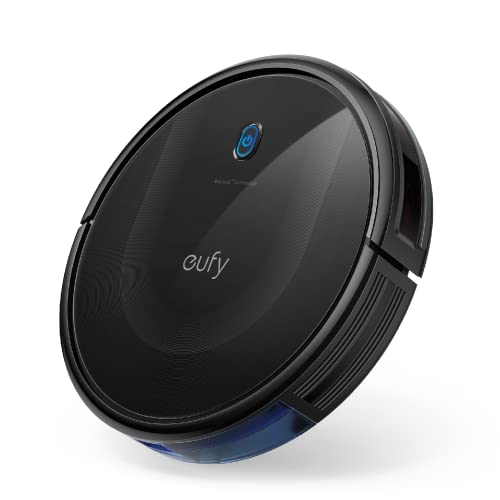
eufy RoboVac 11S Max super-thin robot vacuum with BoostIQ technology, 100-min runtime, and quiet operation. Ideal for hard floors and medium-pile carpets.
Mid-Range Vacuum + Mop: eufy E25 vs iRobot Roomba 104 Combo
eufy E25 is a powerhouse. Its 20,000 Pa turbo suction is among the highest available in any robot vacuum-mop combo. The HydroJet roller mop system refreshes itself twice per second with clean water, eliminating the common problem of spreading dirty water across your floors. The all-in-one station auto-empties dust into a 3-liter sealed bag (approximately 75 days), self-washes the roller mop, dries it with 50°C hot air to prevent mildew, and auto-refills the water tank. Laser-guided navigation supports up to 5 floor plans, AI obstacle avoidance, and a 125-minute runtime in combined vacuum-and-mop mode. The extendable CornerRover arm reaches baseboards and furniture legs that the main body misses. With 15,938 ratings and a 4.2-star average, the E25 has strong user validation. The main limitation: it requires 2.4 GHz Wi-Fi only, with no 5 GHz support.
iRobot Roomba 104 Combo brings iRobot’s trusted ClearView LiDAR navigation to a combo vacuum-mop unit with a 75-day AutoEmpty Dock, SmartScrub mopping technology (2X deeper scrubbing in high-traffic zones), and automatic carpet detection that stops mopping when carpet is sensed. The allergen-trapping dock seals 99% of allergens as small as 0.7 microns — an advantage for allergy-sensitive households. However, the Roomba 104 Combo has a 3.7-star average across 1,704 ratings, suggesting reliability inconsistencies that prospective buyers should weigh carefully. It also requires Wi-Fi for full functionality.
Comparison summary: The eufy E25 delivers superior mopping technology (HydroJet vs. standard microfiber pad), higher raw suction power (20,000 Pa), and a more comprehensive all-in-one base station at a competitive price point. The Roomba 104 Combo’s SmartScrub is genuinely useful for dried-on messes, and iRobot’s allergen-focused AutoEmpty dock is a strong advantage for allergy households. Overall, the eufy E25 offers better hardware value; the Roomba 104 Combo offers stronger allergy-focused convenience.
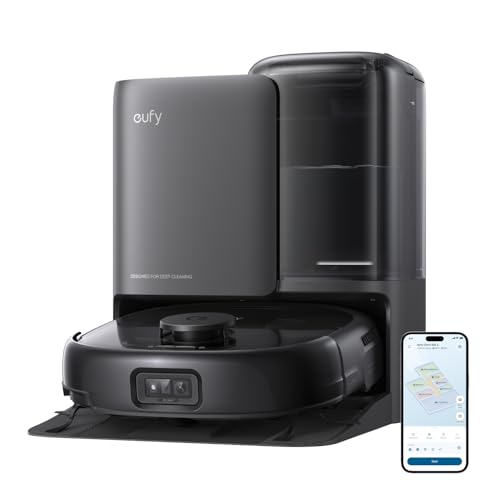
eufy E25 robot vacuum and mop combo with 20,000 Pa suction, HydroJet self-cleaning mop, all-in-one station, and laser navigation. Full expert review.
Premium Self-Emptying: eufy X10 Pro Omni vs iRobot Roomba Plus 505 Combo
eufy X10 Pro Omni is eufy’s flagship system. It combines 8,000 Pa suction, dual spinning mop pads with 12 mm auto-lift on carpet, AI.See obstacle avoidance (100+ object types), iPath Laser Navigation with AI.Map 3.0, and the fully automated All-in-One Omni Station. The Omni Station washes mop pads with fresh water, dries them with 45°C heated air, empties the dust bin into a 2.5-liter sealed bag (approximately 2 months), and maintains a 3-liter clean water supply. The Pro-Detangling roller brush resists hair tangling — a critical feature for pet owners. At 4.1 stars from 3,275 ratings, it has strong real-world approval, though some users note the large Omni Station footprint requires dedicated wall space.
iRobot Roomba Plus 505 Combo is iRobot’s current premium flagship. PrecisionVision AI obstacle avoidance identifies and avoids cords, socks, and pet waste with impressive accuracy. The AutoWash Dock self-empties for 75 days, washes mop pads, heat-dries them, and runs self-cleaning cycles to prevent dock buildup. The extending DualClean Mop Pads with PerfectEdge reach 18% more wall-edge area than standard unextended pads, and SmartScrub delivers 2X deeper scrubbing action for dried-on spills. ClearView Pro LiDAR and Carpet Boost (automatic suction increase on carpet) round out an impressively capable system. At 3.8 stars from 528 ratings, it is early in its consumer reception but shows strong initial performance.
Comparison summary: This is the closest matchup between the two brands. The Roomba Plus 505 Combo edges ahead in obstacle avoidance sophistication (PrecisionVision AI vs. AI.See), wall-edge mopping coverage (PerfectEdge extension), and dock self-cleaning capability. The eufy X10 Pro Omni counters with higher listed suction (8,000 Pa vs. Roomba’s relative-only rating), a larger clean water tank (3L vs. unspecified), and a lower price point. For buyers who prize maximum mopping thoroughness and the most advanced obstacle avoidance available, the Roomba Plus 505 Combo justifies its premium. For buyers who want flagship performance at a meaningfully lower cost, the eufy X10 Pro Omni is the stronger value.

eufy X10 Pro Omni robot vacuum and mop with 8,000 Pa suction, auto mop washing and drying, self-emptying, and AI obstacle avoidance. Full expert review here.
eufy’s Unique Selling Points
Beyond the spec comparisons, eufy has three distinctive advantages that no amount of Roomba marketing can paper over:
1. Works Without Wi-Fi The eufy RoboVac 11S Max is the clearest example: a fully functional, genuinely useful robot vacuum that has never needed a smartphone app, a Wi-Fi password, or a cloud service. This is increasingly rare in the smart home era, and for a specific group of buyers — particularly older adults, renters with complex network situations, or privacy-conscious consumers — it is a decisive advantage.
2. Price-to-Performance Ratio Anker’s supply chain and manufacturing expertise allows eufy to sell robots with LiDAR navigation, self-emptying stations, and advanced mopping systems at prices that Roomba simply cannot match without significantly cutting margin. You are not buying a cheap robot when you buy eufy at mid-range pricing; you are buying a well-engineered robot at a fair price.
3. Clean, Simple Design Language eufy robots have a consistent, understated aesthetic — primarily black, low-profile, minimalist. The base stations are reasonably compact (relative to competitors) and blend into home environments without looking like industrial equipment. This matters for buyers who care about how appliances look in their living spaces.
Who Should Buy eufy?
Choose eufy if you:
- Want a robot vacuum without Wi-Fi dependency, especially the RoboVac 11S Max or eufy C10
- Are price-sensitive and want the best hardware per dollar spent
- Own pets and need high-Pa suction plus anti-tangle brush technology (eufy E25, eufy X10 Pro Omni)
- Want a vacuum-mop combo with a genuinely self-maintaining all-in-one station at non-flagship pricing
- Prefer a straightforward setup experience without a complex smart home ecosystem
- Live in an apartment or home with low-clearance furniture (the 2.85-inch slim profile models)
Who Should Buy Roomba?
Choose Roomba if you:
- Are deeply invested in the Amazon Alexa smart home ecosystem and want seamless native integration
- Need best-in-class AI obstacle avoidance (PrecisionVision AI on the Plus 505 Combo)
- Have severe allergies and prioritize the Roomba AutoEmpty Dock’s 99% allergen-trapping sealed bag system
- Want SmartScrub’s back-and-forth deep scrubbing for kitchens with frequent dried-on spills
- Value the decades of brand reliability and extensive customer service and replacement parts availability
- Prefer the Roomba Home App’s granular per-room cleaning controls and Amazon ecosystem integrations
Quick Comparison Table
| Feature | eufy RoboVac 11S Max | eufy E25 | eufy X10 Pro Omni | Roomba 105 Vac | Roomba 104 Combo | Roomba Plus 505 Combo |
|---|---|---|---|---|---|---|
| Navigation | Infrared / Random | LiDAR | iPath LiDAR | ClearView LiDAR | ClearView LiDAR | ClearView Pro LiDAR |
| Suction | BoostIQ | 20,000 Pa | 8,000 Pa | 70X (relative) | 70X (relative) | 70X (relative) |
| Mopping | No | HydroJet Roller | Dual Spin Mop Pads | No | SmartScrub Pad | SmartScrub DualClean |
| Self-Emptying | No | Yes (75 days) | Yes (~2 months) | Optional dock | Yes (75 days) | Yes (75 days) |
| Wi-Fi Required | No | Yes (2.4GHz) | Yes (2.4GHz) | Yes (2.4GHz) | Yes (2.4GHz) | Yes (2.4GHz) |
| Obstacle Avoidance | Infrared | AI-based | AI.See (100+ types) | LiDAR-based | LiDAR-based | PrecisionVision AI |
| Slim Profile | 2.85 inches | Standard | Standard | 10.4 cm | 10.4 cm | 10.7 cm |
| User Rating | 4.1 ★ | 4.2 ★ | 4.1 ★ | 3.7 ★ | 3.7 ★ | 3.8 ★ |
Ratings based on verified user reviews at time of publication.
Frequently Asked Questions
Is eufy as good as Roomba?
For most buyers in 2026, yes — and often better for the price. eufy’s mid-range and premium robots match or exceed Roomba’s hardware specifications at lower price points. Where Roomba still leads is in software ecosystem depth, Amazon Alexa integration, and certain obstacle avoidance refinements on flagship models. For pure cleaning performance per dollar, eufy is the stronger choice.
Does eufy work without Wi-Fi?
Yes. Entry-level models like the eufy RoboVac 11S Max operate entirely via remote control with no Wi-Fi required. Even eufy’s app-connected robots allow basic start/stop/dock functions without active Wi-Fi. Roomba’s scheduling and smart features are largely app-dependent and require Wi-Fi connectivity.
Do Roombas last longer than eufy robots?
iRobot has a longer track record in the market, and replacement parts, filters, and brushrolls for Roomba are widely available. eufy has been manufacturing robots since 2016 and has built a strong reputation for durability, but has fewer years of long-term data. Both brands offer standard one-year warranties, with iRobot offering extended warranty programs. Neither brand has a decisive durability edge based on available evidence.
Which is better for pet hair, eufy or Roomba?
Both brands have strong pet hair solutions. The eufy E25 with DuoSpiral anti-tangle brushes and 20,000 Pa suction is particularly effective. The eufy X10 Pro Omni features a Pro-Detangling roller brush specifically designed to resist hair wrap. Roomba’s multi-surface rubber brush design also handles pet hair well. For shedding pets on mixed flooring, eufy’s higher Pa ratings give it a slight suction edge; Roomba’s rubber brush design is arguably more tangle-resistant at entry and mid-tiers.
Can eufy map multiple floors?
Yes. The eufy E25 supports up to 5 separate floor maps, and the eufy X10 Pro Omni via AI.Map 3.0 also supports multi-floor mapping. This is a significant advantage over many competitors and is genuinely useful for multi-story homes.
Is Roomba worth the extra cost over eufy?
In specific scenarios, yes. If you are a heavy Alexa user, need PrecisionVision AI obstacle avoidance (the only system that reliably identifies pet waste to avoid it), or specifically want Roomba’s SmartScrub deep mopping on the Plus 505 Combo, the premium is justified. For most buyers, however, eufy delivers equivalent or better hardware at a meaningfully lower price point, and the extra spending on Roomba largely buys brand recognition and ecosystem integration rather than better cleaning performance.
Does the eufy or Roomba handle carpet better?
Roomba’s 3-Stage Cleaning System with Carpet Boost and multi-surface rubber brush is highly regarded for carpet performance. eufy’s BoostIQ (entry-level) and high-Pa suction (mid/premium) are both strong for carpet. On thick pile carpets, Roomba’s Carpet Boost gives it a marginal edge. On low-to-medium pile carpets — the majority of home installations — both perform comparably well.
What is the best eufy robot vacuum in 2026?
For most buyers, the eufy E25 offers the best combination of vacuum power, HydroJet mopping, and automated all-in-one station at a price that undercuts Roomba’s equivalent significantly. For pure vacuum-only use with a self-emptying station, the eufy C10 is an excellent mid-range choice. For the flagship hands-free experience, the eufy X10 Pro Omni is a compelling alternative to the Roomba Plus 505 Combo at a lower cost.
eufy RoboVac 11S Max super-thin robot vacuum with BoostIQ technology, 100-min runtime, and quiet operation. Ideal for hard floors and medium-pile carpets.
Final Verdict
The eufy vs Roomba debate is less a question of quality and more a question of priorities.
Choose eufy if maximizing value, operating without Wi-Fi dependency, or getting the highest Pa suction and most autonomous all-in-one base station features for your budget are priorities. eufy has grown from a budget upstart into a legitimate premium competitor, and in 2026 it matches or beats Roomba across most measurable hardware categories while consistently undercutting on price.
Choose Roomba if you are deeply embedded in the Amazon Alexa smart home ecosystem, need PrecisionVision AI’s best-in-class obstacle avoidance (particularly for homes with pets who leave messes), or place strong value on the iRobot brand’s decades of robot vacuum specialization and customer support depth.
For most households shopping for their first robot vacuum, or upgrading from an aging model, eufy is the smarter purchase in 2026. For smart home power users with existing Roomba ecosystems, Alexa integration needs, or specific obstacle avoidance requirements, Roomba’s premium remains defensible.
Either way, both brands will keep your floors cleaner than doing nothing — and that is the point.
Ready to Find Your Perfect Vacuum?
Browse our expertly reviewed vacuum cleaners and make an informed decision
Browse All Vacuums