How to Vacuum Stairs: Step-by-Step Guide and Best Vacuum Picks
How to vacuum stairs the right way — expert technique guide with the best vacuums for stairs including handhelds, canisters, and stick vacuums.
Table of Contents
- Why Stairs Accumulate So Much Dirt
- What Makes a Vacuum Good for Stairs
- Step-by-Step: How to Vacuum Stairs the Right Way
- The Right Attachments for Stair Cleaning
- Best Vacuums for Stairs in 2026
- Carpet vs. Hard-Surface Stairs: Does It Change Your Approach?
- How Often Should You Vacuum Stairs?
- Tips for Making Stair Vacuuming Easier
- Frequently Asked Questions
- The Bottom Line
Stairs are the most awkward place to vacuum in any home. Most people avoid them until the dust bunnies become impossible to ignore, the carpet looks visibly dingy, or pet hair starts rolling off the edges like tumbleweed. It is a completely understandable instinct — dragging a heavy upright up and down a narrow staircase while crouching at odd angles is nobody’s idea of a good time.
Here is the thing: vacuuming stairs is genuinely easy once you have the right technique and the right tool. The problem is almost never effort — it is approach. Most people use the wrong vacuum, hold it the wrong way, and work in the wrong direction. This guide fixes all of that. You will learn a simple, repeatable step-by-step method that gets stairs cleaner in less time, plus the five best vacuums purpose-built for the job.
Why Stairs Accumulate So Much Dirt
Before getting into technique, it helps to understand why stairs get so dirty so quickly. Every time someone walks up or down, shoe soles and socks grind debris into the carpet fibers or push it into the corners where the tread meets the riser. Pet hair clings electrostatically to carpet pile and migrates toward the edges. Dust settles on the horizontal treads and is stirred up with every footstep, drifting toward the wall edges and balusters.
The geometry of stairs also works against standard vacuuming tools. A full-size upright vacuum cannot stand upright on a tread — the angle is wrong, the machine is too heavy to carry safely, and the wide cleaning head misses the corners entirely. This is why most upright vacuums, even powerful ones, are simply the wrong tool for this surface.
What Makes a Vacuum Good for Stairs
Not every vacuum handles stairs well. Here are the qualities that matter most:
Lightweight design. You may be carrying the vacuum up and down multiple times. Anything over 10 lbs starts to feel like a workout. The best stair vacuums weigh between 2 and 8 lbs.
Convertible or handheld mode. A vacuum that detaches into a portable handheld unit — sometimes called Lift-Away or 2-in-1 mode — gives you the freedom to sit on a step and clean at eye level without wrestling with a long handle. This is the single most useful feature for stair cleaning.
Built-in or included crevice tool. Stairs have a specific high-dirt zone where the tread meets the riser and where the tread meets the side wall. A crevice tool is the only attachment that reaches these spots reliably. Without one, you are leaving the dirtiest part of every step untouched.
Upholstery tool or mini motorized brush. If your stairs are carpeted, a motorized upholstery attachment agitates the fibers and pulls out embedded pet hair and fine dust far better than a plain suction head.
Cordless operation or a long cord. Cords are hazardous on stairs. A cordless vacuum eliminates the trip hazard entirely. If the vacuum is corded, look for at least a 15- to 20-foot cord so you can reach a landing outlet without switching mid-staircase.
Good suction-to-weight ratio. Stair carpet takes a beating and often holds more embedded debris than flat-floor carpet. You need enough suction to lift it out, not just skim the surface.
Step-by-Step: How to Vacuum Stairs the Right Way
Follow this method every time and your stairs will be consistently clean without unnecessary effort.
Step 1: Always Work Top to Bottom
Start at the top step and work your way down. This is non-negotiable. When you vacuum a step, loosened debris falls downward onto the steps below. If you start at the bottom and work up, you vacuum the same dirt twice — or worse, you redistribute it onto steps you have already cleaned.
Position yourself one or two steps above the step you are cleaning. This gives you a natural, ergonomic angle to reach the tread without straining your back or losing your balance.
Step 2: Vacuum the Riser First
The riser is the vertical face of the step — the part your toes kick when you stub them. Most people skip the riser entirely, which is a mistake. Risers accumulate a surprising amount of dust, especially on painted or stained wood surfaces where static electricity traps fine particles.
Hold your handheld or detached pod against the riser and make two or three passes from side to side. On carpeted risers, use your upholstery tool or a soft brush nozzle. On hard risers, the standard suction nozzle works fine. The key is to vacuum the riser before the tread so any debris you knock loose falls onto the tread, which you clean next.
Step 3: Vacuum the Tread
The tread is the horizontal surface you step on. This is where most of the visible dirt accumulates. After vacuuming the riser, move to the tread and vacuum from the back wall edge toward the open front edge, working in overlapping passes.
On carpeted treads, use your upholstery tool or motorized mini brush to agitate the pile and pull out embedded debris. Make at least two passes in slightly different directions — fibers trap debris at different angles, and cross-direction passes release more of it. On hard treads (wood, tile, vinyl), the standard nozzle with no brush roll works best to avoid scattering debris.
Apply slightly more pressure at the back of the tread where it meets the riser. This junction is a natural debris trap and tends to hold more dirt than the center of the step.
Step 4: Attack the Edges and Corners with the Crevice Tool
The front corners where the tread meets the two side walls, and the back groove where the tread meets the riser, are the highest-concentration dirt zones on any stair. No standard vacuum head reaches these spots without the crevice tool.
Attach your crevice tool and run it firmly along all four edges of each tread: the two side edges, the back groove, and the front lip. Angle the tip into the corner and drag slowly — rushing this step means leaving behind exactly the debris that makes stairs look dirty.
On carpet stairs, the crevice tool also helps remove the fine, matted debris that accumulates at the base of the carpet where it meets the wall trim or stair nosing. This single step makes a visible difference in how clean the stairs look when you are done.
Step 5: Use the Upholstery Tool on Carpet Stair Runners
If your stairs have a carpet runner — a strip of carpet down the center with exposed wood on either side — or full carpet with a visible pile, the upholstery tool is your finishing pass. The upholstery tool (sometimes called a fabric nozzle) has a wider, flatter head than the crevice tool and is designed to glide across soft surfaces.
Run it across each carpeted tread using firm back-and-forth strokes. If you have a motorized upholstery or pet hair attachment, use that instead — the spinning brush agitates the pile and lifts embedded pet hair and dander that plain suction leaves behind.
On stair runners with decorative edging or fringe, use the upholstery tool at a lower suction setting to avoid catching and pulling the fibers.
The Right Attachments for Stair Cleaning
You do not need a specialized stair vacuum system — you need the right attachments used in the right order. Here is a quick reference:
| Attachment | Use Case |
|---|---|
| Crevice tool | Corners, edge grooves, gap between tread and riser |
| Upholstery tool | Flat carpet passes, fabric stair runners |
| Motorized mini brush | Embedded pet hair, high-traffic carpet treads |
| Soft dusting brush | Painted or stained wood risers, balusters |
| Extension wand | Reaching upper steps from a landing without climbing |
Most vacuum packages that include a handheld or convertible mode will come with at least a crevice tool and an upholstery tool. If yours did not, both attachments are inexpensive universal additions available at most hardware stores.
Best Vacuums for Stairs in 2026
These five vacuums were selected specifically for stair use based on their weight, portability, attachment ecosystems, and real-world performance on both carpeted and hard-surface stairs.
1. Bissell Featherweight Stick Vacuum 2033 — Best Overall for Stairs
The Bissell Featherweight 2033 was practically designed with stairs in mind. At just 2.6 lbs, it is one of the lightest vacuums on the market in any category. It converts between stick vacuum, handheld vacuum, and stair vacuum in seconds — the product description literally calls it a stair vacuum in its three-use design. The corded operation means you never worry about battery dying mid-staircase, and the included crevice tool handles edge and corner cleaning on every step.
It is not a powerhouse for deep-pile carpet, but for regular maintenance of carpeted or hard stairs, it does the job without asking you to haul a heavy machine up and down a flight. The small 0.67-liter dirt cup is the main limitation — empty it before you start.
Best for: Anyone who wants a purpose-built, featherweight stair tool at a budget price.
View the Bissell Featherweight 2033 Review
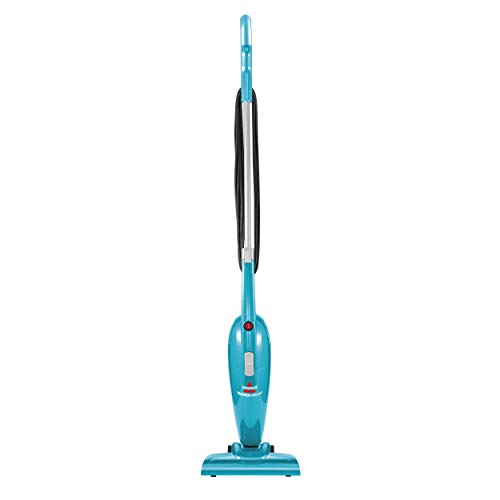
Bissell Featherweight 2033 lightweight stick vacuum converts to handheld. Bagless, corded, with crevice tool for carpets, hard floors, and stairs.
2. BLACK+DECKER Dustbuster CHV1410L — Best Dedicated Handheld
The BLACK+DECKER Dustbuster CHV1410L is the quintessential stair handheld. It weighs roughly 2.6 lbs, runs on a 16V battery with cyclonic action that maintains suction longer between cleanings, and features a built-in crevice tool on the nozzle so you never have to go hunting for an attachment. The rotating 180-degree slim nozzle reaches tight spots along stair edges and underneath balusters that conventional nozzles cannot access.
Its compact size means you can sit on a step and vacuum at eye level — the most ergonomically correct and effective stair-cleaning position. The washable filter and bowl keep ongoing costs at zero. The trade-off is runtime: it is designed for quick sessions, not whole-house cleaning, which is exactly the right tool philosophy for a staircase.
Best for: Quick stair touch-ups between deep cleans, apartment stairs, or households that already own a full-size vacuum for floors.
View the BLACK+DECKER Dustbuster CHV1410L Review
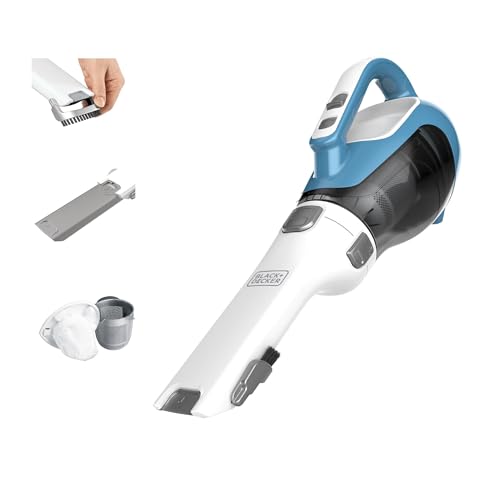
BLACK+DECKER Dustbuster AdvancedClean cordless handheld vacuum with cyclonic suction and 16V battery. Great for home and car. Read our expert review now.
3. Kenmore DS1030 Cordless 2-in-1 Stick Vacuum — Best Cordless Stick for Stairs
The Kenmore DS1030 delivers what most cordless stick vacuums promise but few actually deliver: a genuinely useful handheld mode that does not feel like an afterthought. The detachable handheld unit weighs under 3 lbs on its own, making it perfectly comfortable to carry up a flight of stairs and work step by step. Up to 45 minutes of cordless runtime in low mode is more than enough to cover even a long, multi-landing staircase.
The LED headlight is a practical bonus for stairs — interior staircases are often under-lit, and the headlight reveals dust and debris along baseboards and in corners that you would otherwise miss. The EasyCut nozzle prevents hair tangling on carpeted stairs, which is a common frustration when vacuuming carpet runners.
Best for: Multi-floor homes where you want one cordless vacuum that handles both floors and stairs without compromising on either.
View the Kenmore DS1030 Cordless 2-in-1 Review
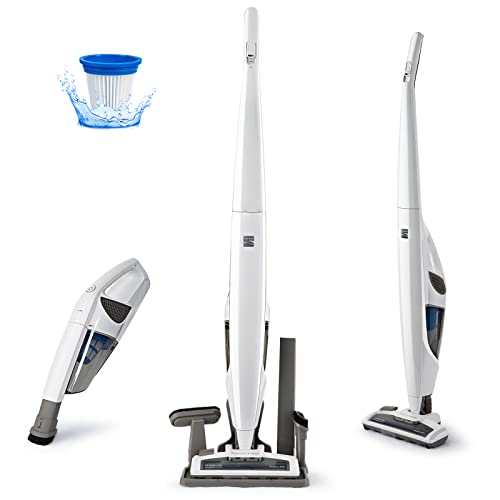
Kenmore DS1030 cordless stick vacuum with 45-min runtime, LED headlight, 2-speed suction, and detachable handheld. Lightweight at under 3 lbs. Full review!
4. Shark Navigator NV352 Lift-Away — Best for Deep-Carpet Stairs
If your stairs have thick, plush carpet that needs serious suction and agitation, the Shark Navigator NV352 is the answer. Its Lift-Away feature detaches the canister pod from the wand and floor head, turning the machine into a lightweight portable unit with full suction power. You can carry the pod up the stairs, attach the hose and upholstery tool, and clean each step with the same suction that makes the Navigator an outstanding whole-home vacuum.
The HEPA filter with Anti-Allergen Complete Seal traps 99.9% of dust and allergens — an important consideration if your household includes allergy sufferers, since stairs concentrate tracked-in pollen and pet dander. The swivel steering and included crevice tool round out a complete stair-cleaning package. At approximately 13.5 lbs as a full unit, you would not carry it step by step — the right approach is to leave it at the top or bottom landing and use the hose to reach the steps.
Best for: Homes with heavily carpeted stairs, pet hair problems, or allergy concerns that need the power of a full-size upright with above-floor flexibility.
View the Shark Navigator NV352 Lift-Away Review

Shark Navigator NV352 Lift-Away upright vacuum with HEPA filter, swivel steering, and anti-allergen technology. Ideal for carpet, stairs, and bare floors.
5. Eureka Blaze 3-in-1 Stick Vacuum — Best Budget Option
At just 4 lbs and with a 3-in-1 convertible design, the Eureka Blaze NES215A punches well above its price point for stair cleaning. It converts between stick vacuum, handheld, and crevice cleaner — three modes that map almost perfectly to the three stair cleaning tasks: tread cleaning, close-range step cleaning, and edge/groove cleaning. The corded design provides consistent suction at a price that makes it a realistic second vacuum kept dedicated to stair duty.
Swivel steering makes it easy to maneuver in the tight space at the top and bottom of a staircase. The capture nozzle handles larger debris on hard-surface stairs without scattering. It is not the tool for deep carpet extraction, but for maintaining clean stairs between thorough cleanings, it is hard to beat at this price.
Best for: Budget-conscious households, rentals, or anyone wanting a dedicated lightweight stair vacuum without spending on a premium model.
View the Eureka Blaze 3-in-1 Review

Eureka Blaze 3-in-1 lightweight stick and handheld vacuum with swivel steering. Just 4 lbs for hard floors and carpet. Read the expert review today!
Carpet vs. Hard-Surface Stairs: Does It Change Your Approach?
Yes, slightly. The core technique — top to bottom, riser first, tread second, edges last — applies to both. But the attachment selection and pressure differ.
Carpeted stairs benefit most from the motorized mini brush or upholstery tool on the treads, as the spinning action lifts embedded debris that suction alone cannot remove. Use the crevice tool with firm pressure in the corners and back groove where carpet pile traps the most debris.
Hard-surface stairs (wood, tile, stone, vinyl) need a gentler approach. Skip the motorized brush roll — the bristles can scratch unfinished wood or scatter debris. Use the standard suction nozzle or soft dusting brush on the treads and risers. Pay extra attention to the front lip of each tread where debris gathers visibly.
Carpet runners on wood stairs require both approaches at once. Use the upholstery or motorized tool on the runner, then switch to a soft nozzle for the exposed wood edges. The crevice tool handles the seam between the runner and the wood tack strip.
How Often Should You Vacuum Stairs?
The honest answer: more often than most people do.
High-traffic stairs (main staircase used by the whole household multiple times daily) benefit from vacuuming once or twice a week. Dirt ground into carpet pile shortens the carpet’s life and becomes harder to remove the longer it sits.
Low-traffic stairs (basement access, secondary staircase) can be vacuumed every two weeks.
Homes with pets should vacuum main stairs two to three times per week, especially during shedding season. Pet hair bonds to carpet fibers and becomes nearly impossible to remove once it has been walked in repeatedly.
Allergy households should aim for once or twice weekly minimum, as stairs concentrate allergens from tracked-in pollen and pet dander.
A quick pass with a lightweight handheld or stick vacuum takes under five minutes for a standard staircase. The frequency recommendation becomes much easier to follow once you have a dedicated stair vacuum that lives near the staircase rather than in a closet across the house.
Tips for Making Stair Vacuuming Easier
Keep a dedicated stair vacuum nearby. A small handheld or lightweight stick vacuum stored in a closet on the landing makes it dramatically more likely you will actually vacuum stairs regularly. Removing the friction of setup and retrieval is the single most effective behavioral change.
Vacuum stairs before the floors below. Any debris that falls off the stairs during cleaning will land on the floor, which you can pick up during your regular floor pass.
Use a long extension cord if corded. If your corded vacuum’s cord is too short, an extension cord taped to the baseboard at the top landing allows you to work the entire staircase from one outlet.
Dry-sweep loose debris first on hard stairs. A dry microfiber mop or soft broom down the staircase before vacuuming collects large loose debris faster than vacuuming it directly, saving battery or reducing how often you have to empty a small dirt cup.
Do not skip the balusters. While you are on the stairs, run a soft dusting brush attachment up the balusters and along the handrail. It takes thirty seconds and prevents dust from resettling onto the treads you just cleaned.
Frequently Asked Questions
Can I use a robot vacuum on stairs?
No. As of 2026, no consumer robot vacuum can navigate stairs. Robots are confined to flat surfaces and will stop — or fall — at a stair edge. A handheld or stick vacuum is the only realistic option for automated stair cleaning in the current market. See our guide to stair-climbing robot vacuums for the latest on where this technology stands.
What is the easiest type of vacuum to use on stairs?
A lightweight cordless handheld is the easiest in terms of physical effort and maneuverability. A convertible 2-in-1 or 3-in-1 stick vacuum is the most versatile, as it handles both stairs and floors. For deep carpet, a Lift-Away canister-style vacuum provides the most suction with good portability.
How do I remove pet hair from carpet stairs?
Use a motorized mini brush attachment or dedicated pet upholstery tool rather than plain suction. Work in firm, overlapping strokes. A rubber-edged squeegee or rubber glove dragged across the carpet before vacuuming also helps consolidate hair into clumps that are easier to suction up. Vacuuming more frequently (two to three times per week during shedding season) prevents hair from bonding deeply into the pile.
Is it better to vacuum stairs with a handheld or a stick vacuum?
It depends on your staircase. A handheld allows you to sit on a step and clean at eye level — ideal for thorough, detail-oriented cleaning. A stick vacuum is faster for covering each tread quickly but requires crouching or reaching. Many users find a convertible vacuum (stick that detaches to handheld) gives them the best of both approaches.
My stairs have carpet and wood edges — which attachment do I use?
Use the motorized or upholstery tool on the carpet portions, then switch to a soft nozzle or dusting brush on the bare wood edges. The crevice tool handles the seam between the carpet and wood tack strip. Never use a motorized brush roll directly on unfinished wood.
Can I vacuum stairs with a regular upright vacuum?
Technically yes, but it is awkward and ineffective. The cleaning head of a standard upright is too wide to cover a stair tread evenly, and the machine is too heavy and unwieldy to maneuver safely on a slanted staircase. Most uprights cannot reach the riser or the back groove without the hose and an attachment, which turns the process into a cumbersome operation. An upright with a Lift-Away or Lift-Off feature (like the Shark Navigator series) solves this by letting you detach the canister and use it like a lightweight portable unit.
How do I prevent stairs from getting dirty so fast?
A few habits make a big difference: a shoe rack or shoe-removal area at the base of the stairs reduces tracked-in debris significantly. A door mat at every exterior entrance captures outdoor dirt before it reaches the stairs. Brushing pets in a dedicated area away from the staircase reduces the volume of loose hair that migrates to the steps.
The Bottom Line
Vacuuming stairs is straightforward once you follow a consistent method: start at the top, vacuum the riser before the tread, work the edges with a crevice tool, and finish carpeted steps with an upholstery or motorized brush. The technique takes about five minutes to learn and under five minutes to execute once you are in the habit.
The vacuum matters more here than almost anywhere else in the home. A heavy upright is the wrong tool. A lightweight handheld, a convertible 2-in-1 stick, or a Lift-Away canister vacuum makes the job genuinely easy. Any of the five picks above will serve you well — the right choice depends on whether you need a dedicated stair-only tool, a versatile whole-home solution, or heavy-duty suction for thick carpet.
Start at the top. Work your way down. Do it every week. Your stairs will stay clean with almost no effort at all.
Ready to Find Your Perfect Vacuum?
Browse our expertly reviewed vacuum cleaners and make an informed decision
Browse All Vacuums