Best Robot Vacuum for Carpet and Hardwood 2026: Seamless Multi-Floor Cleaning
Best robot vacuums for carpet and hardwood floors — auto carpet boost and rubber brushes for seamless transition between floor types.
Table of Contents
- Why Mixed-Floor Homes Demand Specialized Robot Vacuums
- Key Features to Look for in a Robot Vacuum for Carpet and Hardwood
- How Robot Vacuums Detect Floor Type Changes
- The 6 Best Robot Vacuums for Carpet and Hardwood Floors
- How to Use Virtual Boundaries to Prevent Mopping on Carpet
- Comparison Table
- Tips for Getting the Best Results on Mixed Floors
- Frequently Asked Questions
- Final Thoughts
Most homes are not built on a single floor type. You step out of a carpeted bedroom into a hardwood hallway, cross into a tiled kitchen, and maybe pass over a living room rug along the way. That mixed reality is exactly why choosing the right robot vacuum matters more than most people realize. A robot that excels on hardwood but leaves carpet half-cleaned — or one that handles carpet beautifully but scratches your wood floors — is not truly working for your home. The best robot vacuums for carpet and hardwood floors do something remarkable: they transition between surfaces without hesitation, without manual intervention, and without compromising the quality of either clean.
In 2026, the technology behind multi-floor robot vacuums has matured significantly. Carpet Auto-Boost, full-rubber spiral brush rolls, mop-lift systems, and LiDAR-based floor detection have moved from premium-only features into a much wider range of products. This guide breaks down exactly what to look for, explains how the technology works, and recommends six proven models that handle the full spectrum of home flooring with confidence.
Why Mixed-Floor Homes Demand Specialized Robot Vacuums
The challenge of cleaning both carpet and hardwood with a single robot is not just about suction power. The two floor types have completely different requirements. On hardwood, you want the robot to glide gently, avoid scattering fine debris ahead of the cleaning head, and never use stiff bristles that can leave micro-scratches over time. On carpet, you need aggressive suction, motorized brushroll agitation to lift embedded dirt from fibers, and enough power to pull pet hair from deep within the pile.
A robot calibrated only for one surface will underperform on the other. Too much suction on bare wood can scatter dust bunnies across the room. Too little on carpet leaves the underlying dirt untouched while only skimming the surface. The robots in this guide solve this problem with intelligent detection and automatic adjustment — delivering the right cleaning approach to each surface type without any input from you.
Key Features to Look for in a Robot Vacuum for Carpet and Hardwood
Auto Carpet Boost (Automatic Suction Adjustment)
Carpet Auto-Boost is arguably the most important feature for mixed-floor homes. When the robot’s sensors detect a transition from hard flooring to carpet, the motor automatically increases suction power — sometimes dramatically — to compensate for the added resistance of carpet fibers. On hard floors, the motor runs at a quieter, more energy-efficient level. The moment the robot crosses onto carpet, the suction ramps up to pull embedded dirt, dust, and pet hair from the pile.
Without this feature, you face a compromise: either set the suction high enough for carpet (which is loud and inefficient on hard floors) or set it for hard floors (which leaves carpet cleaning superficial). Carpet Auto-Boost eliminates that compromise entirely.
Rubber Brush Rolls
Brush roll material matters enormously on hardwood floors. Traditional stiff-bristle brush rolls can be aggressive enough to scatter debris on smooth surfaces, and over time the bristles themselves can leave faint surface marks on unfinished or lightly finished wood. Full-rubber or rubber-silicone spiral brush rolls solve both problems: the flexible rubber fins grip debris effectively on all surface types, resist hair wrapping far better than bristles, and make direct contact with hard floors without the risk of scratching.
On carpet, rubber brush rolls still provide adequate agitation for loosening embedded dirt, though they work best on low-to-medium pile rather than thick shag or high-pile carpet. For most homes with a mix of hardwood, tile, and standard carpet, a rubber brush roll is the optimal choice.
Low Profile for Under-Furniture Access
A robot vacuum that cannot get under your furniture is only cleaning half the floor. Beds, sofas, entertainment centers, and dining tables all accumulate significant dust and debris beneath them — often more than exposed open areas. The best multi-floor robots maintain a profile of 3 inches or less, enabling them to slip under furniture on both carpeted and hard floor surfaces. This is particularly important in homes where area rugs under furniture sit on hardwood, as the robot must navigate the transition from hardwood to rug to hardwood all while remaining low enough to stay under the furniture frame.
Mop Lift for Combo Vacuum-Mop Units
For robot vacuums that also mop, a mop-lift system is essential in mixed-floor homes. Without it, a robot mopping on hardwood will drag a wet pad directly onto carpet when it transitions surfaces — leaving moisture behind that can damage carpet backing, promote mold, or simply leave wet footprints throughout your home. A mop-lift mechanism raises the mopping pad by 5–10mm when the robot detects carpet, allowing it to continue vacuuming the carpet while keeping the mop safely above the fibers. This single feature is what makes combo vacuum-mop robots genuinely usable in homes with both floor types.
LiDAR Navigation and Floor Mapping
Robots equipped with LiDAR (Light Detection and Ranging) navigation use laser pulses to build accurate, real-time maps of your home. This precision navigation enables the robot to clean in systematic, methodical rows rather than bouncing randomly between surfaces. It also enables features like No-Go Zones, room-specific scheduling, and multi-floor mapping — all of which are particularly valuable in homes where different rooms have different flooring types that may require different cleaning frequencies or approaches.
How Robot Vacuums Detect Floor Type Changes
Modern robot vacuums use a combination of sensor technologies to identify surface transitions in real time.
Ultrasonic and mechanical resistance sensors in the wheel assembly detect changes in rolling resistance as the robot moves from a smooth hard floor to carpet. The increased resistance from carpet fibers triggers the Carpet Auto-Boost response.
Infrared floor sensors measure the reflectivity of the surface below the robot. Hardwood and tile surfaces reflect infrared light differently than carpet fibers, allowing the robot to distinguish between surface types and adjust its motor speed accordingly.
Optical sensors on some premium models analyze the visual texture of the floor surface, providing an additional layer of surface identification that works alongside mechanical and infrared detection.
Weight and drag analysis in the robot’s motor controller monitors the load on the motor in real time. As carpet fibers create drag on the brush roll and chassis, the controller increases power output to maintain consistent cleaning performance.
Most robots combine at least two of these approaches to create a reliable, fast-responding detection system. Premium models can detect a surface change and adjust suction within one to two seconds of crossing the threshold, meaning the robot is already operating at the correct power level well before it reaches the center of the new surface.
The 6 Best Robot Vacuums for Carpet and Hardwood Floors
1. MAMNV D13S MAX — Best Overall for Mixed Floors
Rating: 4.5/5 | 2,271 Reviews | Suction: 11,500Pa
The MAMNV D13S MAX is the most capable multi-floor robot vacuum in this guide. Its 11,500Pa suction motor is powerful enough to handle deep carpet cleaning that many robot vacuums in this class simply cannot match, while its Carpet Auto-Boost function automatically detects hard-to-carpet transitions and increases suction strength to compensate for the added fiber resistance. On hardwood, the robot scales back to an efficient, quiet level that picks up fine dust and debris without scattering.
The LiDAR Smart Mapping navigation system builds precise room-by-room floor plans that support multiple floor maps — ideal for multi-story homes where each level may have a different mix of flooring types. You can set No-Go Zones directly in the app to keep the robot away from delicate rugs or areas with low-clearance furniture it might struggle to exit.
The 90-day self-emptying base station is a standout feature for busy households. After each cleaning run, the D13S MAX autonomously docks and evacuates its dustbin into a sealed bag that holds 70–90 days of accumulated debris. For pet owners dealing with constant daily hair accumulation, this means weeks of genuinely hands-free operation. The 160-minute runtime provides whole-home coverage in a single session, and the robot’s 3-in-1 vacuum, sweep, and mop functionality means hardwood floors receive both dry vacuuming and wet mopping in one pass — while the mop avoids carpet areas automatically.
Best for: Large mixed-floor homes, pet owners, users who want premium hands-free automation
Key specs: 11,500Pa suction | Carpet Auto-Boost | LiDAR navigation | 90-day self-emptying | 160-min runtime | 3-in-1 vacuum, sweep, mop

MAMNV D13S MAX robot vacuum & mop with 11500Pa suction, LiDAR mapping, 90-day self-emptying base & 160-min runtime. Works with Alexa. Shop now.
2. Roborock Qrevo QV 35A — Best for Rubber Brush Performance
Rating: 4.3/5 | 1,457 Reviews | Suction: 8,000Pa
The Roborock Qrevo QV 35A brings two features that directly address the carpet-and-hardwood challenge: a full-rubber spiral main brush and a 10mm mop lift. The rubber brush roll is SGS-certified with a 0% hair tangle rate — it glides gently across hardwood without risking scratches while still providing sufficient agitation for low-to-medium pile carpet. Unlike bristle-based brush rolls that can fling fine debris on smooth surfaces, the rubber fins maintain consistent contact and suction across both floor types.
The mop-lift system raises the dual spinning mop pads by 10mm the instant the robot detects carpet, eliminating any risk of moisture damage to carpet fibers. The dual 200RPM spinning mops scrub dried spills and light stains from hardwood and tile with real effectiveness — not just the passive drag mopping offered by cheaper models. With 30 adjustable water flow levels, you can fine-tune mopping intensity for delicate hardwood versus sealed tile or laminate.
The all-in-one docking station handles dust emptying, water tank refilling, mop washing, and mop drying automatically — reducing maintenance to near zero for weeks at a time. PreciSense LiDAR navigation creates accurate multi-floor maps, and the 8,000Pa HyperForce suction delivers strong performance across all surface types.
Best for: Homes with hardwood that needs mopping, pet owners who want tangle-free operation
Key specs: 8,000Pa suction | Full-rubber spiral brush | 10mm mop lift | All-in-one dock | PreciSense LiDAR | Multi-floor mapping

Roborock Qrevo QV 35A robot vacuum and mop with 8000Pa suction, all-in-one dock, anti-tangle brushes, and dual spinning mops. Smart LiDAR navigation.
3. Shark AI Ultra AV2511AE — Best for Carpet Deep Cleaning
Rating: 4.0/5 | 8,260 Reviews
The Shark AI Ultra AV2511AE takes a different approach to multi-floor cleaning: instead of simply increasing suction when it detects carpet, its Matrix Clean navigation system makes multiple overlapping passes across the floor using a precision grid pattern. The result is 30% more thorough carpet cleaning compared to single-pass robots — a meaningful difference in homes where carpet fibers have accumulated weeks of embedded dirt and pet hair.
The 360-degree LiDAR vision system scans your home with enough precision to navigate in complete darkness, building accurate floor maps and identifying objects in the robot’s path. The self-cleaning brushroll actively resists hair wrap during cleaning, maintaining consistent suction performance even in homes with shedding pets. When the robot finishes a session, it returns to the XL bagless self-empty base, which holds approximately 60 days of debris before needing attention.
The Shark AI Ultra does not include mopping functionality, which makes it better suited for homes where hardwood floors only need vacuuming rather than wet cleaning. For carpeted rooms, the Matrix Clean pattern and powerful suction deliver noticeably deeper results than most competing robots. The Recharge and Resume function ensures the robot completes large-home cleaning sessions by docking to recharge and then returning to exactly where it left off.
Best for: Homes with significant carpet area, pet owners who prioritize carpet deep cleaning over mopping
Key specs: Matrix Clean multi-pass navigation | 360° LiDAR | Self-cleaning brushroll | 60-day bagless self-empty | Recharge and Resume

Shark AI Ultra robot vacuum with Matrix Clean navigation, 60-day self-empty base, LiDAR mapping, and voice control. Expert review for pet owners.
4. eufy RoboVac 11S Max — Best Budget Pick
Rating: 4.1/5 | 16,258 Reviews
The eufy RoboVac 11S Max proves that effective multi-floor cleaning does not require a flagship price tag. Its BoostIQ technology automatically increases suction within 1.5 seconds when the robot transitions from hard flooring to carpet — one of the fastest response times in its class. On hardwood, tile, and laminate, it runs quietly and efficiently. On carpet, it ramps up to extract fine dust and light debris from the fibers without any input from you.
The 11S Max’s defining physical characteristic is its 2.85-inch height, making it one of the thinnest robot vacuums available. This ultra-slim profile allows it to clean under sofas, beds, entertainment centers, and other low-clearance furniture that taller robots simply cannot reach. Given that the areas beneath furniture tend to accumulate the most dust and pet hair — on both hard and carpeted surfaces — this capability directly translates to cleaner floors.
With a 100-minute runtime and automatic return-to-dock recharging, the 11S Max covers most apartments and single-story homes in a single session. It does not include Wi-Fi or app connectivity, relying entirely on a remote control for scheduling and mode selection. For users who prefer simplicity over smart-home integration, this is a feature rather than a limitation.
Best for: Budget-conscious buyers, apartments, users who want simple no-app operation
Key specs: BoostIQ auto suction adjustment | 2.85-inch ultra-slim profile | 100-min runtime | Quiet operation | Automatic self-charging | Remote control
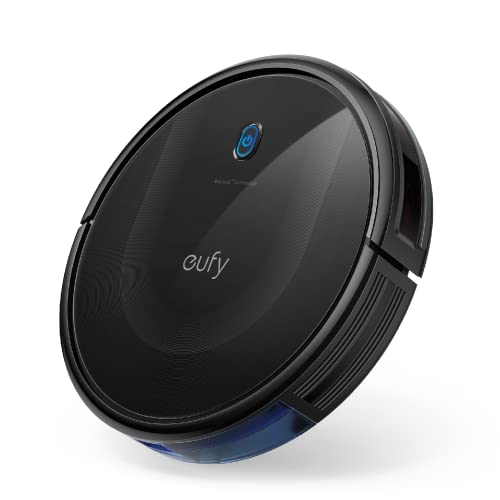
eufy RoboVac 11S Max super-thin robot vacuum with BoostIQ technology, 100-min runtime, and quiet operation. Ideal for hard floors and medium-pile carpets.
5. Tikom G8000 Max — Best Budget Vacuum-Mop Combo
Rating: 4.4/5 | 3,863 Reviews | Suction: 5,000Pa
The Tikom G8000 Max delivers 5,000Pa of suction alongside simultaneous vacuuming and mopping capability at a price point that undercuts most premium alternatives. Its ultra-slim 2.99-inch profile navigates under the same low-clearance furniture as more expensive models, and its large wheels handle the threshold transitions between hardwood, tile, and carpeted areas with minimal hesitation.
For homes with a mix of hardwood floors that benefit from mopping and carpeted bedrooms that need vacuuming, the G8000 Max handles both in a single cleaning run. The 300ml water tank provides enough capacity for standard room-sized hard floor areas, and the 450ml dustbin holds a full session’s worth of debris from mixed surface cleaning. The 150-minute battery life covers most apartments and mid-sized homes without interruption.
It is important to note that the G8000 Max does not include a mop-lift system, meaning the mop pad will drag across carpet if both surfaces are in the cleaning path. The recommended approach is to use the app to schedule separate vacuuming runs for carpet-heavy areas and vacuum-plus-mop runs for hard floor areas, using virtual boundaries to separate the zones. For households willing to make this scheduling distinction, the G8000 Max delivers impressive value.
Best for: Budget buyers who want vacuum and mopping, apartments with separate carpet and hard floor zones
Key specs: 5,000Pa suction | 2-in-1 vacuum + mop | 2.99-inch slim profile | 150-min runtime | App, remote, voice, and button control | Four cleaning modes

Tikom G8000 Max robot vacuum and mop combo delivers 5000Pa suction, 150-min runtime, and 4 cleaning modes for hard floors, carpets, and pet hair.
6. ROPVACNIC S1 — Best for Hardwood Mopping Precision
Rating: 4.5/5 | 160 Reviews | Suction: 5,200Pa
The ROPVACNIC S1 distinguishes itself with an electronically controlled water tank that offers four-stage water flow adjustment — a meaningful step up from the gravity-fed passive water tanks found in most budget combo robots. This precision control allows you to calibrate exactly how much moisture is applied to hardwood versus sealed tile versus laminate, preventing over-wetting of sensitive wood surfaces that can cause warping or finish damage over time.
The 5,200Pa suction handles daily debris maintenance effectively on both hard floors and low-pile carpet, and the anti-tangle brush design prevents the matted hair buildup that reduces cleaning efficiency in homes with shedding pets. The dual rotating side brushes sweep debris from edges and corners into the main suction path, making it particularly effective along baseboards and around furniture legs on both surface types.
At 7.6cm tall with a 30.5cm diameter, the S1 fits under most standard furniture and navigates between chair legs and tight spaces efficiently. Smart app control via Wi-Fi and compatibility with both Amazon Alexa and Google Assistant make it easy to schedule cleaning sessions and adjust settings remotely. For new households or smaller homes looking for precise mopping control without a premium price, the ROPVACNIC S1 is a well-executed option.
Best for: Homes with delicate hardwood that needs careful mopping, first robot vacuum buyers
Key specs: 5,200Pa suction | Electronically controlled 4-stage water flow | Anti-tangle brush | Wi-Fi + Alexa + Google Assistant | 7.6cm slim profile | Self-charging
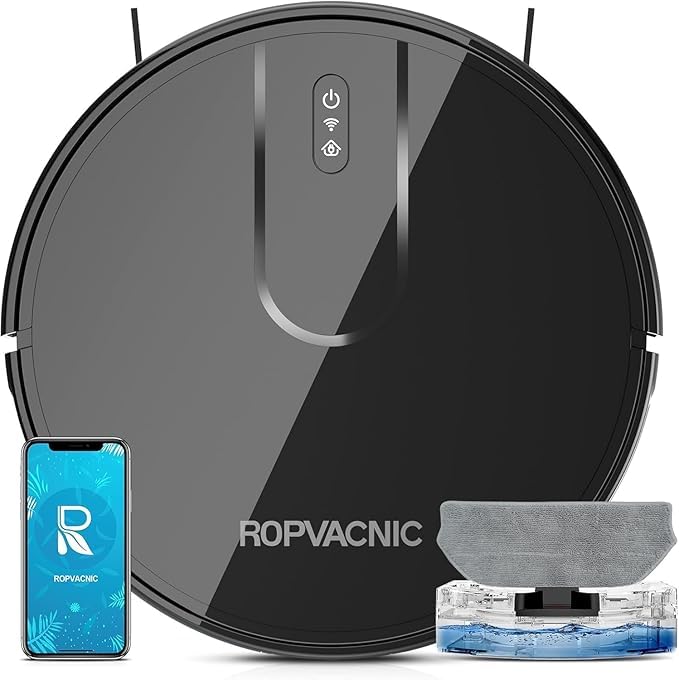
ROPVACNIC S1 robot vacuum and mop combo with 5200Pa suction, smart app control, Alexa compatible, and self-charging. Ideal for pet owners.
How to Use Virtual Boundaries to Prevent Mopping on Carpet
For any robot vacuum-mop combo operating in a home with both hard floors and carpet, virtual boundaries are an essential tool. Even models with mop-lift systems can benefit from app-configured boundaries that prevent the robot from wasting time attempting to mop over large carpeted areas or entering rooms where mopping is never needed.
Set No-Go Zones for carpeted rooms when mopping. Using your robot’s app, draw exclusion zones around carpeted bedrooms, living room rugs, and any area with high-pile carpet before starting a mop cycle. This keeps the mopping function restricted to the hard floor areas where it provides actual value.
Create separate cleaning schedules by zone. Most app-connected robots allow you to schedule different cleaning programs for different rooms or zones. Schedule a vacuum-only run that covers the entire home (including carpet) on weekday mornings, and a vacuum-plus-mop run restricted to hard floor zones on weekend evenings.
Use room-specific cleaning for targeted sessions. When hardwood floors need a quick mid-week mop after cooking or a muddy entrance, use room-specific cleaning to send the robot to just the kitchen or entryway without disturbing carpeted areas.
Maintain No-Go Zones around area rugs with fringe. Rugs with decorative fringe edges can be problematic for robot vacuums on any floor type — the fringe can get caught in brush rolls or side brushes. Setting small virtual boundaries around the edges of fringe rugs protects both the rug and the robot, regardless of what floor type the rug sits on.
Comparison Table
| Model | Suction | Carpet Auto-Boost | Mop Lift | Self-Empty | Rating | Best For |
|---|---|---|---|---|---|---|
| MAMNV D13S MAX | 11,500Pa | Yes | Yes (smart) | 90 days | 4.5 | Best overall |
| Roborock Qrevo QV 35A | 8,000Pa | Yes | 10mm | Yes (all-in-one) | 4.3 | Rubber brush + mopping |
| Shark AI Ultra AV2511AE | High | Yes | No mop | 60 days | 4.0 | Carpet deep cleaning |
| eufy RoboVac 11S Max | BoostIQ | Yes | No mop | No | 4.1 | Budget / slim profile |
| Tikom G8000 Max | 5,000Pa | No | No | No | 4.4 | Budget combo |
| ROPVACNIC S1 | 5,200Pa | Yes (3 levels) | No | No | 4.5 | Mopping precision |
Tips for Getting the Best Results on Mixed Floors
Do a pre-clean sweep before the first run. Before your robot vacuum’s first session in a mixed-floor home, manually pick up large items — toys, shoes, charging cables — from the floor. Robot sensors can navigate around most obstacles, but cables and small items on the floor can disrupt the cleaning path and reduce coverage efficiency.
Set cleaning frequency differently for carpets and hardwood. High-traffic hardwood entryways and kitchen floors may need daily runs, while carpeted bedrooms might be fine with three or four runs per week. Use room-specific scheduling to tune the frequency to each area’s actual needs.
Keep the robot’s sensors and brush rolls clean. Surface transition sensors rely on clean optical and infrared sensors to detect floor type changes accurately. A thin layer of dust on the sensor window can cause delayed or incorrect detection. Wipe sensors with a dry cloth every week or two, and clean hair from brush rolls regularly to maintain peak performance.
Use boundary strips for problem transitions. If your home has an unusually high threshold between carpet and hardwood, physical magnetic boundary strips placed across doorways can help train the robot to approach the transition at an optimal angle, reducing the chance of the robot getting stuck mid-transition.
Empty the dustbin after carpet-heavy sessions. Even with self-emptying docks, checking the robot’s onboard dustbin after a session that covered significant carpet area is good practice. Heavy carpet runs in pet-heavy homes can fill a 200–300ml dustbin faster than the self-emptying cycle expects.
Frequently Asked Questions
Can a robot vacuum actually clean both carpet and hardwood floors well?
Yes, but the quality difference between models is significant. Robots with Carpet Auto-Boost, full-rubber brush rolls, and LiDAR navigation consistently outperform budget models that use fixed suction and random navigation. The models in this guide are specifically selected for their ability to deliver effective cleaning on both surface types — not just passable results on one and adequate results on the other.
What pile height carpet works best with robot vacuums?
Most robot vacuums perform best on low-to-medium pile carpet (up to about 0.5 inches). High-pile carpet, shag carpet, and thick area rugs present challenges because the robot’s chassis can drag on the pile, reducing mobility and sometimes causing the robot to get stuck. If your carpets are medium-to-high pile, look for robots with higher suction power (8,000Pa or above) and verified carpet compatibility in the manufacturer specifications.
Do robot vacuums scratch hardwood floors?
Robot vacuums designed for mixed floors generally do not scratch hardwood when used correctly. Rubber brush rolls are the safest choice for hardwood, as they make direct floor contact without hard bristles. However, debris trapped under the robot’s chassis or wheels — small stones, grit tracked in from outside — can cause scratches. Shaking out entryway rugs before running the robot reduces this risk significantly.
Should I mop before or after vacuuming with a combo robot?
With a combo vacuum-mop robot, the machine vacuums and mops in a single pass — there is no sequencing needed. However, for standalone mopping cycles after vacuuming, it is best to vacuum first and then mop, ensuring wet mopping does not push loose debris around the floor before it is collected.
How do I prevent the mop from getting my carpet wet?
Choose a robot with an automatic mop-lift system (like the Roborock Qrevo QV 35A with its 10mm lift or the MAMNV D13S MAX), or use virtual boundaries in the app to exclude all carpeted areas when running a mopping cycle. Even with a mop-lift system, double-checking that your No-Go Zones are properly configured is good practice — especially around area rugs at the edges of hard floor zones.
How often should I run my robot vacuum on mixed floors?
For most households, running the robot daily in high-traffic areas (kitchen, entryway, living room) and every other day in lower-traffic areas (bedrooms, offices) maintains a noticeably cleaner home than weekly manual vacuuming. Robot vacuums are most effective as daily maintenance tools rather than deep-cleaning replacements — pair them with occasional manual vacuuming for embedded dirt in high-pile carpet.
Is LiDAR navigation necessary for mixed-floor homes?
LiDAR navigation significantly improves cleaning coverage and efficiency in homes with multiple flooring types because it enables systematic, room-by-room cleaning rather than random coverage. It also enables the app features (No-Go Zones, room scheduling, virtual boundaries) that are particularly valuable for managing mopping and vacuuming separately across different floor zones. If your budget allows, LiDAR is a meaningful upgrade for mixed-floor homes.
Final Thoughts
The best robot vacuum for carpet and hardwood floors is one that genuinely handles both surfaces without compromising either. Auto carpet boost ensures the robot always brings the right suction to the job. Rubber brush rolls protect your hardwood while still cleaning carpet effectively. And a low profile ensures no dust accumulates in the places that matter most — underneath your furniture, regardless of what floor type it sits on.
For most households, the MAMNV D13S MAX offers the best overall balance of power, intelligence, and hands-free convenience. If rubber brush performance and mopping precision matter most, the Roborock Qrevo QV 35A is the standout choice. For budget buyers who need a proven multi-floor performer at a modest price, the eufy RoboVac 11S Max delivers BoostIQ technology and an ultra-slim profile that most competitors at its price cannot match.
Whatever your floor mix, there is a robot vacuum in 2026 that handles it seamlessly. The key is knowing which features matter for your specific home — and the guide above gives you exactly that.
MAMNV D13S MAX robot vacuum & mop with 11500Pa suction, LiDAR mapping, 90-day self-emptying base & 160-min runtime. Works with Alexa. Shop now.
Ready to Find Your Perfect Vacuum?
Browse our expertly reviewed vacuum cleaners and make an informed decision
Browse All Vacuums