Best Vacuum for Basement 2026: Powerful Picks for Concrete & Carpet
Best vacuums for basements — strong suction for concrete floors, good filtration for dust and mold spores, including wet-dry options.
Table of Contents
- Best Vacuum for Basement 2026: Powerful Picks for Concrete & Carpet
- Why Basements Demand a Purpose-Matched Vacuum
- Key Features to Look For
- Finished vs. Unfinished Basement: Cleaning Needs Compared
- The 6 Best Vacuums for Basements in 2026
- How to Choose the Right Vacuum for Your Specific Basement
- Basement Mold and Moisture FAQ
- Final Thoughts
Best Vacuum for Basement 2026: Powerful Picks for Concrete & Carpet
Basements are unlike any other space in your home when it comes to vacuuming. They combine challenges that no other single room presents all at once: raw concrete or painted cement floors that generate fine silica-laden dust with every footstep, potential moisture and humidity that breeds mold spores and musty odors, cobwebs stretching from floor to ceiling in corners that rarely get attention, workshop debris ranging from sawdust to metal shavings if you do any DIY work down there, and — in finished basements — carpet or area rugs that trap everything the concrete floor generates. Some basements even experience minor water intrusion after heavy rain, which transforms a dry cleanup job into a wet mess a standard vacuum was never built to handle.
The vacuum you use upstairs almost certainly is not the right tool for your basement. A lightweight stick vacuum with a HEPA-Type filter may handle the weekly carpet cleanup in your living room, but send it into a damp, dusty, unfinished basement and it will clog, lose suction, and potentially exhaust fine particulates back into the air. The stakes are higher than they seem: concrete dust contains respirable crystalline silica, mold spores in damp basements are a genuine respiratory hazard, and construction debris from home projects includes particles that destroy unprotected motors.
This guide covers exactly what to look for in a basement vacuum, walks through the distinct needs of finished versus unfinished basements, and recommends six specific products suited to the full range of basement conditions — from bare concrete utility rooms to fully carpeted finished living spaces.
Why Basements Demand a Purpose-Matched Vacuum
Concrete Floors: Fine Dust and Abrasion
Even a sealed concrete basement floor generates dust. Unsealed concrete is a continuous source of fine cement and silica particles that get kicked up with every pass of a brush or vacuum head. The dust settles back down, mixes with tracked-in dirt, and creates a layer of fine particulate that a vacuum without strong, sustained suction cannot fully capture. Worse, concrete dust is abrasive — it wears down soft roller brushes and can damage motor bearings in vacuums not built for it.
For concrete floors, you want a vacuum with high airflow and direct suction, either a canister with a hard floor nozzle or an upright with the brushroll turned off. Strong suction pulls the fine dust up rather than scattering it. HEPA or equivalent sealed filtration is not optional — concrete dust includes particles below 10 microns that standard filters exhaust back into the air.
Moisture and Mold Spores
Basements rank among the most moisture-prone spaces in any home. Even without active water intrusion, humidity condenses on cold concrete walls and floors, creating the conditions for mold and mildew growth. Mold spores range from 1 to 100 microns in diameter — well within the capture range of a true HEPA filter, but entirely capable of bypassing a standard consumer filter and being redistributed into the air by a poorly sealed vacuum.
If your basement has any evidence of past moisture — water staining on walls, efflorescence on concrete, a musty smell — a vacuum with a fully sealed HEPA filtration system is essential. Vacuuming moldy surfaces with an inadequate filter can aerosolize spores that were previously settled, actively worsening indoor air quality. See our detailed guide on the best vacuums for mold for filtration specifics.
Workshop Debris and Construction Dust
Home workshops in basements generate some of the most demanding cleanup challenges a vacuum can face: sawdust, wood shavings, fine sanding dust, drywall particles, paint chips, small hardware like screws and nails, and grinding debris. Many of these particles are hazardous at fine sizes, and the sheer volume and variety of material overwhelms most household vacuums quickly.
A vacuum intended for regular workshop use in a basement needs to handle both fine dust and coarser debris without clogging, maintain consistent suction throughout a heavy cleanup session, and have a filtration system that protects both the motor and the room’s air quality. Our best vacuums for construction dust guide covers the filtration standards in depth.
Large Open Spaces Require Reach and Capacity
Basements are often the largest undivided floor space in a home — an open utility room, a sprawling unfinished space, or a finished rec room that spans the entire footprint of the house. Cleaning efficiently across that space requires a long cord or large battery capacity, a wide cleaning path, and a generous dust container so you are not stopping every five minutes to empty. Canister vacuums excel here: you park the canister and extend the hose and wand far across the floor without dragging the full machine. Long-cord uprights also work well for large open floor plans.
Key Features to Look For
Strong Suction for Concrete
Airflow — measured in CFM (cubic feet per minute) or air watts — matters more than motor wattage alone. For concrete floors, you want a vacuum that maintains high airflow at the nozzle to lift fine particles off a hard, smooth surface. Direct suction nozzles (hard floor attachments without a brushroll) are better than motorized brushrolls on bare concrete, since a spinning brush can scatter dust before the suction captures it.
HEPA or Sealed Filtration for Mold and Fine Dust
Any vacuum for basement use should carry a true HEPA filter — rated to capture 99.97% of particles at 0.3 microns — in a fully sealed housing. A sealed system means all exhaust air passes through the HEPA filter with no bypass paths through housing gaps. This is critical for mold spores, concrete dust, and any fine particulate from workshop activities.
Wet-Dry Capability for Finished Basements
A finished basement with tile or polished concrete floors that may experience occasional minor moisture intrusion — or simply need to be washed as well as vacuumed — benefits from a wet-dry floor cleaner or a machine that can handle damp surfaces. Purpose-built wet-dry vacuum mops can simultaneously vacuum and wash hard floors, combining two cleaning steps into one pass.
Attachments for Cobwebs and Tight Corners
Basement cleaning almost always involves above-floor surfaces: cobwebs in ceiling corners, dust on utility pipes and beams, debris behind storage shelving, and tight spaces around water heaters, HVAC equipment, and support columns. A crevice tool, dusting brush, and sufficient hose or wand reach are non-negotiable for thorough basement cleaning. Telescoping wands that extend to 9 feet or more make ceiling work possible without a ladder.
Cord Length or Battery Capacity for Large Areas
For an unfinished basement that may extend 1,000 square feet or more, a corded vacuum with at least a 25–30 foot cord is preferable to a cordless with limited battery runtime. For finished basement spaces used more like living areas, cordless convenience may outweigh the reach advantage of a corded machine.
Finished vs. Unfinished Basement: Cleaning Needs Compared
Unfinished Basement Needs
An unfinished basement — raw concrete floors, exposed framing, utility pipes and mechanicals — is the more demanding environment. The primary challenge is concrete dust and coarse debris (gravel, dirt tracked in, workshop material). Moisture management matters: the vacuum must handle fine, potentially damp debris without clogging. Filtration requirements are highest here because the particles are most hazardous and there is no carpet to trap them before they go airborne.
For unfinished basements, prioritize:
- Canister vacuums with large-capacity bags or bins and hard floor nozzles
- HEPA-sealed filtration without exception
- Long reach for overhead spaces (cobwebs, pipes, beams)
- High airflow (at least 40 CFM at the nozzle for handheld tools, higher for full-size machines)
- Durable construction that handles occasional debris including pebbles, small hardware, and wood scraps
Finished Basement Needs
A finished basement — carpeted, drywall, ceiling tiles, used as a bedroom, rec room, or home office — functions much more like the main floors of the house. Carpet requires a motorized brushroll for deep fiber cleaning. The sealed space without the air circulation of above-grade rooms can trap allergens and humidity more intensely than other rooms, making filtration still critically important.
For finished basements, prioritize:
- Upright or canister vacuums with motorized brushroll for carpeted areas
- Multi-surface capability if the floor includes both carpet and hard flooring
- HEPA filtration for allergen and mold spore control
- Lift-Away or canister functionality for cleaning upholstered furniture and the stairs leading to the basement
- Wet-dry capability if the finished space includes tile, polished concrete, or bathroom areas
The 6 Best Vacuums for Basements in 2026
1. DEWALT 20V Cordless Handheld Vacuum DCV501HB — Best for Workshop Cleanup and Unfinished Basements
The DEWALT DCV501HB is purpose-built for exactly the kind of environment an unfinished basement presents. Engineered alongside DEWALT’s professional power tool lineup and designed to comply with OSHA Table 1 housekeeping rules, this vacuum handles construction-grade debris with a level of filtration and durability that no household handheld matches.
At the heart of its performance is a true HEPA filter rated to capture 99.97% of particles at 0.3 microns, combined with 46 CFM of airflow — powerful enough to pull drywall dust, concrete powder, sawdust, wood shavings, and fine silica particles off concrete floors without scattering. It handles coarser debris too: screws, nails, small pebbles, dried caulk, and wire cuttings are no obstacle for its gulper brush and high-airflow design.
The six included attachments make it genuinely versatile for basement use. The extension tube and floor nozzle convert it into a stick-style floor vacuum for ground-level cleanup. The flexible hose reaches around equipment and into tight corners. The crevice nozzle cleans along the base of concrete walls and behind utility pipes. The built-in LED work light — a practical jobsite feature — illuminates dark corners under workbenches, behind storage shelves, and inside cabinets where debris accumulates unseen.
Because it runs on DEWALT’s 20V MAX battery platform (battery sold separately), existing DEWALT tool owners can use the same batteries they already own across their power tool collection. Runtime is up to 21.4 minutes on a 5Ah battery — enough for focused workshop cleanups and targeted basement maintenance.
Best for: Unfinished basements, active home workshops, post-project cleanup of concrete, drywall, and sawdust debris.
Rating: 4.7/5 (6,136 reviews)
Key specs: 46 CFM airflow | True HEPA | 3.3 lbs (without battery) | 20V MAX battery platform | 6 attachments | LED work light | Belt clip
Pros:
- Handles construction debris including screws, nails, and fine concrete dust
- HEPA captures 99.97% of fine particulates — critical for silica and mold spores
- LED light illuminates dark basement corners
- OSHA Table 1 compliant for professional dust management
- 6 attachments including floor nozzle, flexible hose, and crevice tool
Cons:
- Battery sold separately adds to initial cost
- Dry-only — cannot handle wet spills or standing water
- Smaller capacity than a full-size canister
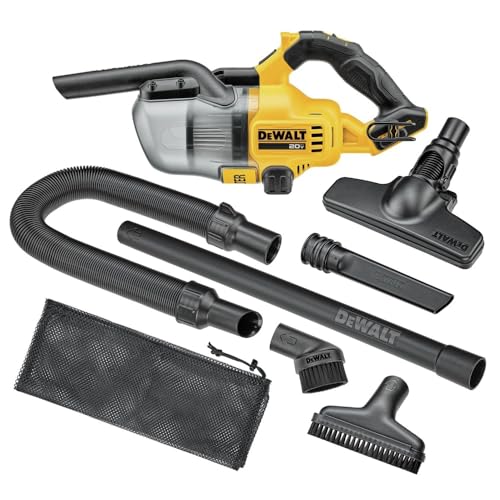
DEWALT 20V cordless handheld vacuum with HEPA filter, LED light, 6 attachments, and 46 CFM suction. Built for jobsites, workshops, garages, and vehicles.
2. Shark AZ2002 Vertex Powered Lift-Away — Best Upright for Finished Basements with Mixed Floors
The Shark Vertex AZ2002 is Shark’s most powerful upright vacuum, and it shows. With 1,344 watts of motor power, DuoClean PowerFins technology, and a Powered Lift-Away system, it is engineered to tackle finished basements that combine carpet, hard flooring, and above-floor surfaces in a single cleaning session — without swapping machines.
The DuoClean PowerFins system pairs a soft front roller that captures fine particles from hard floors with a PowerFins brushroll that digs deep into carpet fibers. For a finished basement that transitions between tile and carpet — common in basements that include a bathroom, utility area, and living space — this means consistent, maximum-effectiveness cleaning on every surface without adjusting settings or swapping floor heads.
The Powered Lift-Away feature is particularly well-suited to basement geometry. Detach the motor pod with a button press and the brushroll keeps spinning at the cleaning head, letting you push the powered nozzle completely under low-profile furniture, around support columns, and into corners that a standard upright cannot reach. Attach the hose and accessories to use the pod for cleaning basement stairs, window wells, storage shelves, and the wall-to-ceiling junction where cobwebs cluster.
Anti-Allergen Complete Seal with HEPA filtration captures 99.9% of dust and allergens at 0.3 microns in a fully sealed system. This is essential for finished basements used as bedrooms or living spaces, where mold spores and fine concrete dust from the original construction can remain suspended in the air if disturbed by an inadequate vacuum.
The 30-foot power cord provides substantial reach across a large, open finished basement floor plan. The 1-quart dust cup handles extended cleaning sessions without requiring constant emptying, and LED headlights on the nozzle reveal debris along dark baseboards and under furniture.
Best for: Finished basements with carpet and hard flooring, multi-surface basement cleaning, homes where mold and allergen management is a priority.
Rating: 4.3/5 (10,240 reviews)
Key specs: 1,344W | DuoClean PowerFins | HEPA Anti-Allergen Complete Seal | Powered Lift-Away | 30-foot cord | 1-quart dust cup | 16.4 lbs
Pros:
- DuoClean PowerFins handles both concrete-adjacent hard floors and carpet in one tool
- Powered Lift-Away maintains brushroll suction when detached for furniture and stair cleaning
- HEPA sealed filtration traps mold spores and fine basement particulates
- 30-foot cord covers large open basement floor plans
- Self-cleaning brushroll prevents hair and fiber wrap during extended sessions
Cons:
- At 16.4 lbs, it is heavy to carry down stairs for basement access
- Corded design requires outlet access in the basement
- Higher price point than basic uprights

Shark AZ2002 Vertex upright vacuum with DuoClean PowerFins, self-cleaning brushroll, Powered Lift-Away, and HEPA filtration. Ultimate power for pet hair and deep cleaning.
3. Kenmore BC3005 Bagged Canister Vacuum — Best for Allergen and Mold Control in Large Basements
The Kenmore BC3005 is a full-featured bagged canister vacuum with triple HEPA filtration and allergen seal technology — a combination that makes it one of the most capable vacuums available for basements where mold spore control and fine dust management are the primary concerns.
The dual-motor system delivers 210W of sustained suction at the hose end, providing the consistent airflow needed to pull fine particles off concrete and extract embedded debris from carpet without the suction fade that affects some single-motor machines during extended basement cleaning sessions. The four height adjustments optimize the cleaning head for the surface being cleaned, from deep-pile carpet to bare sealed concrete.
Where the BC3005 truly distinguishes itself for basement use is in its reach. The extendable lightweight aluminum telescoping wand provides up to 9.5 feet of cleaning height — enough to reach the ceiling of most basements from the floor without a step stool. For cleaning cobwebs from ceiling corners, dusting overhead pipes and beams, and vacuuming high storage shelves, this wand reach eliminates the need for a separate duster or ladder in routine basement maintenance.
The bagged design is a significant advantage for basement use. When vacuuming concrete dust, mold-adjacent debris, or workshop material, the bag acts as a primary containment layer throughout the entire cleaning session. When you are done, you remove the sealed bag and discard it without reopening a dustbin full of potentially hazardous fine particles. The triple HEPA filtration system with allergen seal captures 99.97% of particles and ensures nothing that gets sucked in escapes back into the basement air through housing gaps.
The 26-foot retractable cord provides excellent coverage for large basement floor plans, and the included crevice tool, upholstery brush, and bare floor tool cover the essential basement cleaning scenarios from floor to ceiling.
Best for: Large basements with mold and allergen concerns, spaces with high ceilings and overhead cobwebs, households prioritizing the hygienically sealed bag disposal system.
Rating: 4.0/5 (12,138 reviews)
Key specs: Dual motor | 210W+ suction at hose | Triple HEPA (99.97%) | Allergen seal | 9.5-foot telescoping wand | 26-foot retractable cord | 14-inch cleaning width
Pros:
- Triple HEPA filtration with allergen seal — best-in-class for mold spore and fine dust capture
- 9.5-foot telescoping wand reaches ceiling cobwebs and overhead pipes without a ladder
- Bagged design allows hygienic disposal of hazardous concrete and mold-adjacent debris
- 26-foot cord covers large open basement areas from a single outlet
- Dual-motor system maintains strong suction across extended cleaning sessions
Cons:
- Ongoing cost of replacement HEPA bags
- Narrower 14-inch cleaning path is slower on large open floor plans than wide uprights
- Canister format requires managing the hose connection during whole-room cleaning
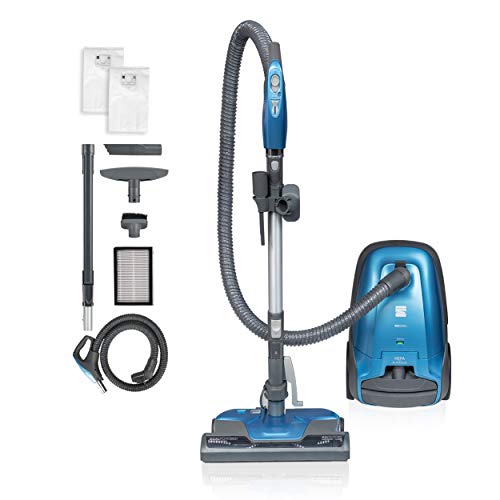
Kenmore BC3005 bagged canister vacuum with triple HEPA filtration, 2-motor system, telescoping wand, and pet-friendly design. Full expert review inside.
4. Miele Classic C1 Pure Suction Canister Vacuum — Best Premium Canister for Concrete and Hard Floors
For homeowners who want a premium, long-lasting solution for concrete and hard floor basements, the Miele Classic C1 Pure Suction is the most refined canister vacuum in this guide. German-engineered and built to last years of regular use, the Classic C1 delivers exceptional suction control, superior AirClean three-stage filtration, and unusually quiet operation — a meaningful quality in a finished basement used as a living space.
The six variable suction settings allow you to match cleaning power precisely to the task. At maximum suction on a bare concrete floor, the C1 pulls fine cement dust and construction debris with the kind of sustained, high-airflow performance that concrete demands. On lower settings, it handles delicate rugs, curtains, and upholstered furniture in a finished basement without risk of damage. This range of control is rare in consumer vacuums and is one of the hallmarks of Miele’s engineering approach.
The AirClean three-stage filtration system — genuine Miele FilterBag, motor protection filter, and AirClean exhaust filter — delivers filtration performance comparable to HEPA-sealed systems. The sealed bag construction means concrete dust and mold-adjacent debris stay locked inside the machine and the bag throughout the cleaning session. Miele FilterBags hold 4.5 liters (4.8 quarts) of debris, providing generous capacity for large basement cleaning sessions before bag replacement is needed.
The SBD 365-3 combination floorhead uses a foot-operated switch to toggle between hard floor and carpet modes. For basements that combine sealed concrete utility areas with carpeted finished sections, this allows seamless transition without tool swapping. The compact canister body — just 12 pounds — is easy to carry down to the basement and maneuver around obstacles like support columns, water heaters, and storage shelving.
The C1 is also remarkably quiet compared to the high-decibel performance of many powerful vacuums, operating at noise levels that let you vacuum a finished basement without disturbing other areas of the home.
Best for: Basements primarily composed of concrete and hard floors, owners who value long-term durability and premium build quality, finished basements used as quiet living spaces.
Rating: 4.4/5 (7,313 reviews)
Key specs: 6 variable suction settings | AirClean 3-stage filtration | SBD 365-3 dual-mode floorhead | 4.5L FilterBag capacity | 12 lbs | German engineering
Pros:
- Six suction settings allow precise control from delicate rugs to bare concrete
- AirClean three-stage filtration provides HEPA-equivalent air quality
- Bagged design with large 4.5L capacity for extended basement sessions
- Quiet operation — well below the noise of most powerful vacuums
- Lightweight compact canister is easy to maneuver in crowded storage basements
Cons:
- Ongoing cost of genuine Miele FilterBags
- Not optimized for deep pile carpet without an optional powerhead upgrade
- Higher initial investment compared to mass-market canisters

Miele Classic C1 Pure Suction canister vacuum with 6 suction settings, AirClean filtration, and German engineering. Ideal for hard floors and low-pile carpet.
5. Shark Rotator NV752 Powered Lift-Away TruePet — Best Value Upright for Finished Basements
With over 44,000 customer reviews and a 4.4-star rating, the Shark Rotator NV752 TruePet is one of the most proven full-size upright vacuums on the market — and it earns a spot on this list as the best value upright option for finished basements that need a dependable, whole-space cleaning solution without the premium price tag of the Vertex.
The NV752 features Shark’s Powered Lift-Away system, which detaches the motor pod while maintaining motorized brushroll agitation at the cleaning head. For basement cleaning, this is invaluable: push the powered nozzle under low-clearance furniture and around support columns, then switch to above-floor mode with the hose and accessories for stairs, shelving, window trim, and the ceiling corners where cobwebs accumulate. The included Pet Power Brush adds motorized agitation for upholstered furniture and fabric surfaces — useful in finished basements used as media rooms or guest bedrooms.
Anti-Allergen Complete Seal with HEPA filtration captures over 99.9% of dust and allergens in a sealed system, providing the mold spore and fine particulate protection that basement environments demand. Advanced swivel steering makes the vacuum responsive and maneuverable despite its full-size weight, and the LED headlights on both the nozzle and handheld unit illuminate debris in dark corners — a specific advantage in basements where lighting is often minimal.
For basements with wall-to-wall carpet or a combination of carpet and hard flooring, the NV752 delivers genuine deep cleaning performance. Fingertip controls switch between carpet and hard floor modes instantly, and the 0.88-quart dust cup is generously sized for extended cleaning sessions across a large finished basement floor plan.
Best for: Finished basements used as living spaces, carpet-heavy basement rooms, budget-conscious buyers who want reliable full-size upright performance.
Rating: 4.4/5 (44,242 reviews)
Key specs: Powered Lift-Away | HEPA Anti-Allergen Complete Seal | Advanced swivel steering | LED headlights (nozzle and handheld) | 0.88-quart dust cup | Pet Power Brush | 15.4 lbs
Pros:
- Powered Lift-Away maintains brushroll power when cleaning under furniture and in tight spaces
- Sealed HEPA filtration captures mold spores and fine basement particulates
- LED headlights on both nozzle and handheld reveal debris in poorly lit areas
- Over 44,000 reviews confirm long-term reliability across diverse households
- Includes Pet Power Brush for deep upholstery cleaning in finished basement spaces
Cons:
- At 15.4 lbs, carrying it down basement stairs requires some effort
- Corded design limits range from a single outlet in very large basements
- Dust cup smaller than some competing uprights at 0.88 quarts

Shark Rotator NV752 Powered Lift-Away TruePet upright vacuum with HEPA filter, swivel steering, LED headlights, and pet power brush for deep cleaning.
6. Bissell CrossWave Turbo 3888A — Best Wet-Dry Option for Finished Concrete and Tile Basements
The Bissell CrossWave Turbo earns its place on this list for a specific use case: finished basements with sealed concrete, polished concrete, tile, or vinyl plank floors that need to be both vacuumed and washed — not just dry-cleaned. No other product in this guide can simultaneously vacuum dry debris and mop hard floors in a single pass. For basement laundry rooms, utility areas with sealed concrete, basement bathrooms, or finished rec rooms with hard flooring, this is the most time-efficient cleaning approach available.
The Two-Tank Technology at the heart of the CrossWave keeps clean water and dirty water completely separate. Clean solution flows continuously from the clean tank through the brush roller onto the floor; the dirty water and debris are collected in the separate dirty tank. This means every pass across your basement floor is made with fresh cleaning solution, not dirty water — a critical advantage over traditional mopping, which progressively spreads contaminated water across the surface being cleaned.
The dual-action brush roll spinning at 3,000 RPM provides aggressive scrubbing action that handles dried-on grime, basement floor marks, paint drips, and general ground-in dirt that accumulates on hard basement floors over time. The seamless switch between hard floor and area rug modes handles mixed basement layouts without requiring a second machine for any carpet sections.
The antimicrobial FreshStart filter guards against odor-causing bacteria on the filter itself — a meaningful feature for basements that may experience intermittent humidity and are cleaned less frequently than upper floors. The included Rinse and Clean Out storage tray makes post-use maintenance straightforward and helps extend the life of the brush rollers.
Best for: Finished basements with sealed concrete, tile, or vinyl floors, basement laundry rooms and utility areas, households that want to vacuum and wash their basement floor simultaneously.
Rating: 4.1/5 (27,883 reviews)
Key specs: Two-Tank Technology | 3,000 RPM dual-action brush roll | Vacuums and washes simultaneously | Antimicrobial FreshStart filter | Hard floor and area rug modes | 11 lbs
Pros:
- Vacuums and washes basement hard floors simultaneously — one pass instead of two
- Two-Tank Technology ensures only clean solution touches the floor
- 3,000 RPM brush roll scrubs dried-on grime and ground-in debris effectively
- Antimicrobial filter resists odor buildup between infrequent cleaning sessions
- Handles transitions between sealed concrete and area rugs without mode complexity
Cons:
- Not designed for unfinished or unsealed concrete — the wet mopping function requires a sealed surface
- Cannot handle deep carpet cleaning or replace a dedicated carpet cleaner
- Requires regular post-use maintenance including tank rinsing and brush cleaning

Bissell CrossWave Turbo 3888A vacuums and washes floors simultaneously. Two-tank system, 3000 RPM brush roll, safe on tile, wood, laminate, and area rugs.
How to Choose the Right Vacuum for Your Specific Basement
| Basement Type | Best Pick | Why |
|---|---|---|
| Unfinished concrete utility room | DEWALT DCV501HB | HEPA, high airflow, handles construction debris and coarse material |
| Active home workshop | DEWALT DCV501HB | Built for jobsite conditions, OSHA-compliant filtration |
| Finished basement, carpeted | Shark AZ2002 Vertex or NV752 | Deep carpet cleaning, HEPA, Powered Lift-Away for stairs and furniture |
| Finished basement, hard floors | Miele Classic C1 or Bissell CrossWave Turbo | Pure suction canister for dry hard floors; CrossWave for wet cleaning |
| Mixed finished/unfinished | Kenmore BC3005 | Multi-surface capability, triple HEPA, 9.5-foot wand for overhead reach |
| Mold and allergen concern | Kenmore BC3005 or Miele Classic C1 | Highest filtration ratings with sealed bag disposal |
| Tile/vinyl basement bathroom | Bissell CrossWave Turbo | Simultaneous vacuum and mop, antimicrobial filter |
Basement Mold and Moisture FAQ
Can vacuuming spread mold spores?
Yes — if the vacuum you use does not have a sealed HEPA filtration system, vacuuming over mold or mold-adjacent surfaces will aerosolize settled spores and distribute them into the air at a higher concentration than before you started. A sealed HEPA system — where all exhaust air passes through a true HEPA filter with no bypass paths — captures spores rather than redistributing them. Always use a HEPA-sealed vacuum when dealing with any surface that shows signs of mold, and empty or replace the bag/filter outdoors immediately afterward.
Should I vacuum a damp concrete floor?
Standard dry vacuums should not be used on actively wet or damp surfaces — this risks motor damage and creates a shock hazard. If your basement floor is wet from minor water intrusion, allow it to dry completely before using a standard vacuum, or use a purpose-built wet-dry vacuum designed explicitly for wet pickup. The Bissell CrossWave Turbo in this guide uses water as part of its cleaning process and is designed for damp mopping on sealed surfaces, but it is not rated for standing water pickup. For significant water intrusion, a dedicated wet-dry shop vac with a wet mode is the appropriate tool.
What MERV or HEPA rating do I actually need for basement mold?
For basement mold concerns, you need a true HEPA filter rated at 99.97% particle capture at 0.3 microns, installed in a sealed housing with no bypass air paths. MERV ratings (used primarily for HVAC filters) do not translate directly to vacuum filtration standards. “HEPA-Type” or “HEPA-Like” marketing terms on budget vacuums do not meet the true HEPA standard and should not be relied upon for mold spore capture. The vacuums in this guide — the DEWALT DCV501HB, Shark AZ2002, Kenmore BC3005, Miele Classic C1, and Shark NV752 — all carry certified HEPA or AirClean-equivalent filtration in sealed systems. See our complete HEPA filter guide for the technical breakdown.
How often should I vacuum my basement?
For unfinished basements, once per month is a reasonable baseline unless active renovation work is occurring, in which case cleanup should happen immediately after each work session before fine dust settles and spreads further. For finished basements used regularly as living spaces, the same frequency as other high-traffic floors applies — weekly for carpeted areas, every one to two weeks for hard floors. Basements with known moisture issues or musty odors should be vacuumed more frequently and the source of moisture addressed before relying on vacuuming alone to manage air quality.
Is the musty smell in my basement dangerous?
A persistent musty smell in a basement is almost always a sign of active mold or mildew growth, even if no visible mold is present. Mold can grow on wall surfaces, inside wall cavities, under flooring, and on stored items. The smell itself is caused by microbial volatile organic compounds (mVOCs) produced by mold metabolism. While vacuuming helps manage settled spores and surface debris, it does not address the source of the odor. Musty basement smells should be investigated for moisture sources — wall cracks, plumbing leaks, poor vapor barriers, inadequate ventilation — and the underlying moisture problem resolved. Vacuuming with a sealed HEPA machine helps limit spore spread during the remediation process, but is not a substitute for addressing the root cause.
Can I use a robot vacuum in my basement?
Robot vacuums are generally not well-suited for unfinished basements — the irregular surfaces, potential moisture, workshop debris, and lack of structured floor layout challenge their navigation and can damage their motors with fine concrete dust and abrasive particles. For finished basements with smooth, regular flooring, a robot vacuum can handle routine maintenance between deeper cleaning sessions, but the filtration standards of most consumer robot vacuums do not meet the HEPA-sealed requirement for mold spore and fine dust management. If you use a robot vacuum in a finished basement, supplement it with periodic deep cleaning using one of the sealed-HEPA machines in this guide.
Final Thoughts
Your basement deserves the same cleaning attention — and better-matched tools — as any other part of your home. The specific combination of concrete floors, moisture risk, cobwebs, workshop debris, and the potential for mold and allergen buildup makes it one of the most demanding cleaning environments you will encounter. The right vacuum is not necessarily the most expensive one, but it does need to match the specific conditions of your space.
For unfinished basements and workshop spaces, the DEWALT DCV501HB offers professional-grade filtration and debris handling in a portable, battery-powered package that goes where corded machines cannot. For finished basements used as primary living spaces, the Shark AZ2002 Vertex provides maximum power, HEPA protection, and the reach to clean every surface from floor to ceiling. The Kenmore BC3005 leads on filtration performance and overhead reach for large, allergen-conscious basements. The Miele Classic C1 is the choice for premium build quality and long-term reliability on hard basement floors. The Shark NV752 delivers proven full-size upright performance at a more accessible price. And the Bissell CrossWave Turbo solves the specific problem of finished concrete and tile basement floors that need to be vacuumed and washed in the same session.
Match your pick to your basement’s specific conditions, and you will have a machine that handles everything your basement generates — from the first footfall on bare concrete to the last pass across a finished carpet.
Ready to Find Your Perfect Vacuum?
Browse our expertly reviewed vacuum cleaners and make an informed decision
Browse All Vacuums